CHAPTER 3: THE LEGACY THAT COULD NOT BE MOVED
She saw only an old boxy utility vehicle completely unable to appreciate the hundreds of hours of precision engineering, historical preservation, and craftsmanship that had gone into every single square inch of its restoration. She could not comprehend that to a person of substance, a beautifully restored piece of mechanical history is infinitely more valuable than any mass-produced plastic-trimmed luxury SUV that money can buy. The final chapter of this long dispute was written on a beautiful Saturday afternoon in late autumn during the official dedication ceremony of the Vance Homestead's new entrance gate. The new HOA board, true to their word, had hired a local master blacksmith to design and forge a stunning custom wrought iron gate. The blacksmith, a man named Samuel, who had been trained in the traditional European methods of ironwork, spent 3 months crafting the gate in his coal-fired forge.
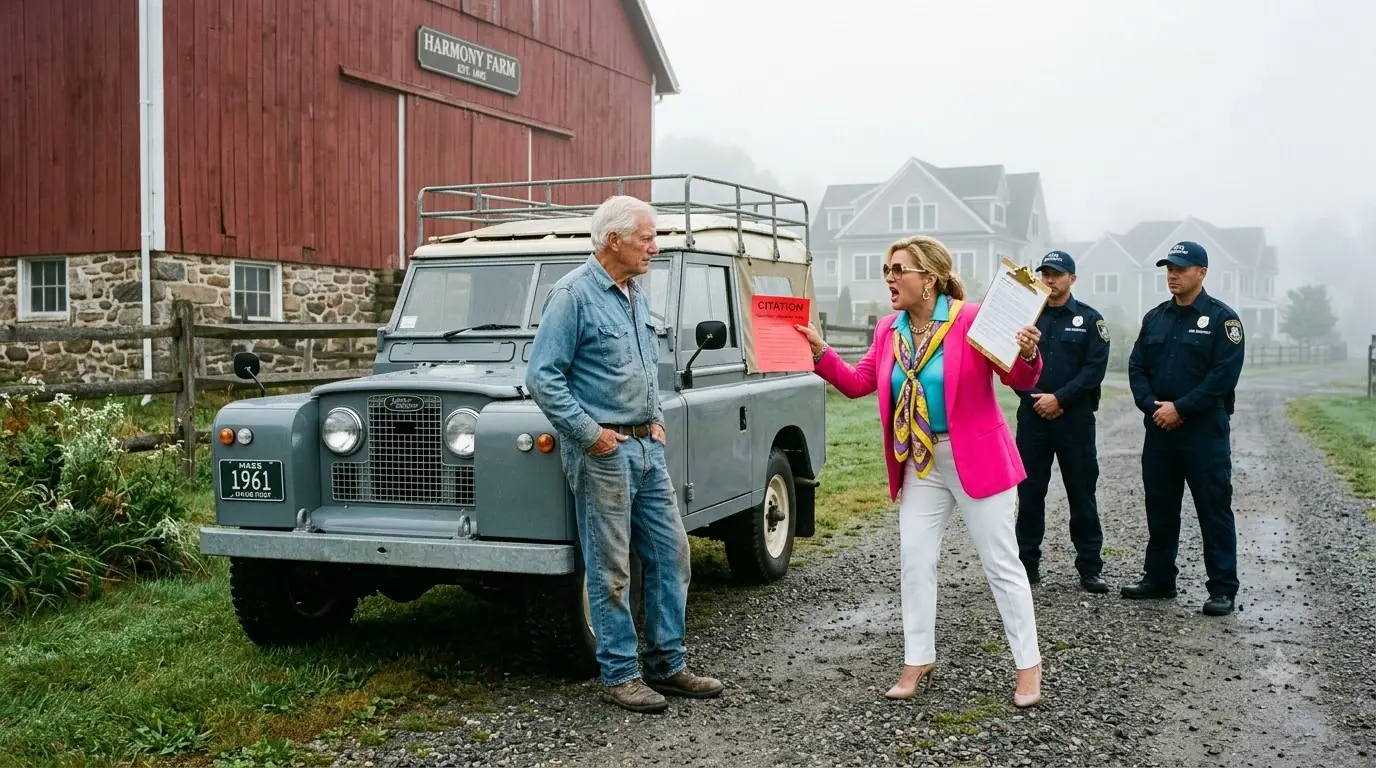
Sheriff Miller and several of his deputies were there leaning against their patrol cars and laughing with the locals. Dave, the county building inspector, was cooking burgers on a large iron grill, a giant smile on his face as he waved his spatula at the crowd. At the center of it all stood the Land Rover parked between the two granite pillars, its battleship gray paint gleaming in the late afternoon sun. The red citation paper was long gone replaced by a beautiful hand-polished brass plaque mounted on the front grill inscribed with the words, "The Vance Homestead established 1867. Let no man lock the harbor. " When it came time to dedicate the gate, Eleanor, the new HOA president, stood on a small wooden bench and raised her glass.
"My friends, neighbors, and guests," she said, her voice clear and warm. "Today, we are not just dedicating a gate. We are dedicating a new beginning. For too long, our community was defined by rules, fines, and divisions. But today, thanks to the immense generosity and grace of Commissioner Marcus Vance, we are defining ourselves by connection, education, and mutual respect.
This gate does not stand to keep us apart. It stands as a monument to how we can live together in peace, respecting our history, while building a brighter future for our children. " The crowd erupted into applause, the sound carrying across the quiet bay. Eleanor stepped down and handed me a large, hand-carved oak key, the symbolic key to the new gate. I walked up to the podium, looking out at the crowd of faces. I saw the residents of the Heights, who had once looked at my farm with suspicion, now smiling warmly.
I saw the kids from my maritime class, their faces covered in chocolate cake and dust, waving their miniature wooden oars at me. I felt a deep, overwhelming sense of peace, a feeling that my grandfather's long struggle to protect this land had finally been validated and completed. "Thank you, everyone," I said simply, my voice carrying a quiet strength. "My family has been in this valley for a very long time. We have seen many things change, but our commitment to this land and to our neighbors has never wavered.
This gate is always open to anyone who comes in search of friendship, learning, or a quiet place to watch the fog roll in. Let's keep it that way. " With a simple pull of the rope, the red ribbon across the arch fell away, and the massive iron gate swung open with a smooth, silent glide, its heavy brass hinges perfectly balanced. The crowd cheered, and the children rushed through the entrance, eager to explore the farm. As the sun began to set over the western hills, casting a warm, golden glow across the valley, I sat on my porch rocking chair holding a fresh cup of coffee. The Land Rover sat quietly in the driveway, its battleship gray body silhouetted against the bright water of the bay.
I knew that there would be more challenges in the future, more changes to the valley, and perhaps more people who would try to test the boundaries of my land. But as I watched the fog begin to roll back in from the open ocean,, wrapping the pine trees in a familiar gray embrace, I knew that we were ready. The roots of this farm are deep, the history is strong, and some things will never ever be moved. Months have passed since the dedication and the winter snows have begun to cap the pine ridges around Miss Bay. The youth maritime program continues to grow, and my weekends are now spent teaching the older kids how to loft full-size boat templates from the architectural plans we draw together on big rolls of heavy brown paper.
We are currently preparing to build a small wooden canvas kayak, a lightweight design that the kids will be able to paddle down the winding creeks of the valley when spring returns. Eleanor often stops by on her walks, occasionally bringing a fresh-baked apple pie or a thermos of hot cider to share on the porch. We talk about the valley, about the progress of the local schools, and about how the neighborhood has slowly settled into a genuine cooperative spirit. The residents of the heights have largely abandoned their obsessive reliance on rigid regulations, replacing their fines with conversations and neighborhood cleanup days where everyone helps out. Sometimes when the wind blows hard from the northeast and the cold rain lashes against the windows of my study, I find myself looking at my grandfather's old 1867 land grant map.
The ink is faded and the edges of the paper are worn and fragile, but the words printed upon it remain as clear and sharp as the day they were written. It is a symbol of a contract, a binding promise between the builders of this nation and the families who cleared its forests and sailed its waters. It is a reminder that the true strength of a community does not lie in its ability to restrict, exclude, or fine its members, but in its capacity for historical preservation, shared work, and genuine mutual support. Victoria's gold-plated clipboard is now nothing but a distant, ridiculous memory in this valley.
Her manufactured empire has been reclaimed by a community of real neighbors who understand that some boundaries are meant to be respected and that some historical roots are simply too deep to be cleared away for an entrance boulevard. The Land Rover Series IIA stands in my workshop, fully restored, rugged, and ready to face whatever the next season brings. Its battleship gray paint, formulated to withstand the harsh corrosive salt of the open sea, remains completely untouched by the winter cold, a testament to what can be achieved when you build with precision care and an unyielding respect for the history that came before you.
END