Chapter 3: The Ruling Outside the Courtroom
The verdict came on a Thursday morning under a sky the color of clean paper. Nora Whitfield's closing argument took 9 minutes. She did not shout. She had learned somewhere in the last 3 days that the loudest thing in a courtroom is a fact. "Three days ago, the state told you a story," she said to the jury.
"A dangerous young man, a brave officer, minimum force. You believed it because the man telling it wore a uniform. And we are raised to trust the uniform. So was Elijah Brooks. He trusted it enough to put both hands in the air." She let that breathe.
"The camera showed you what happened to him anyway. Four minutes were cut from the record. A time was moved. A partner was told what to write. None of that was an accident.
You cannot call it a mistake when it has a pattern. And you have seen six copies of the pattern." She rested one hand on Elijah's shoulder. "This young man spent his summers mowing a dying woman's lawn for free. He has never raised a fist at anyone. The state has already abandoned half of this case.
We are asking you to finish the job. Send him home." Calloway's closing was four sentences. "There is no dignity in defending a building already on fire." Before instructions, Judge Vance looked toward the observer's chair. The court recognizes Judge Keller. Your honor, you have watched these proceedings from the first morning.
If you wish to address the court as a friend of the bench, the bench would be honored. Miles rose slowly. He did not approach the jury box. He stood beside his chair, hands folded, and spoke as if the room were small and the hour were late. Thank you, Judge.
I'll be brief. Brevity is the only gift age gives a speaker. A soft ripple of laughter, the first in 3 days. I spent 20 years on that bench. In all that time, I learned one thing worth repeating.
A badge is borrowed. Character is owned. We loan a young man a piece of metal and the power that comes with it, and the loan has one condition. The truth. Not courage, although we hope for it.
Not kindness, although it helps. The truth. The moment an officer lies under oath, the badge stops being his. He just hasn't returned it yet. He looked at the jury, 12 tired and serious faces.
I did not come here as a judge. I came as a neighbor because a boy who was kind to my late wife needed one person in the room who knew how to listen. Every courtroom should have one. Most don't. That is not the jury's fault.
It is everyone's unfinished work. He nodded once. Thank you for your attention these 3 days. Whatever you decide, decide it on the record. The record is finally honest.
He sat. Nobody moved for a moment, and then Vance instructed the jury, and the jury withdrew. They were gone 40 minutes. When the foreman stood and said the words, "Not guilty." The sound that came out of Elijah's mother was not a cheer. It was older than that.
Something between a sob and a hymn. The sound of a weight hitting the floor after being carried too far. Elijah folded over the defense table like a puppet with the strings finally released. Nora put both arms around him. Lawyer last.
Human first. The gavel fell for the final time, and courtroom four emptied into the marble hallway. And that was where the last accounting happened. Chief Patricia Lawson was waiting by the stone bench with two internal affairs officers and a face that promised nothing good. Voss saw her and stopped walking.
"Officer Voss." Her voice carried down the corridor, flat and public, and she did not lower it. "Effective immediately, you are suspended without pay pending termination and criminal referral. Evidence tampering, perjury, falsification of records. The district attorney has the file." She held out one hand, palm up. "Badge and weapon." The hallway went silent.
The same hallway, the same phones, all of them up now. Voss looked at the chief's open hand. His fingers went to his chest, to the piece of metal he had tapped twice while laughing at an old man, and they fumbled with the clip twice, three times before it came free. He set the badge in her palm, then the holster, the belt suddenly loose around a man who had been wearing borrowed weight for years. "In the notebook." Lawson said.
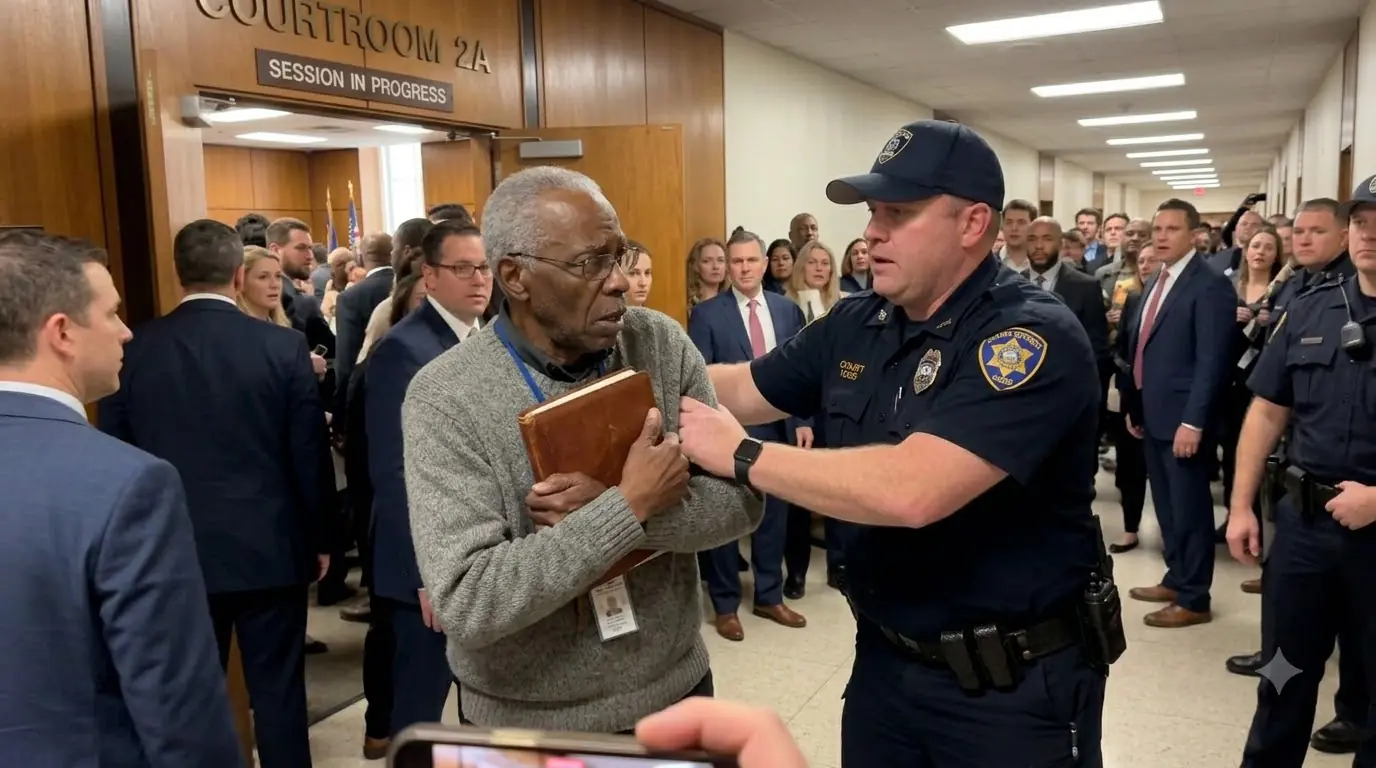
"I'm told you keep things in a drawer." It arrived in an evidence bag 20 minutes later. Brown leather, worn corners. Lawson carried it across the hallway herself and placed it in the old man's hands. Judge Keller, on behalf of the department, I apologize. The rest of my apology will take about a year of work.
You'll see it, not hear it. "That's the right kind," Miles said. His thumbs moved over the cover, finding the soft, worn place where Ruth's hand used to rest. Her writing waited inside, faithful as ever. For the rulings you make outside the courtroom.
He looked up at Derek Voss, unarmed, unbadged, escorted toward the doors he had guarded like a kingdom. "Wait outside," the old man said softly. And this time, the man did. Six months later, Derek Voss stood in a different courtroom, at a different table, and learned what the view was like from the other side.
Evidence tampering and perjury. The jury took less than a day. The judge who sentenced him was not Eleanor Vance, and that was deliberate because Fairmont County did everything by the book now. He served his time in a facility two counties away, where nobody cared what he used to wear to work. His six old cases were reopened, one by one.
Two convictions were vacated by spring. One young man came home to a daughter who had learned to walk while he was gone. The department kept Chief Lawson's promise. Every body camera in the county now uploads automatically to an independent server, untouchable from any workstation. And the policy has a name.
Officers call it the Keller protocol. Most of the new recruits have no idea who Keller is. The old ones make sure they learn. Officer Brennan kept his job, barely, and traded his badge for a desk and a second chance. He teaches the body-camera rules to rookies now.
He teaches them like a man paying off a debt. Elijah Brooks enrolled at the community college in the fall. Pre-law. On his application, where it asked why, he wrote one sentence. Someone showed up for me.
And I want to be someone who shows up. Nora Whitfield wrote his recommendation letter. She has a new job, too. Senior counsel at the public defender's office. And a crate that rolls a little lighter these days.
And every Tuesday morning, if you come to the Fairmont County Courthouse early, you will find an old man in a gray sweater on the stone bench outside courtroom four. Young lawyers bring him coffee and impossible cases. He listens more than he talks. When he does talk, they write it down. The brown notebook stays in his lap.
The leather gone soft at the corners from two pairs of hands. On the newest page, in small, steady letters, there is a name. Elijah Brooks, fall semester. Below it, a line from the notebook's first owner, copied forward so it will not be forgotten. For the rulings you make outside the courtroom.
The biggest ruling of Miles Keller's life never happened on a bench. It happened in a hallway where a man with a badge saw a bag of old clothes and a bag of old clothes decided to stay.
END