Charlie is doing well, and the church that took him in remains the safest and most familiar place in his life.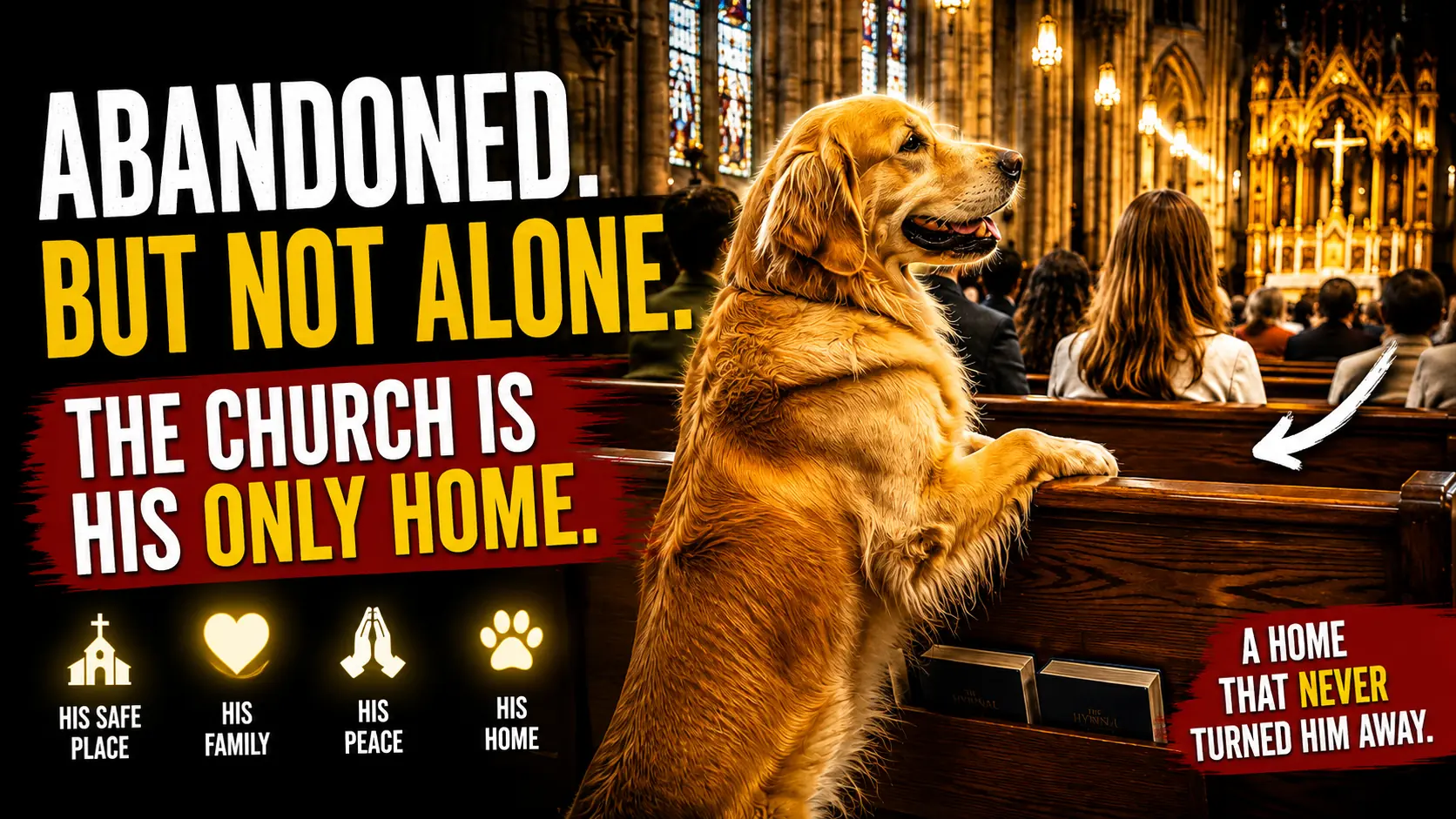
When he first started appearing around the property, people assumed he might simply be lost. Volunteers checked for identification and tried to learn whether someone nearby was searching for him, but no confirmed owner came forward.
So Charlie stayed.
At first, he remained outside.
He slept near the covered entrance and usually moved away when unfamiliar people approached too quickly. Church members learned to give him space. Food and water were placed nearby, and volunteers let Charlie decide when he felt comfortable coming closer.
Over time, he did.
The first change was small.
Charlie stopped retreating every time someone came near.
Then he allowed one person to touch the side of his neck.
A few days later, he remained still while another volunteer rubbed behind his ears.
Eventually, Charlie began greeting familiar members on his own.
The church doors, which had once represented an unfamiliar building, became something he looked forward to seeing open.
Once he began spending time inside, his behavior became noticeably more relaxed.
Charlie seemed to enjoy the calm atmosphere, especially during quieter hours. He would walk slowly between the pews, investigate familiar corners, and then choose a place to settle where he could still see people moving through the building.
The image of him standing with his front paws resting on a pew has become familiar to everyone who knows him.
He is not trying to interrupt anything.
Most of the time, he is simply watching.
His tail moves.
His ears shift toward voices.
He looks from one person to another.
Then eventually, Charlie lowers himself back down.
There is something touching about seeing a homeless dog surrounded by people who care about him.
There is also something bittersweet about it.
At the end of a service, the congregation leaves.
Families walk out together.
Children take their parents' hands.
People climb into cars and go home.
Charlie remains.
We do not know how he interprets those moments.
Dogs do not think about homes and ownership exactly the way humans do.
But Charlie clearly recognizes people and routines.
He notices when familiar members arrive.
He notices when they leave.
And he seems happiest when someone stays near him.
That is one reason we believe he would adapt beautifully to the right permanent home.
His veterinary evaluation has been reassuring.
Charlie arrived needing routine care, but no major medical emergency was discovered. His heart and lungs sounded normal, his mobility was comfortable, and his appetite has been consistently good.
He was slightly underweight when people first began caring for him, but regular meals have helped him reach a healthier condition.
His coat has improved as well.
Basic grooming, consistent nutrition, and a dry place to sleep made a noticeable difference.
Charlie now looks much more like a dog who belongs somewhere.
We just want that somewhere to become permanent.
He continues receiving appropriate preventive veterinary care and regular wellness monitoring while his future is being worked out.
Physically, there is no major reason he cannot be adopted.
The larger question is finding someone who understands what Charlie has already been through.
A dog who has experienced abandonment may need time before fully trusting that a new environment is permanent.
Charlie might follow his adopter from room to room during the first weeks.
He may watch the front door.
He may become especially attentive when someone puts on shoes or picks up keys.
He may need to learn that people can leave and still return.
Those behaviors would not mean something is wrong with him.
They would mean he is adjusting.
The church has already shown us how well Charlie responds to consistency.
At first, he did not trust anyone.
Then the same people kept appearing.
The same bowls were placed down.
The same hands reached toward him gently.
Nobody chased him.
Nobody forced him.
Nobody left him outside simply because caring for a stray dog became inconvenient.
That repetition changed Charlie.
Today, several regular church members can approach him without hesitation.
His tail begins wagging before they reach him.
Sometimes he leans his full weight against their legs while they pet him.
Other times he simply stays nearby.
Charlie does not demand constant attention.
He seems to value presence more than excitement.
That could make him a wonderful companion for someone who appreciates a quieter kind of affection.
He likes walks, but he is equally content resting beside someone.
He enjoys exploring new scents.
He notices birds and squirrels.
He likes being included.
Most importantly, he appears to form strong bonds with people who treat him consistently.
That is the part of Charlie we wish every potential adopter could see.
Not simply the dog standing alone after church.
The dog who relaxes when he recognizes a familiar voice.
The dog who closes his eyes when someone scratches the right spot behind his ears.
The dog who follows a volunteer for several steps and then lies down nearby because he trusts that person to remain there.
Those behaviors tell us Charlie is ready to belong again.
The church community loves him.
That is undeniable.
People check whether he has eaten.
They notice if he seems tired.
They bring him water.
They have found places for him to sleep safely.
They celebrate when he becomes more confident.
In many ways, Charlie already has dozens of people looking out for him.
But there are limits to what a shared community space can provide.
A church is not designed to be a permanent residence for a dog.
There are services.
Events.
Visitors.
Doors constantly opening and closing.
Schedules change.
People go home at night.
Charlie needs something simpler.
One place.
One routine.
One family.
He needs a bed that always smells familiar.
A water bowl that never moves because another event is happening.
A front door he can learn belongs to him too.
A person whose footsteps he hears every morning.
That kind of permanence is different from temporary refuge.
It is what we hope comes next.
His future adopter should be prepared to give him a calm transition.
The first days should not be filled with visitors or constant new experiences.
Charlie needs time to explore.
Let him find his water.
Let him choose a sleeping place.
Let him learn the sounds of the house.
Meals should arrive at predictable times.
Walks should be simple and familiar at first.
And when the adopter leaves briefly, the return should be equally ordinary.
Little by little, Charlie can learn that this new place does not disappear.
One evening turns into another.
Morning keeps coming.
The same person remains part of both.
Eventually, the need to monitor every departure may fade.
That is the future we imagine for him.
A dog once left behind standing at a window, not because he fears abandonment, but because he knows exactly which car belongs to his person.
A dog who hears keys and assumes a walk might be coming.
A dog who sleeps through the night because there is no reason to listen for someone leaving.
A dog whose world becomes pleasantly boring.
There is something especially meaningful about that for Charlie.
The church gave him peace at a time when he had nowhere else to go.
It gave him an answer when his life became uncertain.
He found warmth there.
He found food.
He found gentle hands.
He found people willing to care.
Now we hope that kindness leads to the next thing.
Not because the church has failed him.
Quite the opposite.
The church gave Charlie enough safety to begin trusting again.
Now he is ready for someone to build on that trust.
We imagine his last day there often.
Maybe it will be another Sunday.
Charlie will be sitting near the pews as people arrive.
Someone will kneel beside him.
There will be a leash.
Paperwork will already be finished.
Charlie will walk toward the doors he has watched open hundreds of times.
Only this time, someone will walk beside him.
He will leave the church grounds.
He will climb into a car.
And instead of returning later to the same quiet pew, he will arrive somewhere new.
His home.
Maybe he will still visit the church.
Maybe the people who cared for him will see him again with a healthier coat, a relaxed expression, and someone waiting patiently at the other end of his leash.
We hope so.
Because Charlie's story should not end with a dog who found a safe place after being abandoned.
It should end with a dog who found a person who made sure he never had to search for one again.
For now, Charlie remains surrounded by people who love him.
That matters.
But somewhere, we hope there is one person who can give him the thing he still seems to be waiting for.
Not another temporary shelter.
Not another place filled with kind strangers.
A real home, one good person, and the certainty that this time nobody is going to leave him behind.