Every morning, 11-year-old Charlie leaves the shelter with one of our staff members and follows the same quiet path through a small cemetery.
The routine began shortly after his longtime owner passed away. With no family able to care for him, Charlie was brought to the shelter carrying only his blue collar and a few belongings from the home they had shared.
During his first days with us, the elderly dog barely ate. He slept facing the back of his kennel and showed little interest in toys, treats, or the people passing his gate.
Then a shelter employee learned where Charlie’s owner had been buried.
On their first visit, she expected to guide him between the rows of headstones. Instead, Charlie began pulling gently in one direction, walking slowly but with unusual certainty.
He passed several graves without stopping.
When he reached one weathered stone, Charlie lowered his nose to the ground and became completely still. It was his owner’s grave.
Since then, the walk has become part of his daily routine. Different staff members have accompanied him, sometimes approaching from another path, yet Charlie always stops at precisely the same place.
He smells the grass, circles the headstone once, and stands beside it in silence. Some mornings, he rests his gray muzzle against the stone. On others, he simply looks toward it while his caregiver waits several steps away.
But during one recent visit, Charlie did something that made the shelter employee holding his leash stop in her tracks.
Instead of turning back when it was time to leave, he lay down beside the grave and refused to move.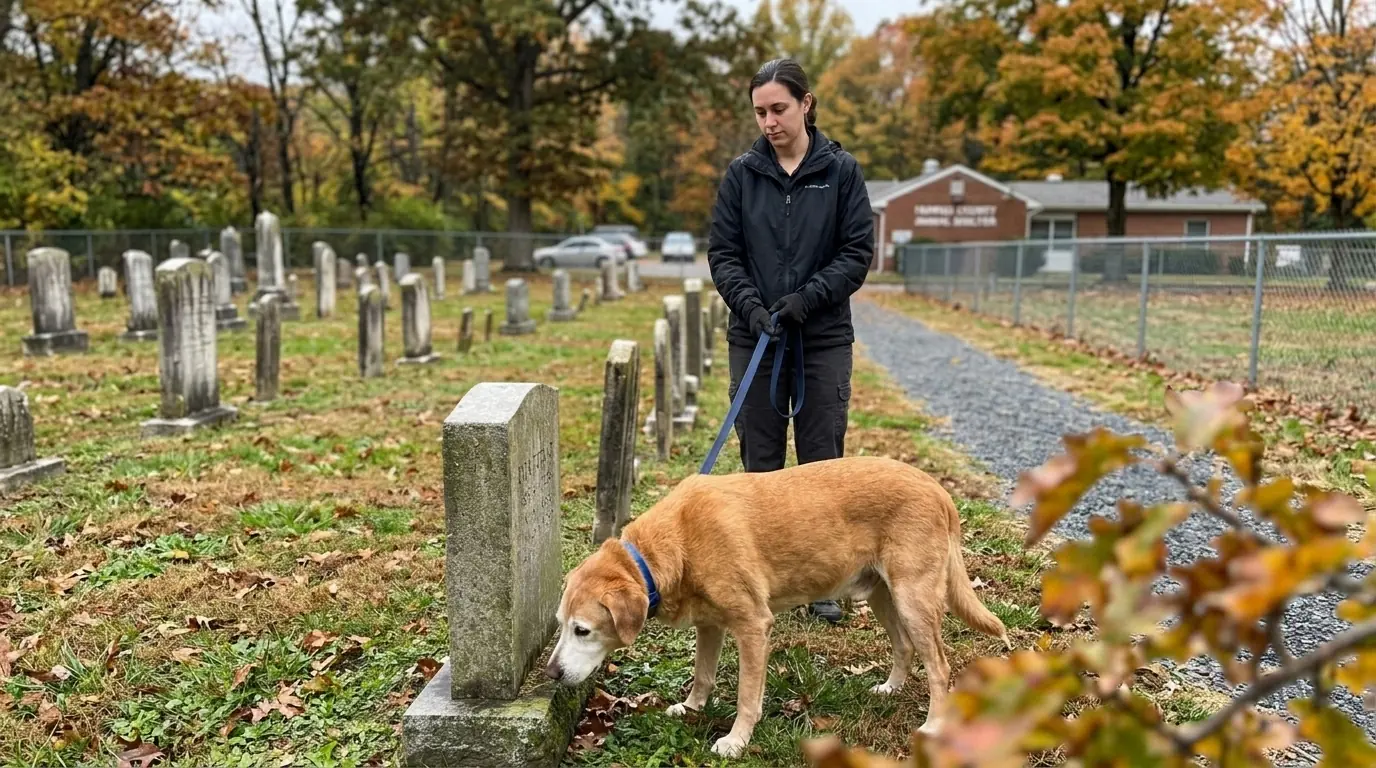
Charlie continues visiting his former owner’s grave almost every day, weather permitting.
His morning begins in the quietest section of the shelter. A caregiver opens his kennel around the same time, attaches his blue leash, and gives him a few moments to stretch. Arthritis makes his first steps slow, but the moment they leave the building, Charlie becomes noticeably more alert.
He follows a familiar route from the shelter grounds to the nearby cemetery. Staff do not lead him toward a particular row. Once they enter through the gate, the leash is kept loose enough for Charlie to choose the direction himself.
He always chooses the same one.
Charlie walks past dozens of headstones before stopping at his owner’s grave. He usually lowers his nose to the base of the stone and smells the grass around it. Then he remains there for several minutes, sometimes standing quietly and sometimes lying beside it.
The team does not know exactly what Charlie recognizes. It may be the familiar route, scents in the surrounding soil, memories associated with previous visits, or a combination of cues. Whatever guides him, his behavior is remarkably consistent.
No one rushes him.
His caregiver waits until Charlie lifts his head or turns toward the path. On most days, that is his signal that he is ready to return. When he recently refused to leave, the employee sat nearby and gave him additional time. After nearly twenty minutes, Charlie finally stood, looked back once, and followed her out of the cemetery.
The visits appear to give structure to his days. After returning to the shelter, he usually eats breakfast and sleeps for most of the morning. He still prefers quiet spaces, but he no longer spends every hour facing the rear wall of his kennel.
In the afternoons, Charlie rests near the gate where he can watch staff moving through the corridor. He has begun accepting gentle scratches beneath his chin and occasionally walks over when his regular caregiver calls him. He rarely plays with toys, though he recently started sleeping with an old fabric ball placed beside his blanket.
Physically, Charlie is stable. He receives medication for arthritis and takes short walks so his joints remain mobile without becoming overworked. His appetite has improved, and he has regained some of the weight he lost after entering the shelter.
Emotionally, his progress remains quiet.
Charlie has not forgotten the person who shared most of his life. The shelter cannot replace that bond, and no one expects him to leave it behind. Instead, the team has made room for it within his new routine.
Every morning, Charlie knows where he wants to go. Every morning, someone walks beside him.
And when he stops at the same grave, his caregiver simply waits—allowing an old dog all the time he needs with the person he still remembers.