Cooper Was Finally Safe—But His Limp Needed Answers
Reader Theme:
Font Size:
24px
The Dog Everyone Had Been Watching
For almost two weeks, Cooper had become a familiar sight around a neighborhood gas station.
Employees first noticed the 6-year-old Labrador Retriever mix wandering along the edge of the parking lot. Sometimes he appeared early in the morning before traffic became heavy. Other times he emerged later in the evening, when the station was quieter.
Nobody knew where he had come from.
He wore no identification that provided an immediate answer, and the people watching him could not determine whether he had recently become lost or had been wandering longer than anyone realized.
What they did know was that Cooper was hungry.
Employees began leaving a bowl of food and fresh water in a protected area near the building. Cooper usually waited until people stepped away before approaching.
If someone tried to walk toward him, he retreated.
Sometimes he moved behind the building. Sometimes he crossed to a quieter section of the property and watched from a distance.
The employees quickly realized that pursuing him only increased his anxiety, so they stopped trying to catch him themselves. Instead, they kept his feeding location consistent and contacted a local rescue for help.
That consistency mattered.
A frightened dog who repeatedly returns to the same location can sometimes be helped more safely by establishing a predictable routine than by repeatedly attempting to corner or chase him. Cooper was learning that food appeared in one particular place and that the people nearby were not going to force contact.
Our team began gathering information about his routine and planning a safe approach.
There was still no way to know exactly what Cooper had experienced before arriving at the gas station.
Fear around approaching strangers can have many causes. A dog may be poorly socialized, overwhelmed by an unfamiliar environment, naturally cautious, frightened after becoming lost, or simply exhausted after surviving outdoors.
We could not responsibly turn Cooper’s behavior into a story about his past.
We could only respond to the dog in front of us.
And the dog in front of us needed patience.
The Rainy Night That Changed Everything
The weather eventually made waiting more urgent.
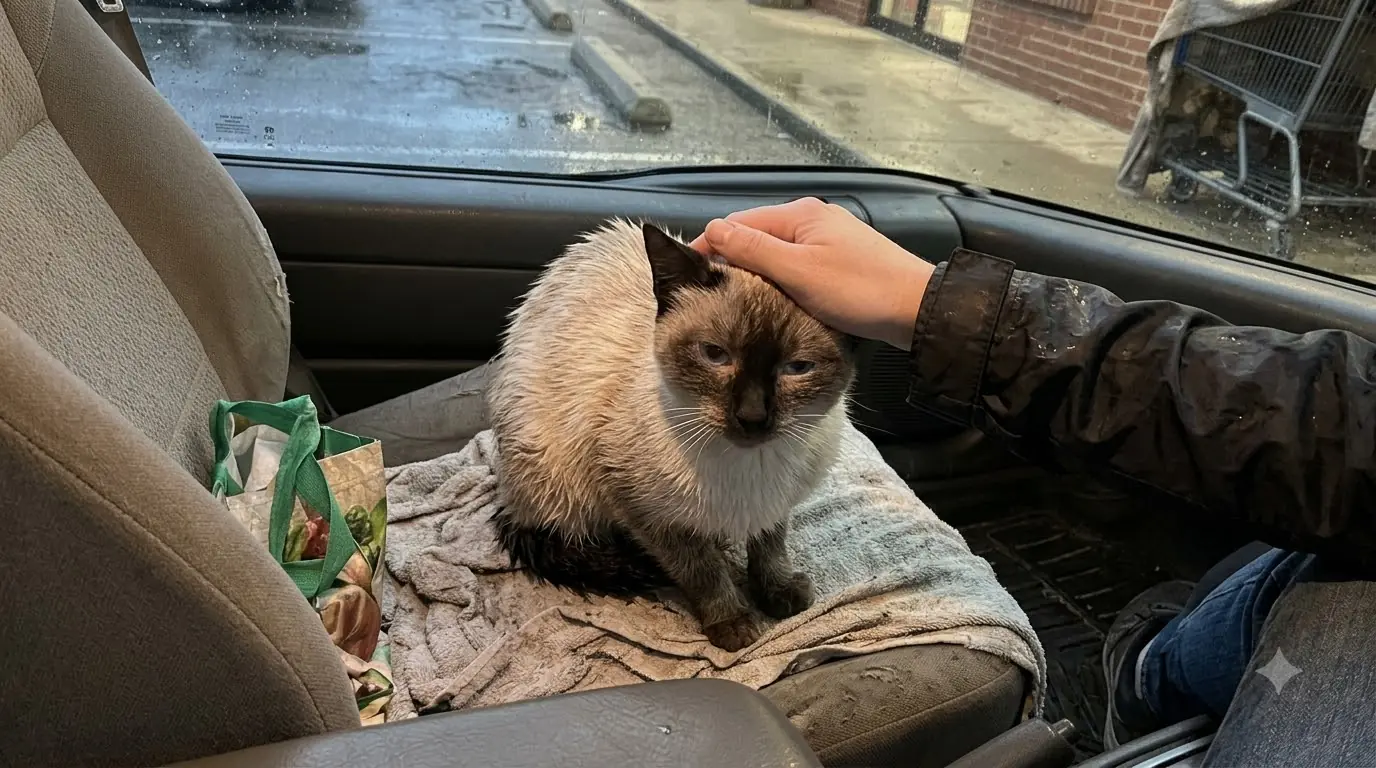
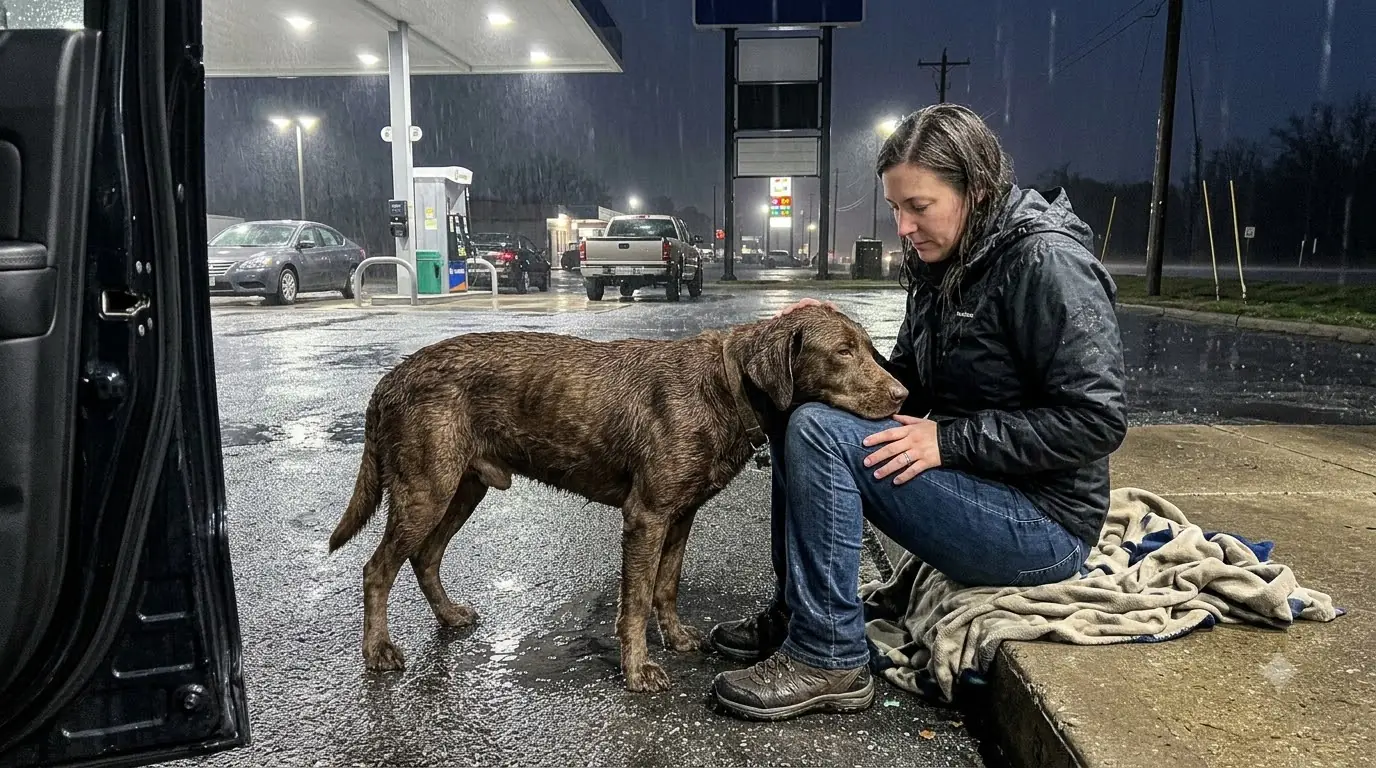
One evening, steady rain moved through the area and temperatures dropped. A rescue volunteer went to check the station and found Cooper beneath the large station sign.
He was curled tightly against the base, trying to stay out of the worst of the rain.
His coat was soaked.
He looked tired enough that the volunteer immediately noticed a difference in his posture. Cooper still watched her carefully, but he did not leave as quickly as he had on previous visits.
She stopped several feet away.
Rather than moving closer, she sat down.
She had brought a blanket, food, a leash, and other basic rescue supplies, but she deliberately kept the interaction simple. Cooper needed to have an escape route and enough distance to feel that he still had choices.
For several minutes, nothing happened.
Cooper watched.
The volunteer waited.
She avoided leaning over him or reaching toward him. Occasionally she spoke quietly, but most of the interaction consisted of simply remaining still.
Minutes became nearly an hour.
Then Cooper stood.
He took a few tentative steps toward her.
He stopped.
He watched her again.
Then he continued.
When he finally reached her, the volunteer still did not grab him.
Cooper made the last decision himself.
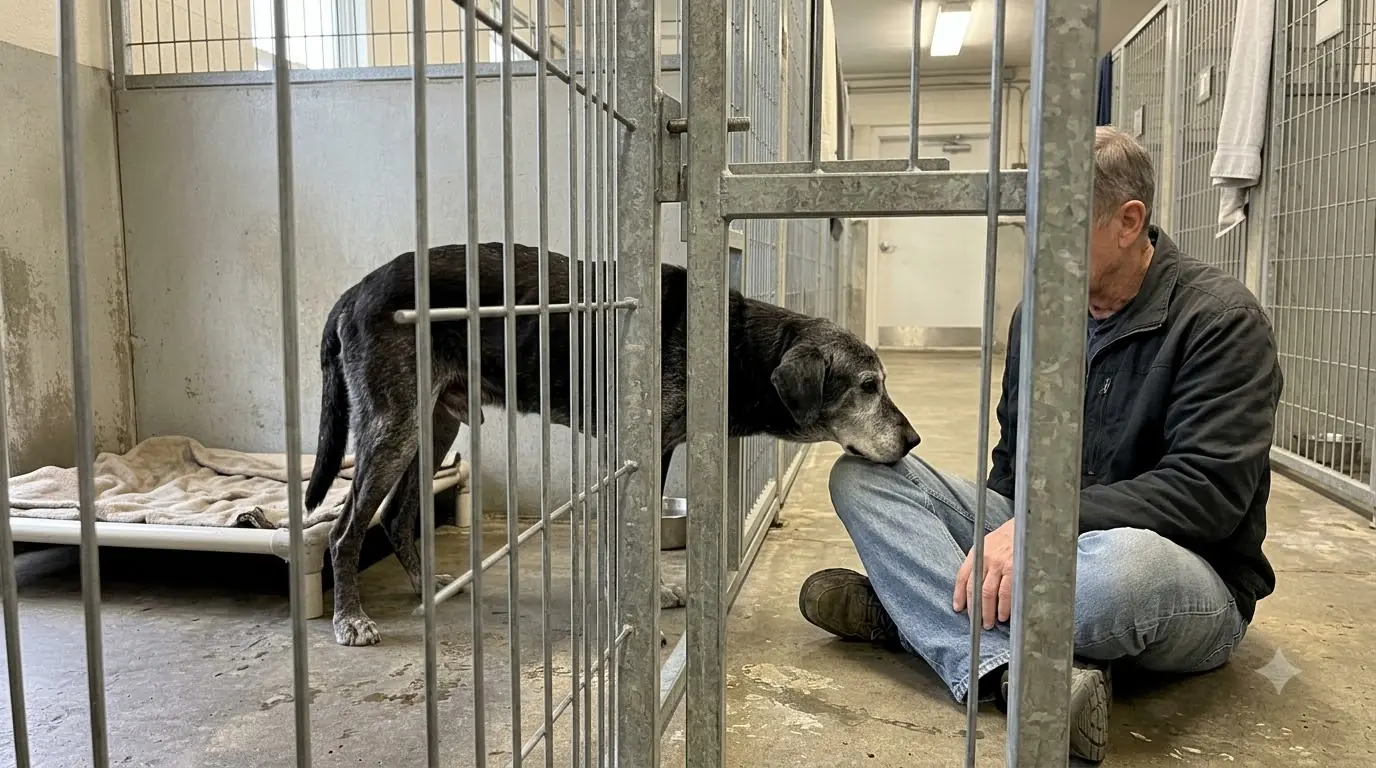
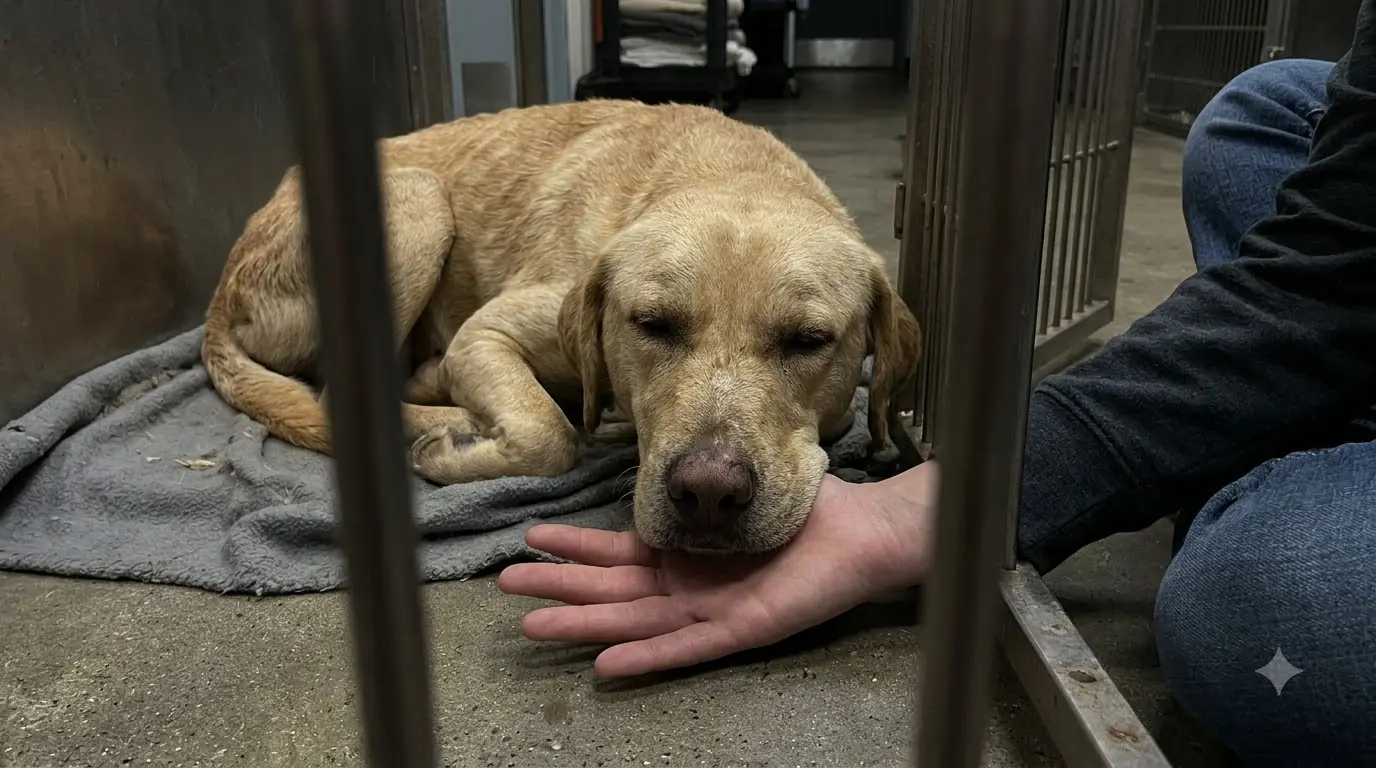
He lowered his head and rested it on her knee.
For a dog who had spent days moving away whenever people approached, it was an extraordinary change in behavior. It did not mean that every fear had disappeared. It did not mean that Cooper suddenly trusted every person.
It meant that, in that particular moment, he was willing to accept help.
The volunteer gently secured him with a leash.
Cooper did not struggle.
When she stood and began moving toward the rescue vehicle, he followed slowly.
For the first time in nearly two weeks, employees watched Cooper leave the parking lot instead of disappearing into the night.
His First Hours Indoors
Cooper arrived tired, wet, and visibly relieved to be away from the weather, although his body language remained guarded.
Our team intentionally kept his intake quiet.
There was no crowd gathered around him and no attempt to introduce him to multiple people. He was given a warm, dry area where staff could observe him without constantly entering his space.
His wet coat was gently towel-dried as much as he comfortably allowed.
Once settled, Cooper drank.
Staff offered a modest portion of easily digestible food rather than immediately giving him a very large meal. Because his nutritional history was unknown and he appeared underweight, we wanted to assess his appetite and gastrointestinal tolerance before increasing portions.
He ate cautiously at first.
After several bites, he looked toward the person sitting nearby.
When nothing was demanded of him, he returned to the bowl.
He finished the meal.
That was encouraging.
Cooper was thin, but he was alert. His gums appeared reasonably pink, his breathing was comfortable at rest, and there was no obvious emergency such as severe respiratory distress or uncontrolled bleeding.
Still, he needed a complete veterinary evaluation.
There was also another concern.
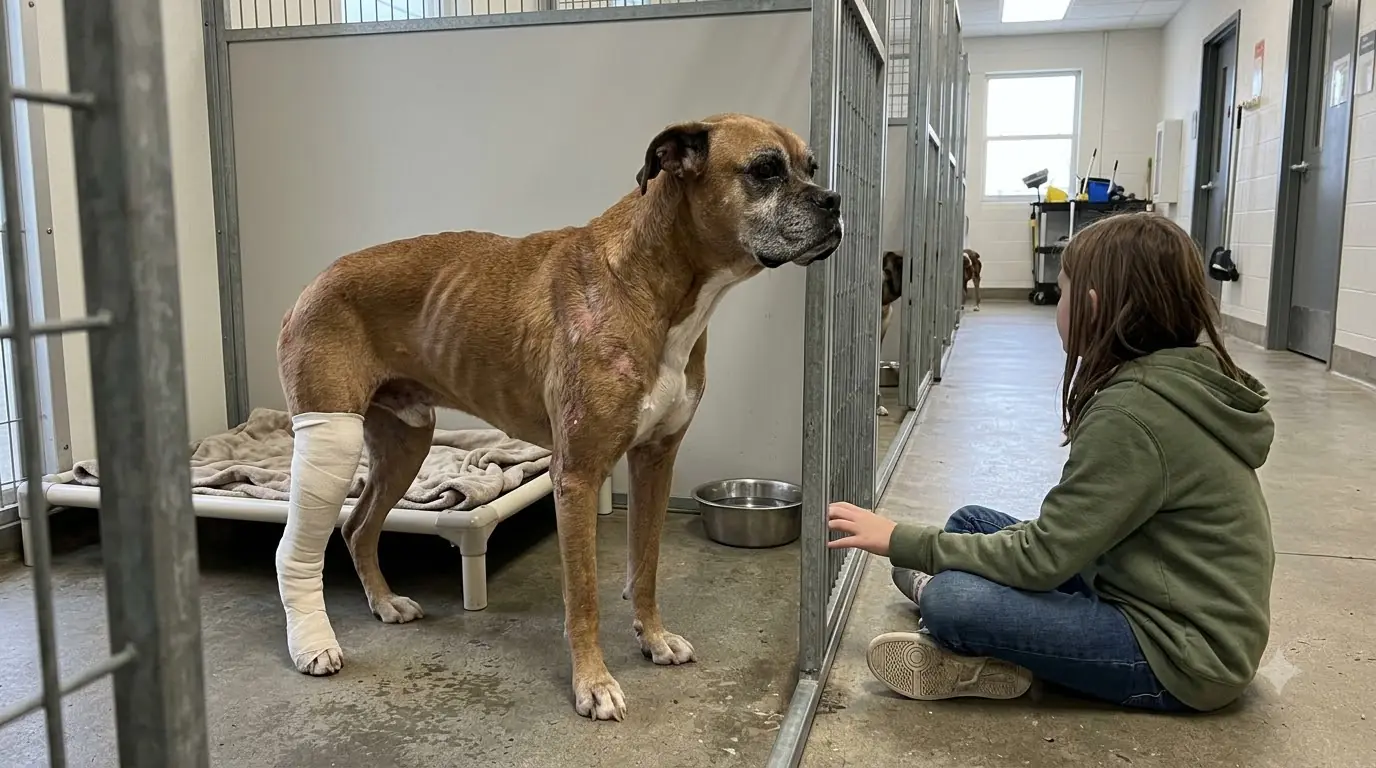
Once Cooper began walking around the intake area, staff noticed that his gait was uneven.
He was favoring a hind leg.
It was subtle when he moved slowly, but after several steps the difference became clearer. He shortened his stride and shifted some of his weight away from the uncomfortable side.
The veterinarian would need to investigate.
Cooper’s Initial Veterinary Examination
The following examination was performed slowly, with breaks whenever Cooper became tense.
At approximately six years old, Cooper was considered a mature adult dog. His Labrador-type build made his weight loss noticeable, particularly around his waist and hindquarters.
A body-condition assessment confirmed that he was under his ideal weight.
Importantly, however, he was not in a state requiring aggressive nutritional intervention.
His heart and lungs sounded normal on examination. His temperature was within an acceptable range after he had warmed and rested. His abdomen was soft without obvious discomfort during gentle palpation.
His skin and coat reflected his recent outdoor life.
There was dirt embedded in the coat, minor superficial irritation in several areas, and his paw pads were dry and irritated. None of those findings appeared to require major wound treatment.
His hind leg was different.
During the orthopedic portion of the examination, the veterinarian found mild swelling and discomfort around one knee.
Cooper did not snap or attempt to bite.
Instead, he pulled the leg away and turned his head toward the veterinarian.
That communication was respected.
The examination paused.
After Cooper relaxed, the veterinarian continued with gentler handling and determined that further imaging was appropriate.
A limp can have many causes, including soft-tissue strain, arthritis, paw injuries, ligament problems, fractures, or other orthopedic disease. Cooper’s physical examination alone could not establish the cause.
Radiographs were recommended.
Looking for the Cause of His Limp
Because Cooper’s history was unknown, his initial diagnostic workup also included routine blood testing and screening appropriate for a dog who had been living outdoors.
Bloodwork was reassuring overall.
There were minor changes consistent with stress and his recent nutritional condition, but nothing suggested major organ dysfunction requiring emergency treatment.
His hydration status improved after he had access to water and rested indoors.
Parasite screening was also performed. Like many dogs with an unknown preventive-care history, Cooper would need a veterinary plan for parasite control and future routine prevention.
Radiographs of the uncomfortable hind limb did not show an acute fracture.
That was welcome news.
They did, however, reveal mild degenerative changes around the knee consistent with early osteoarthritis. Combined with the physical examination, the veterinarian believed Cooper had likely aggravated an already sensitive joint while wandering outdoors.
There was no evidence at that point that emergency orthopedic surgery was required.
The working diagnosis was a painful flare of chronic joint disease with a probable soft-tissue strain.
That distinction mattered.
Cooper did not need to be rushed into an operation. He needed pain management, controlled activity, proper nutrition, rest, and reassessment.
If his lameness failed to improve or instability became more apparent, additional orthopedic evaluation could be considered.
For now, conservative treatment was appropriate.
The First Treatment Plan
Cooper was started on veterinarian-prescribed anti-inflammatory pain medication after his bloodwork indicated that treatment was appropriate.
Exercise was restricted.
That meant no running, jumping, rough play, or long walks.
Instead, staff took him outside on a leash for short bathroom breaks on level ground.
His irritated paw pads were cleaned and monitored. No deep wounds were found, so extensive bandaging was unnecessary. Keeping his feet clean and dry and giving him time away from rough pavement were important parts of his recovery.
Nutrition was another priority.
Rather than trying to make Cooper gain weight as quickly as possible, the veterinary team established a measured feeding plan.
His meals contained a complete and balanced dog food appropriate for an adult dog. Portions were divided across the day initially so staff could monitor appetite and digestion.
Cooper approved of that part of treatment immediately.
By his second full day, he recognized the sound of his food being prepared.
His appetite was strong.
He drank normally and urinated regularly.
His bowel movements were initially somewhat soft, something that can occur with dietary changes and stress, but they improved as his feeding schedule became consistent.
There was no persistent vomiting or diarrhea.
Those ordinary details told us something important.
Cooper’s body was beginning to settle.
The Emotional Recovery Was Different
Physical treatment could be written on a medical chart.
Trust could not.
During his first days indoors, Cooper remained cautious whenever someone entered his room.
He did not hide completely, but he often moved toward the back of his resting area and watched.
Staff avoided walking directly toward him when it was unnecessary.
Instead, they entered sideways, moved slowly, placed food or supplies down, and allowed Cooper to decide whether he wanted interaction.
The volunteer who had sat with him at the gas station visited him again.
His reaction was immediate but quiet.
Cooper stood.
His tail moved in a low, cautious wag.
Then he approached her.
He did not throw himself against her or suddenly become an exuberant Labrador. He simply stood close enough for her to stroke the side of his neck.
That was Cooper’s pattern.
His progress came in small choices.
One day he ate while a staff member remained in the room.
Another day he approached the front of his enclosure before breakfast.
Later, he began resting on his bed instead of staying positioned where he could constantly watch the doorway.
Each behavior suggested that his environment was becoming more predictable.
Learning How to Sleep Again
The first few nights, Cooper slept lightly.
Staff checking him through observation noticed that he frequently lifted his head when he heard doors opening or footsteps in the hallway.
That hyper-alert behavior gradually decreased.
A thick orthopedic-style bed was provided to keep pressure off his uncomfortable joints.
At first, Cooper slept beside it.
Then he put his front half on it.
Eventually, staff arrived one morning and found him stretched across the entire bed, deeply asleep.
He did not immediately rise when someone appeared outside his room.
For a dog recovering from prolonged uncertainty, uninterrupted rest was meaningful.
Good sleep also supported his physical recovery.
His limp was still present, but after several days of controlled activity and pain management, it became less pronounced.
The veterinary team continued monitoring rather than assuming improvement meant the problem was resolved.
Weight Gain Without Rushing
Cooper was weighed regularly.
The goal was gradual improvement in body condition while protecting his sore joint.
Rapid weight gain was neither necessary nor desirable. Extra body weight can place additional stress on arthritic joints, so his long-term target was not simply “heavier.” It was a healthy, lean condition with enough muscle to support mobility.
Over the next several weeks, Cooper began gaining steadily.
His ribs became less prominent.
The muscles around his hindquarters remained an area of focus because prolonged reduced activity can contribute to weakness.
Once the veterinarian was satisfied that the acute discomfort was improving, Cooper’s activity plan was carefully expanded.
Walks became slightly longer.
Still, they remained controlled.
No one took him jogging because he suddenly seemed happier.
No one encouraged him to leap after toys.
Recovery required restraint from the humans as much as cooperation from Cooper.
A Small Setback
About two weeks into his recovery, Cooper had a day when his limp appeared more noticeable again.
There had been no major accident.
He had simply become more energetic and turned quickly during one of his outdoor breaks.
Staff shortened his walks again and contacted the veterinary team.
A repeat examination did not suggest a new fracture or emergency. The knee remained mildly uncomfortable, but there was no dramatic change in stability.
The setback was a reminder that orthopedic recovery is rarely a perfectly straight line.
His medication plan was reviewed, and controlled rest continued.
Within several days, his gait returned to its previous level of improvement.
The team documented the episode carefully because it would matter when deciding what type of home and activity level would suit Cooper.
Discovering Cooper’s Personality
As his discomfort decreased, more of Cooper’s personality appeared.
He turned out to be deeply interested in people once he knew them.
He particularly liked sitting beside someone rather than directly in front of them.
That made sense to the volunteer who had first earned his trust.
The gesture that had started everything—Cooper resting his head on her knee—became one of his favorite forms of affection.
He would approach a familiar person, stand quietly beside their chair, and eventually lower his head onto a leg.
He also developed a fascination with soft blankets.
When staff placed a clean blanket on his bed, Cooper sometimes circled several times before settling into it.
He showed interest in toys but was initially uncertain what to do with them.
A soft rubber toy stuffed with part of his meal became a useful enrichment activity because it allowed him to investigate something new without requiring strenuous movement.
His confidence around unfamiliar people improved more slowly.
Visitors were instructed not to reach over his head.
They were encouraged to ignore him initially and allow Cooper to approach.
Some days he did.
Other days he preferred distance.
Both choices were acceptable.
Moving Into Foster Care
Once Cooper was medically stable enough to leave the rescue facility, we began looking for a foster home that could continue his rehabilitation.
The ideal environment needed to be relatively calm.
We also wanted someone comfortable following an orthopedic management plan instead of assuming that a happier dog should immediately be given unlimited exercise.
A foster volunteer with experience caring for adult dogs offered Cooper a quiet room and predictable routine.
The first evening, Cooper explored carefully.
He sniffed the doorway.
He inspected his bed.
He walked into the kitchen and then returned to the room he had been given.
His foster caregiver did not follow him constantly.
She let him explore.
That night, Cooper ate his dinner and went outside for a bathroom break without difficulty.
He urinated normally and had a formed bowel movement.
Then he returned indoors and settled near the foster caregiver rather than retreating to another room.
It was an encouraging beginning.
Learning the Rhythm of a Home
Foster care gave us information that a shelter environment could not.
Cooper learned household sounds.
The dishwasher initially concerned him.
The vacuum was kept at a distance while he adjusted.
He watched cars through the window but did not become excessively reactive.
Doorways sometimes made him hesitate, particularly when someone was standing directly on the other side. His foster caregiver began giving him more space and allowing him to pass without pressure.
Within days, those hesitations became less frequent.
His daily routine remained simple.
Wake up.
Short bathroom walk.
Breakfast.
Medication when prescribed.
Rest.
Another controlled walk later in the day.
Quiet enrichment.
Dinner.
Evening bathroom break.
Sleep.
Predictability appeared to suit him.
His Follow-Up Examination
At his next veterinary recheck, Cooper was walking more comfortably.
The veterinarian still detected signs of chronic joint change, which was expected. Osteoarthritis does not simply disappear because a dog has rested for several weeks.
The goal was management.
His acute soft-tissue discomfort had improved significantly, and his muscle condition was beginning to return.
The veterinary team discussed long-term strategies with his foster caregiver.
Maintaining a lean body condition would be especially important.
Regular low-impact activity could help preserve muscle strength and joint mobility.
High-impact repetitive exercise would need to be introduced cautiously, if at all.
Future flare-ups were possible.
Depending on his progression, additional therapies could be discussed with his regular veterinarian, including rehabilitation exercises and other evidence-based pain-management options.
Surgery was not indicated based on Cooper’s findings at that time.
He would, however, require routine monitoring as he aged.
Eating, Drinking, and Daily Function
By this stage, Cooper’s appetite was reliably good.
He no longer hesitated before meals.
He drank an appropriate amount of water and showed no concerning changes in urination.
His bathroom habits were consistent.
He could comfortably posture to urinate and defecate, an important functional observation in a dog with hind-limb discomfort.
His stools remained normal on his established diet.
His weight moved toward the veterinarian’s target range.
As his body condition improved, the focus shifted from gaining pounds to maintaining healthy muscle without allowing excess fat to accumulate.
His coat changed too.
Regular nutrition, indoor shelter, and gentle grooming gradually restored its natural appearance.
The dog who had arrived soaked beneath layers of rain and dirt began looking less like a dog surviving outdoors and more like a dog who belonged in someone’s living room.
Trust Became Ordinary
Perhaps Cooper’s biggest behavioral milestone was that affection eventually stopped feeling like an event.
In the beginning, every approach mattered.
Every touch required consideration.
Every moment of closeness seemed significant because Cooper had spent so much time avoiding people.
Months of ordinary consistency changed that.
He began walking into the kitchen when his foster caregiver prepared breakfast.
He slept while she moved around the house.
He sometimes followed her from one room to another, but he was also comfortable resting alone.
When visitors arrived, he remained cautious, yet recovery time shortened.
He might observe someone for several minutes before approaching to sniff their hand or clothing.
Nobody forced the introduction.
Cooper remained in control of the distance.
That approach helped preserve the trust he was building.
What We Still Don’t Know
People naturally want an explanation for a dog like Cooper.
Why was he at that gas station?
Why did he run whenever people approached?
Had he lived with someone before?
Was someone looking for him?
Our rescue followed the appropriate process for a found dog, including checking for identification and making reasonable efforts to determine whether an owner could be located.
But Cooper could not tell us his history.
His behavior alone could not prove what happened.
We therefore do not describe him as abused or deliberately abandoned.
Those conclusions would go beyond what we know.
What we can document is what happened after he was found.
Employees fed a dog who was afraid to approach.
A volunteer sat in the rain instead of chasing him.
Cooper eventually walked toward her.
And from that moment forward, he received veterinary treatment, food, shelter, and time.
That story is enough.
Preparing for a Permanent Home
When Cooper became ready for adoption planning, we wanted his future family to understand both how far he had come and what he would continue to need.
He was not being presented as a medically perfect dog.
He had early chronic joint changes that would require thoughtful lifelong management.
His adopter would need to maintain an appropriate weight, provide regular moderate exercise, and establish care with a veterinarian who could monitor his mobility.
If his limp worsened, persisted, or changed, he would need reassessment rather than simply being given more rest indefinitely.
His behavioral needs mattered just as much.
Cooper had become affectionate with familiar people, but he still benefited from introductions that allowed him to approach at his own pace.
A household willing to give him structure and patience would be preferable to one expecting immediate confidence in every new situation.
None of those needs made Cooper difficult.
They simply made his placement specific.
Good rescue work is not about finding the fastest available home.
It is about finding a home capable of continuing the work that has already begun.
The Blanket by the Bed
His foster caregiver kept one particular blanket near Cooper’s favorite sleeping place.
It was not the exact blanket from the gas station, but it became a quiet reminder of that night.
Cooper frequently slept with his head resting on it.
By then, his daily life looked almost ordinary.
He woke up indoors.
He went outside on a leash with someone he trusted.
He ate breakfast from his own bowl.
He rested comfortably.
He took measured walks.
He received the medical care his joints required.
And when rain struck the windows, Cooper no longer had to search for somewhere dry.
One evening during another heavy storm, his foster caregiver noticed him sleeping through the sound.
He did not pace.
He did not stand at the door.
He did not search the room for an escape.
He stayed stretched across his bed.
Later, when she sat beside him, Cooper woke, walked over, and placed his head on her knee.
It was the same simple gesture he had offered beneath the gas station sign.
But everything around it had changed.
Where Cooper Is Now
Cooper’s recovery is not a story about one dramatic medical procedure.
It is a story about gradual improvement.
His orthopedic condition will continue to require monitoring. Osteoarthritis is a chronic condition, and future discomfort is possible as he ages.
His care plan remains centered on maintaining a lean weight, preserving muscle, providing appropriate exercise, and addressing pain promptly if symptoms return.
Behaviorally, he has made substantial progress.
He no longer spends his days calculating how far he needs to stay from every person.
He seeks affection from people he trusts.
He sleeps deeply.
He eats well.
He drinks normally.
His bathroom habits are consistent.
His mobility has improved enough for comfortable daily walks within the limits recommended by his veterinary team.
Most importantly, Cooper now has something he could not depend on during those weeks at the gas station: consistency.
There is food tomorrow.
There is water tomorrow.
There is a dry bed tomorrow.
There is someone coming back tomorrow.
We cannot erase the days Cooper spent outside, and we cannot explain every part of the life that brought him there.
We also cannot promise that his knee will never hurt again or that an unfamiliar situation will never frighten him.
Rescue does not require those promises.
Sometimes success looks quieter.
It looks like a dog who once disappeared whenever a person approached choosing to walk beside someone.
It looks like gradual weight gain, comfortable movement, normal meals, restful sleep, and veterinary appointments kept on schedule.
It looks like a foster caregiver respecting hesitation instead of forcing confidence.
It looks like a frightened dog discovering that a human hand can wait.
On that rainy night, Cooper needed nearly an hour before he was ready to cross the space between himself and our volunteer.
Nobody pulled him across it.
Cooper crossed it himself.
And when he finally rested his head on her knee, he gave us the opportunity to help with everything that came afterward.
Today, Cooper is warm, medically supported, steadily growing stronger, and surrounded by people committed to giving him the time he needs.
His next chapter will not depend on forgetting where he came from.
It will depend on continuing what began beside that gas station sign: patience, responsible care, and the freedom to trust at his own pace.