“Exit the vehicle now. This car is flagged as stolen.
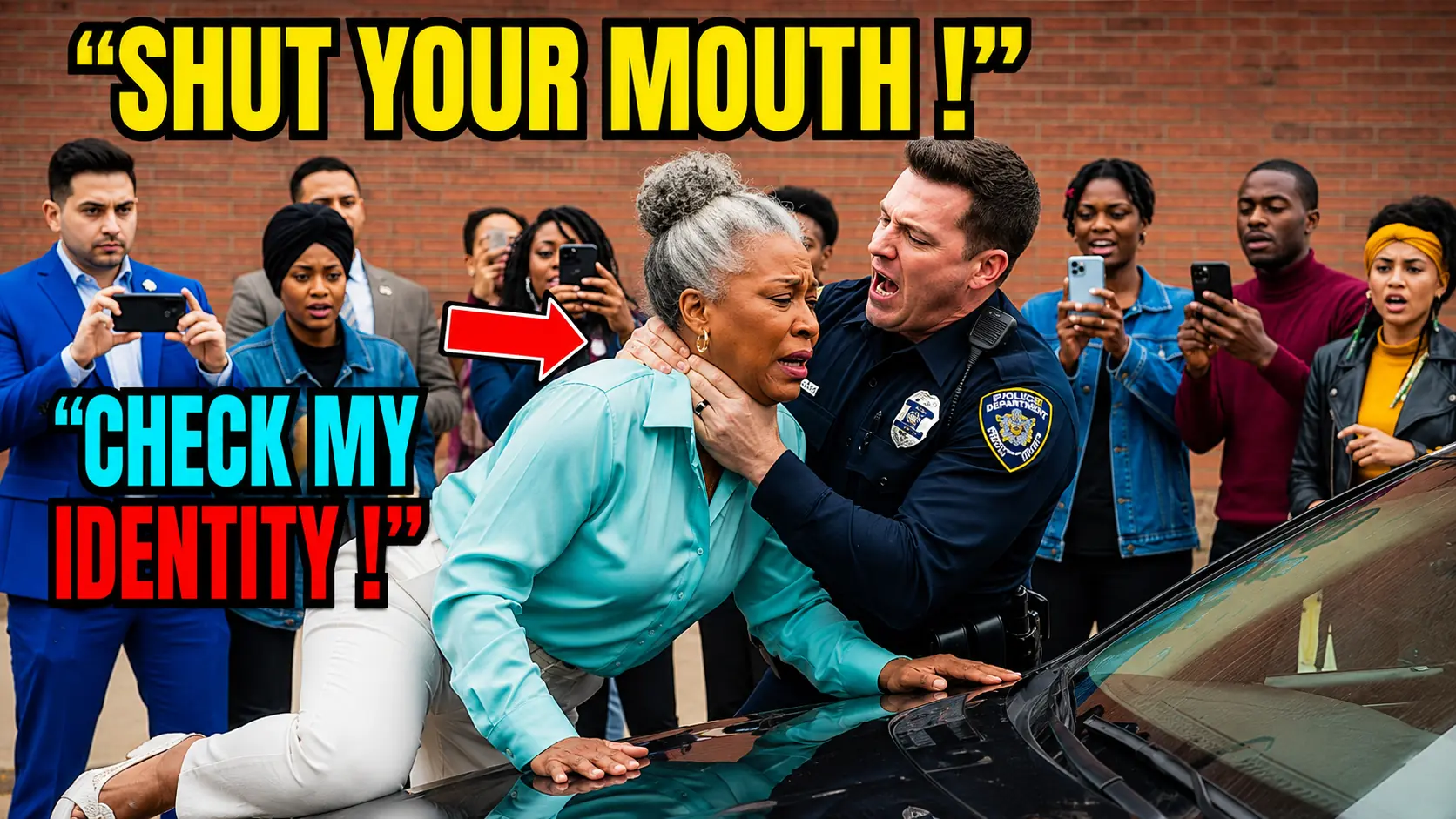
Officer Brentwood’s hand rests on his holster as he stalks toward the black Mercedes. Judge Elaine Washington watches him through her mirror, pulse steady despite the flashing lights that have forced her to the curb five blocks from her own courthouse. His voice cuts through the morning air, sharp with accusation. The cruiser’s dashboard camera blinks red, silently recording what’s about to become the biggest mistake of Brentwood’s career.
Twenty years on the federal bench has taught Washington when to speak and when to let others bury themselves. She reaches deliberately toward her purse. Brentwood tenses, barking orders faster now. The second cruiser’s doors swing open. Backup, arriving for a threat that doesn’t exist.
Washington’s fingers close around her federal judicial ID. She knows exactly how this ends. They don’t. Not yet.
“I said don’t move!” Officer Brentwood shouts, knuckles whitening around his weapon.
Judge Washington freezes, ID card half withdrawn from her purse. Morning commuters slow their vehicles, eyes drawn to the confrontation. Phones emerge from windows. Recording devices capturing what the dashboard camera already sees.
“Officer, I’m simply retrieving my identification as requested,” she says, voice level despite the adrenaline coursing through her veins. “I’m Judge Elaine Washington of the Federal District Court.”
Officer Reynolds exits the second cruiser, approaching with visible uncertainty. His eyes dart between his partner and the composed woman in the driver’s seat.
“Brentwood, maybe we should—”
“She matches the description.” Brentwood cuts him off, reaching for his radio. “Dispatch, requesting additional units for a possible stolen-vehicle recovery.”
What these officers don’t know will change everything.
Just yesterday, Judge Washington delivered the landmark ruling in United States versus Brenner, establishing new standards for police conduct during traffic stops. Her thirty-year ascent from military intelligence officer to JAG Corps to the federal bench has prepared her for moments precisely like this one. She counts silently to ten, planning three moves ahead.
The constitutional violations pile up with each passing second. No reasonable suspicion. No proper identification check. Escalation without cause.
Reynolds shifts his weight, discomfort evident as more civilians gather. The tension in his shoulders suggests he recognizes the situation spiraling beyond protocol.
“Ma’am, please exit the vehicle slowly,” he says, his tone markedly different from his partner’s.
Judge Washington complies. Movements deliberate. The morning breeze catches her silk blouse as she steps onto the asphalt, standing tall despite the officer’s attempts to diminish her. Her court credentials remain visible in her hand, sunlight catching the federal seal.
The courthouse expects her in twenty minutes for a police-misconduct hearing. The irony isn’t lost on her as she observes Officer Brentwood’s name tag, memorizing every detail for what will inevitably follow.
“Place your hands on the vehicle,” Brentwood demands, ignoring the identification she presents.
Judge Washington places her palms against the warm metal of her car. Dignity intact despite the humiliation. The real judgment has yet to begin.
“I am Judge Elaine Washington of the Federal District Court,” she repeats, enunciating each word as Officer Brentwood pats her down with unnecessary thoroughness. “You are making a significant error, officer.”
Brentwood scoffs, his breath hot against her neck.
“Everyone’s innocent. Everyone’s important. Turn around slowly.”
The gathering crowd murmurs as Judge Washington complies, her eyes scanning the bystanders. Across the street, a young Asian man in a tailored suit watches with intense focus. Thomas Chen, her former clerk and current assistant district attorney, locks eyes with her. She gives an imperceptible nod.
Chen immediately pulls out his phone, fingers moving swiftly across the screen as he begins recording. Judge Washington notes the precise time: 9:17 a.m. Every procedural violation adds to the record that will soon become evidence.
“Check her ID, man,” Officer Reynolds suggests, voice low. His discomfort grows as passing cars slow to witness the scene.
“After we secure the situation,” Brentwood dismisses, reaching for his handcuffs. The metal catches the morning light as he unclips them from his belt.
Judge Washington’s mind flashes back to law school. To her first brush with systemic prejudice, when a professor suggested she might be more comfortable in family law rather than constitutional theory. She graduated top of her class. Authored three landmark papers on Fourth Amendment protections. Went on to become the youngest federal judge in the district’s history.
The handcuffs click shut around her wrists. The sound echoes in her ears like a gavel striking wood.
“Officer Brentwood, badge number 4572. You are currently violating Title 18, Section 242, regarding deprivation of rights under color of law,” she states calmly. “Officer Reynolds, badge number 6309. You are witnessing this violation.”
Brentwood tenses.
“How do you know our badge numbers?”
“I pay attention,” she replies simply.
Across the street, Attorney Chen slides his phone into his pocket. Evidence secured. He makes a call, speaking urgently into the receiver. Judge Washington recognizes the familiar rhythm of his crisis protocol. Three people will be notified. The Chief Justice. The district attorney. And her judicial clerk.
“Search the vehicle,” Brentwood instructs Reynolds, who hesitates before complying.
Washington watches as Reynolds opens her car door, carefully examining the interior. His movements lack his partner’s aggressive certainty. When he opens the glove compartment, he finds her vehicle registration and proof of insurance, both clearly displaying her name.
“Brentwood,” Reynolds calls, holding up the documents. “These look legitimate.”
“Could be forged,” Brentwood dismisses without looking. “Check the trunk.”
The radio on Brentwood’s shoulder crackles with dispatch requesting an update. He steps away to respond, giving Judge Washington a moment to assess the growing situation. Three police cruisers now block the street. Morning traffic backs up in both directions. At least seven bystanders record the scene on their phones.
She remembers the exact statute they’re violating. She wrote the opinion on it last year. Simmons versus Department of Public Safety established that officers must check identification before detention when no immediate danger exists.
Reynolds pops the trunk and goes still.
“Brentwood. You need to see this.”
Inside the trunk rest Judge Washington’s judicial robes, carefully hung in a garment bag with the federal court seal visible on the breast pocket. Next to it sits her briefcase containing case files for today’s docket.
Brentwood glances inside, unmoved.
“Anyone can buy a costume.”
“This doesn’t feel right,” Reynolds mutters, lifting the garment bag for closer inspection.
“I am invoking my right to counsel,” Judge Washington announces clearly, ensuring the dashboard camera captures her words. “I am also informing you that you are currently detaining a federal judge on her way to court without cause, without checking readily available identification, and after being informed of my position.”
Brentwood’s radio crackles again. This time a different voice comes through. Deeper. Authoritative.
“Unit 47, this is Lieutenant Foster. What’s your current situation with the traffic stop at Maple and Fifth?”
Brentwood frowns at the unexpected inquiry.
“Standard stolen-vehicle procedure, Lieutenant. Suspect detained. Vehicle being searched.”
“Has identification been verified?”
The lieutenant’s question hangs in the air. Before Brentwood can respond, a third police cruiser arrives. Lieutenant Diane Foster steps out, her twenty years of experience evident in her measured movements. She surveys the scene with practiced efficiency. The handcuffed woman in professional attire. The growing crowd. The open Mercedes trunk displaying judicial robes.
“I requested backup, not supervision,” Brentwood mutters as Foster approaches.
“And yet here I am,” Foster replies evenly.
She turns to Judge Washington, maintaining a respectful distance.
“Ma’am, I’m Lieutenant Foster. May I ask your name?”