The first sound Harlan Whitaker would remember afterward was not the police siren.
It was the sharp crack of a honey jar against the crosswalk and, moments later, the sudden silence that fell when a uniformed man put both hands on a disabled stranger and decided that no one would stop him.
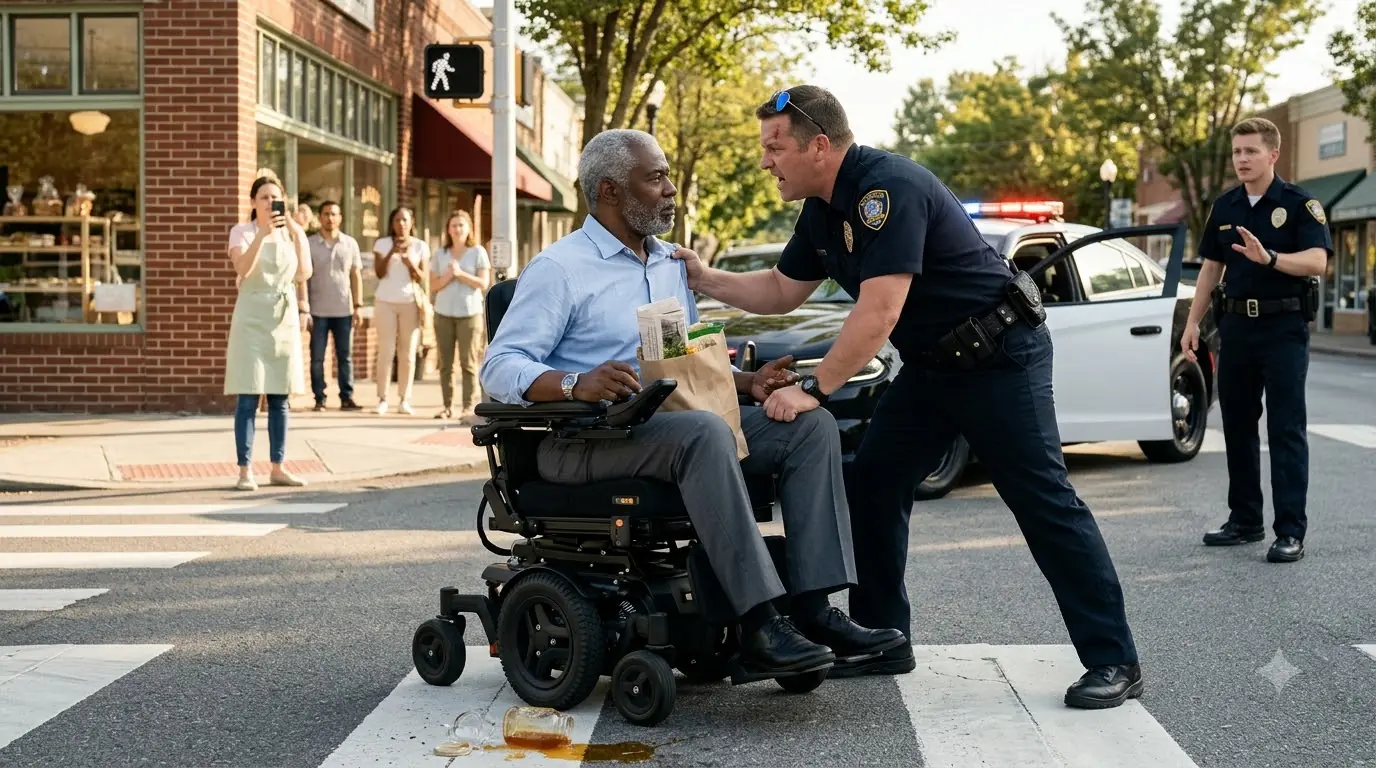
The jar of honey had cost eleven dollars. Harlan would eventually spend months explaining why those eleven dollars had almost nothing to do with what happened at the intersection of Fourth Avenue and Elm Street, and why a small accident on an ordinary afternoon exposed something the town of Oakridge had been refusing to see for years.
Before the video, before the courthouse and the news vans, before Officer Derek Langford discovered that a man in a wheelchair could carry a history he knew nothing about, there was only an afternoon warm enough to soften the tar along the seams of the pavement. A pedestrian signal shone white across a two-lane street. A bakery door stood open to let out the smell of cinnamon. Somewhere nearby, a delivery driver was trying to convince a reluctant hand truck to climb a curb. Nothing about the day suggested that anyone would remember it.
Oakridge sat on the outskirts of a Midwestern city, close enough for commuters to reach downtown before nine and far enough that residents talked about the city as though it were another country. In its older neighborhoods, modest houses stood beneath enormous maples, their driveways cracked by winters and roots. Along the commercial streets, shopkeepers knew which customers wanted coffee without asking and which children were old enough to be trusted with a quarter for the newspaper machine. A visitor could spend an afternoon there and reasonably call it peaceful. Harlan had made the same judgment when he bought his small brick house eighteen months earlier.
He had chosen it because the front path was level and the doorway could be widened without destroying the porch. The previous owner had been a retired music teacher who left behind an overgrown rosemary bush and a kitchen with a window facing east. Harlan liked the morning light, the modest distance to the grocer, and the way a person could hear rain on the roof without the constant traffic that had surrounded his former apartment in Washington. He liked that the neighborhood children learned his name before they learned the details of his career. Most of all, he liked the possibility of being ordinary.
Being ordinary required effort. Harlan was sixty-two, a Black Army veteran and retired Federal Bureau of Investigation supervisor whose legs had not carried his weight for almost eleven years. He wore his silvering hair close to the scalp and kept his beard neatly trimmed, a habit that had survived barracks inspections and decades of federal meetings. He favored button-down shirts, clean trousers, and dark shoes polished for the satisfaction of the work rather than for anyone's approval. His motorized wheelchair had been modified by a specialist to suit his broad shoulders and the limited reach of his lower back. He knew the motor's smallest changes in pitch as intimately as other men knew the sound of their own footsteps.