“Excuse me, officer. My neighbor’s hearing starts in five minutes. May I go in?”
“Wait outside, old man.”
“I beg your pardon?”
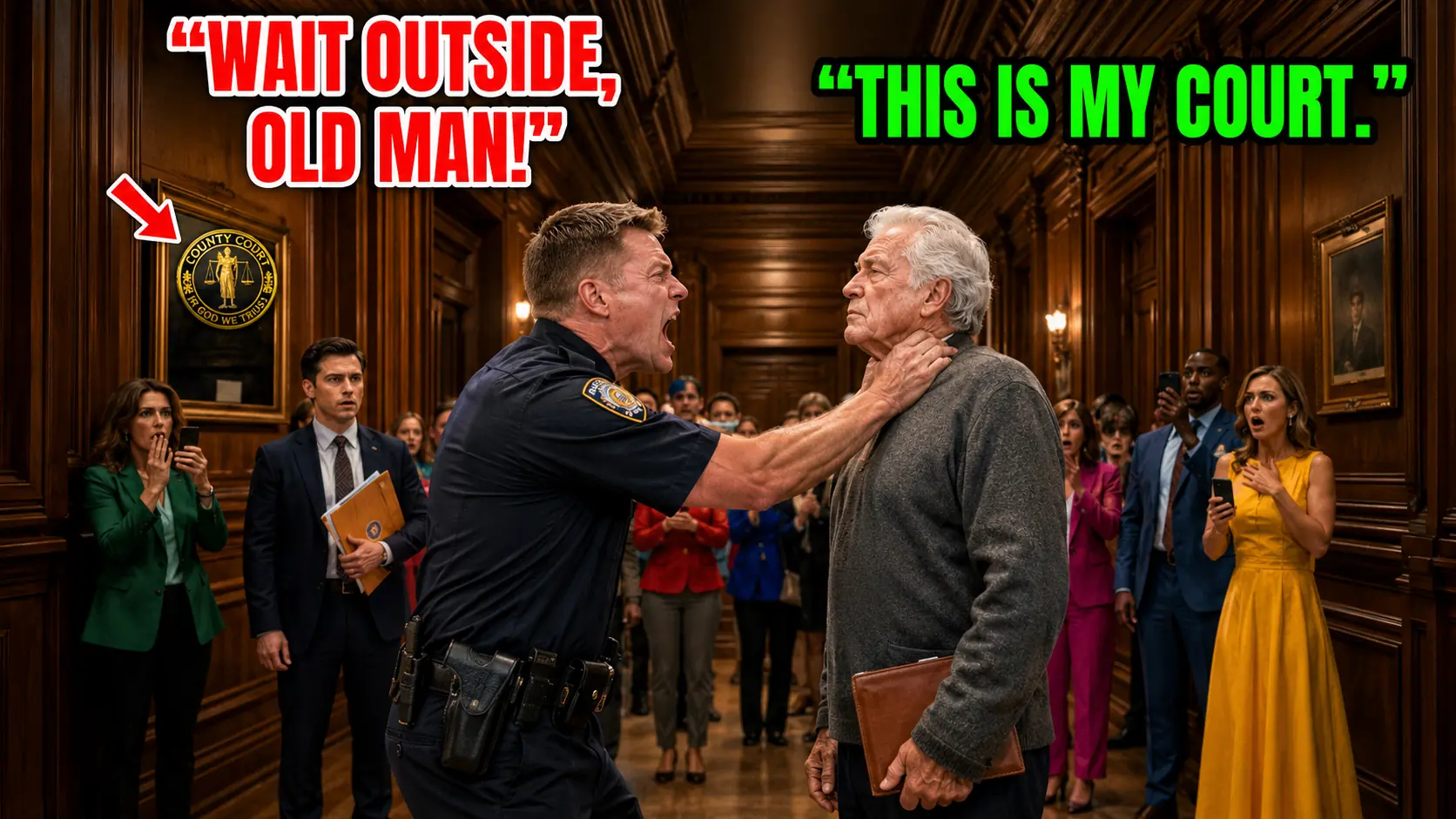
“You heard me. Court is for people who matter. Not shuffling grandpas in thrift-store sweaters.”
“Sir, the gallery is open to the public. I only want to sit in the back.”
“And I only want you gone. What is this? A diary?”
“Please be careful with that notebook. It was a gift from my wife.”
“Now it’s mine. Call it evidence of loitering.”
“Son, do you know whose courtroom this is?”
“Yeah. Mine. I keep the trash out of it. Move before I find a reason to cuff you.”
“Then I’ll wait. I’m very good at waiting.”
“Whatever, old man. Just stay out of my courtroom.”
The hallway laughed with Officer Voss, not knowing the quiet man he mocked had run this entire court for twenty years.
The next morning, courtroom four filled before nine. Fairmont County still loved a trial. Word had spread that a local teenager faced three years for assaulting a police officer, and the gallery benches creaked under the weight of curiosity.
Miles Keller stood at the door again. This time it was not Voss who met him. It was a heavy-set bailiff with silver hair and a careful limp. A man named Gus Halloran.
Gus studied the old man’s face for a long moment. Something flickered behind his eyes—half a memory trying to surface.
“Gallery is open, sir,” Gus said quietly. “Back row has space.”
“Thank you kindly.”
“Do I know you from somewhere?”
“I have one of those faces,” Miles said, and walked in.
He took the last seat in the last row, folded his hands, and watched the machinery of justice begin to move. He knew this room. He knew the sticky hinge on the jury door. He knew the water stain above the clerk’s desk shaped like the state of Florida. Twenty years leaves fingerprints on a man’s memory, and the man leaves fingerprints on a room.
At the defense table sat Elijah Brooks, nineteen, in a borrowed suit one size too big. His mother had ironed it twice that morning. His hands stayed flat on the table exactly the way his lawyer had told him. He looked like a boy trying very hard to seem small.
Assistant District Attorney Scott Calloway rose first. He was tall, polished, the kind of lawyer who rehearsed his pauses.
“Your Honor, the evidence will show that on the night of March twelfth, the defendant attacked Officer Derek Voss during a routine stop. This was not a misunderstanding. This was an assault on a man who wears a badge so the rest of us can sleep at night.”
Judge Eleanor Vance listened from the bench with a stillness that gave nothing away. She was in her fifties, sharp-eyed, famous for patience and infamous for the end of it.
Then the state called Officer Derek Voss.
He walked to the stand like a man accepting an award. Pressed uniform. Fresh haircut. He smiled at the jury before he even sat down, and half of them smiled back. People want to believe the uniform. That is the whole point of one.
“Officer Voss, tell us about that night,” Calloway said.
“Routine patrol on Carver Street. Around 9:15, I observed the defendant acting suspicious near the hardware store. Pacing. Checking windows. I initiated contact—polite and professional. He got aggressive immediately. Shouting. Swearing. When I attempted to detain him, he struck me in the chest and resisted. I used the minimum force necessary to bring him under control.”
The story rolled out smooth as poured concrete. Every sentence landed in order. Every detail arrived on time, dressed and rehearsed. The jury leaned in. A woman in the second row shook her head at Elijah as if she already knew the verdict.
In the back row, Miles Keller did not move. But inside his mind, a single phrase had snagged like a thread on a nail.
Around 9:15.
The charging documents had been read aloud during arraignment, and Miles had been listening from the hallway. The original incident report logged the stop at 9:40. Twenty-five minutes did not just vanish from a trained officer’s memory. Sloppy men forget details. Lying men rearrange them.
The story was perfect. That was the problem. Lies rehearse. Truth remembers.
Calloway kept going, feeding his witness easy questions, and Voss kept hitting them like batting practice. The teenager swung first. The officer feared for his safety. The arrest was textbook. Somewhere in the third retelling, the strike to the chest became a strike at his face. Nobody else seemed to notice the wound migrating.
Miles noticed. He had spent two decades watching testimony from a higher chair than anyone in this room. He knew the rhythm of a memorized script. Real memory wanders. It backtracks. Corrects itself. Stumbles into honesty. Voss never stumbled once. His story had no loose threads because someone had already cut them all off.
“And the defendant’s notebook claim,” Calloway said almost casually. “He alleges you confiscated personal property in the courthouse yesterday.”
“I removed a potential security item from an unidentified loiterer,” Voss said. “Standard procedure.”
In the back row, the unidentified loiterer allowed himself one slow blink.
Gus Halloran turned from his post by the wall and looked at Miles again. Longer this time. His brow folded as if he were doing arithmetic with very old numbers. Miles met his eyes, calm as Sunday, and the bailiff turned away with the question still sitting on his face.
The defense had its turn. Nora Whitfield stood up, and the difference between the two tables became painful to watch. She was young and smart and drowning. Eighty open cases will do that. Her cross-examination was earnest and toothless.
“Did you identify yourself?”
“Yes.”
“Did you feel threatened?”
“Of course.”
Each answer closed a door she did not know how to reopen.
“No further questions,” she said finally, and the words sounded like surrender.
But the state had one more witness. And this is where the concrete cracked.
Officer Tyler Brennan had been Voss’s partner for two years. He took the stand the way a man steps onto thin ice, testing each word before putting weight on it. He confirmed the stop. He confirmed the arrest. Then Calloway asked him to describe the moment the defendant struck Officer Voss.
Brennan paused. It was a small pause. Two seconds, maybe three. But silence has a different texture when it is hiding something, and the whole room felt the temperature change.