“Scrubs? Anyone can buy scrubs.
What, you think putting on a costume makes you a doctor? Officer Brandon Mitchell’s voice dripped with contempt, his flashlight locked on her face.
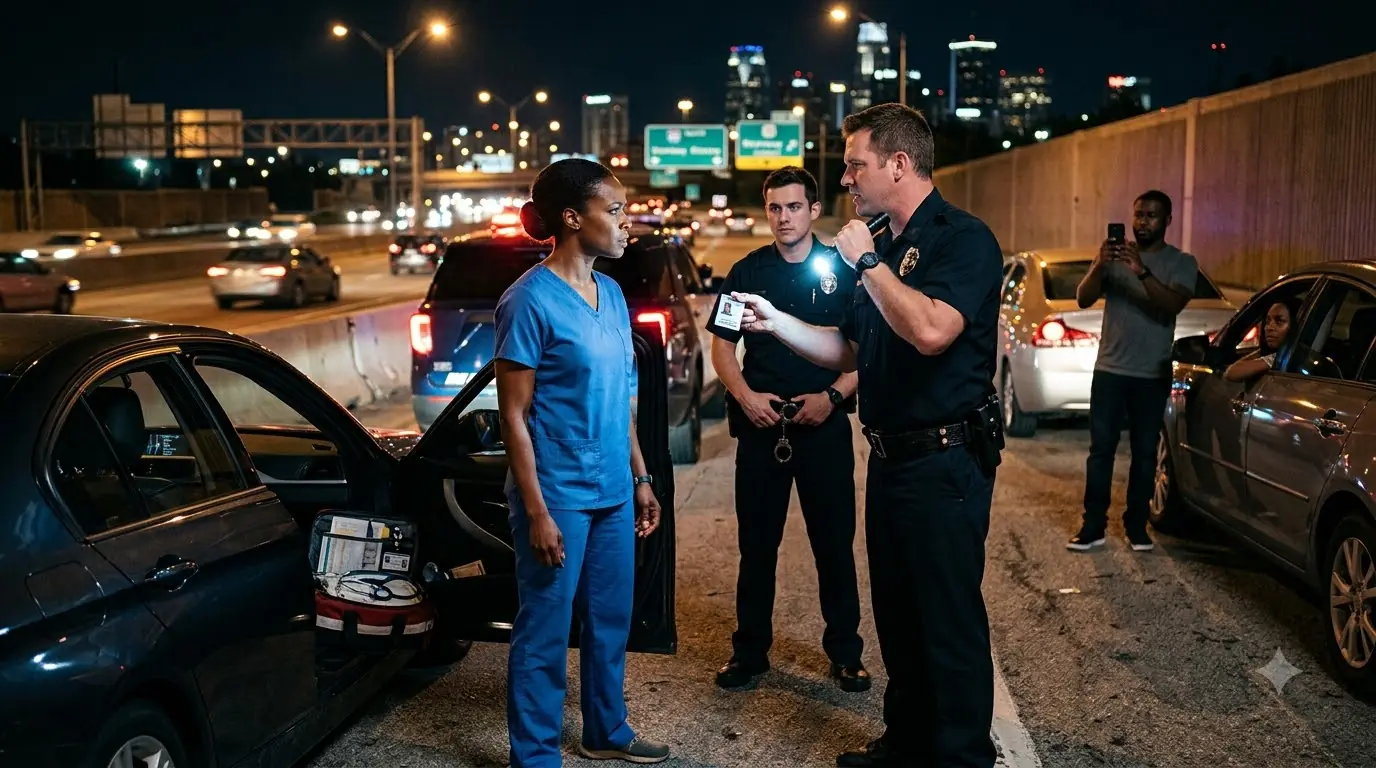
”“Officer, I apologize for my speed. I’m a trauma surgeon at Metropolitan General.
There’s a patient—”
“Yeah? So where’s your real ID?
Or did you steal that too, along with this fancy car?”
Maya’s voice stayed calm, soft, professional. “Sir, my hospital badge is in my bag.
My stethoscope is right there. The hospital is calling me.
A boy is dying.”
“A boy is dying,” Mitchell mimicked cruelly. “You people always got some story.
Step out. Hands behind your back.”
Hayes pulled out the handcuffs.
10:52 p.m. In three hours, Mitchell would stand in front of his police chief and hear the five words that ended his career.
But right now, he had no idea who he was arresting.
Three hours earlier, Maya Richardson pulled off her scrubs in the hospital locker room. Fourteen hours on her feet, three surgeries, two saves, and one loss that still stung.
Dr. Patricia Carter leaned against the doorway.
“Go home, Maya. You’ve been here since 6:00 a.m.”
Maya rubbed her neck. “Just finishing notes.
Tom’s in a council meeting anyway.”
She did not say her husband’s full title: Police Chief Thomas Richardson. They had learned in Chicago to keep that quiet.
Too many whispers. Too many assumptions.
A Black woman doctor married to a white cop climbing the ranks. People talked.
They still did.
Maya texted him. “Heading home.
How’s the meeting?”
Three dots appeared, then: “Rough. They want me to delay body-camera implementation.
I’ll be late.”
She drove home, fifteen minutes through the city. Their house sat in a quiet, mixed professional neighborhood, the kind of place where people nodded hello but did not pry.
Maya showered, changed into sweats, heated leftover Thai food, and sat on the couch with her phone. She was scrolling through medical journals when her phone rang at 10:45 p.m.
Dr. Carter’s voice was tight.
“Maya, I need you back. GSW patient, 17-year-old male, massive internal bleeding.
ETA ten minutes. You’re the only one who can handle this.”
Maya was already moving. “Prep OR 2.
I’m fifteen minutes out.”
She did not waste time changing completely. Surgeons kept spare scrubs at home for exactly this reason.
She pulled on blue cotton scrubs, grabbed her bag with her hospital ID and stethoscope, and ran to her car, the BMW registered under Tom’s name. They had done that for privacy too.
After Chicago, they wanted separation, professional distance. Maya backed out fast and hit the gas.
Somewhere across the city, Marcus Webb was in an ambulance. Seventeen years old, a scholar-athlete with an MIT scholarship for engineering.
He had been walking home from his friend’s house when a drive-by caught him in the wrong place at the wrong time. The bullet tore through his abdomen.
His mother, Sharon, rode in another car behind the ambulance, praying, screaming, begging God. At Metropolitan General, Dr.
Carter was scrubbing in.
Her hands moved fast. She was good, but she was not Maya.
Maya had twelve years of trauma surgery. Maya had hands that did not shake and instincts that saved lives when minutes mattered.