"Do you really think a man like you belongs in seat 3A?"
The question was asked at the exact moment Miles Sloan had begun to believe he might enjoy his day off. He was standing in the forward cabin of Crestline Flight 2286, one hand resting lightly on the seat in front of him, his boarding pass still visible on his phone.
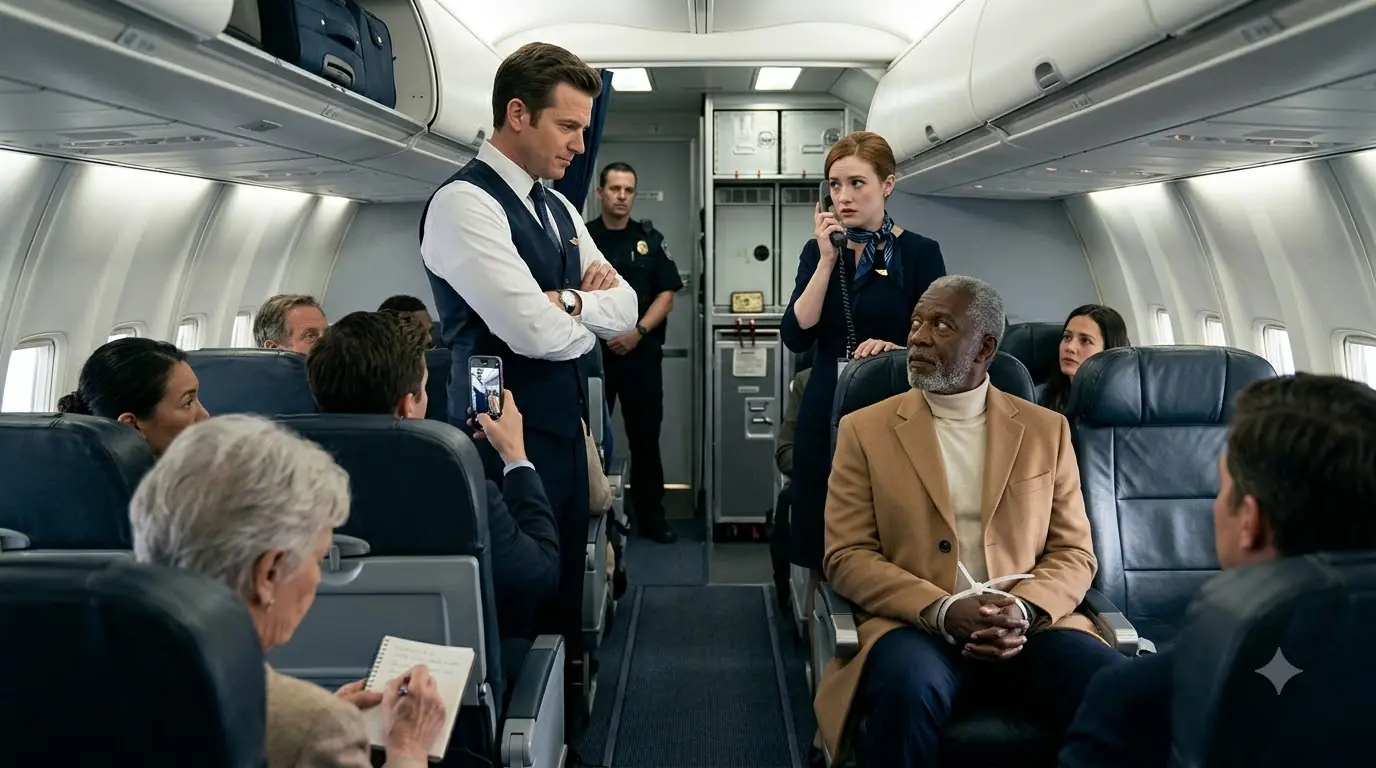
The man who had spoken wore a watch worth more than Miles's first car and a smile practiced on people who were expected to recognize his importance. Beside that man, a young woman in an immaculate cream-colored jacket looked anxiously from the seat number to the purser waiting in the aisle.
"I think I belong wherever my boarding pass says I belong," Miles answered.
The man laughed without amusement. "Bye-bye, buddy. Enjoy the back of the plane."
Miles looked at the number above the window. Three A. He looked at the passenger's name glowing on his screen, then at the uniformed employee whose eyes were already traveling over his plain sweatshirt and worn carry-on bag. "Okay," he said, so quietly that it barely sounded like an argument. "Just remember you said that at thirty-four thousand feet."
He did not know then that the aircraft would be diverted, that federal investigators would meet it on the ground, or that a man seated twenty rows behind him was carrying a secret far more dangerous than an unwanted passenger in first class. He knew only that he had earned this seat through fourteen years of ordinary travel and that he wanted to see his mother before her birthday dinner was over. The last thing he wanted was a confrontation. That would make the next several hours almost unbearable, because every effort he made to avoid one would be interpreted as evidence that he deserved it.
Earlier that morning, Miles had stood in a crowded departure terminal with a paper cup of coffee cooling in his hand. Through the enormous windows, baggage carts moved between waiting aircraft, their yellow lights blinking beneath a slate-colored sky. Travelers hurried toward gate announcements, families compared boarding groups, and a little boy pressed both palms against the glass every time a jet crossed the taxiway. Miles watched the boy for a moment and remembered being that age, when a machine leaving the ground seemed less like engineering than a miracle.
"There he is," his mother said when he answered her call. "Tell me you are not working on your day off, baby."
"Not today, Mama. I'm at the gate. They just moved me up to first class."
"First class? Well, look at you, Mr. Fancy." Her laughter came through the phone warm and unguarded, a sound that carried the small kitchen of her Phoenix house across half the country. "I told your aunt Denise you would finally start using all those miles you keep collecting. She said she thought you were saving them until you turned eighty."
"Fourteen years of miles," Miles said. "Nothing fancy about it. They kept upgrading everybody ahead of me until there was one seat left."