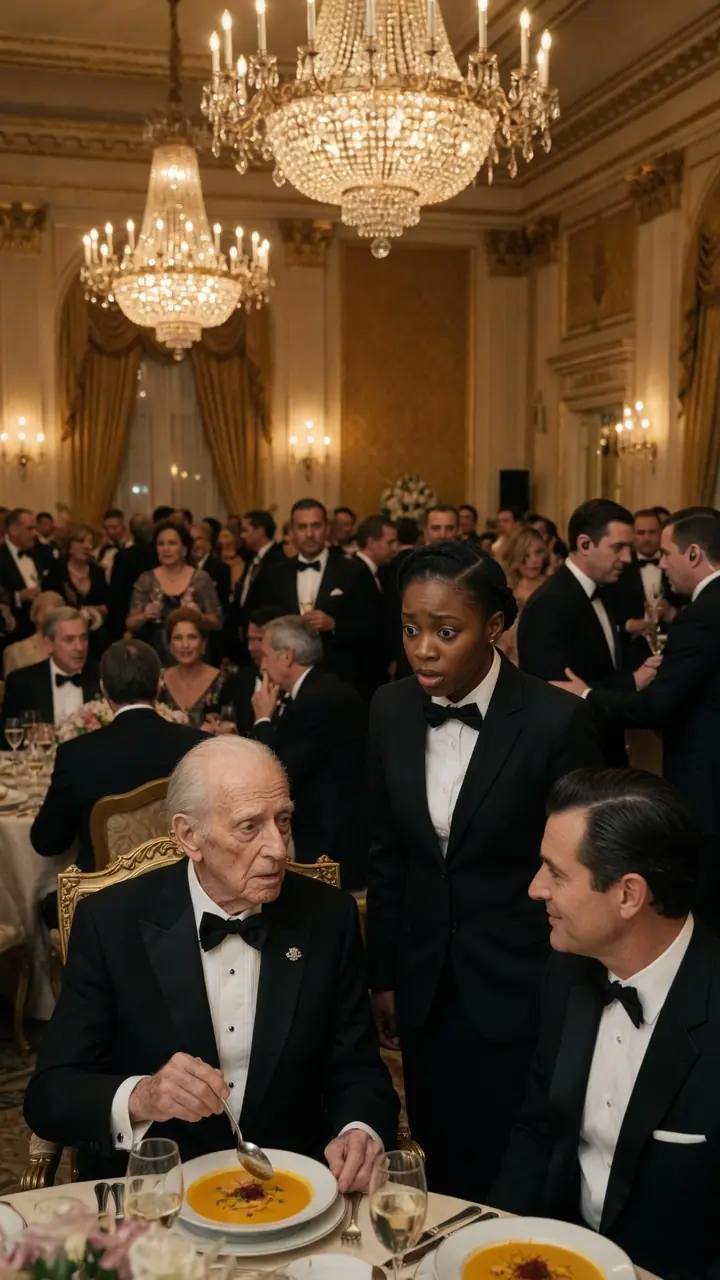
Who are you, you filthy rat, getting out here to stop me? A nineteen-year-old Black girl, a waitress in a borrowed black suit, buried in tuition debt, her sick mother home alone.
“Don’t eat that, sir.”
“What?”
“Please don’t. I beg you.”
“Take your hand off my table.”
“Sir, if you take that bite, you will die.”
“How dare you? Security! Get this girl out of my sight!”
She lunged, snatching the fork from his hand. “Please. Please listen to me. Listen to me!”
“Get out!”
But Quinn knew that smell. No. She’d smelled it once before, the night her father died.
To understand those four words, you have to go back four hours.
The alarm screamed at 4:40 a.m., and Quinn slapped it silent before it could wake her mother. The apartment was cold, but she didn’t turn on the heat. The bill was already two weeks late. By phone light, she found the kitchen, where her flashcards hung taped above the stove. Reaction equations, color change charts, lethal dose thresholds. She mouthed them while the kettle warmed.
Cardiac glycosides, bitter, slows the heart. Methanol, sweetish, blinds, then kills.
A cough came from the other room. Then her mother’s voice, thin as paper. “Quinn? Baby, you’re up already?”
“Go back to sleep, Mama.”
Renata Griffith appeared in the doorway anyway, gripping the frame, an oxygen line looped under her nose. At fifty-one, she moved like seventy. “You didn’t sleep. I heard you turning pages all night.”
“Exam Monday.”
“Exams.” Her mother shuffled to the table and lowered herself down, breathing hard. “Baby, listen to me. The catering shifts, take more of them. Drop a class if you have to. We can’t keep—”
“I’m not dropping anything.” Quinn set tea in front of her. “I’m two semesters from my degree, Mama. Two.”
“And what good is a degree if they put us out on the street?”
Quinn didn’t answer. On the fridge hung a single envelope, return address in red. Tuition, final notice. Beside it stood four prescription bottles, every one of them low.
“Your daddy would have told you the same thing I’m telling you,” Renata said softly. “Stop carrying us. You’re nineteen.”
“Daddy,” Quinn said quietly, “is exactly why I’m not stopping.”
Renata looked away because five years gone and the wound still bled. Theodore Griffith, chemistry teacher, gentle, brilliant, had come home one night gray and sweating. The ER doctor barely looked at him. Cardiac event, he said, then probably food poisoning. Go home and rest. They sent him out the door and he was dead before sunrise. No real autopsy, no answers, just a death certificate with a guess written on it.
Quinn had been fourteen. Over his coffin she promised she would learn exactly how people die so no one could ever shrug and guess again. That promise was a chemistry degree now. That promise was 4:40 in the morning.
She zipped her backpack. Inside, beneath the textbooks, sat the two things she carried everywhere. Her father’s battered field notebook, its leather worn soft, and a small homemade case of reagent vials and test strips, the kind that turned colors when they touched something they shouldn’t.
Renata watched her tuck them away and almost smiled. “Your worry blanket.”
“It’s just habit, Mama.”
“Mhm. You’d take that thing to church.”
By dusk, Quinn was across the city in the basement kitchen of the Heartwell Grand Hotel, knotting a borrowed bow tie at her throat. The catering crew swarmed under fluorescent light, stacking trays for the night’s event. A black-tie gala for the Coleman Medical Foundation, tickets ten thousand dollars a plate. The number didn’t feel real. Her heat bill was sixty.
Della Okafor clapped her hands once, and the room snapped to attention. Built like a brick wall and twice as immovable, she held a clipboard in one fist. “Listen up. Tonight, there are two hundred of the richest donors in this state upstairs. Senators, surgeons, the chairman himself.” She swept her eyes across them. “You will be silent. You will be invisible. You pour, you clear, you vanish. Nobody talks to a guest. Nobody so much as looks a guest in the eye. We clear?”
“Yes, Chef,” the crew murmured.
“Griffith.” Della’s gaze pinned her. “You’re new, so you’re on water and bussing the head table. The head table is the chairman. You drop one glass near that man, and you don’t just lose tonight. You lose every shift I ever give you. Understood?”
“Understood.”
“Then move.”
Upstairs, the ballroom was another planet. Chandeliers dripped gold and diamonds caught the light at every table. Quinn moved along the walls with her water pitcher, invisible, exactly as ordered. And even invisible, she couldn’t stop seeing. She caught a busser about to reset a fork that had touched the floor, and swapped it before it reached a plate. She spotted an allergy card flipped to the wrong setting and quietly turned it back. She watched a line cook wipe a knife on a shellfish board, then reach for a vegetable tray, and she slid the board away without a word. Nobody thanked her. Nobody noticed her at all.
A waiter beside her followed her gaze and snorted. “You always this jumpy?”
“My dad used to say half of staying safe is just paying attention.”
“Rich folks pay people to pay attention for them.”
“Yeah.” She refilled a glass for a woman who never looked up. “Must be nice.”
At the head table, an empty chair waited beneath a small brass placard. Chairman H. Coleman. Quinn straightened the water glass at his setting, lined the rim to the knife, and moved on, telling herself the same thing she’d been telling herself all week. Just get through tonight. Tuition’s due Friday.
She had no idea the man who would sit in that chair was about to change her life, or that someone had already decided he wouldn’t leave the room alive.
The chairman arrived late, and the whole room rose to meet him. Hayes Coleman came through the gold doors slowly, one hand resting on the arm of a younger man who steered him toward the head table. At sixty-one, the chairman should have looked formidable. Instead, he looked carved down, his tuxedo loose at the collar, his skin the color of old paper. He smiled and shook the hands that reached for him, but Quinn, pressed against the wall with her pitcher, saw the truth. The slight tremor, the careful steps, a man rationing every ounce of strength he had left.
“Heard he’s been sick for months,” the waiter beside her whispered. “Best doctors in the country, and not one of them can name it.”
“What do they say it is?”
“That’s the thing. They don’t say anything.”
The younger man eased Hayes into the chairman’s chair, then took the seat beside him, and Quinn finally got a look at him. He had the same sharp jaw as Hayes, but none of the wear. A smile that never quite reached his eyes. She heard a passing server murmur the name, Sterling Coleman, the chairman’s brother.
She refilled three glasses and was turning back toward the kitchen when something stopped her. Sterling wasn’t watching the stage, where the foundation’s director had begun thanking donors. He was watching the kitchen doors. And when a runner pushed through with the first course, Sterling rose, murmured something about checking on the kitchen, and followed the man back through the swinging doors.
It was nothing. Rich men did odd things.
Quinn carried her empty pitcher down to refill it. And that was how she ended up at the service station, ten feet from the chef’s pass, when she saw it.
Sterling Coleman stood close to the executive chef, a broad man whose name tag read Vance Whitaker. Their backs were half turned, their voices low under the kitchen clatter. Sterling’s hand moved, and something small passed between them. A vial, amber glass, no bigger than a thumb. Vance didn’t take it like a gift. He took it the way you take something you’re afraid of.
“I can’t,” Vance said. “Mr. Coleman, please. Not this.”
“You can, and you will.” Sterling’s voice stayed pleasant, which made it worse. “One bowl, the chairman’s. You’ve seen what he eats, the saffron bisque, every gala, fifteen years. It goes in his, and only his.”
“He’s your brother.”
“And your daughter starts at Briarwood in the fall. Lovely school. Be a shame if the tuition fell through.” A pause. “Or worse.”
Quinn’s pitcher hung forgotten in her hand. She watched Vance’s jaw work, watched his eyes go wet and furious and helpless all at once. Then his shoulders dropped and he turned to the row of bisque bowls waiting under the heat lamps, and he uncapped the vial.
The smell reached her a half second later, bitter with something sweet curled underneath it. Almonds and solvent, wrong in a way the warm saffron couldn’t hide.
Quinn’s whole body went cold because she knew that smell. She had smelled it once before, bent over a folder of independent lab results she’d begged a chemistry professor to run, three years after they buried her father. Cardiac glycoside. Oleander. And methanol to mask the bitterness. The exact combination that had killed Theodore Griffith.
For a moment, she couldn’t move. The kitchen roared around her. Pans, voices, the hiss of the lamps, and she stood frozen with a pitcher of water and a memory of a hospital hallway.
Then Vance set the dosed bowl onto a tray, alone, and slid it to a runner. “Head table,” he said, not meeting anyone’s eyes. “Chairman, hands only. Don’t let it sit.”
The runner lifted the tray. The doors swung. The bowl was moving.
Quinn’s mind sprinted through everything at once. She was nineteen. She was nobody. She had a sick mother and a final notice on the fridge and a supervisor who’d promised to end her if she so much as looked a guest in the eye. If she opened her mouth and was wrong, she’d be thrown out tonight and blacklisted by morning. If she was right and stayed silent, a man would lift a spoon to his mouth in about ninety seconds and never set it down.
She thought of her father, gray on the kitchen floor. She thought of the doctor who hadn’t paid attention.
“Miss?” Della’s voice cracked behind her like a whip. “Why is your pitcher empty and your feet not moving? Head table needs water. Go.”
It was the worst order and the only opening she’d get. The water went to the head table. So did she.
She set down the pitcher, filled the chairman’s glass with a hand that would not stop shaking, and watched the runner lower the saffron bisque in front of Hayes Coleman. He picked up his spoon. He picked up his spoon and the room kept laughing and clinking around a man who had ninety seconds to live.
Quinn’s body moved before her fear could vote. She stepped in close, past the rule, past Della, past every reason to stay invisible, and she leaned to his ear. “Don’t eat that, sir.”
The spoon stopped an inch from his lips. “Excuse me?”
Hayes turned and his eyes, pale, tired, suddenly sharp, found hers. “Please don’t eat it. I’m begging you. Put it down.”
“Take your hand off my table.” His voice dropped to ice and color climbed into his gray cheeks. Heads at the head table turned. “Who are you?”
“Nobody. I’m nobody. But if you take that bite, you will die tonight.”
“How dare you?” He set the spoon down hard, but only to push back his chair, rising on trembling legs, his face flushing crimson with rage. “Security! Get this girl out of my sight.”
“Sir, listen to me, please.”
Across the room, Della went white and started forward at a dead walk, mouthing one furious word at Quinn. “Out.”
Two hotel security men peeled off the wall. A woman at the next table clutched her pearls. “The help is insane,” she hissed, and somebody else laughed, nervous and cruel.
“I’m so sorry, Mr. Coleman.” Della called, reaching them, seizing Quinn’s elbow. “She’s new. She’s gone. Right now. Quinn, move.”
“No.” Quinn dug in. “Della, please. I saw.”
Then Sterling Coleman rose smoothly from his seat, and his voice slid over all of it, warm and reasonable and deadly. “It’s all right, everyone. Just a confused young lady. Sit, Hayes. Eat your soup before it’s cold. You’ve had a long night.”
“Eat your soup, Hayes.”
That sentence, calm, helpful, aimed at the bowl, was the thing that broke Quinn’s last hesitation. She tore her arm out of Della’s grip and lunged, snatching the bowl off the table. Gasps rolled across the ballroom. A security guard’s hand clamped onto her shoulder and hauled. “Ma’am, you’re coming with me.”
“Smell it.” Quinn twisted, holding the bowl out toward Hayes, soup sloshing the rim, her voice cracking into something between an order and a sob. “You’ve eaten this every gala for fifteen years. Smell it. Tell me it smells right, and I’ll walk out that door myself. Please. Just smell it.”
Something in her face, the certainty under the terror, made him pause. Hayes lifted one hand, and the guard froze. The old man leaned down. He breathed in. And Quinn watched the rage drain straight out of his face.
“There’s—” He swallowed. “There’s something under the saffron.”
“Almonds and solvent.” Quinn said. “Oleander and methanol. I watched a man pour it in ten minutes ago in your kitchen.”
“This is absurd.” Sterling laughed, but it came a half beat too late. “Hayes, she’s hysterical. She’s a waitress. Guards, remove her, then let me prove it.”
Quinn swung her backpack off her shoulder and dropped to one knee on the ballroom floor in her borrowed black suit. Two hundred millionaires watching a waitress dig through a knapsack. Her hands shook so badly, she nearly dropped the case. Reagent vial, test strip. Her father’s voice in her head. Half of staying safe is just paying attention.
“What is she doing?” Someone demanded. “What is that?”
“Chemistry.” She dipped the strip into the bowl, added two drops from an amber-capped vial, and held it up where the chandelier light could catch it. “If I’m wrong, this stays yellow and you can throw me in the street. Breathe in.”
The strip did not stay yellow. Breathe out. It bloomed. First a deep bruised blue, then a creeping green at the edge. The two reactions stacking exactly the way her flashcards above the cold stove had promised they would.
“Blue is the cardiac glycoside.” Quinn’s voice steadied even as her hands wouldn’t. The room had gone so silent, she could hear the violins still sawing on the far side of it, unaware. “Green is the methanol. Both in his bowl.” She lifted her eyes to Sterling. “In nobody else’s.”
For one heartbeat, nobody breathed.
Then Vance Whitaker’s voice broke from the kitchen doorway, where he’d stood white-knuckled the whole time. “It’s true.” He was crying openly now, a broad man folding in on himself. “God forgive me. It’s true. He made me. He said he’d hurt my little girl if I didn’t. Mr. Coleman, I’m sorry. I’m so sorry.”
Every head at the head table turned toward Sterling. His reasonable smile finally slid off his face. He looked at the strip, at the weeping chef, at his brother’s stunned eyes, and he ran. Three steps toward the doors before an off-duty officer two tables over came up out of his chair and put him down on the marble with a knee in his back. Sterling thrashed and shouted something that no longer sounded calm at all.
The ballroom erupted. Chairs scraped. Phones came up. A woman screamed. A dozen voices shouted for police at once.
And in the middle of it, Hayes Coleman sat very still, staring at the trembling girl on her knees who held a strip of paper that had just saved his life.
“You,” he said, and could not finish.
“You should sit down, sir.” Quinn’s whisper was nearly gone. The adrenaline drained out of her in a rush, and the cold arithmetic came in behind it. She’d caused a scene, touched a guest, defied Della, ended her job in front of the whole city. She braced for it. “I’m sorry about your dinner. I’ll get my things and go.” She started to rise.
Hayes caught her wrist, gently, the grip of a weak man, but she stopped anyway. “You are not going anywhere,” he said. “What is your name?”
Before she could answer, the doors banged wide, and the night dissolved into flashing red and blue. Officers poured in. Someone in a suit was already shouting about the foundation’s lawyers. Someone else was bagging the bowl, the vial, the blue-green strip still pinched in Quinn’s fingers. A paramedic crouched in front of Hayes, pressing two fingers to his wrist, asking if he’d swallowed anything, anything at all.
“No,” Hayes said, never taking his eyes off Quinn. “Not tonight, because of her.”
Della stood frozen a few feet away. The speech she’d rehearsed about firing this girl dying unsaid in her throat. Around the room, two hundred people who had refused all evening to so much as look a waitress in the eye were now staring at no one else.
Quinn let an officer guide her into a chair. Her knees had stopped working. She kept hold of the strip, evidence, her father’s lessons, fifteen years of one promise, all of it bruised blue and green in her shaking hand, and she did not let go.
“What is your name?” Hayes asked again, leaning toward her as the chaos roared.
“Quinn.” She managed. “Quinn Griffith.”
For just a moment, the old man’s face changed. Not shock at the poison, something older and deeper, as if she’d struck a bell that had been silent for years. But the paramedics moved between them, and the moment was swallowed by the storm.
By midnight, the ballroom had emptied of everything but uniforms. The chandeliers still burned over abandoned half-eaten plates, a forest of overturned chairs. Sterling was gone. Cuffed, read his rights, folded into the back of a cruiser while his lawyer’s number rang unanswered. Vance sat against the kitchen wall with a blanket on his shoulders and a detective crouched beside him, taking down every word between sobs.
And in the middle of it all, Quinn sat in a chair she’d been guided into an hour ago and still hadn’t found the strength to leave.
A detective took her statement twice. She gave the same answers both times, because they were simply true. When he finally clicked his pen shut, Hayes Coleman crossed the room toward her. Slow, but steady now. Color creeping back into a face that had been gray all night. He pulled a chair around and sat, eye to eye with her, the way no guest had looked at her all evening.
“I owe you my life,” he said. “I don’t say that as a figure of speech. I mean it as a debt.”
He reached into his jacket and drew out a checkbook and a pen. “Tell me a number. Whatever it is, double it. Pay your tuition. Pay your mother’s doctors. Walk out of here tonight and never pour another glass of water for anyone as long as you live.”
Quinn looked at the checkbook. She thought about the red envelope on the fridge. She thought about her mother counting pills into a Sunday organizer, making four bottles stretch into five weeks. The number he was offering could erase all of it in a single stroke.
“No,” she said. “Thank you, but no.”
Hayes’s pen stopped. “I beg your pardon?”
“I didn’t do it for money.” Her voice was quiet and certain. “If I take your check, then that’s what tonight becomes. A transaction. And it wasn’t.” She swallowed. “Somebody should have spoken up for my father once. Nobody did. So I wasn’t ever going to be the person who stayed quiet. That’s all. That’s the whole reason.”
At the word father, something moved behind the old man’s eyes again. That same struck bell stillness she’d seen before the paramedics pulled them apart.
“Your father,” Hayes said carefully. “What happened to your father, Quinn?”
“He was poisoned.” She held the old man’s gaze. “They called it food poisoning and sent him home to die. I was fourteen. I spent the next five years learning chemistry, so I’d never have to take anyone’s guess for an answer again.” A tired, crooked, almost smile. “Turns out it came in handy.”
For a long moment, Hayes Coleman said nothing at all. He looked at her the way a man looks at a face he is trying to place, or one he’s been searching for. Then, very slowly, he closed the checkbook and put it away.
“You’re right,” he said. “It would have cheapened it. Forgive me.”
Instead, he took out a single, plain, white card. No title, no company crest, just a name and a number handwritten on the back. And pressed it into her palm, and folded her fingers over it.
“But you will take this. And you will use it. Whatever you need, anything, any hour, you call that number. Promise me.”
“Mr. Coleman, I can’t just—”
“Promise me.”
It wasn’t a command. It was nearly a plea.
“Okay,” she said softly. “I promise.”
He rose, steadied himself on the chair back, and looked down at her one last time. “Quinn Griffith,” he murmured, as if testing the weight of it. “Go home to your mother. Sleep. You’ve done a braver thing tonight than anyone in this room will manage in their whole lives.”
Then he was gone, an aide at each elbow, out through the gold doors into the flashing night.
Quinn sat alone among the ruined tables, turning the blank little card over and over in her fingers, certain she would never have a single reason to call it.
She was wrong about that. She was wrong about almost everything that had happened tonight. But she wouldn’t learn how wrong until morning.
In the back of the chairman’s car, Hayes Coleman did not look at the city sliding past his window. He looked at his phone and at the photograph on its screen and at the name his assistant had just typed back to him.
“Pull everything on the Griffith family,” he said quietly. “The mother, the girl, and the father, Theodore. I want it tonight, not tomorrow.” A pause. “I’ve been looking for them for years. I’d nearly stopped believing I’d find them.”
His assistant glanced up. “Sir, find who?”
But Hayes only closed his eyes and pressed the phone to his chest.
Across town, Quinn couldn’t sleep, either. She sat at the kitchen table with a cup of tea gone cold and the smell would not leave her. That bittersweet thread of almonds and solvent curling up out of a stranger’s bowl. She knew it. She had spent three years of her life knowing it, hunched over a folder of independent lab results she’d begged a professor to run on a tissue sample no one else had bothered to keep. Oleander. Methanol. The same hand, almost. The same recipe.
Her father had not died of food poisoning. She had known that for years and been unable to prove who. And tonight, in a ballroom full of strangers, she had smelled the ghost of it again.
She pulled out her phone and searched the name without deciding to. Hayes Coleman. Chairman, Coleman Medical. Net worth in the billions. Hospitals in nine states. And there, in the third article down, a single line that stopped her cold. The chairman had been gravely and mysteriously ill for the better part of a year. Doctors baffled. Tests inconclusive.
Six months, she thought. Slow.
She set the phone face down and didn’t pick it up again.
At a hospital across the city, an emergency physician would soon reopen Hayes Coleman’s chart and notice something everyone had missed. Faint, repeating traces in six months of routine blood work, written off each time as noise. Not noise. A dose. Then another, then another. Someone had been killing the chairman by inches, patient as a clock. Until tonight, when patience ran out and the dose came all at once.
But Quinn didn’t know that yet. She only knew that at six a.m. a courier buzzed her building and she opened her door to a plain envelope with no return address. Inside was no note, no check, just a single old photograph. Two young men in faded college sweatshirts, arms slung over each other’s shoulders, laughing at something outside the frame. One of them was a much younger Hayes Coleman. The other was her father.
The next morning, Hayes Coleman asked to see her and answer a question Quinn had been asking her whole life.
The car came at ten. Quinn almost didn’t get in it. She stood on the curb with the photograph in her coat pocket and her heart going like a fist on a door. But she got in. She had questions now that were louder than her fear.
They drove her not to an office, but to a hospital suite high above the city where Hayes sat propped in a bed he clearly resented. An IV in one arm and color, real color, back in his face. On the table beside him lay a thick folder and a detective’s card.
“They told me this morning,” he said without preamble, gesturing at the folder, “what my brother has been doing to me.” His voice was steady, but his hands were not. “For six months, Quinn, Sterling has been poisoning me for six months, a little at a time. Small enough that fourteen specialists called it a mystery and sent me home with vitamins.” A bitter laugh. “The illness everyone whispered about. It had a name all along. It was him.”
“Why?” Quinn asked quietly.
“Money. The oldest reason there is.” Hayes opened the folder. “Sterling owes the wrong people one point two billion dollars he doesn’t have. As my only living brother, he inherits everything the day I die. So he set out to make that day arrive slowly so no one would look too hard.” He slid a page toward her. Bank records, threats, a burner phone log. “He cornered my own chef. Threatened the man’s eight-year-old daughter to force his hand. That’s who my brother is. That’s who I broke bread with every Sunday.” A bitter laugh. “The illness everyone whispered about. It had a name all along. It was him.”
He looked at her. “And the only person in a ballroom of two hundred who could smell the difference between saffron and a death sentence was a nineteen-year-old waitress carrying a chemistry kit in her backpack.” He shook his head slowly. “Tell me how that happens by accident.”
“It doesn’t.” Quinn said. “I told you. My father was poisoned the same way. Oleander. Methanol. I know that smell because it’s the smell that took him from me.” She drew the photograph out of her pocket with a shaking hand and held it up. “So you tell me, Mr. Coleman. Why do you have a picture of him? Why did you send it to my door?”
The steadiness finally left Hayes Coleman’s face. He took the photo from her with great care. The way you hold something you’ve grieved.
“Because Theodore Griffith was my best friend.” he said. “We were roommates. Two scholarship kids who couldn’t afford the school we’d talked our way into. Him from a teacher’s family. Me from nothing at all. He tutored half the chemistry department to pay his rent. He was the smartest, kindest man I ever knew, and I built an empire on lessons he taught me at a kitchen table for free.”
Quinn couldn’t breathe.
“We lost touch the way young men do,” Hayes went on. “I chased money. He chased a classroom and a family. And then, five years ago, I tried to find him again to thank him, to give back some of what he gave me. And I learned he died. Food poisoning, the certificate said. Sent home from an emergency room.” His jaw tightened. “I never believed it. Theodore knew more about toxins than any doctor in that hospital. A man like that does not die of a bad oyster. I hired people. They found nothing. The trail went cold, and his family had moved, changed numbers, vanished into grief.” He looked up at her, his eyes wet. “I have spent five years looking for a widow and a child I’d never met. I had almost given up.”
“And then?” Quinn whispered.
“I said my name in your ballroom. And then you said your name in my ballroom.” Hayes pressed the back of his hand to his mouth for a moment. “Theodore’s daughter. Carrying his notebook, I’d bet. Smelling poison no one else could smell. Because he taught it to you the way he taught it to me.”
“Quinn, last night his daughter saved my life with the very thing that couldn’t save his.” His voice broke completely. “I do not believe that is a coincidence. I think that’s Theo still in the room, still paying attention.”
For a long moment, neither of them could speak. Outside the window, the city went on, indifferent, while inside it, two strangers who weren’t quite strangers sat holding the same dead man between them in a photograph.
“They reopened his case this morning,” Hayes said at last quietly. “I made them. Whoever poisoned your father used the same method someone taught my brother. I am going to find out if those two facts are one fact.” He set the photo against his heart. “I owe Theodore that. And I owe you a great deal more than a check.”
Quinn looked at the picture of her father, young, laughing, alive, his arm around a man who would one day search five years for her. And something inside her chest that had been clenched shut since she was fourteen began very slowly to come loose.
“He used to say half of staying safe is just paying attention,” she said.
Hayes let out a sound that was half a laugh and half a sob. “Yes. He said it to me a thousand times.” He wiped his eyes and for the first time smiled at her like family. “Then let’s both keep paying attention, Quinn Griffith, because I have an offer to make you, and it has nothing to do with charity.”
Then Hayes made an offer that put Quinn down into a chair. He had his assistant bring it in writing because he wanted her to see it was real and not the gratitude of a frightened old man.
She read the first page twice and still didn’t believe it.
“A full scholarship,” Hayes said, watching her face. “Every remaining semester. Tuition, books, lab fees, a living stipend so you never knot a borrowed bow tie again. You finish your degree and then medical school after it if you want it. All of it paid with no claim on you in return.”
“Mr. Coleman, I’m not finished.” He turned to the second page. “Your mother. The Coleman Foundation runs a family medical fund. Effective today, every dollar of Renata Griffith’s care is covered. Her medications, her specialists, in-home oxygen, the works. That red envelope on your refrigerator?” Quinn flinched. She hadn’t told him about it. “My people are thorough. It’s already paid. It will stay paid.”
Quinn’s eyes filled, and she pressed the heel of her hand against them, furious at herself for crying in front of this man.
“And the last page,” he said gently, “is the one I care about most. When you finish your training, chemistry, medicine, whichever you take, I want you to come build something inside my company. A division that doesn’t exist yet. Rapid toxin screening. The exact thing that would have caught what happened to your father at the door, instead of in a coffin.” He set the folder down. “I want you to lead it. Not as a favor, because last night you found in ninety seconds a poison that my entire medical and security apparatus missed for half a year. I am not a sentimental man, Quinn. I have never seen an instinct like yours. I would be a fool not to hire it.”
For a long moment, Quinn just stared at the pages on her lap. Then she shook her head, not refusing, just overwhelmed. “This is too much,” she said. “People don’t— This doesn’t happen to people like me. I’ll wake up on that bus tomorrow, and none of it will be real.”
“It is precisely because of who you are that it’s happening,” Hayes said. “You stood in a room that had spent all night treating you like furniture, and you risked the only thing you had, your job, your future, your mother’s medicine, to save a man who screamed in your face.” He leaned forward. “Charity is when I give money to soothe my own conscience. This is not that. This is a debt, and an investment, and, if you’ll allow an old man to say it, a chance to finish something your father started. Those are three different things and not one of them is pity.”
Quinn thought of Renata at the kitchen table telling her to drop out. She thought of the flashcards above the cold stove, the promise over the coffin, five years of 4:40 a.m. alarms.
“Okay.” She whispered. “Okay.”
“Yes.” Hayes Coleman closed his eyes briefly as if a weight he’d carried for five years had finally been set down. “Good.” He said. “Good.”
There was one more thing and he saved it for last because he knew what it would do to her.
“I told you they reopened your father’s case.” He picked up the detective’s card from the table and held it out. “I didn’t tell you why they agreed so quickly. The toxin Sterling used, the formulation, the oleander and methanol mask, it isn’t common, Quinn. It’s a signature. The investigators think whoever supplied it to my brother may have sold it before to other people for other jobs.” He let that settle. “Five years ago in this city to someone who wanted a chemistry teacher silenced before he could prove what he discovered about it.”
Quinn went very still.
“You think the same person?”
“I think it is possible your father didn’t die of a misdiagnosis at all. I think it’s possible he died because he was paying attention to the wrong thing.” Hayes’s voice was iron now and very kind. “And I think for the first time in five years, there are people with badges and subpoenas who want to find out. I’m paying for every one of them.”
“And Sterling?”
“Charged this morning. Attempted murder, fraud, conspiracy. He’ll answer for all of it.” A pause. “The chef, Vance, will not. He came forward. He told the truth. He was a father protecting his child under threat. The district attorney has agreed to leniency. I asked her to.” Hayes almost smiled. “A man who breaks under a threat to his daughter and then risks everything to confess in a ballroom, that’s not a villain, Quinn. That’s just someone who is waiting for one brave person to go first. You went first.”
The tears came then, the ones Quinn had been refusing since she was fourteen. Not grief. Grief she knew by heart. These were something she’d stopped letting herself feel. The dangerous, electric beginning of hope.
“He used to tuck me in,” she said, her voice cracking, “and tell me the truth always smells like something. You just have to be brave enough to put your nose to it.”
Hayes reached across and took her hand the way an uncle might. “You were the only one in the room paying attention. Go home, Quinn. Tell your mother the envelope is gone. Then come back and let’s finish what they started. Both of them.”
Quinn walked out of that hospital with a folder worth more than every paycheck of her life combined. But it wasn’t the money she carried down in the elevator, pressed against her chest like something breakable. It was the hope.
One whisper in a ballroom started something that outlived the headlines.
The story broke before Quinn even got home. By the time her bus reached her stop, a news van was already idling outside the hotel and a Chiron crawled across screens in every diner and waiting room in the city. Waitress foils billion-dollar murder plot. Poison caught mid-bite. The clip someone had filmed on a phone, a young woman on her knees in a borrowed suit, holding up a strip of paper that turned blue and green under the chandeliers, passed a million views by morning and didn’t slow down.
But the headlines were the smallest part of what she’d set loose.
At Coleman Medical, Hayes did not wait to recover before he acted. Within a month, every emergency room in his nine-state network carried a new standing order, printed and laminated and taped beside the intake desk. Any patient presenting with sudden unexplained cardiac or gastrointestinal collapse was to be rapid screened for common toxins before being sent home. No more guessing. No more probably food poisoning.
The protocol had a name on the masthead, the Griffith Standard, and a one-line preamble Hayes had written himself. Because someone was paying attention.
The first life it saved belonged to a retired bus driver in another state entirely, a man Quinn would never meet. He came into a Coleman emergency room, gray and sweating, was nearly discharged with antacids, and a young resident, following the new laminated card, ran the screen instead. Antifreeze. A jealous tenant. The man went home to his grandchildren three days later, never knowing that a chemistry student two thousand miles away had written the reason he was alive.
Quinn went back to school, but not the way she’d left it. The 4:40 alarms stopped. The borrowed bow tie went in a drawer. She sat in the front row now instead of nodding off in the back after a double shift. Her professors, who had known her as the quiet, exhausted girl who somehow still aced every exam, watched her come alive. She finished the semester at the top of her class and didn’t have to skip a single meal to do it.
Renata changed, too. The oxygen tank stayed, but the gray left her face. New specialists found a treatment the old clinic could never afford, and one afternoon, Quinn came home to find her mother standing at the stove, actually standing, cooking, humming for the first time in two years. Renata turned, wooden spoon in hand, and for a moment, neither of them could speak.
“Your daddy,” Renata finally said, “would be insufferable right now. You know that? Strutting around, telling everyone at church his baby caught a poison with her nose.”
Quinn laughed until she cried.
Vance Whitaker rebuilt slowly in a small kitchen across town that didn’t care about galas. The leniency held. His daughter started at her school in the fall, after all. And on her first day, he sent Quinn a single text. “She got in. Thank you for going first.” Quinn saved it and never deleted it.
And the thing about a wave is that it doesn’t stop where you can see it. Other hospital systems read about the Griffith Standard and copied it, then improved it, then taught it. A medical school three states over added Quinn’s ballroom footage to its first-year ethics lecture. “Not for the chemistry,” the professor told his students, “but for the choice. A girl with nothing chose a stranger’s life over her own security. That is the entire job. Remember her.”
In a community college chemistry class, much like the one Quinn had clawed her way through, a first-generation student named Daniella watched the clip on her phone before lecture and thought, for the first time, that maybe someone like her belonged in a lab coat, too. She changed her major that week. She would not be the last.
Quinn didn’t see most of it. She was too busy living the life that had cracked open in a hospital suite, studying, sitting with her mother, driving out on weekends to a quiet records office where two detectives and a forensic chemist were slowly, carefully pulling her father’s case back into the light, page by page, test by test.
It was working. All of it. The thing she’d whispered into a billionaire’s ear had grown legs and walked out into the world and started saving people she would never meet.
And somewhere in the middle of all that hope, on an ordinary Tuesday, the detective called with the first real answer about her father in five years.
Five years later, Dr. Quinn Griffith walked into a hospital lab on a long night and the past came full circle.
The case on her screen was routine. A man brought into a Coleman emergency room two floors down, sweating, gray, his heart slowing for no reason anyone could name. A decade ago, a tired physician would have called it a cardiac event and sent him home to die in his sleep. Tonight, a laminated card sent his blood to her instead.
Quinn ran the screen herself, the way she always did. The strip bloomed blue at the edge, and she was already on the phone to the floor before it finished. Her voice calm and certain. “It’s a cardiac glycoside. He’s being poisoned. Antidote, now, and call the police.”
They reached him in time. He went home to his family that weekend, alive, because somebody had finally been paying attention.
She was the somebody now. She had been for years.
In the lab behind her, a first-year analyst named Daniella froze over a result she wasn’t sure of, a senior attending breathing down her neck. The old terror of speaking up out of turn written all over her face. Quinn had seen that look before, in a mirror, in a ballroom, at nineteen.
“If something’s wrong,” Quinn told her quietly, “you say it out loud, even if your voice shakes, especially then.”
Daniella swallowed and said it. She was right.
On the wall by the lab door hung a small framed plaque, newly mounted, that Quinn touched on her way out every shift, the way some people touch a doorpost. “The Theodore Griffith Scholarship,” it read, “for first-generation students in medicine and the sciences.” Hayes had endowed it the year the case finally closed. The year the supplier who’d sold the poison twice, to a desperate brother, and to whoever wanted a chemistry teacher silenced, was at last named, charged, and convicted.
Theodore Griffith had been right about everything. It had only taken his daughter fifteen years in a stranger’s saffron bisque to prove it.
Hayes still came to dinner on Sundays, slower now, but stubbornly alive. A great uncle to a family he’d searched five years to find.
On her desk, beside her credentials and her father’s worn field notebook, sat the photograph of two laughing young men in college sweatshirts.
That night, before she switched off the lab lights, Quinn picked up the notebook and ran her thumb over the soft leather, the way she had a thousand times. Then she said the four words that had started all of it, not in fear this time, but like a small private prayer to the father who taught her the smell of the truth.
“Don’t eat that, sir.”
And she smiled and went home.