"Don't start it, sir." The voice was thin, almost swallowed by the soft hush of the fountain at the center of the circular drive, but it carried the kind of certainty that a man notices even when he is not yet ready to be noticed. Richard Caldwell heard it the way you hear a door close in another room of a very large house, late at night, when you had thought you were alone. He paused with his hand already on the polished chrome of the door handle. The black sedan was warm in the late afternoon sun, the kind of car that costs more than most people's homes, and is so quiet when it idles that you sometimes forget it is running. His driver had not yet come out.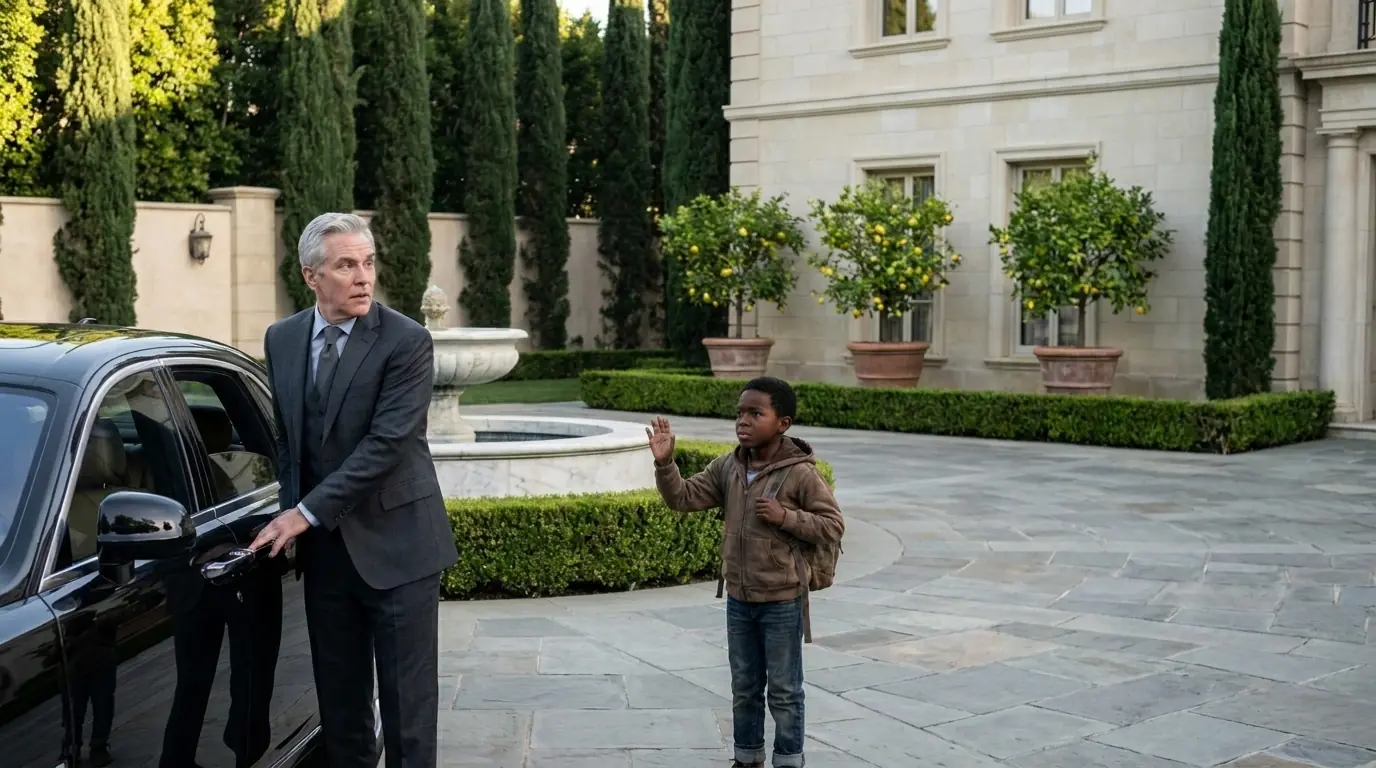
He had told Marcus he would drive himself this evening. He had told Marcus a lot of things this week. "Don't start it, sir." "Please." Richard turned his head slowly. He was sixty-three years old, with a kind of silver hair that television producers ask their stylists to imitate, and a tailored charcoal three-piece suit that had been measured to his shoulders in a small shop in London 19 years earlier, and remeasured every two years since. He was, by any reasonable accounting, one of the wealthiest men in the state.
He had stepped out of his front door perhaps 11 seconds before, and in those 11 seconds the world he understood had been the world of his estate. The clipped boxwoods, the Italian cypresses standing in disciplined rows, the cream stone facade of the house his late wife had loved, and he could no longer quite bring himself to love alone. The boy did not belong in that world. He stood maybe fifteen feet away on the flagstones of the drive, one palm raised flat in front of him, the way a small crossing guard holds up a hand to stop traffic. The other hand white-knuckled on the strap of a backpack that was filthier than the boy was, and the boy was not clean.
He could not have been older than eight, possibly younger. His skin was a deep umber brown, his hair a soft uncombed crown of dark curls that the wind kept lifting and setting back down. He wore a hooded jacket the color of damp cardboard, sleeves frayed at the cuffs. The jeans were two sizes too long, rolled at the ankle in a way that suggested someone had once tried to make them fit and given up. The boots on his feet had been someone else's boots first and possibly someone else's before that.
But his eyes did not match any of it. His eyes were dark and steady and locked on Richard's face with the unblinking gravity of a child who has been carrying something heavy for a long time and has finally found the one person he was meant to give it to. A landscaper somewhere at the far edge of the property was running an edge trimmer. The sound seemed very distant, the way ordinary sounds become distant in the seconds before something extraordinary happens.
"Son," Richard said, and his voice came out softer than he intended. "You shouldn't be on the property. The gate is locked. How did you get in?" "I climbed the wall by the lemon trees. I didn't break anything." The boy's chin came up half an inch. "Sir, please don't start the car. The brakes are cut." Richard's hand was still on the door handle. He felt the metal beneath his palm with sudden exact clarity, the small grooves where his thumb rested, the slight warmth of sun-heated chrome. He did not move it. He did not lift it away. He simply became very suddenly aware of it.
"What did you say?" "The brakes." The boy swallowed. The motion went through his whole small throat. "I saw a man do it. Two nights ago when you weren't home. He came in through the side gate where the camera doesn't reach."
I was sleeping in the alley behind your wall because the shelter on Pier Street was full and I heard the gate. I climbed up to see and I saw him. He had a black bag and a flashlight with a red filter. He stayed beneath your car for a long time, tampering with something underneath, and then poured a thin liquid onto the ground from a bottle. It looked like oil, but it was thinner. After he finished, he made a phone call and said the job was done and that you would not make the curve." Richard did not move. Somewhere inside the house a clock he had bought in Vienna in 1997 was striking the half hour and the small bronze chime came faintly through the open front door and the boy did not flinch, did not look away, did not let his hand drop. Richard Caldwell had built a fortune of $740 million over forty years on a single principle that he had once written on a yellow legal pad in a hotel room in Chicago when he was 28 years old. The principle was this, most disasters announce themselves first."
They knock politely. The cost of listening is almost nothing. The cost of not listening is everything. He had forgotten that principle exactly twice in his life. Once in 1996 when he had ignored his auditor's careful suggestion about a partner in Singapore and once in 2011 when his wife Elena had said very quietly over breakfast that her chest sometimes felt tight when she climbed the stairs and he had told her she worked too hard and they should plan a vacation.
She had been gone fourteen months later. He took his hand off the door handle. He took it off slowly the way you take your hand off a thing that might still be hot and he stepped back from the car one full step and then a second step and the gravel of the drive made the small careful sound that gravel makes under expensive shoes.
"What's your name?" he asked. "Elijah." The boy's hand was still raised, but it was beginning to tremble at the wrist now. "Elijah Brooks." "Elijah, I want you to put your hand down. You're not in trouble. Nothing is going to happen to you."
I want you to come over here, away from the car, and stand by the fountain. Can you do that for me?" Elijah lowered his hand. He did not run to the fountain. He walked deliberately, the way a child walks when he has decided not to be a child for a few more minutes, and he kept his backpack strap clutched in his other hand the whole way. When he reached the fountain, he stopped beside it and put his small back against the cool marble basin and watched Richard and waited."
Richard reached inside his suit jacket for his phone. His fingers found it without his eyes, the way a man's fingers find a thing he has touched 10,000 times. He drew it out. He looked at the screen. He did not call his head of security.
He did not call his estate manager. He did not call Marcus, his driver, who lived in the small guest cottage at the rear of the property, and who would already be wondering, perhaps, why Mr. Caldwell had told him to take the evening off after fifteen years of never being told to take an evening off. He did not call any of them. He called the police.
There's also a substance on the driveway under the chassis that I believe to be brake fluid, but I'm not certain. I need a forensic unit, and I would like to request that a detective from the major crimes division come to the property. No, sir, I am not in immediate danger. There is a child here, an eyewitness. He will need to be handled with care.
He's eight years old. Yes. Thank you. I'll be at the front fountain. He hung up.
Elijah was watching him with an expression Richard could not quite name. It was not relief. It was something quieter than relief, something more careful. It was the expression of a child who has spent enough years being disbelieved by adults that being believed for the first time feels less like a celebration, and more like standing very still and waiting to see whether the believing will hold. Richard walked to the fountain.
He did not crouch the way one is supposed to crouch with children, because something in the boy's posture suggested he had been crouched at too many times by social workers and shelter staff. He simply sat down on the broad marble lip of the fountain beside him at a respectful distance, and rested his forearms on his knees. "You saved my life," he said. Elijah did not answer. He turned his head and looked at the black car the way a person looks at something that has stopped meaning what it used to mean.
"How did you know it was my car?" Richard asked. "How did you know to come back today?" "I didn't know it was today." Elijah's voice was small. "I came every day. This is the fourth day. I sat across the road by the big oak tree."
I waited for someone to come out of the house. I was scared they would call the police on me before I could tell them. The first three days, only a lady came out. She drives a white car. She wasn't the one the man on the phone said." Richard went very still."
"What did the man on the phone say, Elijah? Say it exactly. Elijah took a breath. He took it the way children take a breath when they are about to recite something they have practiced in their head for days because they are afraid they will forget a word that matters. He said, "It's done.
The brake line is cut clean through and I drained most of the fluid. He won't notice in the driveway. The damage was designed to remain hidden until he reached the curve, when the brakes would fail completely." Then he listened for a long time. And then he said, "Don't worry about the kid. There's no kid.
There's nobody on this street at night. It's just me and the dog from the neighbor's house and the dog doesn't talk." And then he laughed. And then he said, "The wife's been gone six years. There's nobody to ask the right questions when he's gone. The estate goes to the trust.
You handle the trust. We split the difference. That was the deal. That's still the deal." And then he said, "Yes, sir, Mr. H, that's what he called him. Mr. H.
Richard did not move for a long time. He was a man who had spent the better part of his adult life learning to keep his face arranged correctly when difficult information arrived. He had received the news of his wife's death over a satellite phone in a boardroom in Frankfurt and had finished the meeting before excusing himself because the deal had affected 800 jobs and a man does not let 800 families absorb his grief. He had been trained by life and by long practice to receive blows without flinching. He flinched now.
A small flinch, just at the corner of his jaw, the kind of flinch only a child watching very carefully would see. Elijah saw it. "Sir, do you know who Mr. H is?"
"I might," Richard said. His voice came out so quiet he almost did not hear himself. "I might, Elijah."
I'm trying very hard right now to be wrong about it. His estate attorney—the man who managed the family trust, the man who had stood at Elena's funeral with one hand on Richard's shoulder for the entire 40-minute service and had said nothing because there was nothing to say. The man who had been to dinner at this house perhaps 200 times. The man who had drafted, two months ago, a quiet amendment to the trust that Richard had signed almost without reading because he had trusted the signature line under his own name and the hand that held the pen offering it. Howard Henley. Mr. H. Richard closed his eyes for a moment.
When he opened them again, he was looking at the lemon trees at the side of the drive, the ones the boy had climbed over to get into the property. They were heavy with fruit this year. Elena had planted them. She had said once, laughing, that a house was not really a home until something growing in the garden could be eaten. He turned to Elijah.
You said you've been coming here for four days. Where have you been sleeping? Behind the gas station on Pier Street. There's a place behind the dumpster where the wind doesn't reach. I have a blanket.
I rolled it up in my backpack. Elijah patted the strap as if to prove this. I get water from the bathroom in the gas station. The man who works the night shift, he knows me. He gives me a hot dog sometimes if there's one left at the end of the night that he was just going to throw out.
His name is Mr. Patel He's nice. Where are your parents, Elijah? A small silence. The boy did not look away. My mother died last year.
She was sick for a long time. After she died, my aunt said she would take me, but she has four kids already and her boyfriend doesn't like kids. So I stayed for a little while and then I left because I could tell. I went to the shelter. The shelter is okay.
It's full sometimes. When it's full I sleep behind the gas station. How old are you? Eight. I'll be nine in November.
Does anybody know you came here today? Mr. Patel knows I've been coming somewhere. I told him I had to deliver a message to a rich man. He told me to be careful. He told me rich men don't always like messages from kids like me.
Richard sat with that for a moment. He was aware dimly that his hand was trembling slightly where it rested on his knee and he was aware that he did not want the boy to see it tremble. He pressed his palm flat against his thigh. The first siren entered the long drive at exactly that moment faint and rising and Elijah's small body tensed beside him on the fountain. It's all right, Richard said, they're coming for us.
Not for you. For us. The first car was a marked unit white with the city seal on the door and it came up the long drive at a careful speed rather than a fast one because the dispatcher had relayed Richard's exact words and the responding officers had been told this was a vehicle-tampering case, not an explosive threat. A second vehicle unmarked followed it. A third a small white van with the words forensic services lettered along the side in modest blue brought up the rear and parked at a respectful distance from the sedan.
The detective who got out of the unmarked car was a woman in her early 50s named Cordelia Marsh. She wore a navy blazer over a pale gray blouse and walked with a slightly stiff gait of someone who has spent 30 years sitting in cars and now does her own physical therapy on a foam roller in her living room every night. Her gray hair was cut short. She wore no jewelry except a thin gold band on her left hand that Richard, who noticed such things, recognized as the kind of ring widowed women keep on long after they could decide otherwise. She came to the fountain first.
She did not look at the car. She looked at Elijah. "Hello," she said, "my name is Detective Marsh. I'm going to be the person in charge of this from now on. Is it all right if I sit down with you both?" "Yes, ma'am," Elijah said.
She sat on the marble lip of the fountain on the other side of Elijah so that the boy was between two adults and not surrounded by them and she set her notebook on her knee without opening it. "Before I ask you anything, Elijah, I want you to know two things. The first is that you are not in trouble. Not for being here, not for climbing the wall, not for sleeping behind the gas station, not for any of it. The second is that everything you saw and everything you heard belongs to you."
You don't have to tell me. You already told Mr. Caldwell and he believed you and that's what mattered. If you tell me, too, it will help us catch the man who did this and the man who paid him. But you get to decide. Take your time." Elijah looked up at her."
He looked at her for a long moment. Then he said, "I'll tell you." "Thank you," Detective Marsh said. And she opened her notebook. While Elijah spoke in the same careful and exact way he had spoken to Richard, two members of the forensic team approached the black sedan. They did not touch it.
One of them dropped to his knees on a soft mat, he had unrolled from a bag, and lowered a small camera on a flexible cable beneath the chassis. The other stood by the front fender with a clipboard and a phone taking photographs of the dark smear that had pooled on the flagstones beneath the engine. The smear had been hidden from above by the body of the car. Richard had not seen it when he walked out of the front door. He had not been looking.
He had been thinking about the meeting he was driving to, the dinner with the chairman of the regional hospital board, the conversation he had planned about funding a new pediatric wing in his wife's name. The technician with the camera spoke quietly to the technician with the clipboard. The technician with the clipboard walked to Detective Marsh and bent down and murmured something in her ear that took perhaps 7 seconds. Detective Marsh nodded once. Her face did not change.
When the technician walked away, she turned to Richard. "Mr. Caldwell, the forensic team has confirmed what the young man told you." The brake line on the front driver's side has been cut. It's a clean cut, not a wear failure. There's also evidence of fluid drainage from the reservoir.
The damage was done in a manner specifically designed to delay the failure. The sabotage was designed to delay the failure until after you had left the driveway, when you would have had no effective brakes. They are also recovering tool marks. Whoever did this knew exactly what he was doing. This was not a kid with a wire cutter.
This was a trained mechanic, possibly someone with experience in commercial sabotage. We have seen this signature before. "How recently?" Richard asked. Three times in the past eighteen months. All three victims were wealthy men.
Two survived. One did not. "The case is open." Richard looked at her steadily. "Mr. Caldwell, before I ask you anything else, I need to know one thing."
Is there anyone in your life right now, anyone at all, who would benefit financially from your death? I'm not asking you to accuse. I'm asking you to think. Richard was already thinking. He thought of Howard Henley's hand on his shoulder at Elena's funeral.
He thought of the amendment to the trust, signed in November, the language of which he had skimmed in a hurry because he had been late for a flight to Tokyo. Yes, he said quietly, I'm afraid there is. He told her in the short, careful sentences a man uses when he is trying very hard to separate what he knows from what he merely suspects because 30 years of business had taught him that the difference between those two categories was the difference between a lawsuit you win and a lawsuit you lose. He told her about Howard Henley, attorney, 58 years old, partner at Henley, Marsh and Cole. He told her about the trust, restructured in November, the amendment whose precise language he could no longer fully recall, but which he had a sudden cold suspicion had moved something significant in the trustee's direction.
He told her about the dinner six weeks ago at which Howard had asked, with the careful tone of a man fishing in shallow water, whether Richard had given any further thought to his estate planning. And had Richard considered that the foundation Elena had loved might be better served if certain discretionary powers were consolidated. He told her about the way Howard's hand had paused on the wine bottle when Richard had said he would think about it in the morning. Detective Marsh wrote, without looking down at her notebook. The pen moved across the page in small, steady strokes.
Elijah watched her hand with the quiet interest of a child who has not had many adults write things down on his behalf. "How long have you known him?" Detective Marsh asked. "thirty-one years. He drafted my first will the year I bought this house. Has he been to the property recently?" "Two weeks ago. He came for lunch."
He sat in the garden room. He was alone with the house for about 20 minutes while I took a call upstairs. The side gate has a keypad. He knows the code. He has known it for years.
Mr. Caldwell, I need to ask you to do something difficult. I need you to not call him. I need you to not text him. I need you to not signal in any way by your absence from a scheduled event or by any other behavior that something has changed. We are going to put a discreet detail on his office and his residence within the hour.
We are going to need time to build the case properly because a man like Howard Henley with his resources will be very difficult to convict unless we have him cleanly. Do you understand?" "Yes. Was there anything on your calendar this evening that involved him?" "No. I was driving myself to the chairman of the hospital board's home for dinner. Howard knew about the dinner.
He recommended I make the donation, in fact. He said it would be good for the family name. Did he know you would be driving yourself?" Richard paused. He had to think. He found to his surprise that he could not quite remember."
He had told Marcus that morning to take the evening off because he had wanted, simply and without articulating it to himself, to be alone in a car for an hour. He had not told Howard. Howard had not asked. And yet, "He may have assumed," Richard said slowly, "He knows I sometimes drive myself when I want to think. The curve on River Road is on the route to the chairman's house."
There is no other route that doesn't add 40 minutes." Detective Marsh nodded. "All right, Mr. Caldwell, we are going to take this car as evidence. We are going to need to walk through your house and your security system. We are going to need to interview your driver, your housekeeper, your gardener, and anyone else who has had access to the property in the last two weeks. None of them are suspects at this moment.
We are simply collecting context. You are going to need a different vehicle and a different driver tonight, and you are going to need to be somewhere that Howard Henley does not know about and cannot easily find out about. Do you have such a place?" "I have a fishing cabin on the lake. It is in a trust under my late wife's maiden name. Howard does not know it exists." "Good.
We will arrange transportation." Detective Marsh turned then slowly to the boy beside her on the fountain. "Elijah," she said, "I need to ask you a question now, and I want you to know that there is no wrong answer. Do you have anyone, anyone at all, who is going to be worried that you didn't come back to where you usually stay tonight?" Elijah thought about this seriously. He pulled at the cuff of his hooded jacket with his fingers."
"Mr. Patel," he said finally, "If I don't come back to the gas station by midnight, he will start to worry. He will probably walk around the block to look for me. He has done that one time before when I was sick and I fell asleep in the church doorway instead of going back." Detective Marsh wrote down Mr. Patel's name. She wrote down the address of the gas station on Pier Street. She underlined it twice.
By 6:40 in the evening, the long drive of the Caldwell estate was a quiet operation. Three unmarked vehicles, a flatbed tow truck with felt blankets folded across its bed, two technicians in clean coveralls examining the black sedan with the patience of jewelers. The marked unit had been moved up the drive and parked just inside the front gate, which had been quietly closed and locked. A uniformed officer stood at the gatehouse with a clipboard, turning away the catering truck that arrived at 6:45 to deliver an arrangement of canapés Richard had ordered the day before for a gathering that was no longer going to happen. Richard sat on the fountain with Elijah.
He had not moved from the marble lip in over an hour. Someone, one of the officers, had brought a thin gray blanket from the trunk of a cruiser and draped it around the boy's shoulders. Elijah held the corners of it with both hands the way he held the strap of his backpack, with a kind of careful disbelief, as if at any moment the adult who had given it to him might come back and ask for it. Detective Marsh came across the flagstones in her stiff careful walk. She had been on the phone for the last 20 minutes, pacing back and forth at the edge of the lawn, and her face when she returned was the face of a woman who had received exactly the information she had asked for and was not pleased to have been right.
Mr. Caldwell, she said, we've public docket records for Henley, Marsh and Cole. In the last fourteen months, three of their estate clients have died in what were ruled accidental vehicle incidents. Two of those clients had recently signed amendments to their trusts, giving expanded discretionary authority to their attorney of record. In both cases, the attorney of record was Howard Henley. The third client survived a serious crash but suffered permanent brain injury.
He is currently a ward of a trust managed by Howard Henley. Richard said nothing for a long moment. He looked at the cypresses standing in their disciplined row along the side of the drive. Elena had loved those trees. She had said once that they reminded her of the long thin priests at the church of her childhood, standing in a line neither approving nor disapproving, simply present.
"I want to be very clear, sir." Detective Marsh continued. "If you had pulled out of this driveway tonight, the working theory in the morning would have been that an older gentleman with a habit of driving fast lost control on River Road, struck the embankment, and went over the rail into the gully. The car would have been heavily damaged by fire on impact. The cut brake line would, in all probability, not have survived the burn intact enough to prove sabotage. Mr. Henley would have been at the chairman's home by then, almost certainly, accepting the news with appropriate shock."
He would have personally insisted on managing the estate. And in approximately fourteen months, two-thirds of your foundation's discretionary assets would have been quietly transferred under his control." "How much?" Richard asked. "Based on the most recent public filings of the foundation, approximately $87 million." Richard nodded slowly. He was not surprised by the number. He was not even, he realized, surprised by the name."
Some part of him, some small careful part of him that had been trained by forty years of business to notice the moment a hand pauses on a wine bottle, had already known. "Detective," he said quietly, "the boy." "Yes, sir." "I was getting to that. He has nowhere to go. The shelter is full as often as it's not. He sleeps behind a gas station."
He has been climbing my wall for four days to deliver a message that saved my life. He is eight years old. He has lost his mother. He has an aunt who does not want him. I am not letting him go back to a dumpster tonight.
I am not letting him go back to a dumpster ever. I understand, sir. I would suggest that whatever arrangements you make tonight be temporary in nature and run through child protective services, both for his protection and for yours. There will be paperwork. There will be background checks.
There will be a social worker assigned. None of it has to be ugly. Some of it can move very quickly when an adult of means and a willing child are involved and there is no objection from a legal guardian. Does the boy have a legal guardian?
"There's no one," Elijah said, and they both turned to look at him. His voice was very small. "My aunt signed a paper. She told me she signed a paper that she wasn't responsible anymore. I don't know what kind of paper."
She said it at the kitchen table and she cried a little, but she signed it anyway." They left the estate at 7:20 in the evening in a plain dark green SUV that Detective Marsh had requisitioned from the department fleet. A uniformed officer drove. Detective Marsh sat in the front passenger seat with her notebook open on her knee. Richard and Elijah sat in the back. The boy's backpack was on the floor between his feet."
The gray blanket was still around his shoulders. He had not taken it off. They made one stop on the way out of the city. The gas station on Pier Street was the kind of small two-pump operation that survived on cigarettes, lottery tickets, and the steady patronage of working people coming off late shifts. Inside behind a scratched Plexiglas counter, a small middle-aged man with kind eyes and a name tag that read r a j s h p a t e l was re-stocking a display of energy drinks.
He looked up when the bell over the door rang. He saw Detective Marsh first. His face tightened in the small instinctive way that people who have lived in difficult neighborhoods learn to tighten their faces when official people walk in. Then he saw Elijah behind her. His face changed.
"Elijah, beta, what has happened?" Are you in trouble? He came out from behind the counter so quickly he knocked over a stack of cup lids and did not stop to pick them up. He knelt in front of the boy and took the boy's small face in his hands and turned it gently from side to side looking for damage. Are you hurt?
Did someone hurt you? Tell me, Beta. No, Mr. Patel. I'm okay. I delivered the message.
He listened. Mr. Patel looked up at Richard then. He looked at the dark suit. He looked at the silver hair. He looked at Detective Marsh's badge clipped to her belt at hip level.
He drew his conclusions, all of them, in perhaps 4 seconds. "Sir," he said standing up, "I do not know what is happening, but this boy is a good boy. He has slept behind my dumpster for 8 months. I have not called anyone because every time I think to call, I look at where the system would put him and I cannot do it. He has the heart of a man twice his size."
Whatever it is he told you, it is true. He does not lie. "He saved my life tonight, Mr. Patel," Richard said quietly. "I am here because he saved my life. He came to find me to say so before he came back here. I wanted to meet you because he wanted me to know about you."
He told me you give him a hot dog sometimes at the end of the night. Mr. Patel's face did something complicated. He is too proud to take more than one. I have offered. He says one is enough.
He paused. Where are you taking him? Somewhere safe for tonight. The person who tried to harm me may still be a danger. I want Elijah out of the city until that man is arrested.
A social worker will be involved by tomorrow morning. Everything will be done properly. I am not taking him anywhere he does not want to go. If he wants to stay here, he stays here. Mr. Patel looked down at Elijah.
"Beta," he said softly, "do you trust this man?" Elijah considered the question with the same gravity he had given every question that had been asked of him that evening. He looked up at Richard. He looked for a long time. "Yes, Mr. Patel."
I trust him. He believed me on the first time. He didn't make me say it twice. Mr. Patel nodded once. He went back behind the counter.
He opened a small drawer beneath the register and took out a folded piece of paper that was creased and re-creased from being folded and unfolded many times. He brought it out and handed it to Richard. This is my phone number, sir. I work the night shift here Tuesday through Saturday. If anything happens to that boy, anything at all, you will call me first.
Before you call any office. Before you call any agency. Before any newspaper. You will call me. Yes.
"Yes, Mr. Patel." I will. Good. He turned back to Elijah and crouched again. He took the boy by the shoulders.
"Be brave. You have always been brave. This is no different. And eat. Whatever he gives you, eat."
You are too thin. Your mother would scold me for letting you stay this thin." Elijah's eyes filled. He did not cry. He nodded once sharply and threw his small arms around Mr. Patel's neck and Mr. Patel held him with the careful awkward tenderness of a man who is not used to being someone's last steady person, but has been doing his best at it anyway. The cabin on the lake sat at the end of a half-mile gravel road that turned off the main highway at a faded wooden sign Elena had hand-painted herself the summer after they were married."
The sign said simply Birch Hollow in careful blue letters and the paint had faded, but the sign had not been replaced because Richard had not been able to bring himself to replace anything Elena had touched. It was nearly 9:00 in the evening when they arrived. The lake lay flat and dark beyond the trees holding the last gray light of the sky in long silver strips. A loon called once from somewhere out on the water and then was quiet. The driver pulled the SUV up to the front porch.
Detective Marsh stepped out first and walked the perimeter of the cabin with a flashlight before she signaled the all clear. There is a state trooper coming to sit at the top of the gravel road tonight, Mr. Caldwell, she said when she returned. He'll be in an unmarked car. He will be there until we have Mr. Henley in custody, which we expect to happen tomorrow morning at approximately 7:00. I will call you the moment the arrest is made.
Until then, please stay inside the cabin. Do not light the porch lights. Do not answer the door for anyone except a uniformed officer with a badge you have personally verified. Do you understand?
Yes, Detective. There is also a woman on her way from Child Protective Services. Her name is Mrs. Adame. She is one of our most experienced social workers and a personal friend. She will arrive at approximately 10.
She will conduct a short intake interview with Elijah. She will help us file the temporary emergency placement paperwork tonight so that the boy is legally in your care under the supervision of the agency starting at midnight. None of this is permanent. All of it is reversible. But it gets him safely out of the system's default for tonight, which would be a group home 30 miles from here.
I assumed you would prefer the alternative. "Thank you," Richard said. "Thank the boy," Detective Marsh said.
"He earned it." Inside the cabin was cold but clean. A housekeeper drove out twice a month to dust and air the rooms and make sure nothing had been chewed by mice. The main room had a fieldstone fireplace, a long worn leather couch the color of old saddle, two deep armchairs flanking the hearth, and a wall of windows that looked out over the lake. The kitchen was small and old-fashioned with painted cabinets Elena had repainted herself one weekend in 2003. A narrow staircase climbed to a loft bedroom upstairs.
There was a smaller bedroom downstairs with a single bed and a quilt Elena's grandmother had made. Richard built a fire. He had not built a fire in three years. His hands remembered. He laid the kindling in the small careful pyramid Elena had taught him, struck the long match, and watched the flame catch and climb.
Elijah stood in the doorway with his backpack still on his shoulders, watching. "You can put your bag down," Richard said gently. "You can sit anywhere. Anywhere you want." Elijah considered the room. He walked slowly to the deep armchair nearest the fire.
He sat on the very edge of it. He held the strap of his backpack between his knees with both hands. "Are you hungry?" "A little, sir." "Don't call me, sir. Not here. My name is Richard."
You can call me Richard or you can call me Mr. Caldwell if Richard is too strange, but please not, sir. Not in this house." "Yes, Mr. Caldwell." Richard went into the kitchen. He found a can of tomato soup in the pantry, a sleeve of crackers that were nearly fresh, a wedge of cheddar in the small refrigerator that the housekeeper kept stocked with basics. He heated the soup on the stove. He cut the cheese into careful slices and arranged them on a plate with the crackers."
He poured a glass of milk from a carton he had checked twice for date. He brought it all to a small round table by the windows and set it down. "Come and eat." Elijah came. He sat at the table. He looked at the food the way a person looks at food that has been put in front of him with no expectation that he earn it.
He picked up the spoon. He took the first bite slowly. He took the second bite less slowly. By the fifth bite, he was eating like a child who had not had a hot meal in longer than an 8-year-old should ever have to remember. Richard sat across from him.
He did not eat. He watched the fire move in the hearth, and he watched the lake go fully black beyond the windows, and he watched, occasionally, the small bent head of the boy who had walked out of a back alley four days running to deliver a message to a man he had never met. Mrs. Adame arrived four minutes past 10:00 in a small dark blue sedan that crunched up the gravel road quietly. She was a tall woman of perhaps 50, dressed in a long dark coat over a deep green sweater and brown slacks with her hair pulled back in a soft low knot. She carried a leather portfolio and a small canvas bag from which Richard later learned she had brought a stuffed elephant, a coloring book, three brand new pencils, and a pair of warm pajamas in size eight because she had been told over the phone what the child weighed and she had a closet at home full of clothes for exactly this kind of evening.
She did not ask Richard any questions before she went to the boy. She knelt in front of the armchair where Elijah sat and she introduced herself by her first name, which was Folake, and she told him that her job was not to take him anywhere and not to ask him hard questions, but to make sure that the grown-ups around him were doing what grown-ups were supposed to be doing, which was making him safe and warm and fed. She asked him if he had been safe tonight. He said yes. She asked him if he had been fed.
He said yes and pointed at the empty soup bowl on the table by the window. She asked him if anyone had touched him in a way that did not feel right. He said no. She nodded and made three small marks in her portfolio and that was the entire intake interview. Afterwards, she sat with Richard at the small round table while Elijah dozed in the armchair by the fire, the gray blanket pulled to his chin, the stuffed elephant she had given him tucked into the curve of his arm.
"Mr. Caldwell," Mrs. Adame said quietly, "I have done this job for twenty-six years. I have placed seven hundred children in emergency situations. I am going to say something to you that I do not say to most of the adults who sit across from me at midnight on a difficult night. Are you listening?"
Yes. This boy will let you love him. He has been hurt and he is wary, and he will test you in ways you do not yet anticipate, but he is not broken. The mother who raised him for 7 years built something in him that the streets have not been able to take. He will let you love him if you decide to love him.
The question I need you to think about tonight before I file any paperwork in the morning is whether you understand what you are deciding. Are you a man who is going to be in this child's life next December? Next December, five years from now? At his high school graduation?
At the wedding of a girl or a boy he has not yet met? Because if you are going to drift, Mr. Caldwell, you will drift now and we will find him another home. There are good homes available. There are not as many as we need, but there are some. What there is not for this child is room for another adult to come close and then leave.
Richard did not answer immediately. He looked at the fire. He looked at the small dark hair of the boy in the armchair, rising and falling with the slow breath of deep sleep.
"My wife and I were not able to have children," he said quietly. "We tried for fourteen years. We adopted twice and both adoptions fell through at the end through no fault of ours. After the second one, Elena said she could not do it again. We did not speak of children after that."
She built a foundation for them instead. She funded scholarships. She built libraries in schools. She did everything you can do for children when you cannot have them at your own table." He looked at Mrs. Adame."
"I am sixty-three years old. I do not know what I have left. 20 good years, perhaps. Perhaps fewer. But every one of those years was supposed to end tonight on River Road."
And every one of those years was given back to me by an 8-year-old boy with mud on his cheek and a backpack full of nothing. I am going to spend every one of them, Mrs. Adame. I am going to spend them on him. And if I am wrong about myself, if I drift, you will hear from me before he does. I will not let him be the one who finds out.
That is my promise. Mrs. Adame looked at him for a long moment. "That is the right answer, Mr. Caldwell. I will file the paperwork in the morning." She left at 11:00. The state trooper rotated at midnight.
Richard sat in the second armchair beside the fire and watched the boy sleep until the dawn came. Detective Marsh called at 7:18 in the morning. Howard Henley had been arrested at his home in the wealthy hillside neighborhood north of the city as he walked out his front door in a charcoal overcoat carrying a briefcase. He had not resisted. He had asked for his attorney before the lead officer finished reading him his rights.
His mechanic, a man named Vincent Doyle, a former Army combat engineer who had been dishonorably discharged in 2009, had been picked up at a motor inn on the south side of the city at approximately the same time. Mr. Doyle, faced with a cracked phone whose call records had already been pulled, had begun cooperating within the hour. He had named two other clients of Mr. Henley's whose fatal crashes he had been paid to arrange, and he had named a third name that the federal field office had been hoping to hear for nearly 2 years. Richard listened to the entire report standing at the window of the cabin with the phone pressed to his ear, watching a thin gold mist rise off the surface of the lake.
"Thank you, Detective."
"Don't thank me, Mr. Caldwell. Thank the boy." In the armchair behind him, Elijah stirred. He sat up. He blinked at the unfamiliar room. For half a second, his face did the small frightened thing that the faces of children who have woken up in too many unfamiliar rooms learn to do. Then he saw Richard at the window.
He saw the fire still burning low in the hearth. He saw the gray blanket tucked around himself and the stuffed elephant in the crook of his arm. His face settled.
"Good morning, Mr. Caldwell."
"Good morning, Elijah." "Is the man with the H going to jail?" "Yes." "He is already in jail." "He will not be coming out." Elijah considered this. He nodded once, gravely. The way he had nodded at every important piece of information he had received in the past 18 hours.
"Mr. Caldwell."
"Yes?" "Is Mr. Patel going to be okay?" "Mr. Patel is going to be fine." "I am going to go see him this afternoon and you can come with me if you would like." "I want to talk to him about something." "About what?" "About whether he might like a different job." "A job at my company." "Something that pays him properly." "Something with insurance." "So that he does not have to work nights anymore if he does not want to." Elijah's eyes widened slightly. "Can you do that?" "I can offer." "He will decide." "He is a proud man." "He may say no." "I am hoping he will say yes." The boy thought about this for a long moment. Then he climbed out of the armchair and crossed the room and stood beside Richard at the window. He was very small beside the tall pane of glass. The mist on the lake was beginning to lift.
Two ducks moved across the silver water in a slow line.
"Mr. Caldwell."
"Yes, Elijah?"
"My mom used to say that the world only works because some people are paying attention when other people aren't. She said most people don't pay attention. She said the ones who do are the ones who hold the world up." Richard did not trust his voice for several seconds.
"Your mother sounds like she was a remarkable woman."
"She was. She made me promise to keep paying attention, even when I was tired, even when nobody was watching me. She said paying attention was the most important thing a person could do."
"You kept your promise, Elijah."
"I tried." Richard put his hand slowly and very gently on the small head of the boy beside him. Elijah did not move away. After a moment, he leaned his cheek very lightly against the side of Richard's leg, the way a child leans against a tree he has decided is solid. They stood like that for a long time watching the mist lift off the lake while in the city behind them a man in a charcoal overcoat was being booked into a holding cell and a mechanic was naming names, while a small, kind man named Mr. Patel was about to receive a phone call that would change his life and a social worker named Mrs. Adame was already at her desk filing the paperwork that would begin slowly and properly and without fanfare the legal building of a family that the world had not seen coming.
Elena's lemon trees three hundred miles away in the side garden of the estate were heavy with fruit. It was going to be a good day. It was going to be the first of many.