Emergency Dog Rescue Saves Chained Stray Dog After Days of Suffering Alone Beside an Abandoned Fence
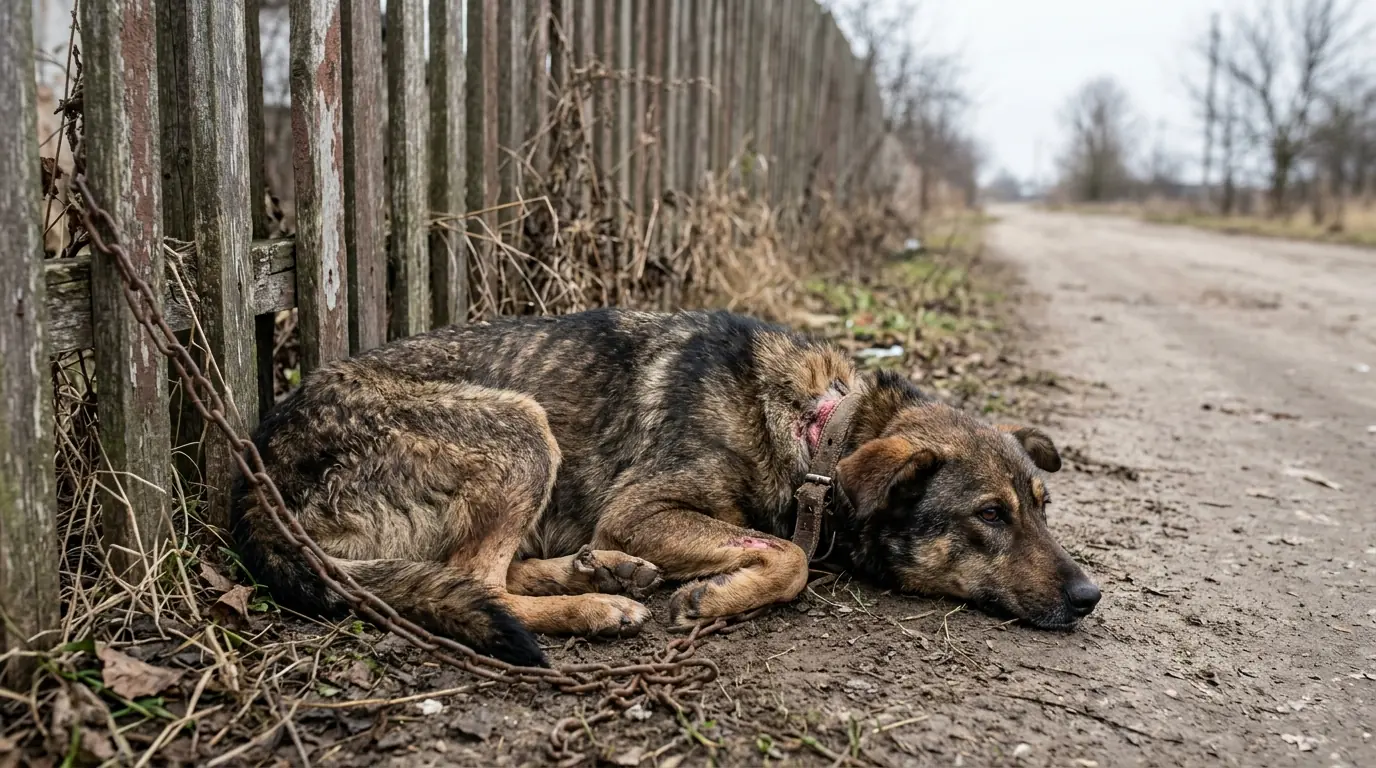
The first thing rescuers noticed wasn't how thin the dog had become.
It was the heavy steel chain still hanging from his collar.
The frightened stray lay beside an old wooden fence at the edge of a quiet country road, too exhausted to stand. Thick mud covered his body, his ribs protruded beneath his tangled coat, and his breathing was slow and shallow. Every attempt to lift his head seemed to drain the little strength he had left. The chain trailing beside him had carved away large patches of fur around his neck, leaving raw, inflamed skin that had likely been rubbing against metal for days.
It was immediately clear that this wasn't a dog born on the streets.
He had once belonged to someone.
A Rescue Team Responds
A passerby contacted a local animal rescue organization after noticing the dog lying in the same place for two consecutive days.
When volunteers arrived, they found the chain still attached to a worn metal collar. Judging by the rust on the links and the length of the chain, rescuers suspected the dog had been tethered for an extended period before either escaping or being abandoned.
The dog never attempted to run.
Instead, he remained motionless, quietly watching the rescuers approach. His gums were pale, suggesting dehydration, and his body condition score was estimated at 2 out of 9, indicating severe weight loss. Even gentle handling caused him to flinch, especially when the chain shifted against the wounds on his neck.
Because of the obvious injury to his front leg, the rescue team transported him using a rigid stretcher to prevent additional damage.
Veterinary Examination Revealed Multiple Medical Problems
At the emergency veterinary hospital, stabilization became the first priority.
An intravenous catheter was placed immediately to begin fluid therapy while blood pressure, heart rate, oxygen saturation, and body temperature were continuously monitored. His temperature was slightly below normal, consistent with prolonged exposure and poor body condition.
Once stable, veterinarians removed the heavy collar and chain.
The injuries hidden beneath were more serious than anyone expected.
A deep circumferential pressure wound surrounded much of his neck where the collar had repeatedly rubbed against the skin. In several areas, the abrasion extended through the superficial skin layers, exposing inflamed tissue underneath. Dirt and dried debris had accumulated inside the wound, creating a significant risk of bacterial infection.
Fortunately, the injury had not damaged the trachea or major blood vessels.
Diagnostic Testing Explained Why He Couldn't Walk Properly
Digital radiographs were performed on the injured front leg.
The X-rays revealed a partially healed fracture of the right radius along with extensive soft tissue swelling around the carpal joint. The fracture showed signs that it had occurred weeks earlier and had begun healing without any medical treatment, leaving the limb unstable and painful.
Additional X-rays confirmed there were no pelvic or spinal fractures.
Bloodwork revealed moderate dehydration, mild anemia, low blood protein levels caused by prolonged malnutrition, and elevated white blood cell counts consistent with an active skin infection.
A fecal examination also identified intestinal hookworms, a common parasite that likely contributed to his severe weight loss and poor body condition.
Intensive Treatment Began Immediately
The veterinary team carefully clipped away the matted fur surrounding the neck wound before flushing the injured tissue with warm sterile saline. Dead tissue was gently removed, and a specialized antimicrobial dressing was applied to reduce bacterial growth while promoting healthy healing.
Broad-spectrum intravenous antibiotics were started immediately.
Pain management combined opioid medication during the first several days with anti-inflammatory treatment after his condition stabilized. Intravenous fluids corrected dehydration, while a carefully controlled feeding program was introduced to prevent refeeding syndrome, a potentially dangerous complication that can occur when severely malnourished dogs receive large amounts of food too quickly.
Because his fractured leg remained stable, orthopedic specialists recommended conservative treatment using a custom support splint rather than surgery.
Rehabilitation Focused on Both Body and Mind
For the first week, the dog spent most of his time sleeping.
As his hydration improved and his pain became better controlled, his appetite slowly returned. Small, high-calorie meals were offered several times each day, allowing him to regain weight safely without overwhelming his digestive system.
Daily wound care became an essential part of his recovery.
The neck injury was cleaned, disinfected, and re-bandaged every 24 hours. Within two weeks, healthy granulation tissue had replaced the inflamed wound surface, and the risk of infection had decreased significantly.
Physical rehabilitation began once he could comfortably bear weight.
Veterinary rehabilitation specialists introduced controlled leash walks, balance exercises, and passive range-of-motion therapy to strengthen the injured leg while preventing joint stiffness. As the fracture continued healing, his gait became steadier with each passing week.
Learning That Not Every Human Causes Pain
Perhaps the greatest challenge wasn't physical.
Whenever anyone reached toward his neck, he instinctively lowered his head and froze, a behavior commonly seen in dogs that have experienced prolonged restraint or neglect.
The veterinary staff worked patiently to rebuild his confidence.
Treats were paired with every bandage change, soft voices replaced sudden movements, and gentle handling gradually taught him that human hands could bring comfort instead of fear.
The first time he wagged his tail, the entire rehabilitation team celebrated.
Soon afterward, he began greeting familiar caregivers at the kennel door each morning, eagerly accepting affection and resting his head against anyone willing to sit beside him.
A New Life Without Chains
Ten weeks after his rescue, follow-up X-rays confirmed that the fractured radius had healed successfully.
His neck wounds had completely closed, healthy fur had begun growing back around the previously damaged skin, and his body condition score had improved from 2/9 to 5/9 as he steadily regained muscle and weight.
Today, the frightened dog no longer wears a chain.
Instead, he wears a lightweight collar with an identification tag—a symbol not of restraint, but of safety.
Now living in foster care, he spends his days exploring secure yards, enjoying regular meals, and falling asleep on soft blankets instead of cold dirt. He continues to build confidence with every new experience and has become a gentle, affectionate companion who eagerly seeks attention from the people around him.
His recovery is a powerful reminder that while chains can leave lasting scars on the body, compassionate rescue, expert veterinary care, and patient rehabilitation can heal wounds that once seemed impossible to overcome.