"It's hopeless. We're doomed."
The engineers panicked, clutching their heads and weeping. The room fell into a deathly silence.
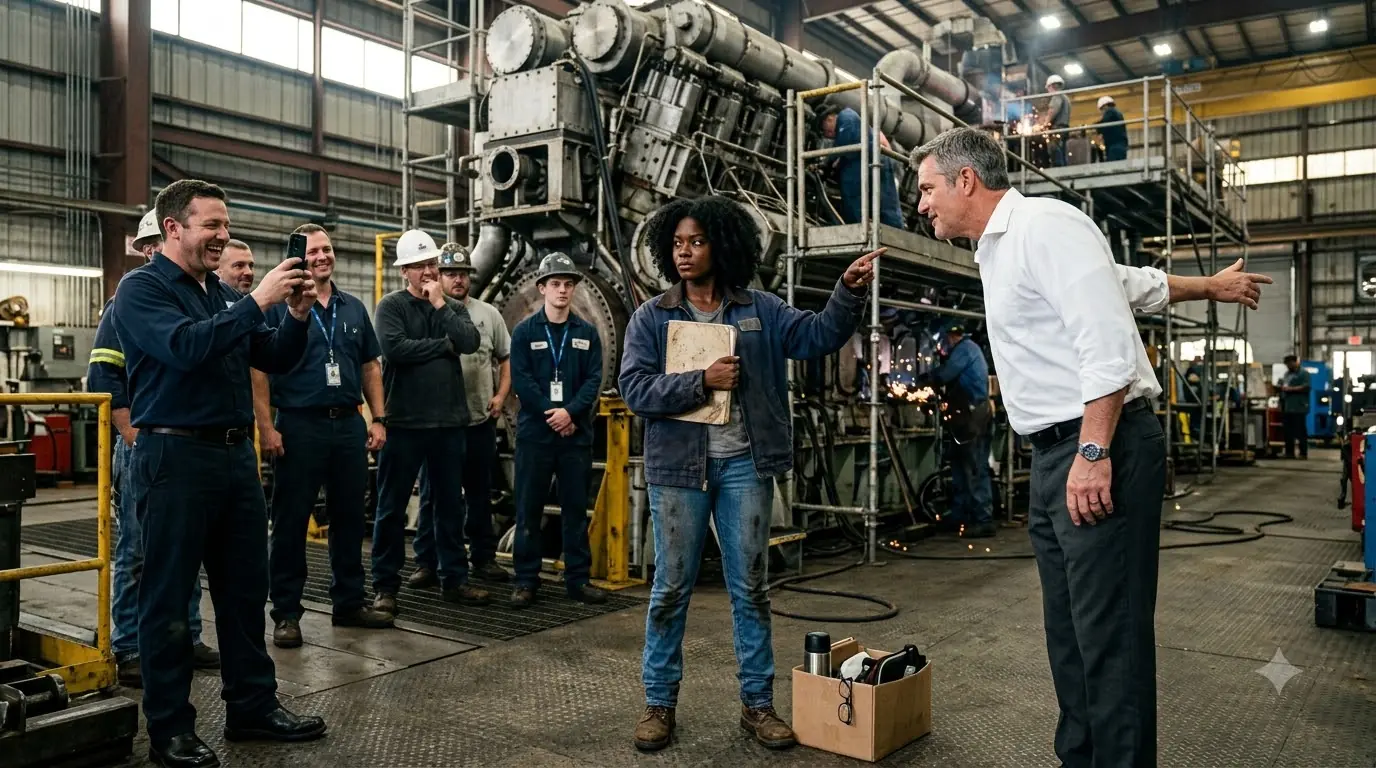
"I think I know what's wrong."
"What the hell?" Grant Whitmore turned around. "You're just a janitor's child, the kind who uses your brain for cleaning. What do you know without a mop?"
"Please, just let me try."
Laughter broke out.
"Did you drop your brains in the toilet while scrubbing? Want to make a fool of yourself? Try it." Grant's face contorted. "Let's see what your genius brain can do with a $40 million engine."
He looked at the team members. "It's hopeless anyway. Watching that idiot mess with scrap metal is fun."
But what Grant did not know was that the girl he had just called hopeless held the only key to waking the Titan.
The Hargrove Shipyard stretched along the Gulf Coast like a rusted cathedral. Sixty years of salt water and diesel smoke had darkened its steel walls. Cranes towered above the dry docks. Welding sparks fell like orange rain from the catwalks above.
For three generations, this yard had built warships, tankers, and cargo vessels for the United States Navy. Every family in Port Calloway knew someone who worked behind those gates. The shipyard was the town's heartbeat. When Hargrove thrived, the town thrived. When Hargrove bled, the town bled.
And right now, Hargrove was bleeding out.
Two contracts had been lost in the past year, and a third was on life support. Layoff rumors circled the break room like cigarette smoke. The old-timers said they could feel it coming, the same slow death that had already taken the steel mills two counties over.
The problem sat in Bay 12, a 16-cylinder marine diesel engine called the Titan V16. Twenty-eight thousand horsepower were locked inside a block of cast iron the size of a school bus. Fifteen years ago, the Titan had been the crown jewel of the yard, the most powerful engine Hargrove had ever produced and the one that put them on the Navy short list for elite contracts.
Then it died.
No warning. No explanation that satisfied anyone. One morning, the Titan seized mid-test and every attempt to revive it failed. Engineers flew in from three states. Consultants billed six figures. Nothing worked.
The Titan sat in Bay 12 like a monument to something nobody could explain.
Until three months ago, when the Navy came calling.
Commander Hayes arrived with a contract worth $40 million. A new class of patrol vessel needed an engine with the Titan's exact specifications. The Navy had tested alternatives. None matched.
The contract had one condition that made Grant Whitmore's stomach turn: restore the original Titan V16. No substitutes. No redesigns. The original engine or nothing.
Grant had spent 15 years building his reputation on the Titan's blueprints, the blueprints he claimed as his own, the ones that earned him the title of chief engineer, the ones that put his name on the brass plaque outside Bay 12.
The ones he stole from Earl Jackson.
Grant assembled his best team. Eight engineers with degrees from Georgia Tech, Virginia Tech, and MIT spent three months circling the Titan like surgeons around a patient they could not diagnose. They replaced fuel injectors. They rebuilt the turbocharger assembly. They tested every sensor, every relay, every gasket.
The Titan did not move.