He Was Still Attached to the Fence
By the time rescuers arrived, there was almost nothing left behind the rental house.
The windows were closed.
The rooms visible through the glass appeared empty.
There were no cars in the driveway and no people moving between the house and yard.
But beside the back fence, a Pit Bull mix was still there.
A tether ran from his collar to the fence.
Next to him sat a plastic bucket.
When rescuers checked it, the bottom was dry.
The dog stood as they approached.
He did not rush toward them.
He did not bark continuously or throw himself against the end of the tether.
Instead, he watched.
His body stayed slightly back from the strangers entering the yard, his weight shifting between his front feet while his eyes followed every movement.
The rescuers did not know how long he had been there.
They did not know when the last person had left the property.
They could document only what was in front of them: an empty rental house, a tethered dog, and a water container with nothing left in it.
They approached slowly.
One person turned sideways rather than walking directly toward him.
Treats were tossed within reach.
The dog sniffed the first one without eating it.
The second disappeared.
A few minutes later, he allowed a rescuer close enough to secure a slip lead before the tether was removed.
For the first time since anyone had found him, nothing connected him to that fence.
He was walked toward the rescue vehicle.
He stopped once and looked behind him.
Then he climbed in.
What happened after the vehicle began moving was the part rescuers would remember.
He Would Not Lie Down
The back of the vehicle had been prepared for transport.
There was bedding.
There was enough room for the dog to settle.
He had water available once it was safe to offer it.
After the stress of being approached, handled, untied, and loaded into an unfamiliar vehicle, rescuers expected him to eventually lower himself onto the bedding.
He did not.
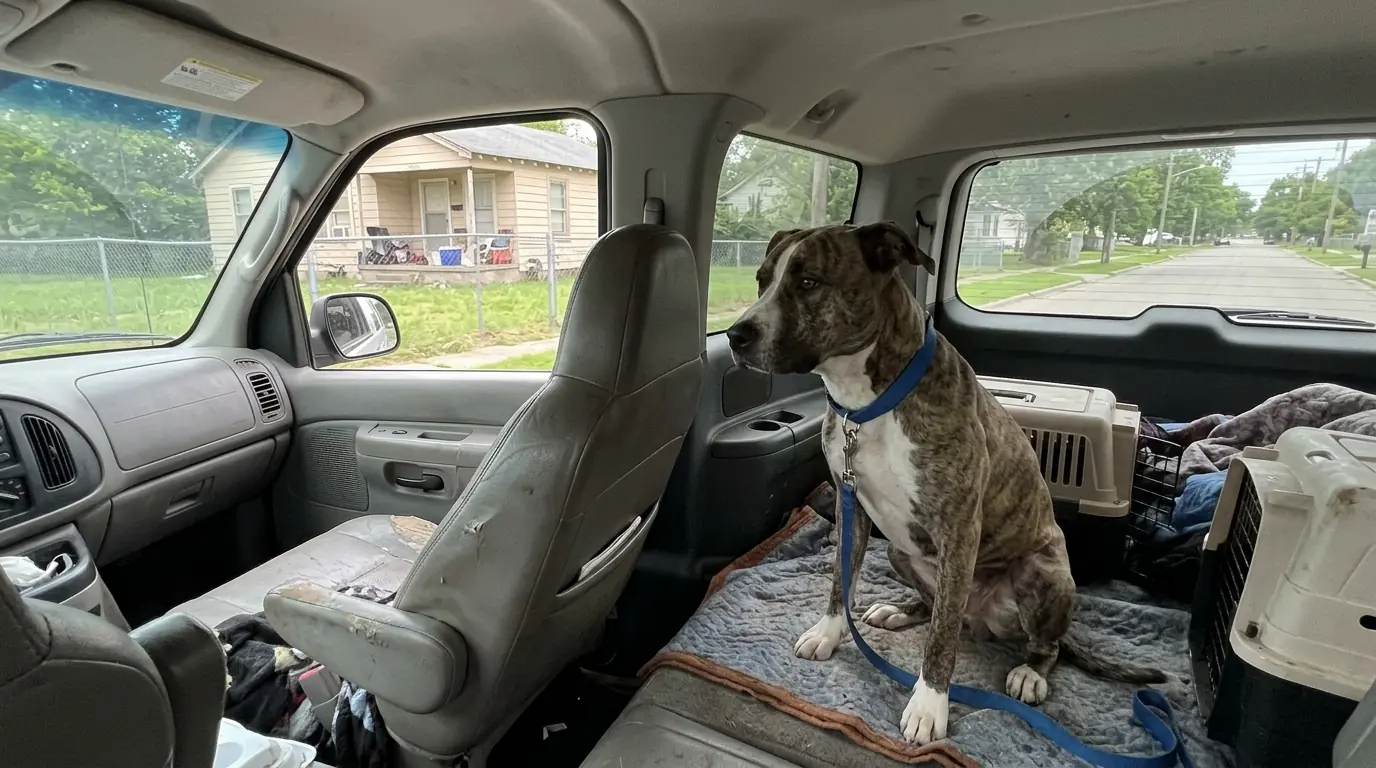
He sat close to the window.
As the vehicle pulled away, his head turned toward the house.
At the end of the street, he looked again.
Then again.
His body remained facing forward, but his neck kept twisting toward the rear.
The house became smaller.
He continued watching.
A rescuer sitting nearby did not pull him away from the glass or try to force him down.
Nobody could know what he understood about what was happening.
It would have been easy to say he was waiting for someone.
It would have been easy to say he knew he had been abandoned.
There was no way to prove either.
What they could say was that after being physically released from the property, he remained intensely oriented toward it.
Even when it was disappearing behind him.
There Were Questions Nobody Could Answer
The property manager had been contacted after the house was found vacant.
From the information available to the rescue, the tenancy had ended and the occupants were no longer living there.
The dog had not left with them.
Beyond that, the organization was careful about what it claimed publicly.
They did not know who had last fed him.
They did not know who had last filled the bucket.
They could not determine exactly how long the water had been gone.
They did not know whether someone had intended to return.
Those unanswered questions mattered legally and ethically.
Rescue organizations often encounter situations where the condition of an animal is obvious but the complete human history is not.
The dog could not provide that history.
The empty house could not either.
So the team documented what could be verified.
Photographs were taken of the tether setup and surrounding area.
The dry water container was noted.
The dog's body condition and behavior were recorded.
The appropriate local authorities were notified as required.
Then the rescue turned its attention to the part it could change immediately.
The dog in the vehicle.
His First Examination Started With Water
At intake, the Pit Bull mix was alert and ambulatory.
He could walk independently.
His gums were evaluated.
His heart and respiratory rate were checked.
His temperature was taken.
The veterinary team assessed hydration, body condition, skin, paws, ears, mouth, abdomen, joints, and the area around his neck where the tether and collar had rested.
He was thirsty.
That alone did not establish how long he had been without water, but combined with the dry bucket, it justified careful attention to hydration.
Water was offered in controlled access rather than turning the moment into a frantic event.
He drank.
He stopped.
Then returned to the bowl.
His hydration deficit appeared mild to moderate rather than immediately life-threatening.
There was no need to manufacture an emergency that was not present.
He was thin, but not profoundly emaciated.
His ribs were easier to feel than they should have been.
Muscle over his hindquarters was reduced.
The skin around his neck showed mild irritation where equipment had been resting, but there was no deep embedded collar wound.
His paw pads were dry and worn.
His coat was dusty.
None of those findings could tell staff precisely how long he had been tethered.
They told them what his body needed now.
Bloodwork Helped Establish a Baseline
Because his recent access to food and water was uncertain, the veterinary team performed baseline bloodwork and a urinalysis.
They wanted to look for evidence of significant dehydration, kidney problems, infection, anemia, electrolyte abnormalities, or other issues that could change his treatment plan.
The results were reassuring overall.
There was evidence consistent with dehydration, but no indication of acute kidney failure.
His blood sugar was stable.
He was not severely anemic.
Nothing suggested that he needed emergency surgery or intensive hospitalization.
That did not mean he was simply "fine."
His body condition needed improvement.
His skin needed monitoring.
His neck needed time without pressure from a tether.
His dental health required routine follow-up.
Most importantly, his behavior suggested that his first days in care should be quiet.
He Kept Looking at Doors
The behavior from the rescue vehicle did not disappear immediately.
During his first day in the shelter, the dog paid extraordinary attention to exits.
Whenever the kennel door opened, he stood.
Whenever someone walked toward the main hallway, he watched.
Outside for bathroom breaks, he frequently turned toward the parking area when car doors closed.
Staff did not describe that as him searching for an owner.
They could not know that.
The shelter itself was new.
Newly admitted dogs often monitor every sound and movement because they do not yet understand the environment.
But his repeated orientation toward departures was strong enough that staff documented it.
The first night, he slept very little.
He lay down briefly, then stood when footsteps passed.
He would circle once and sit near the kennel gate.
When the building became quieter, he finally lowered himself onto the bed.
Even then, his head remained upright for a long time.
Food Revealed Another Piece of His Condition
His first meals were deliberately modest.
Because he was underweight but not severely starved, he did not require an extreme refeeding protocol.
Still, staff wanted to avoid overwhelming his digestive system after an unknown feeding history.
He ate quickly.
Very quickly.
His first portion disappeared within moments.
At the next meal, staff used a slow-feeding setup.
That reduced the speed.
He remained highly focused on the food but did not show concerning aggression toward caregivers.
No one reached into his bowl unnecessarily.
Food security is not built by repeatedly taking food away to "test" a dog.
Instead, staff made meals predictable.
Food arrived on schedule.
The bowl was placed down.
He was allowed to finish.
Then the empty bowl was removed.
Within several days, he still ate enthusiastically, but the frantic edge began to soften.
The Tether Had Limited More Than His Radius
Outside, staff noticed something else.
He walked in circles.
Not constantly.
But when first brought into a larger fenced yard, he explored in an arc that looked surprisingly similar to the radius of a tether.
He would move several feet, curve around, then turn back.
The first time, it could have meant nothing.
Dogs circle for many reasons.
But the behavior appeared repeatedly during his earliest outings.
Staff wondered whether his movement pattern had been shaped by spending significant time attached to a fixed point.
They could not know how long that pattern had existed.
They did not force him out of it.
Instead, they gave him space.
A long line was used in secure areas so he could explore without pressure.
Treats were scattered beyond his usual arc.
Interesting scents were placed farther away.
Caregivers walked in gentle curves rather than pulling him straight across the yard.
Little by little, his path expanded.
Nobody Tried to Make Him Love People
The Pit Bull mix was tolerant of staff from the beginning.
That was not the same as being comfortable.
He allowed a leash to be clipped.
He accepted food.
He could be examined with patient handling.
But direct physical affection was not his first priority.
When someone sat in his kennel, he often remained several feet away.
If a hand reached toward the top of his head too quickly, he lowered his posture and shifted back.
Staff adjusted.
They stopped reaching.
They sat sideways.
They tossed treats.
They allowed him to approach.
For several days, his closest voluntary contact consisted of sniffing someone's shoes.
Then one afternoon, he sniffed a caregiver's hand.
The hand remained still.
He stepped away.
The next day, he did it again.
Trust was allowed to accumulate in small pieces.
The Window Behavior Returned During Transport
Several days after intake, the dog needed transportation to a veterinary partner for follow-up care.
Staff wondered how he would react to being inside a vehicle again.
He climbed in more easily this time.
For the first several minutes, he stood.
Then he sat beside the window.
Every time the vehicle slowed near a house or driveway, his head turned.
He watched buildings pass.
He looked behind the vehicle several times.
But there was a difference.
He did not remain upright for the entire trip.