The first time anyone in Millbrook County noticed seventeen-year-old Caleb Voss loading a rotted beehive onto the back of his father's flatbed truck, they assumed he was hauling garbage to a burn pile.
The box had been sitting beside the Detweiler barn so long that grass had grown through its bottom boards, and the gray wood came apart at one corner when Caleb lifted it.
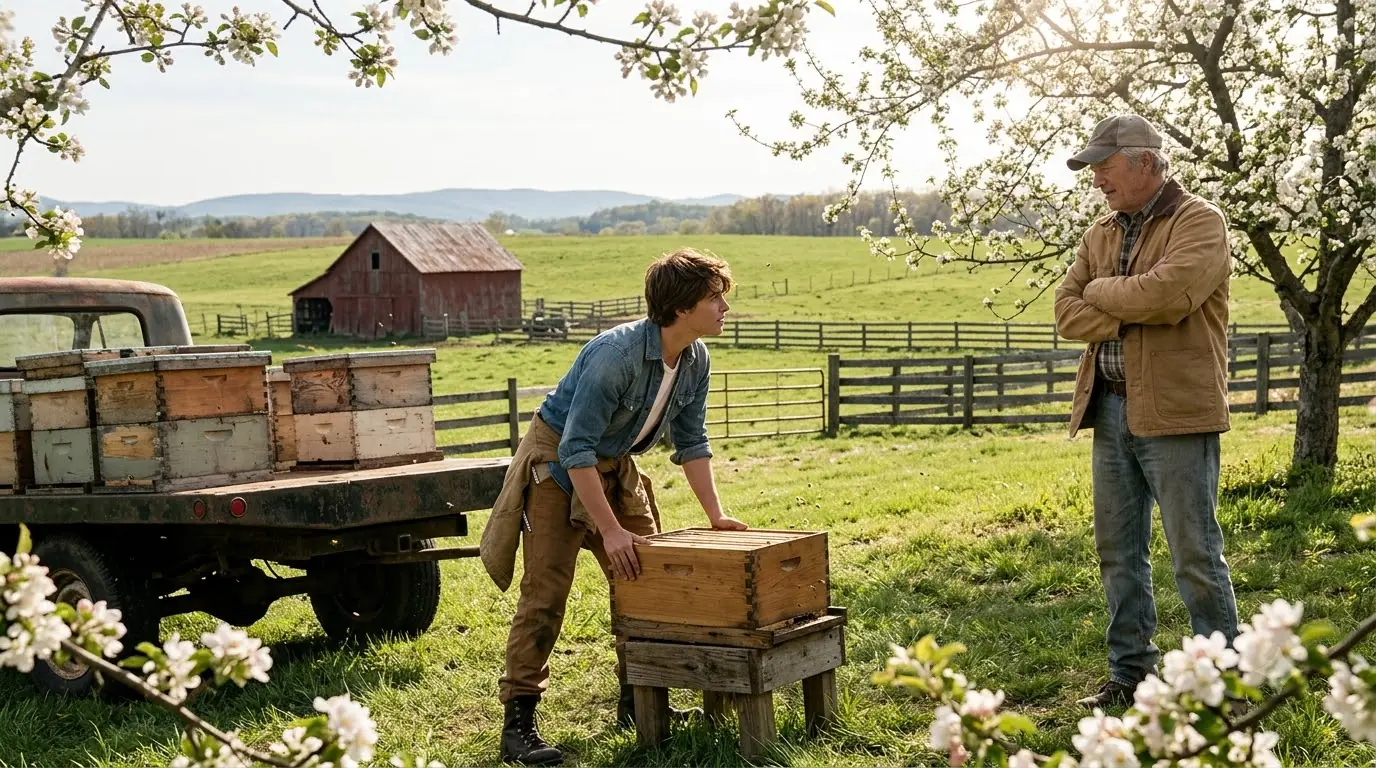
He set the broken pieces down carefully, gathered the loose frames, and asked old Arthur Detweiler whether there had been anything unusual about the bees before they disappeared. Detweiler looked at the boy as if he'd asked whether the dead cow buried beyond the pasture might still be milked.
"They died," the farmer said. "That's about all you need to know."
"Do you remember when?"
"Two winters ago. Maybe three. Why would you want that thing?"
Caleb glanced at the hive, its entrance choked with leaves and one side streaked dark where rainwater had run down it for years. He could have told the man about the orchard behind the farmhouse, where apple blossoms opened every spring and fewer apples appeared every fall. He could have explained the sketches in the notebook he carried against his chest, or the careful list of questions he had made after reading a book about pollinators in the school library. But he was still learning what the questions meant, and he had discovered that an unfinished explanation was an invitation for other people to finish it badly.
"I'm trying something," he said.
Detweiler made a sound halfway between a laugh and a cough. "Well, you're welcome to try it with my junk. Take the stack behind the grain shed too, if you can carry it."
Caleb thanked him, though the older man had already turned away, and went back to work. When he finished, there were five hive bodies, a shallow super, and a heap of warped frames in the truck, all secured with an old yellow ratchet strap. Two of the boxes would later prove too damaged to use. Another would have to be discarded because its history and condition made it an unacceptable risk for living bees. At that moment Caleb knew none of this; he knew only that someone had given him a chance to examine what everyone else considered a loss.
By the time he had asked at a fourth farm and then a fifth, people began noticing that the discarded equipment was not going to the burn pile at all. It was going behind the equipment shed on the Voss property, where Caleb had cleared a rectangle of ground and laid salvaged pallets beneath the stacks. A week later there were twenty-three boxes. When the last snow melted from Miller's Ridge, there were more than forty, arranged in rows under mismatched sheets of roofing metal like a small abandoned village waiting for its residents to return.
It was an odd sight even in a county accustomed to odd projects. Millbrook County sat in a shallow valley two hours from the nearest interstate, a place of dairy herds, hay fields, gravel lanes and apple orchards that occupied the sunny slopes above the creek. The families living there had