At six o’clock on a Tuesday morning in rural Nebraska, eight-year-old Maisie Callaway was standing beside the Henderson family’s trash barrel with both arms buried almost to her shoulders.
She was not looking for food.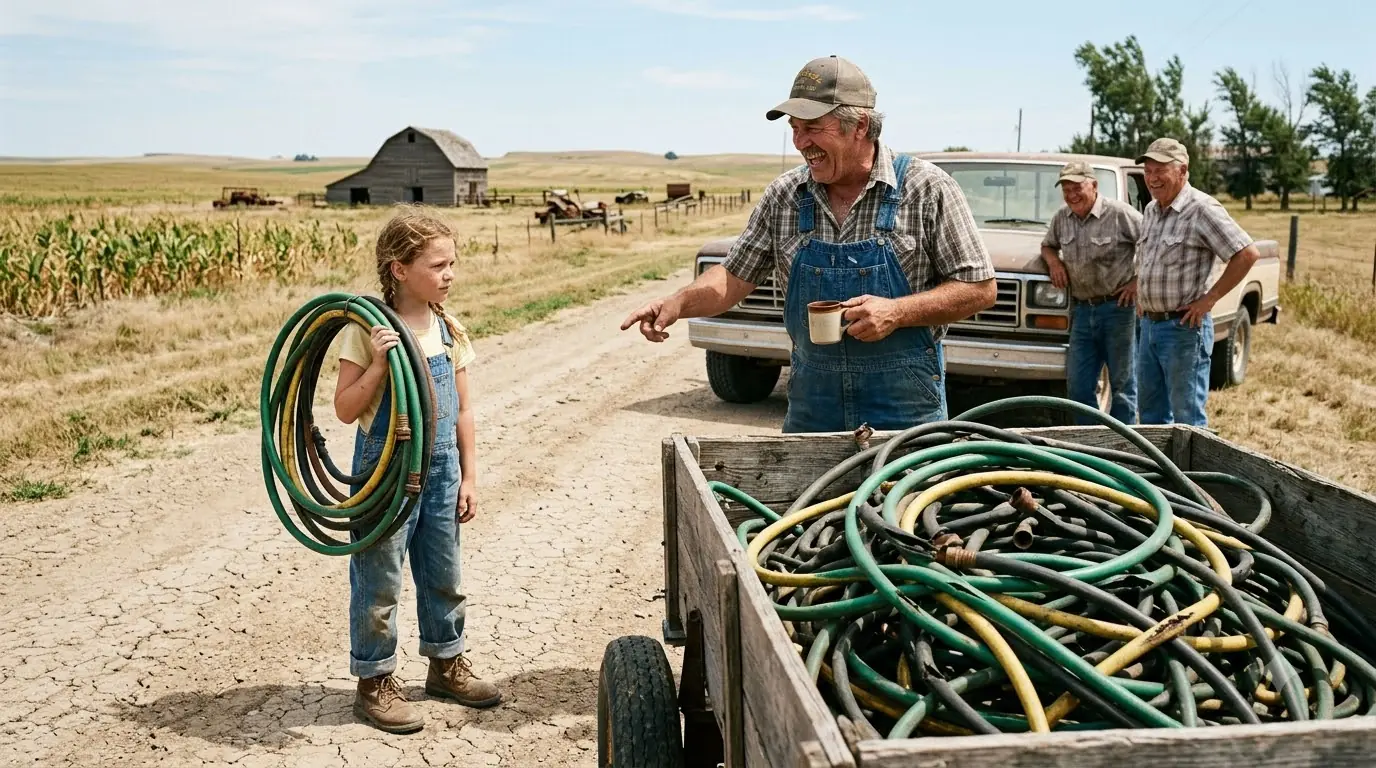
She was not collecting aluminum cans.
She was not searching for toys someone had thrown away.
She was trying to pull out a cracked green garden hose.
The hose had been folded into the trash so tightly that it fought her every time she tugged.
Maisie planted both sneakers against the gravel beside the barrel, leaned backward, and pulled again.
The hose came free suddenly.
She nearly fell.
A metal coupling struck the ground with a sharp clank.
Maisie picked it up, inspected the split rubber running along one side, then began coiling the hose over her shoulder.
That was when Henry Henderson opened his front door.
He was wearing a bathrobe and holding a coffee mug.
For several seconds, he simply watched.
“Maisie?”
She stopped.
“Yes, sir?”
“You want that old thing?”
She looked at the hose.
“Yes, sir.”
Henry came farther onto the porch.
“That hose is split down the middle.”
“I know.”
“It leaks everywhere.”
“I know.”
“I ran over part of it with the mower last summer.”
Maisie looked down at a flattened section.
“I saw that.”
Henry frowned.
“Then what in the world do you want it for?”
Maisie adjusted the coil on her shoulder.
“I need it.”
“For what?”
She thought for a moment.
Then said:
“I’m not sure it works yet.”
Henry laughed.
Not cruelly.
The confused laugh adults often gave children when the child was obviously serious about something that made no sense.
“Well, if you can make that thing useful, you’re welcome to it.”
“Thank you.”
She walked away.
Henry watched until she disappeared around the corner.
By breakfast, he had told his wife.
By lunch, she had told Mrs. Pruitt.
By evening, the story had traveled farther than Maisie had.
The Callaway girl was collecting garbage.
The next morning she brought home another hose.
Then another.
One was yellow and brittle from years of sunlight.
Another had three pinholes and no connector on one end.
Old man Webber gave her a fifty-foot hose he had accidentally driven over with his tractor.
The hose was crushed near the middle and pierced in at least six places.
“You sure, honey?”
“Yes, sir.”
“You know this won’t hold pressure.”
“I know.”
Webber scratched his white beard.
“What are you doing with them?”
Maisie smiled.
“I’m testing something.”
“What?”
“I’ll tell you if it works.”
Webber laughed.
“Fair enough.”
By Friday, eleven broken garden hoses were stacked behind the Callaway barn.
That was when Maisie’s older brother decided he had seen enough.
Tucker Callaway was sixteen.
He had the permanent expression of someone who believed the world would operate much more efficiently if people would simply answer questions directly.
He found Maisie behind the chicken coop carrying a red hose with a missing nozzle.
“You know everybody thinks you’ve lost your mind.”
Maisie kept walking.
“Mrs. Pruitt called you a strange little collector.”
Maisie shrugged.
Tucker followed.
“Seriously.”
Nothing.
“What are you doing?”
“Working.”
“On what?”
Maisie stopped.
She looked at him.
Then at the hose.
Then back at him.
“The part nobody noticed.”
Tucker stared.
“What does that mean?”
Maisie walked away.
“That is not an answer!”
“It’s the answer I have.”
Tucker watched her disappear behind the barn.
Then muttered:
“You’re weird.”
From behind the barn, Maisie called:
“I heard that.”
“Good.”
By Sunday, half the church seemed to know.
Three women stood near the coffee urn after the service.
Maisie was only ten feet away helping her mother stack paper cups.
The women clearly believed she could not hear them.
“She has Webber’s hose too.”
“The one he ran over?”
“That one.”
“Bless her heart.”
They tried not to laugh.
Failed.
“What could an eight-year-old possibly do with eleven broken hoses?”
Maisie kept stacking cups.
Her mother, Renata Callaway, heard them too.
She glanced toward her daughter.
Maisie’s face did not change.