The private runway shimmered beneath the noon heat.
Beyond the chain-link perimeter fence, the desert-colored grass had turned almost white beneath the sun.
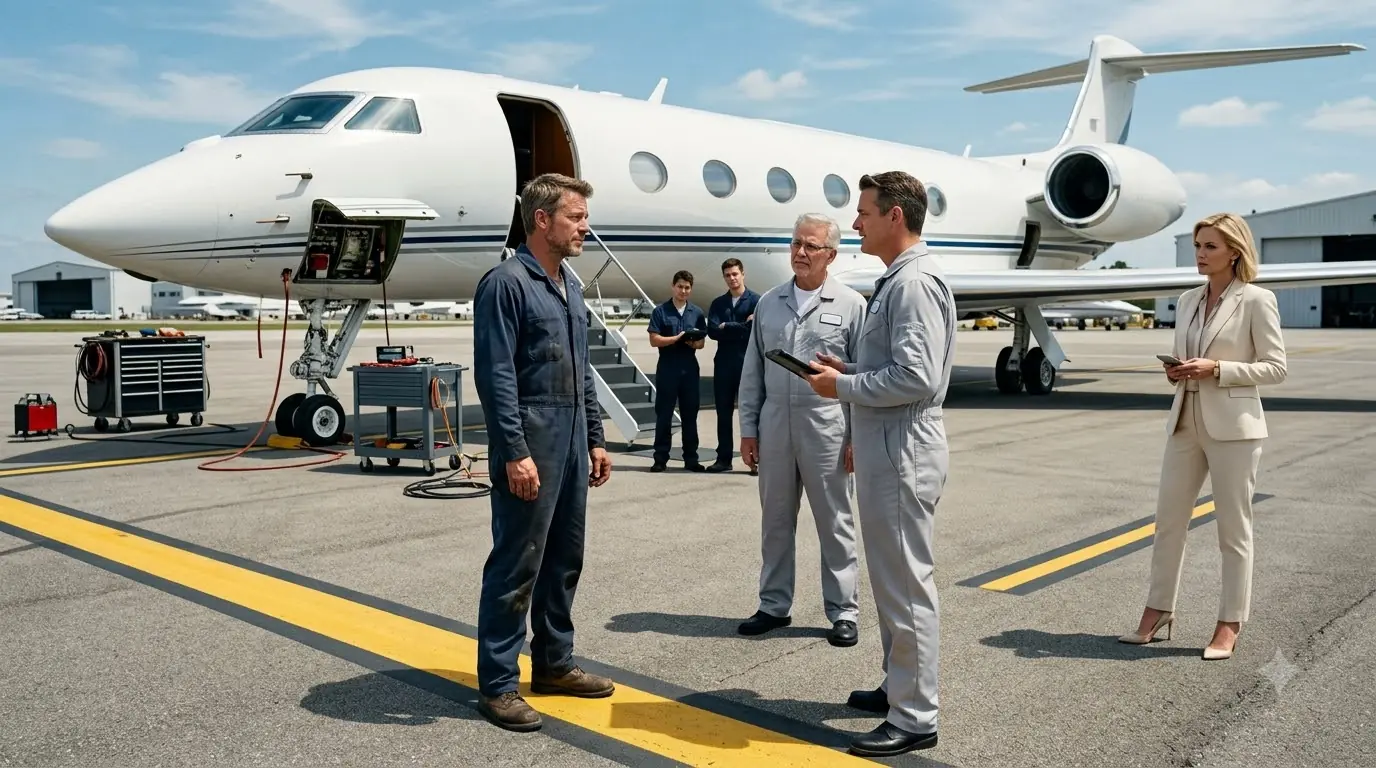
The asphalt looked soft in the distance, bending beneath waves of rising air, while service trucks moved between hangars with their yellow beacons flashing lazily against a sky so clear it seemed almost artificial.
At the center of the ramp sat a Gulfstream G650.
White fuselage.
Dark blue stripe.
Polished wings reflecting the sunlight.
Nearly sixty million dollars of aircraft standing completely motionless.
The boarding stairs remained down.
The cabin door stood open.
The pilot had already attempted the startup sequence three times.
Nothing.
The auxiliary power unit tried to come online, stumbled through part of its cycle, and dropped out again before producing stable power.
The lead engineer, Richard Hanley, stood beneath the tail with a diagnostic tablet in one hand and a headset hanging around his neck.
He shook his head.
“Again.”
Captain Daniel Reeves, visible through the cockpit windshield, reset the system.
A warning disappeared.
Another came back.
Richard watched the data scroll.
The APU attempted another start.
A faint whine rose beneath the tail.
It climbed.
Hesitated.
Then stopped.
Richard swore under his breath.
Inside the cockpit, Daniel leaned back and removed his headset.
On the ramp below, Evelyn Cross checked her watch.
She was forty-six, tall, elegant, and dressed in a charcoal-gray suit that seemed untouched by the heat despite everyone else on the tarmac already sweating through their shirts.
Her dark blonde hair had been pulled into a precise knot.
A leather briefcase rested beside the stairs.
An assistant stood several yards away holding two phones.
Evelyn Cross was not merely wealthy.
She belonged to the category of wealth that caused rooms to rearrange themselves before she entered them.
Her investment group controlled manufacturing companies, logistics firms, commercial property portfolios, and enough voting shares in several corporations that business reporters had given her the nickname the Quiet Knife.
She rarely raised her voice.
She did not need to.
If Evelyn Cross told a company to improve by Friday, people stayed awake until Friday.
If she said a meeting mattered, private jets were supposed to start.
This one had not.
“How long?”
Richard Hanley looked toward her.
“I don’t know yet.”
“That is not an answer.”
“We’re still isolating the fault.”
“You have been isolating it for fifty-two minutes.”
Richard glanced at the tablet.
“We’re seeing conflicting data.”
“I do not need the biography of the problem, Mr. Hanley. I need a departure time.”
He swallowed.
“We may need Gulfstream field support.”
“How long?”
“Best case, three to four hours.”
Evelyn stared at him.
Richard continued because silence felt worse.
“If they have someone available locally.”
“And if they do not?”
“Tomorrow morning.”
Evelyn looked toward her assistant.
“My meeting?”
“Denver board session begins in two hours and forty-seven minutes.”
“Video?”
“The board chairman says the acquisition vote requires in-person attendance under the amended governance agreement.”
Evelyn’s jaw tightened.
The meeting involved a medical-equipment manufacturer her firm had been negotiating to acquire for eleven months.
Eight thousand employees.
Four countries.
A purchase price approaching four billion dollars.
She had personally spent three weeks preventing the company from being broken apart by a competing bidder.
She was not missing that vote because a new aircraft refused to start.
Richard turned back toward the jet.
“Let’s run the fuel controller check again.”
Two engineers moved closer.
A third opened a panel.
Tablets appeared.
Headsets went on.
Everyone began talking in the technical shorthand of people who wanted desperately to sound like they were moving toward an answer.
At the edge of the ramp, behind a painted yellow line, Lucas Meyer stopped carrying a cardboard box.
He had been walking from the supply shed toward Hangar Four when he heard the failed start.
Not the first failed start.
The fourth.
He stood in the sun with the box balanced against his hip and listened.
Lucas was forty-two years old.
Six feet tall.
Broad through the shoulders without being particularly muscular.
Brown hair beginning to gray above his ears.
A face that always looked a little more tired than his age suggested.
He wore a navy maintenance shirt faded almost to blue-gray and work pants with an old grease stain along the left thigh that no amount of washing had ever removed.
The shirt had once carried embroidered company patches above both pockets.
Those patches had been cut off five years earlier.
The faint rectangular shadows remained.
His boots were six years old.
The soles had been replaced twice.
One lace had been knotted where it had snapped.
Lucas could have afforded new boots eventually.
But eventually always arrived behind rent, groceries, school expenses, electricity, health insurance, and the hundreds of small costs involved in raising a ten-year-old boy alone.
He lowered the box onto a service cart.
The aircraft attempted another start.
Lucas tilted his head.
The APU spool rose.
A faint metallic tremor appeared beneath the clean turbine whine.
Almost nothing.
Half a beat.