"You there. The little girl in the back. Come up here."
Chase Hendricks did not need to raise his voice to make five hundred people turn their heads, but he raised it anyway.
It rolled through the Orpheum Theatre in downtown Los Angeles, bounced off the ornate ceiling, and reached the final row where twenty children from Jefferson Elementary School stood in white shirts and black trousers or skirts.
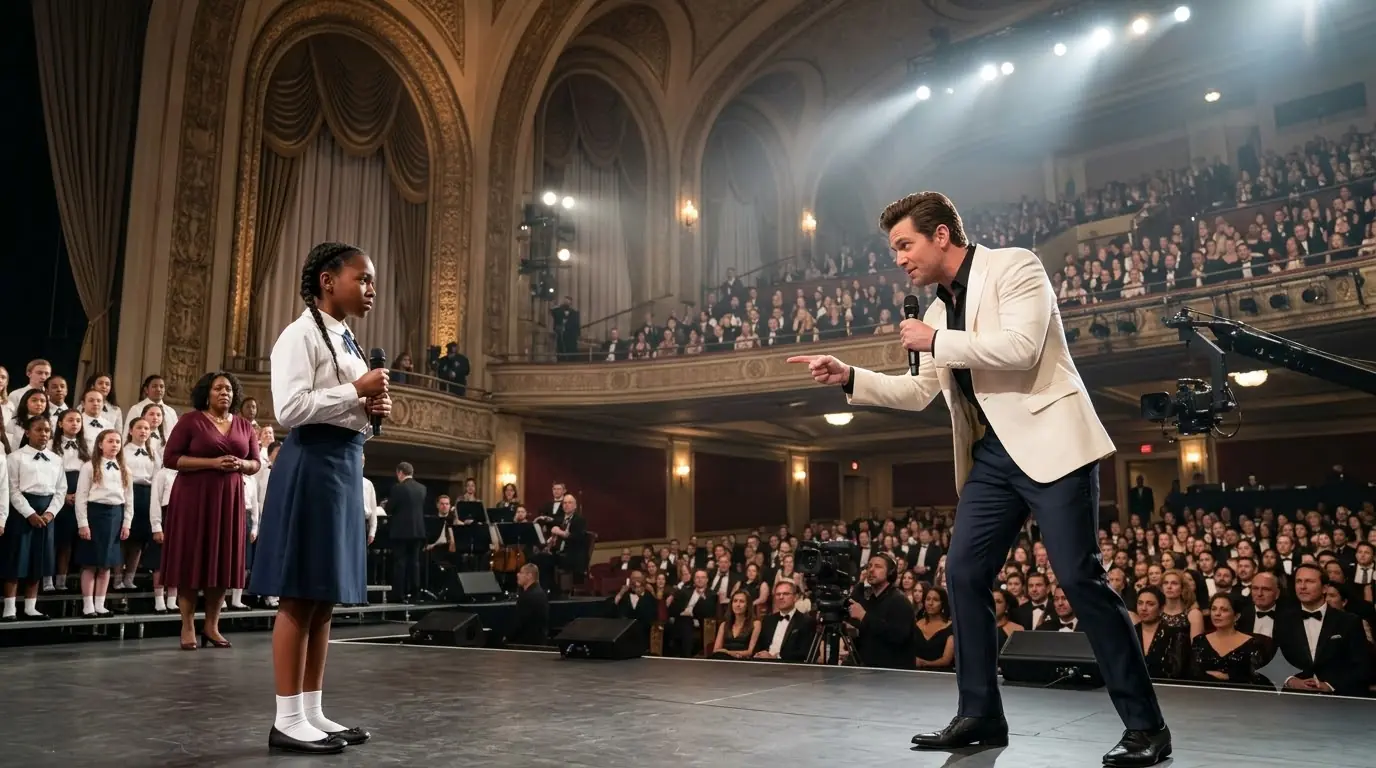
For one confused second, eleven-year-old Zara Williams thought he meant somebody behind her. Then Chase lifted one manicured finger and pointed straight at her face.
"The one with the cheap uniform," he said, smiling as though he had made a delightful joke. "Yes, you. Don't hide."
The livestream counter in the production booth had passed two million viewers a few minutes earlier. In the theater, donors in evening clothes leaned sideways to see what had caught the attention of the famous singer whose name dominated every advertisement for the charity gala. Zara felt the heat rising beneath the collar of the white blouse her mother had purchased from a discount store that morning. She had spent the past hour trying to make herself invisible, and now every camera in the room seemed to be finding her.
"I'm sorry, sir," she said. Her voice barely traveled beyond the choir riser. "I didn't mean anything."
"Then you won't mind coming up here and showing everybody what you can do." Chase walked toward the steps leading to the children's risers, his gleaming microphone held casually in one hand. When Zara did not move quickly enough, he reached for her shoulder and guided her toward the center of the stage with enough force to make her stumble. The audience murmured, uncertain whether this was part of the entertainment. Chase kept smiling, because a man could disguise a great deal of cruelty as friendliness when the cameras were already rolling.
Ms. Anita Johnson, the choir director, rose from her position beside the accompanist. "Mr. Hendricks, perhaps we could let the children finish their scheduled number first," she said. Her words disappeared beneath the opening applause Chase had encouraged with a gesture. Zara glanced backward and caught her teacher's worried expression before a spotlight erased everything beyond the first few rows.
"Let's see whether you can actually sing or whether you're taking up room," Chase announced. He turned toward the band and snapped his fingers. "Higher Ground. Give her my bridge."
The musicians looked toward the sound booth. Zara knew the song, as nearly everyone in America knew it, because its final rising phrase had become the signature of Chase Hendricks's career. It was the same high note journalists described as impossible, the one fans paid hundreds of dollars to hear him hold at the end of every concert. She also knew something the people applauding did not. She had heard him try to sing that note without help only four hours earlier.
Chase leaned closer, covering the head of his own microphone with his palm. He thought his words would be private, but Zara's microphone remained live at her side, and a small green light shone on its body. "Fail quietly, kid," he whispered. "You'll embarrass yourself enough without making a speech about it."