The village of Ashkam had not seen a duke in living memory, and it did not quite know what to do with one.
It had managed admirably over the years with second sons, with the occasional baronet, with a colonel who had returned from the peninsula with one arm and excellent manners. But a duke, with his title and his carriage, and his three outriders, who looked as though they had never once been surprised by anything, was a different matter entirely.
The village watched him arrive on a Tuesday in October and talked of nothing else until Thursday when Mrs. Hartwell's chimney caught fire and gave them something more immediate to discuss. By Friday, however, they were back to the Duke.
His name was Edmund Ashford, and he was the fifth Duke of Caendale, and he had come to Ashkam for reasons that were, depending on who you asked, either perfectly sensible or deeply suspicious. He had a small property here, nothing grand, a manor house with 20 rooms and good farmland, and a name nobody in London would have recognized, and he had chosen it, so his solicitor, Mr. Payne, had explained to the relevant parties as the location for his marriage.
The relevant parties were the family of Miss Cesily Halt. Mr. Payne had presented himself at Holt House on a Thursday morning in September, asked for Mrs. Halt and explained with the careful precise diction of a man who understood that what he was saying was unusual and intended to convey it without appearing to that his grace the Duke of Caendale wished to propose terms of marriage to Miss Halt, eldest daughter of the late Reverend Halt, and that the settlement proposed was set out in the documents he had taken the liberty of bringing with him.
Mrs. Halt had needed to sit down. Cesily had not needed to sit down. She had read the settlement twice, asked three questions about the jointure, about the covenant proposed for her mother and sister, about the legal standing of the latter, which Mr. Payne confirmed was unusual, but binding, and said she would give her answer in the morning.
Her answer in the morning was yes. She had not said yes because she was in love with the Duke. She had met him twice, once the previous spring at the home of their mutual acquaintance, Lady Foresight, where they had been properly introduced, and subsequently talked for 20 minutes about the political situation.
He had asked her view on the parliamentary reform question with the directness of a man who expected an actual answer, and she had given him one, and he had disagreed with two thirds of it with equal directness, and she had found this so unexpectedly pleasant that she had forgotten to be strategic about the impression she was making.
The second time was at a county dinner where he had sat beside her and said almost nothing, but had listened to everything with the quality of attention that some people spend their whole lives performing, and he appeared simply to have. She had found him striking in the way that very contained people are striking.
You could not tell looking at him what was happening underneath, and that either intrigued you or unnerved you. It had intrigued Cesily, which she recognized even then as information about herself. She had said yes because the settlement was just, because her mother would stop lying awake at night, because the Duke had not seemed in either of their meetings like a man who would make her miserable, and because, if she was honest, and Cesily was relentlessly honest with herself, she was tired of managing alone.
She had not told anyone that last part. It was not the sort of thing she said. The wedding was quiet in the church at the top of Ashkam's single significant street on a morning in November when the light came in low and pale through the east window and made everything look like an engraving.
Jane cried. Their mother held herself together with the particular rigidity of a woman who would cry later in private with great thoroughness. Edmund Ashford stood at the altar with the stillness of a man who had stood at attention in more demanding situations than this, and said his vows in a clear, even voice that carried to the back pews. 
Cesily said hers and meant them, which he had decided beforehand was the only dignified way to approach the matter. The breakfast afterward was at Holt House, too small for the occasion, and full of neighbors who kept asking the Duke questions about London that he answered with minimum words and maximum courtesy.
Cesily watched him from across the room and noticed that he was not uncomfortable precisely. He simply existed at a slight remove from everything, as though there were a pane of glass between him and the proceedings that he had installed himself and was not yet sure how to remove.
She was standing at the bookcase, not reading, only standing the way she always did when she needed somewhere to be, when he crossed the room to her. She had a volume of Hannah More's "Coelebs in Search of a Wife" in her hand, which she had picked up without thinking, and which she now felt the slight absurdity of holding on her wedding day.
"I believe I have read that," he said without preamble. "It is not very good," she said. "No."
He looked at it briefly. "More is better when she is arguing than when she is instructing." "That is true of most people," Cesily said.
He almost smiled. She cataloged this immediately because it seemed like the kind of thing worth cataloging, a slight compression at one corner of his mouth, gone before it fully arrived. They found a corner of the room that was not occupied by neighbors or her mother's hospitality, and he spoke with the same directness he had applied to the parliamentary question at Lady Foresight's.
No preamble, no softening. The marriage was, he said, a practical arrangement. He needed a wife who was not ornamental, who could manage an estate, who would not require him to perform emotions he did not have time for.
He had obligations that were significant and constant, and would frequently take precedence. He would not pretend otherwise. Cesily let him finish.
She had the discipline trained by years of reading arguments she disagreed with, to let a thing be fully said before responding to it. And in return, she asked, "The settlement, security for your family, the covenant is binding. I want you to be certain of that. Access to the Caendale library, which is considerable."
A brief pause. "And I will not interfere with your thinking." "You say that as though it is a concession," she said.
"Some men would consider it one." "Then I am glad I am not marrying some men."
He nodded once. The manner of a man who has reached a conclusion. And then because she was Cesily and she had been carrying the question since Mr. Payne's visit, she asked it.
There is the matter of succession, she said. It was not comfortable to say, and she said it anyway, because discomfort was not a reason to avoid precision.
He met this without flinching. It is a consideration. I will not pretend otherwise.
He looked at her steadily. I will not, however, reduce this marriage to that consideration. What happens between us will be, I hope, a matter of time and mutual accord, not obligation.
It was more honestly said than she had expected. She filed it accordingly. You could have married someone with connections, she said.
Someone useful to your position. Yes. Why didn't you?
He was quiet long enough that she thought he might not answer. Then because I needed someone who would not mistake the arrangement for something it isn't.
She understood, or she thought she did. She carried that understanding into the carriage and into the marriage and into Caendale, where she arranged her books on a shelf in the sitting room she claimed as her own.
She placed her copy of Wollstonecraft's "Vindication" at eye level, her private reading, not for drawing rooms, but hers, and told herself she knew exactly where she stood. She was wrong, but she would not know that for some time.
Caendale Manor sat at the end of a long elm-lined drive that made it look more impressive on arrival than it perhaps warranted and rather more melancholy in November than it likely appeared in June. It was a house that had been well-managed and not in some time much loved.
Cesily could see that within the first hour. The rooms were clean and correct and had the quality of spaces arranged for function rather than habitation. Good portraits, cold fireplaces, and a housekeeper, Mrs. Webb, who showed her around with the weariness of a woman not yet sure whether to be relieved or threatened by the new duchess.
Cesily thanked her with enough specificity that Mrs. Webb departed slightly less weary. Edmund showed her the library himself, which he had not expected.
It was on the ground floor, south-facing, and in the low November light, it had a warmth the rest of the house did not. Two walls of shelves from floor to ceiling, a reading desk by the window, a fireplace that had been recently cleaned.
"It was my father's," he said from the doorway. He did not come in.
He used it considerably more than I have. What did he read? History, law, agricultural improvement, a pause.
He was not a man who read for pleasure. Are you? He looked at the shelves.
I used to be. She wanted to ask what had changed. She did not because it was their first day in the house.
She was not going to spend her goodwill on questions he was not yet disposed to answer. "Thank you for showing me," she said instead.
He nodded and left, and she stood alone in the library in the fading afternoon light. She chose a shelf for her own books and unpacked them that evening, placing the Wollstonecraft at eye level, and told herself this was enough.
The first month at Caendale had a careful rhythm to it. Edmund was gone by 8 each morning to the estate office or the farms or the various demands a dukedom generated regardless of season.
He returned for dinner which they took together in the smaller dining room. Her suggestion since the formal room sat 12 and felt with two people like eating inside a very large very quiet argument.
He agreed without discussion. They talked at dinner. This was not she gathered guaranteed.
He had warned her about efficiency and unavailability, and she had expected a husband who treated the dinner table as somewhere to be physically present and mentally absent. Instead, he asked her things, specific things, what she had done with the morning, what she thought of Mrs. Webb's management of the still room, whether she had ventured as far as the South Field.
He listened to her answers with the qualities she had noticed at their county dinner, completely without performing attention. She answered honestly because honesty was her only mode.
She had reorganized the still room with Mrs. Webb's reluctant cooperation. She had walked to the South Field and found the drainage inadequate.
She had spent 2 hours in the library and read 40 pages of Gibbon and disagreed with most of them. Gibbon on what? He asked. 
The decline. He is too willing to reduce everything to failures of character.
He underestimates structure. And you prefer structural explanations. I prefer accurate ones.
He looked at her across the candles. That is not the same thing. No, she conceded, but it is closer.
He almost smiled, the second kind, brief gone before it arrived, and she had not yet decided what it meant. She did not think about it afterward, or she tried not to.
December brought neighbors. Ashkam's small society had exercised considerable restraint, three full weeks, before concluding that the new duchess had settled sufficiently, and that calls were now not only acceptable, but practically overdue.
They arrived in the pattern Cesily recognized from years as a clergyman's daughter, the most important first, the merely curious second, the genuinely friendly last. Lady Foresight came on a Wednesday, which was correct.
She was 60, sharp, and had the kind of face that had been handsome so long it had calcified into authority. She sat in Cesily's sitting room and looked at the bookshelves with the expression of someone whose suspicions had been confirmed.
"You've made it a study," she said. "I've made it liveable," Cesily said. "Same thing for you."
She accepted her tea. How is he? Cesily understood the question was not social. Occupied, she said.
He is always occupied. Lady Foresight looked at her directly. That is not an answer.
It is the accurate one. Cesily, she set down her cup. I have known Edmund Ashford since he was 19 years old, and his father was dying, and he stood in that estate office, and did not flinch once.
I have watched him manage everything placed in front of him with extraordinary competence and almost no visible cost to himself. A pause. I introduced you to him because I thought you were the one person in this county who might refuse to take him at face value.
The arrangement is clear, Cesily said. We both understood it. Did you?
He was explicit. Edmund is always explicit. That does not mean he is complete.
Lady Foresight stood. Come to dinner on Thursday. Bring him if he can be extracted. After she left, Cesily sat for a moment with her hands around her cup and looked at the Wollstonecraft on the shelf and thought about the word complete.
She put the thought away. It was not useful. The snow came the second week of December, early for that part of the country, and inconvenienced everyone except Cesily, who found it clarifying.
The county roads became briefly impossible. Calls were suspended and Caendale contracted to itself, the house, the staff, the two of them.
They developed, without planning it, a habit of the library. It began practically. The library was warmest in the afternoon, south facing, and they both found themselves there around 3:00 with no particular coordination.
The first time it happened, they acknowledged it with the careful neutrality of two self-possessed people avoiding making anything of nothing. He took the chair at the reading desk. She took the window seat.
They read. They did not talk. She found after an hour that it was entirely comfortable.
The second afternoon he looked up from his estate correspondence. He read it in the library, which she found both practical and faintly melancholy, as though he could only permit himself to be in the room on a pretext, and said without ceremony, "What are you reading?"
She held up the book, not the Wollstonecraft, that she kept for evenings in her sitting room private. This was Astell's "A Serious Proposal to the Ladies" which she had found on the lower shelves that morning.
"I didn't know you had this," she said. "My mother's, I believe. She left a number of things. Have you read it?"
No. She argues that women's apparent inferiority is entirely the result of their want of education. Cesily looked up from the page.
She is somewhat undermined by then arguing that women should use this education chiefly to improve their virtue. Do you disagree with her conclusion? I disagree with her ceiling.
She fought for the right to build a mind and then told women to use it to become better wives. A pause.
That is a rather good image. I know, she said, and went back to reading.
The third afternoon, he said without looking up from his papers. There is a first edition of the Wollstonecraft in the collection if you are interested.
She looked at him. He had not looked up. Which Wollstonecraft? The Vindication. 1792.
My father acquired it. I don't believe he read it. She went to the shelves and found it.
He had told her the section without being asked, which meant he knew where it was, which meant he had looked. It was a first edition.
The spine slightly faded, the pages uncut in places. She held it carefully.
She put it back and returned to her window seat and did not say what she was thinking. What she was thinking was that he noticed more than he showed.
She had suspected this. Now she was certain. The question was what to do with the certainty, and the answer she arrived at after a week of careful, honest thinking, was nothing.
The arrangement had been named. She had accepted it clearly. Noticing that he was more than he presented was not an argument against the arrangement.
It was simply additional information about the man she had married and she could file it accordingly and be sensible about it. She was very good at being sensible.
Christmas at Caendale brought his family. The Dowager Duchess arrived on the 22nd in a carriage considerably grander than Edmund's, which Cesily suspected was intentional.
She was 63, lean, elegant, and had the quality of a woman who had spent 40 years ensuring rooms arranged themselves around her without visible effort. She looked at Cesily the way one looks at a piece of furniture one did not choose and is not yet sure about.
"You are smaller than I expected," the Dowager said. "You are more direct than I expected," Cesily said pleasantly.
A pause. The Dowager's mouth curved very slightly. "Edmund said you were like this."
"Did he?" "He said you were. I believe the word was precise."
She looked around the entrance hall, which Cesily had arranged with fresh greens and new lamps, because the original arrangement had been dark, and she had found it oppressive. You have changed things.
Some things not structural. No, just the things that matter.
The Dowager handed her pelisse to a footman. I suppose that is sensible.
Edmund's younger brother arrived the following day, Lord Charles Ashford, 24, with their mother's angular face and none of her containment. He shook Cesily's hand too enthusiastically and talked for 45 minutes about a horse he had recently purchased and then looked mortified and said he had been told he talked too much about horses.
So you do, Cesily said, but it is a very interesting horse. He beamed at her.
She liked him immediately. It was Charles who said it 3 days before Christmas without any sense of what he was saying.
They were in the drawing room after dinner. Edmund at the window with a glass of port. The Dowager doing embroidery.
Cesily with a book she was not reading. Charles sprawled in an armchair with the physical ease of someone who had never been required to perform correct posture.
"It's better, isn't it?" Charles said to the room in general. "Having someone here, the house was," he made a gesture rather a lot of silence before.
"It was quiet," Edmund said from the window. "That is a kind word for it," Charles looked at Cesily.
He was here alone for nearly 3 years after. Well, he caught something in the air.
Edmund had not moved, had not made a sound, but something had shifted and adjusted course. At any rate, it is better now.
Cesily looked at her book. She could feel Edmund looking at her, and she did not look up.
After well, the Dowager had returned to her embroidery with the deliberateness of a woman choosing not to add to something. Charles wore the expression of a man who had put his foot somewhere he hadn't seen until it was too late.
After what? She did not ask. That night in her room, she sat at the small desk by the window and turned after, well over in her mind like a coin she couldn't identify.
She had believed she had taken the marriage with clear eyes. She was beginning to understand that clear eyes are only useful if you have been shown the whole picture.
She had not been shown the whole picture. Whether she was owed. It was a question she went to sleep without resolving, which was unusual for her, and woke with still unanswered, which was more unusual still.
January settled over Ashkam like a sentence. The Dowager departed on the third, having surveyed Caendale with the thoroughness of a general conducting reconnaissance, and took her leave of Cesily with a look that was not warm exactly, but was reconsidered, as though she had arrived with one assessment, and was departing with something less certain.
"Are you will write to me," the Dowager said, not a question. "If you would like," Cesily said.
"I would like to know. The house is in good hands. I believe it is." A pause.
Edmund does not talk about things you may have noticed. I have. It is not, the Dowager said carefully.
Because there is nothing to say. She got into her carriage before Cesily could respond.
Charles left the same morning, ringing Cesily's hand and telling her she ought to come to London for the season, that he would personally introduce her to everyone worth knowing, and quite a few who weren't.
"I look forward to it," she said, and meant at least the first part. And then it was the two of them again, and the house and the January light, not paler than November, but thinner, as though the sky had less to offer, and knew it.
The library continued. They did not discuss continuing it. It simply persisted, the way habits do when no one objects to them.
She had begun, without quite deciding to, to talk more, not about herself. She was not by nature a person who offered her interior life as conversation, but about what she was reading.
She had found that he responded to ideas the way other men responded to anecdote, with genuine engagement, push back when he disagreed, the occasional question that required her to think harder than she had been.
He had read more than she expected. He had opinions he kept compressed until invited, then expressed with a brevity that occasionally landed with more force than elaboration would have managed.
They disagreed about Gibbon twice more, about Locke once at some length, about whether the enclosure acts were economically inevitable or a moral failure dressed as economic necessity.
The longest argument they'd had, conducted over two afternoons in the library, ending without resolution because, Cesily said, neither of them could finish without more data.
You treat every disagreement as resolvable, he said. Aren't they? No.
He looked at her steadily. Some are simply disagreements, two positions, both defensible, irreconcilable. Then what do you do with them?
Hold them, he said, and keep talking to the person who holds the other one. She looked at him.
He had returned to his papers with the manner of a man who had said something ordinary. She picked up her book.
She did not look at the Wollstonecraft, her copy on the shelf, she had claimed, but she was aware of it. It was Mrs. Webb who told her, though not on purpose.
Cesily had developed over the winter months a habit of consulting Mrs. Webb in a manner that was technically deference and functionally collaboration. The housekeeper knew everything about Caendale's management and had been making decisions without sanction for years, which had produced a woman simultaneously highly competent and quietly resentful at not being credited for it.
Cesily credited her. The relationship had improved accordingly. They were discussing the East Wing, rooms that had been closed since before Edmund's tenure and needed assessment, when Mrs. Webb said, with the careful neutrality of someone navigating near something they'd been told to leave alone.
The late Duchess's rooms, of course, have been kept ready as they were. She stopped.
Cesily let the pause sit for precisely long enough to be a question without being one. His grace was married before your grace, Mrs. Webb said, with the thoroughness of a woman who believed in completion.
The late Duchess, Lady Harriet. They were married 5 years ago. She was with us 2 years.
A fractional pause. She died. Fever. It was very sudden.
Thank you, Mrs. Webb, Cesily said. It was all she said.
She walked back to the library. She stood in the doorway. He was not there.
It was morning. And looked at the shelves and the reading desk and the chair he used and the window where the thin January light came in.
And she thought after well after Harriet three years alone in this house a first marriage that had been something real not just arrangement or the Dowager would not have navigated so carefully and Charles would not have said rather a lot of silence with that particular face.
He had been here alone for 3 years and then he had married her chosen her specifically because she would not mistake the arrangement for something it wasn't because he could not do it again.
She sat down in her chair by the window and did not open the book in her lap for a long time. She was not angry.
She checked for that first and found it absent. What she felt was more difficult, not betrayal, because he had not lied.
Exactly. He had named the arrangement. He had been precise.
He had said, "Do not mistake this." And now she understood why, and the why made the naming more deliberate than she had given him credit for, and more costly probably than she had understood.
He had protected himself. She did not blame him.
What she had not considered was whether he had also protected her, given her clear boundaries, so she would not fall into something he could not promise to sustain, whether convenience had been chosen not in coldness, but in a kind of terrible care.
She sat with this for a long time. Then she opened her book.
She did not tell him she knew. It was not information that needed acknowledgement.
It was simply the fuller picture, and she had it now, and she would file it accordingly. The problem, a small problem she told herself, a manageable one, was that filing it did not change how the library felt in the afternoon, did not change the arguments about Locke, or the almost smile, or the first edition she had put back on the shelf, because it was the correct thing to do, and she was always going to do the correct thing.
She was beginning to understand that this was perhaps its own kind of damage. February brought a thaw, which brought mud, which brought the resumption of calls and the county reactivating itself after winter, and with the county came Sir Gerald Vain.
Vain held a small baronetcy, a moderate estate in the next parish, political ambitions he made no secret of, and the specific energy of a man who had decided at some point to make himself agreeable to everyone, and had become genuinely skilled at it.
He had a new wife, recently arrived from Bath, and they called on a Thursday in February, when the drive had dried sufficiently to risk a carriage. The new Lady Vain was pleasant and nervous, and clearly uncertain how to conduct herself around a duchess.
Cesily put her at ease with practiced efficiency. Sir Gerald himself was charming, articulate, and gave Cesily the very specific feeling within 20 minutes of being assessed, not impertinently, but deliberately, the way a man measures a room before he speaks in it.
Edmund was present for the call in the way he was occasionally present for calls, there physically, contributing exactly enough, watching rather more. When Sir Gerald made a remark about the current state of the reform question, Cesily responded with more specificity than he had perhaps expected.
She saw him recalibrate. "You take an interest in politics, Duchess," he said.
"I take an interest in most things," she said. He smiled.
There was something in it that was neither impertinent nor entirely innocent. Across the room, Edmund set down his cup.
After the Vains had left, Edmund stood at the window and looked at their departing carriage with the expression he used for things he was thinking about without intending to share. Cesily collected the cups with unnecessary efficiency.
You did not like him, she said. I did not say that.
You said nothing. That was how I knew.
He turned from the window. He looked at her for a moment. He was taking a measurement.
Yes, she set the cups down. He does that.
I don't think he means harm by it. It is simply how he processes a room.
And you don't mind being processed? She minded slightly. I found it manageable.
You find most things manageable? She looked at him. There was something in how he said it.
Not criticism, but not neutral. A weight she wasn't sure how to read.
Is that a quality you object to? She asked. No.
He picked up a book from the side table. His left there yesterday which she had not moved.
It is a quality I He stopped. What I admire, he said after a pause a beat too long.
It is efficient. He left.
She stood in the sitting room with the cups and thought about that pause. She was not going to attribute meaning to a pause.
She was absolutely not going to do that. She moved the cups.
She went to the library. She took down the Wollstonecraft and read for an hour and did not think about the pause.
She thought about it the entire time. Sir Gerald returned two weeks later alone.
Lady Vain visiting her sister in Newbury with a copy of a recent pamphlet he thought would interest the duchess and a question about drainage on a shared boundary that technically required the Duke's attention.
Edmund received him in the estate office. Sir Gerald then called on Cesily in the sitting room as propriety permitted.
He was good conversation. She would not pretend otherwise.
He had read broadly, if not deeply, and held opinions firmly up to the point where she contradicted them, at which point he revised with a cheerfulness she found curious in a man who had seemed moments earlier so certain.
"You ought to come to the spring assemblies," he said near the end of his visit. "The county thinks well of you, but most have not yet seen you. You are rather shut away here."
"I am not shut away," she said pleasantly. "I am at home." Is there a difference?
Yes, one is a choice and the other is a condition. He smiled.
He was about to say something else when Edmund appeared in the doorway. He had finished with the drainage question and stood there a moment with the controlled expression of a man recalibrating the contents of a room.
Vain, he said, your grace. Sir Gerald rose smoothly and took his leave, and Cesily saw him out with the minimum of required courtesy, and returned to find Edmund standing in the sitting room, looking at nothing in particular, with an expression she had not seen on him before.
It was not neutral. He is harmless, she said.
I know that. Then what?
He was here 40 minutes, Edmund said. A call is 20.
She looked at him steadily. He is good conversation. Yes.
He picked up the pamphlet Sir Gerald had left and looked at it without reading it. He is Edmund.
He looked at her. If you have something to say, she said carefully. You can say it.
A long moment. She watched him decide. No, he said finally.
I don't. He set the pamphlet down and left.
She stood in the sitting room in the afternoon light and felt the shape of what had not been said move through the air between them. She had told herself she was sensible.
She had filed things. She had been in every sense she could measure precisely what he had asked for, capable, undemanding, present without requiring anything in return.
And she was beginning to understand, with the slow precision of a woman who understood things eventually and thoroughly, that she was not as detached as she had told herself to be.
She had not noticed exactly when it happened. Somewhere between the arguments about Gibbon and the afternoon light in the library, and the almost smile and the first edition whose location he knew without being asked, somewhere in the careful months of a man who did not perform attention, and therefore, when he gave it, made it mean something.
She had noticed. She had filed it. And filing, it turned out, was not the same as not feeling.
She sat down on the sofa alone in the room and was very still for a moment. Then she picked up the pamphlet Sir Gerald had left because she was above all things practical, and she read it and found it not very good, and set it aside, and allowed herself, for exactly as long as it took to breathe in and breathe out, to acknowledge that she was in a great deal of trouble.
Then she went to set the trouble aside, the way she always did. And found for the first time that it would not go.
March arrived with wind and the particular restlessness that comes when winter has lasted long enough to feel personal. Cesily had made a decision in February, sitting alone in the sitting room with a pamphlet she hadn't read and a feeling she couldn't file.
And the decision was this. She would not act on it.
The feeling was hers alone, and she would manage it the way she managed everything, with discipline, useful days, and a great deal of reading. She threw herself into the estate with a thoroughness that surprised even Mrs. Webb.
She reorganized the household accounts, found two places where the steward had been approximate in his arithmetic, and corrected them without drama. She called on the tenants, not required of her, and Edmund had said carefully she need not, and went anyway, because it was right, and because motion helped.
She visited old Mrs. Carol at the north end of the lane, who was 91 and largely blind, and had opinions about the previous four dukes of Caendale that she delivered without mercy. She walked every boundary of the home farm in boots unsuited to it, and came home with a thorough understanding of where the fencing needed work.
Edmund watched all of this. She knew because she had learned to feel his attention, not its presence exactly, but its quality, which was different from other people's.
Other people looked at her and saw what she was doing. He looked at her and seemed to be thinking about why.
She did not ask what he concluded. It was Lady Foresight who named it because Lady Foresight was 60 and had no patience for watching sensible people be idiots.
She came on a Tuesday in the first week of March, sat in Cesily's sitting room, drank half a cup of tea, and said, "You are working yourself into furniture."
Cesily looked up from the household ledger. I am managing the estate.
You are burying yourself in it. Lady Foresight looked at the ledger.
How are your evenings with Edmund? Adequate. Adequate.
Lady Foresight repeated. I see.
She set her cup down. What has happened? Nothing has happened.
Cesily, I have known you since you were 14 and argued with your father's curate about the epistles. Something has happened.
Outside the March wind moved through the elms. I understood the arrangement. Cesily said finally.
I believed I understood it completely. And now, now I understand it more completely, she looked at her hands.
That is all. Lady Foresight studied her with the look of someone who knows more than they are saying, and is deciding how much is useful.
He is not, she said eventually, as concluded as he appears. I know that.
Do you know why he appears so? Mrs. Webb told me about Harriet. Ah, a pause.
Then you know the shape of it, not the texture. She stood.
She had said what she came to say. He chose you, Cesily.
Edmund Ashford does not make accidental choices. He is constitutionally incapable of it.
At the door, she turned back. Ask yourself what a careful man chooses when he is done being careful.
She left. Cesily sat for a long time with the ledger open and unread and thought about careful men and the choices they make when they have been very alone for a long time and do not yet know how to stop.
The argument happened on a Thursday. It was not by any objective measure a large argument.
In a different marriage, it would not have been an argument at all. It concerned the spring assembly, a county affair organized by the local gentry committee held at the assembly rooms in the next village for which an invitation had arrived at Caendale through proper channels.
Cesily had accepted on their behalf, because accepting was correct, and she had not thought Edmund would object. He did not precisely object.
What he did was go quiet in the specific way she recognized as objection compressed into manners. You do not want to go, she said.
I did not say that. You went quiet.
I am often quiet. Not like that.
She looked at him across the dinner table. If you don't wish to go, say so, and I will decline for us both.
It is not a question of wishing, he set down his fork. Vain will be there.
Sir Gerald will be there, she said calmly, along with most of the county. He is a prominent figure on the committee.
That is not a reason to decline. I am not suggesting it is a reason.
Then what are you suggesting? He looked at her.
The candle light made his face less readable than usual, which was already not very readable. Nothing, he said.
Forgive me. We will go.
She looked at him across the table and felt something harden in her chest, not anger, but a sadness that was clean and precise. He had been about to say something.
She had felt the shape of it moving toward them, and then he had retreated into manners, and she did not know how to go in after him.
She had never known how to go in after people. It was, she understood now, exactly his problem, too.
This was perhaps the most complete disaster available to two human beings. Both the sort of person who waited for a door to open and neither knowing how to open it.
As you like, she said, they finished dinner in a quiet that was not comfortable. The assembly was on a Friday.
Four county families, a string quartet of variable quality, and the usual social machinery of a county gathering that had been starved of novelty all winter.
The rooms were well lit, and the supper adequate, and Cesily wore the dark blue silk she knew was her best color, which she had not put on without awareness of it.
Edmund handed her out of the carriage and offered his arm, and she took it, and they went in together, as they always did things, correctly, with the appearance of ease, and a silence between them that other people probably read as composure.
Sir Gerald greeted them near the door, with his customary energy, bowed correctly to Edmund, and expressed his pleasure at the Duchess, condescending to attend with the precise degree of deference a baronet owes a duchess in public.
His wife was beside him, warm and genuinely pleased to see Cesily, and drew her almost immediately into conversation about a novel she had been reading, which Cesily was grateful for.
She danced twice, once with young Mr. Fairclough, who was 17 and terrified, and once with old Mr. Pettigrew, who was 70 and not terrified, but whose dancing was an act of hope over physical reality.
Edmund did not dance. This was, she gathered, established county knowledge.
He stood near the windows with the stillness of a man entirely comfortable with his own watchfulness. She could feel him across the room.
She had stopped pretending she couldn't. Sir Gerald found her between dances and brought her a glass of lemonade with the ease of a man who had calculated that the gesture was within the limits of acceptable attention.
"You are good for the county, Duchess," he said. "They needed someone to look up to who would also argue with them."
"I don't argue with everyone," she said. You told me in February that the drainage question had a correct answer, and I had simply not found it.
I have been thinking about it since the drainage question had a correct answer. He smiled.
He lowered his voice a fraction, not conspiratorially, but with the register of a man shifting from public to semi-private. His grace watches you rather constantly.
I wonder if he knows he does it. She kept her expression pleasant.
He watches everything. It is how he manages rooms.
Sir Gerald looked at her with the assessing qualities she had noticed in February and said nothing further which was she thought the most interesting thing he had done all evening.
She moved away and stood beside Mrs. Pettigrew and discussed the comparative merits of various preserves with sincere attention for seven full minutes which was as long as it took her heart to settle.
In the carriage home the night was clear and cold and Edmund sat across from her and looked out of the window. Did you enjoy the evening? She asked.
Tolerably, he glanced at her. You tolerably, she said, the carriage moved through the dark.
The sound of the horses was even and steady, and she thought about careful men and what they choose, and about Lady Foresight's question, which she had not yet answered to her own satisfaction.
"Edmund," she said. Yes.
She had not planned what came next. She was a planner, a filer, a person who arrived at conversations prepared.
She had not prepared this one. I know about Harriet, she said.
The carriage was very quiet. Mrs. Webb, she said in January, she didn't intend to say it.
He was still in the way that was different from his usual stillness. The stillness of someone who has been moving toward a thing for a long time and has now arrived and does not yet know whether to step forward or back.
I see, he said. I am not asking for anything, she said too quickly, and she knew it.
I simply thought you should know that I know so that there is no I wanted you to know.
What do you know? He said quietly. That she was here, that she died, that you were alone for 3 years afterward.
She looked at her hands in her lap. That when you described the arrangement, you were describing protection for yourself.
I understood it. Did you? Yes.
Silence. The carriage slowed for a bend in the road.
You were reading Hannah More, he said. The first time we spoke properly at Foresight House, you had picked it up from the side table and were holding it without reading it because Lady Foresight had been talking for 20 minutes, and you were being too polite to redirect her.
She stared at him. You remember that? I remember all of it.
He looked at her steadily across the dark carriage. The parliamentary question, the way you listened before you answered, the fact that you disagreed with two thirds of what I said and were not in the least concerned about it.
That is not you remember what book I was holding. I noticed things, he said.
I have noticed most things about you since Foresight House. He turned back to the window.
It has been inconvenient. She sat with this Edmund.
He looked at her. The arrangement, she said.
You said it was less than You stopped. Less than what?
He looked at her across the dark carriage. Less than what? She said again, and her voice was very steady.
The carriage pulled up at Caendale before he answered. She did not go to the library the next morning.
She went to her sitting room and sat with her books and did not read them and thought about the carriage and the sentence he had not finished and whether she was going to be the one to finish it.
She was already by her own quiet reckoning considerably further in than she had intended to be. She had built her whole adult life on self-sufficiency as a virtue.
It had served her well. It had kept her functional through her father's death and her family's reduced circumstances and a hundred small negotiations with a world that did not always have room for a woman with her opinions and her reading habits.
She had not needed saving. She needed very little from anyone, and she was proud of that.
And it was also she was beginning to understand the thing standing directly between her and the life she actually wanted. She wanted she had not until recently let herself catalog what that meant.
She wanted the library in the afternoon, and the arguments about Locke, and the almost smile that meant he found her correct, and the quiet knowledge that he had noticed for months, things she had not known he was noticing.
She wanted the whole complicated, careful, honest fact of him. She wanted her husband, not the arrangement, him.
She picked up the Wollstonecraft and held it without opening it. He came to the library that afternoon.
She heard him before she saw him, the specific cadence of his step, and did not look up from her page, though she had been staring at the same paragraph for 20 minutes.
He sat at the reading desk. He did not bring papers.
She looked up. He was watching her with the expression she had not seen until the carriage, without the layer he usually maintained, without the control.
You didn't finish what you were saying, she said in the carriage. No.
Were you going to? I have been trying to finish it since November.
He looked at her steadily. I said convenience because I thought if you understood that it was not for me that I was all ready.
He stopped. I thought it would be a cruelty to tell you that you had walked into something I had not warned you about.
You were protecting me. She said, I was attempting to from your own feelings. Yes.
She sat with this. Her heart was doing something extremely inconvenient.
She was going to have to say it. He had moved as far as he knew how to move, and the remaining distance was hers to close, and she could either do it, or she could file this moment in the category of things she had managed alone.
And she knew, sitting in the library with the afternoon light and the book in her lap, and 5 months of careful, honest accumulation behind her, that she was not going to file it.
She was tired of filing it. I came into this arrangement believing I understood it, she said.
Believing I was suited to exactly this kind of marriage. No entanglements, no expectations.
I am self-sufficient. I have always been self-sufficient.
She looked down at the Wollstonecraft. But it is not a virtue I have been practicing.
It is a habit I formed because the alternative required trusting someone with something, and I did not know how to do that. She looked up.
And neither, it appears, did you? He said nothing.
She held his gaze. I have been falling in love with you, she said, since approximately the argument about Gibbon.
I have been filing it under manageable for 3 months. It is not manageable.
She set the book on the side table. That is what I have to say.
He stood from the reading desk. She watched him cross the library toward her, not quickly, not with the stumbling motion she had always considered over wrought in novels, but with the absolute focused intention of a man who has made a decision and is not reconsidering it.
He stopped in front of her chair. You said in the carriage, she said, her voice completely steady, which surprised her, that you had noticed things about me since Foresight House.
What did you mean? Less than what you wanted to offer.
Less than the truth, he said. The arrangement was the only framework I could construct that did not require me to say.
I am already in some difficulty with regard to you, and I do not know yet whether I am capable of what that means, because the last time I he stopped, began again.
With Harriet, I was not sufficient. I could not give her what she needed, and I could not change what the title required, and she was unhappy in ways I could not correct.
When she died, I had not been enough. For a long time I believed the answer was to ask less of myself, to need less, to arrange it so that no one could be failed because no one was relying on anything.
You failed yourself, she said, not unkindly. Yes, he looked at her.
I know that now. I have known it since approximately the argument about Gibbon, she said.
Before that, he said, "The morning after we arrived, you chose a shelf for your books and ordered them by argument rather than author, and I watched you from the doorway, and thought I had made either a very good decision or a catastrophic one."
The Gibbon argument merely confirmed it. She looked up at him.
"I have watched you walk the home farm in the wrong boots," he said. "I have watched you correct the steward's arithmetic without humiliating him. I have watched you make Mrs. Webb feel credited and my brother feel at ease and Lady Foresight feel she has done something right."
A pause. I have read the Astell you left on the window seat. I know which pages you mark.
You fold the corner a third of the way down, never at the top. And I know you only mark the pages where the argument makes you angry.
She stared at him. You looked at my books. Yes, Edmund.
That is a considerable invasion. Yes, he said. I know.
He did not look away. I am not certain I can be everything that is required of me and also this.
I have not managed both before. But I know that the arrangement, as I described it, was a lie I told to keep us both at a distance I thought was safe.
It was not convenient. It has never been convenient. It has been considerable, she offered very quietly.
Yes, the almost smile. The second kind, brief, entirely unguarded. Considerable.
He offered her his hand. She looked at it.
This was him asking, not reaching, not assuming, asking. She took it.
He drew her to her feet slowly, and they stood close together in the library in the afternoon light, and she looked at him, and thought about five months of almost smiles and arguments, and the specific quality of being known by someone who notices the way you order your books, and she thought about doors and walls, and the difference between the two.
Edmund, she said. Yes, he said, not an answer to a question she'd asked, but somehow exactly right.
He kissed her with the same quality that marked everything he did. Careful at first, and then once committed complete, she kissed him back with more thoroughness than she had applied to most things in her life, and felt for the first time in 5 months, entirely uninterested in being sensible.
The light moved across the floor between them, neither of them noticed. April came with mud and primroses and the county resuming its full social operations and the Duke and Duchess of Caendale attending the Foresight dinner looking in Lady Foresight's private assessment like two people who had recently stopped being idiots.
She said this to no one. She had, however, an expression of deep personal satisfaction that lasted the entirety of the meal and well into the carriage ride home.
The dinner was 12 covers, good wine, and the kind of conversation that Cesily had once moved through as a clergyman's daughter, and now moved through as a duchess.
The same conversation, with a different amount of room to breathe. She sat at Lady Foresight's right, and talked about the reform pamphlets circulating through the county, and ate good food, and felt the specific, unprecedented luxury of being exactly where she intended to be.
Edmund was at the other end of the table. She could manage this now because she had learned was still learning that wanting someone in the room was not the same as requiring them.
Self-sufficiency, it turned out, was a virtue after all. It had only been misdirected.
She looked at him across the candles. He was speaking to old Mr. Pettigrew about the shared boundary drainage question that Sir Gerald had raised in February, and that apparently required continued negotiation.
He looked up briefly and she held his gaze for a moment and looked away. The almost smile happened.
She felt it from 14 ft. "You are rather different," Lady Foresight said quietly beside her.
"I am the same," Cesily said. "You are the same, but you have stopped managing it."
She topped up Cesily's wine without asking. "It is an improvement."
She told him about Astell that evening. They were in the library.
Of course they were. It had become the true center of the house in a She suspected it had always been waiting to be, had only needed people who used it as people rather than as a duke managing his inheritance alone.
She was in the window seat. He was in the other chair, the one closer to hers, which had happened gradually and without discussion.
She liked that it had happened that way. The door and the wall, she said, I have been thinking about it differently.
How so? I thought I was using my mind as a door.
Astell's argument, the education given and then redirected into a wall. But I was making my own wall.
She looked at the Wollstonecraft on the shelf. Self-sufficiency as barricade.
I had confused needing with weakness. They are not the same, he said.
No, you did it too, she pointed out. The arrangement.
Yes, he was quiet a moment. I thought protecting you from expectation was the generous thing.
I had watched Harriet learn what the title required and find she could not sustain it, and I could not change the title, and I thought if I asked nothing, no one could be failed for not providing it.
"You failed yourself," she said again, not unkindly. "You are going to be relentlessly accurate about this for the foreseeable future."
"Yes," she said. "You should know that going in."
"I am in," he said. "I've been in since October. I simply required time to admit it."
She looked at him. You told me in the carriage you were decided at Foresight House.
I was decided, he said, being decided and admitting it are not the same thing.
You above all people should understand that. She opened her mouth.
She closed it. That is, she said, an extremely accurate point, and I resent it.
I know, he said with the dry compression at one corner of his mouth. It was convenient.
She laughed. It came up without permission, and she did not stop it, and he watched her with the open, unguarded expression.
She was still not entirely accustomed to and suspected she would not become accustomed to which was she thought probably the point.
Some things should retain the quality of the unexpected. It kept you honest.
She wrote to her mother on a Tuesday in April which was her habit. But this letter was different from the previous ones.
The ones that had been she recognized now dispatches from a careful distance. The library at Caendale is exceptional.
She wrote Edmund has been reading Astell. He claims he disagrees with significant portions of it, which means we will have an argument about it shortly, and I find I am looking forward to it considerably.
I am looking forward to most things at present. It is not a habit I have previously maintained, but I find it suits me.
I recommend it. Her mother would read between those lines with the thoroughness of a woman who had spent 3 years worrying.
Cesily hoped the worry would become something lighter. She thought it would.
She folded the letter and looked out at the April garden. The elms at the end of the drive were greening.
The primroses had come up along the south wall. The estate was doing what estates do in spring, becoming more than they were, incrementally, not transformed, more.
She thought that was approximately right. She found him in the library that afternoon, which was not surprising.
3:00 South Light, his chair closer to hers. He was reading something she didn't immediately recognize, and looked up when she came in.
"What is that?" she asked. He turned the spine toward her.
The Wollstonecraft, the first edition, 1792, the one his father had acquired and not read.
The pages had been cut recently, by the look of it, the edges still clean.
She stopped in the doorway. You are reading the Wollstonecraft.
You described it with sufficient precision over several months that I thought I ought to have an opinion.
He turned a page. She is considerably more rigorous than her reputation currently allows.
Her reputation is not her fault. No, he glanced up.
It rarely is. She came to her window seat and took up her own copy, the one she had read four times now, the corners folded a third of the way down on more pages than not.
She opened it to where she had stopped. "You will find," she said, that she builds an argument carefully and then does not flinch from where it leads.
"Unlike Astell." "Unlike Astell," she looked at the page.
It is the quality I admire most in a writer, following the argument where it actually goes rather than where one would prefer it to arrive.
He was quiet for a moment. Is that also the quality you admire most in a person?
She looked up at him over the top of her book. Yes, she said.
It is. He held her gaze for a moment with the direct unguarded expression she was still learning to receive without looking away from.
Then he returned to the first edition, and she returned to her own copy, and the library held them both in the afternoon light, the south window, the shelves, the two chairs closer together than the reading desk had ever been.
She turned to a page she had read four times, and found it said something new. That was the thing about certain books she had always known.
They said something different, depending on what you brought to them. She had brought something different now.
Edmund turned a page. Outside, the April wind moved through the greening elms.
The primroses were coming up along the south wall. Neither of them was alone.
She kept reading.
She survived a broken engagement, a ruined reputation, and years of silence. Then a duke who had never needed anything needed her.
Wiltshire, March 1814. The ledger was wrong again. Margaret Forsyth had known it before she opened it, had known it the way she knew when the roof above the East passage was considering a leak, or when Cook was approaching the end of her patience.
A particular quality of dread that lived in the chest and asked nothing of the mind. She sat at her father’s desk, which was now her desk, and added the column for the third time and arrived at the same number, which was not the right number, and set down her pen.
Outside the elm trees were conducting their early March performance, just green enough to suggest hope, not green enough to justify it. Margaret had stopped trusting March 2 years ago. March was when the solicitor had arrived with the papers.
March was when she had learned that her father’s affairs, managed with enormous charm and very little rigor over the course of 30 years, had left the Forsyth household carrying debts that would require a decade of careful work to retire. She had been 22. Her sister Louisa had been 16.
Their mother had taken to her room for 6 weeks and emerged, blinking, to find that Margaret had already spoken to the solicitor, the banker, the tenants, and Cook and had arranged, without fanfare, for the household to continue. That had been the first lesson.
Competence, Margaret had discovered, was not rewarded with admiration. It was rewarded with more to be competent about. The second lesson had come 11 months later in the form of Mr. Charles Oldwick.
She did not think about Mr. Oldwick often. She had trained herself out of it with the same methodical patience she applied to the ledgers, identifying the thought, refusing to follow it, returning her attention to what was real and present and required action. But March had a way of undoing that discipline.
March smelled like the particular afternoon he had come to call, the windows open to the first warm air of the year, the parlor full of watery light, her mother flushed with something very like triumph. He had been handsome. He was still handsome, presumably, wherever he was.
He had been kind and funny in a quiet way, and he had looked at Margaret as though she were the only person in any room he had ever entered. For 4 months, she had allowed herself, carefully, cautiously, to believe it. Then his mother had come to call, alone, without him.
A social visit, ostensibly. Tea was served, pleasantries were exchanged, and then Mrs. Oldwick, in a tone of such perfect courtesy that it took Margaret a full 10 seconds to understand what was being said, had explained that Charles was, of course, very fond of Miss Forsyth, very fond indeed, but that the family had certain hopes for his future, and that a young woman in Miss Forsyth’s particular circumstances, she had paused there with a smile that meant everything the pause contained, perhaps ought to set her sights a little closer to home.
Margaret had poured more tea. She had said nothing that could be repeated unfavorably. She had waited until Mrs. Oldwick left, and then she had sat very still in the parlor for perhaps 20 minutes before going back to the ledgers.
Charles had not come himself. He had written, a letter of such elaborate, agonized apology that it managed to say almost nothing at all. She had read it once, understood it completely, and fed it to the kitchen fire. The word that followed her afterward was unsuitable.
She did not know who had said it first. By the time it reached her, it had already been repeated enough to have the quality of established fact. That had been the second lesson, and Margaret, who was nothing if not a quick study, had learned it thoroughly.
The world had a place for her, and it was not the place she had briefly, foolishly, imagined. She picked up her pen and returned to the ledger.
The letter from her mother arrived on a Tuesday, which was already unpromising. Her mother wrote on Tuesdays when she had something she knew Margaret would object to, reasoning, not incorrectly, that the middle of the week softened resistance.
“My dear Margaret,” it began, “Louisa is in excellent spirits and her complexion has quite recovered from the cold she took in January. Mrs. Holt says she has never seen a girl better suited to a London season, and I am inclined to agree, though, of course, you know best in these matters.”
This was her mother’s method, to agree that Margaret knew best, and then to explain what Margaret would therefore certainly agree to. “I have written to your aunt in Portman Street, and she is more than happy to have us for the season. It will cost very little. Louisa has her new white muslin, which wants only a ribbon, and I shall wear the gray silk, which is perfectly respectable. You will need something, of course, but I am sure you have something suitable already put by.”
Margaret read this twice. Her mother believed that wardrobes replenished themselves through a process of optimistic inattention. “It is Louisa’s best chance, March.” The letter continued, and here Margaret’s objections began to dissolve because this was true.
Louisa was 20, with her mother’s prettiness and, thank God, rather more of her father’s sense. She was good-natured and warm and genuinely well-read, and she deserved a season. She deserved the chance Margaret had not properly had, had not properly taken, or perhaps had not been permitted to keep.
Margaret folded the letter, looked out the window at the elm trees. London, then. She would balance the ledger before she left, and she would leave detailed instructions for the steward, and she would pack one good evening dress and the gray wool that was almost respectable, and she would take Louisa to London for the season.
Not for herself. She was quite clear on that point. She was 24 with a damaged reputation and no fortune, and 7 years of household management to recommend her, none of which were qualities that London particularly rewarded. She was going for Louisa.
She had learned her lessons. She was not going to unlearn them.
She first encountered the Duke of Windham at a concert she was not enjoying. It was the third week of the season. Louisa had been to four balls and two card evenings and a breakfast that had inexplicably lasted until 4:00 in the afternoon and was flourishing.
Margaret had attended everything, positioned herself in the reliable geography of the chaperone, near the wall within sight of her charge, holding a glass of something she never finished, and had found the whole enterprise less disagreeable than she’d expected. The concert was at Lady Ashton’s house in Grosvenor Square, which was large enough to absorb 200 guests without effort.
The musicians were accomplished, the program was Handel, which Margaret genuinely liked. She had secured a chair slightly apart from the main cluster of chaperones, where she could hear the music without being required to discuss it, and had been quietly content for the better part of an hour.
Then the door opened during the second movement, and there was a small rustle of attention, the particular rustle that meant someone significant had arrived. Margaret did not look up immediately. She was listening to the oboe, which was doing something precise and lovely in the upper register, and she saw no reason to interrupt it for a late arrival.
She heard the whispers. “Windham, that is Windham. I did not know he was in town.” And registered, in the abstract way one registers distant weather, that this was apparently of consequence.
She looked up when the oboe paused. He was taller than she’d expected from a duke, which was a foolish thought, since dukes came in all sizes, and she had no reason to have expected anything in particular. He was dark-haired, perhaps 30 or a little more, with the kind of face that looked as though it had made a decision some years ago to stop being surprised by things and had largely succeeded.
He was scanning the room in a way that was not quite polite, not rude, exactly, but searching, with a specific quality of purpose that suggested he was looking for something rather than simply taking in the company. His gaze reached Margaret’s corner and stopped.
She was looking directly at him, which was also not quite polite, and she recognized that a fraction of a second too late to do anything about it, so she held it, evenly, without particular expression, for the 2 seconds it took him to look away and take his seat.
The oboe resumed. Margaret returned her attention to it. She did not think about him again until the interval, when Lady Ashton’s daughter appeared at her elbow in a flutter of ivory silk and said, entirely unprompted, “Is it not extraordinary that the Duke of Windham has come? He is almost never in town before May. Some say he prefers his estate. Some say” She lowered her voice conspiratorially. “that he finds the season tedious.”
“That makes two of us,” Margaret said pleasantly. Miss Ashton laughed, surprised. “You are very droll, Miss Forsyth.”
Margaret smiled and said nothing further, and Miss Ashton moved on, and the second half of the concert began, and the Duke of Windham was four rows ahead and slightly to the left, and Margaret did not look at the back of his head at all, or not more than twice. The oboe did not deserve the competition.
He found her at the interval of Lady Pemberton’s rout 9 days later, which was either coincidence or something that required more careful examination. Margaret was standing near the window of the second drawing room, not hiding, precisely, but occupying a space that required some effort to reach, between a large arrangement of hothouse flowers and a small table of untouched refreshments.
Louisa was visible across the room, laughing at something a perfectly acceptable young man had said, which meant Margaret could breathe for 5 minutes. “Miss Forsyth.” She turned. He was closer than she’d expected.
People of his rank generally maintained a larger perimeter, enforced by the unconscious deference of everyone around them. He had apparently walked through that perimeter without noticing it existed. “Your Grace,” she said. She kept her voice level because there was no other sensible option.
“You were at Lady Ashton’s concert,” he said, not a question. “I was.” “You were listening to the oboe.”
She looked at him more carefully. “Most people were listening to the oboe, your grace. That was broadly the occasion.” “Most people,” he said, “were listening to each other.”
This was accurate. Margaret did not say so because agreeing too readily with a man who had just introduced himself by commenting on her listening habits seemed imprudent. “Are you acquainted with my family, your grace? I confess I am not certain how”
“I am not,” he said. “I asked Lady Pemberton your name.” A pause.
Margaret processed this information with the care it deserved. He had asked Lady Pemberton her name, not Louisa’s name. Louisa, who was in the first flush of her season and genuinely lovely and precisely the sort of girl dukes were supposed to notice.
“How thorough of you,” she said. Something shifted at the corner of his mouth, not quite a smile, the suggestion of one held in reserve. “You were the only person in the room who did not look up when I arrived.”
“I was listening to the oboe.” “Yes,” he said, “that is why I asked.”
Margaret studied him. He was perfectly composed, the practiced ease of a man who had been the most important person in every room he’d entered since the age of probably 12. But there was something underneath it that was neither performance nor condescension. He was genuinely curious about her.
She could not quite account for it, and things she could not account for made her cautious. “I am here as a chaperone, your grace,” she said. “My sister Louisa is making her come out this season. She is the pretty one by the fireplace speaking to the young man in the blue coat.”
“I see her,” he said without looking. “She is also considerably better company than I am,” Margaret said. “She laughs at things because she finds them funny, not because the situation requires it. She is genuinely good. I recommend her to your attention.”
“Miss Forsyth,” he said, and something about the way he said it, not unkindly but with precision, as though her name were a thing he was learning the weight of, made her stop. “I did not come to this window to be redirected.”
The hothouse flowers were very fragrant. The noise of the rout pressed in around them, 200 people and their attendant ambitions, and Margaret was acutely aware that anyone looking toward this window would see her speaking privately with the Duke of Windham, which was exactly the kind of thing that got noticed and discussed and distorted.
“I am aware of that,” she said. “I am also aware that I am a woman of no particular fortune or standing who has already had one public disappointment in the matter of a gentleman’s attention. You will forgive me if I am not in the habit of assuming the best.”
He was quiet for a moment. “Who disappointed you?” “That is not a question I intend to answer.”
“No,” he agreed, “I suppose it isn’t.” He looked at her directly without the usual performance of not quite looking that men of his rank employed with women they found interesting.
“Will you be at the Hartley ball on Thursday?” “I expect so. Louisa has been promised a dance.”
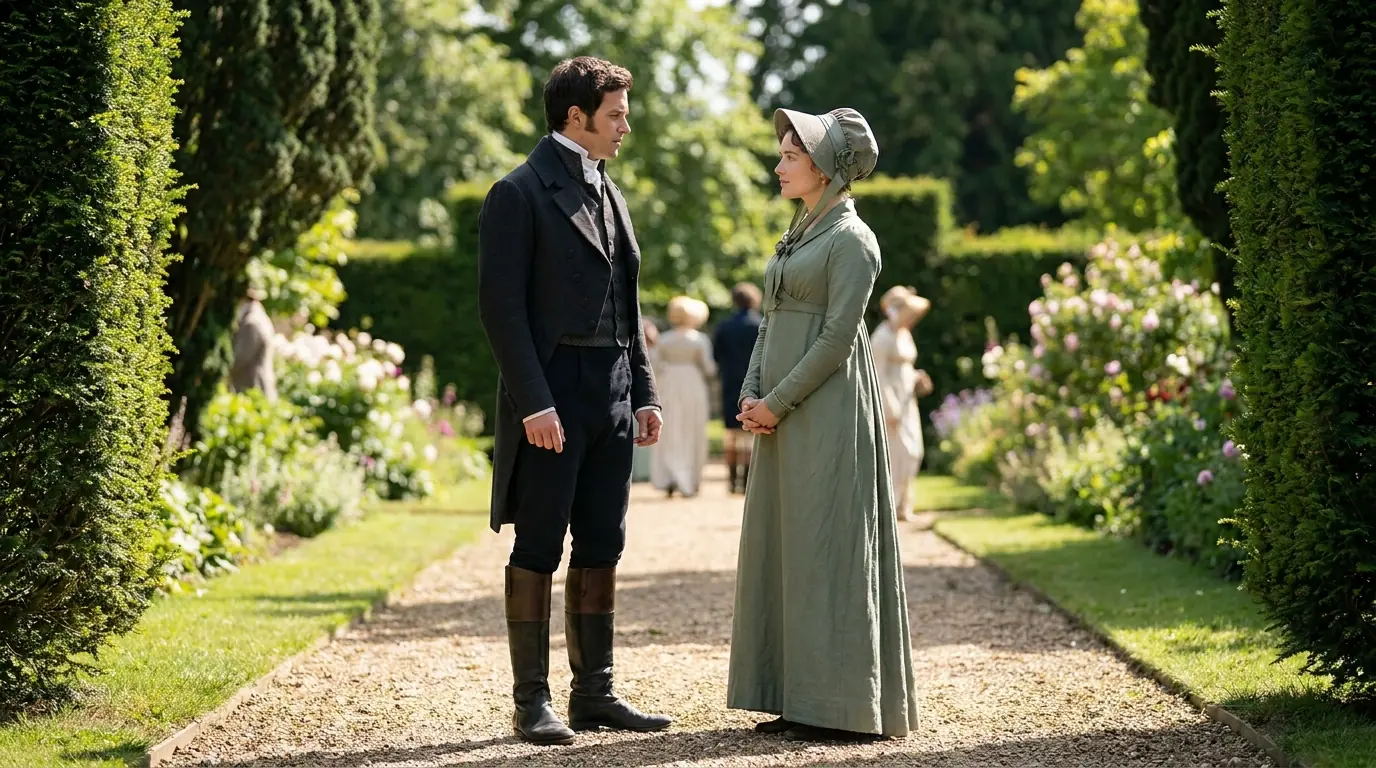
“Then I will see you there, Miss Forsyth.” He inclined his head correctly, the precise degree required by the difference in their positions, and walked back into the press of the rout and was absorbed by it immediately because rooms rearranged themselves around him without his appearing to notice.
Margaret stood by the hothouse flowers for a moment longer than she needed to. Then she located Louisa across the room, confirmed that the young man in the blue coat was still behaving himself, and went to find somewhere to sit down.
She did not think about the way he had said her name. She refused to. She had learned her lessons and she was not going to unlearn them for a duke who had asked Lady Pemberton her name and then walked across a drawing room with the calm certainty of a man who had never been refused anything in his life.
The Hartley ball was everything a London ball in April aspired to be, overcrowded, overwarm, and possessed of a quartet that played with more enthusiasm than precision. Margaret arrived with Louisa and their mother, who had dressed for the occasion in the gray silk and a headdress of uncertain ambition, and who had spent the carriage ride explaining that she had it on very good authority that Lord Hartley’s nephew was not yet engaged.
“He’s not here for Lord Hartley’s nephew,” Margaret said. “One never knows,” her mother said, with the optimism of a woman who had spent 20 years declining to know things that inconvenienced her.
Louisa caught Margaret’s eye and did not smile because she was a person of tact as well as good nature. The ballroom was on the first floor, and Margaret took up her position near the east wall with the comfortable efficiency of someone who had mapped the available chaperone territory and made her selection.
The musicians were attempting a cotillion. The floor was already full. Louisa was collected almost immediately by a young Mr. Davenport who had danced with her twice at the Pemberton rout and whose intentions, if not yet declared, were at least clearly directional.
Margaret watched the floor. She was good at this part, the watching, the assessment, the quiet calculation of who was dancing with whom and whether it signified. She had spent her childhood reading rooms and her adulthood reading ledgers.
People were, in her experience, not entirely different. She did not look for him, or rather she looked for him in exactly the way she would look for any potentially complicating element of the evening, the same attention she gave to the punch bowl’s location relative to her mother or the presence of Mrs. Oldwick should that lady appear. Practical vigilance, nothing more.
He appeared at her elbow at 20 minutes past 10:00. “Miss Forsyth.” The name again landing with that particular weight. She had noticed at the Pemberton rout that he said it differently than other people did. Most people said Miss Forsyth as a form of address, a social label, the verbal equivalent of a visiting card. He said it as though he was paying attention to it.
“Your grace.” She did not turn immediately. She finished observing the measure of the cotillion, confirmed that Louisa was in good hands, and then turned. “You did come, then.”
“I said I would.” “Men frequently say things.” “I am aware,” he said. “I try not to be one of them.”
She studied him again because he consistently invited study and did not seem discomfited by it. Most men of his rank were accustomed to being looked at but not examined. The duke appeared to welcome the distinction.
He was in dark evening clothes simply cut without the elaborate decoration some of his contemporaries favored, a man who had apparently decided that his own presence was sufficient ornament, which Margaret privately conceded was not an unreasonable assessment.
“Are you going to ask me to dance?” she said. “Would you accept if I did?” “No.” “Why not?”
She looked at him steadily. “Because I am here as a chaperone, and because dancing with a duke is precisely the sort of thing that becomes a topic of conversation, and because I do not want to be a topic of conversation.”
“But you already are one,” he said. “You have been seen speaking with me twice, that is sufficient.” Margaret breathed once slowly. “Then the damage is done and there is no need to compound it with a dance.”
“The damage,” he repeated. Something crossed his face, not hurt, he was too composed for that, but something that registered the word with more attention than she had expected. “Is that how you think of it?”
“That is how the world thinks of it. My thinking is largely irrelevant to the outcome.” He was quiet for a moment. Around them the cotillion spun and the candles guttered in the draft of the dancers’ movement and someone somewhere was laughing too loudly.
“Will you walk with me?” he said. “There is a room beyond the card tables that is marginally less audible.” “I cannot leave the ballroom.”
“Louisa is with Davenport who appears devoted. Your mother is in conversation with Lady Fitch, which will occupy her for at least half an hour. The card room is visible from the doors. You would be absent from this wall for perhaps 10 minutes.”
She looked at him. “You have been watching us.” “I arrived 20 minutes ago,” he said. “I have been learning the terrain.” “Why?”
He met her eyes. “Because I wanted to speak with you without an audience and because I was fairly certain you would not make it easy and because” He paused, the smallest pause. “I find that I would like to understand you, Miss Forsyth, and this wall is not conducive to it.”
The musicians launched into a reel. The volume increased accordingly. “10 minutes,” Margaret said, “and the doors remain in view.”
The room beyond the card tables was, as he had promised, quieter. It appeared to be a small library, three walls of books, two chairs, a lamp. Someone had abandoned a glass of port on the mantelpiece.
Margaret stood near the door. The duke stood near the window, which was a respectful distance, and she gave him credit for it. “But you said you were not in the habit of assuming the best,” he said. “What happened?”
“I told you I wouldn’t answer that.” “You did.” “I’m asking again.”
He held her look steadily, not out of prurience. “I’m asking because you are, quite deliberately and with considerable skill, telling me who you are before I can form my own opinion, and I would like to understand whether the story you are telling is the accurate one.”
Margaret was quiet for a moment. Outside dimly the reel. “There was a man,” she said. “He paid me a great deal of attention for four months. Then his mother explained to him that I was not suitable. He agreed with her. The word followed me.”
“What word?” “Unsuitable.”
He said nothing for a beat, then “He was a fool.” “He was a son,” Margaret said. “With a mother. It is not a category that requires particular intelligence to inhabit.”
Something that was genuinely a smile appeared briefly, and she found that it changed the whole arrangement of his face, made it younger and less certain, and considerably more dangerous. “And now,” he said, “when a man pays you attention, you assume the same outcome.”
“I assume a rational outcome based on available evidence.” “I am not that man.” “You are a duke,” she said.
“He was the son of a comfortable country family. The logic that applied to him applies to you with rather more force, not less. Your mother’s opinion of what constitutes suitable will not be more flexible than his. It will be more rigid.”
He looked at her for a long moment. “You have already decided how this ends.” “I have simply read the story before.” She said it without rancor, not bitterly, just factually, the way she would state a column total.
“I do not blame you for your interest, Your Grace. I am not, I hope, so without vanity as to be entirely surprised by it. But I am also not going to perform hope I do not feel, or permit an attachment to form that will reflect badly on us both when it comes to nothing.”
“When?” he said. “Yes.” “Not if.” “No.”
He turned to look at the window, which showed him nothing but his own reflection and the room behind him. Margaret watched him, the line of his jaw, the deliberate stillness of his hands.
He was, she thought, a man accustomed to being a certainty in other people’s calculations. Being placed firmly in the column of probable losses was something he had not expected.
“I have been looking for you since November,” he said to the window. She went very still. “I beg your pardon?”
He turned back. “I was in Wiltshire in November. My friend Cavendish has a house near Marlborough. There was a village. I rode through it on the Thursday, I believe. There was a woman outside an apothecary shop arguing very quietly and with enormous precision with a man who appeared to be a solicitor.”
Margaret remembered this perfectly. The solicitor had been attempting to charge her for a consultation she had not requested on a matter pertaining to a debt she had already settled with a confidence that had suggested he believed she would not have read the relevant documents. She had read them. He had eventually agreed.
“You were on a gray horse,” she said before she could stop herself. Something in his face changed. “You saw me.”
“You rode past. I did not think anything of it.” “I thought,” he said carefully, “a great deal of it. I asked Cavendish who you were. He didn’t know. I asked the innkeeper in the village. He knew the family name, not yours. I wrote to the local magistrate on a pretext.”
He said this last with the equanimity of a man who understood it was slightly absurd and had made peace with that. “I found that Miss Forsyth of Forsyth House, Wiltshire, would likely be in London for the spring season. So, I came to London in March, which I do not ordinarily do.”
The room was very quiet. Margaret was aware of her own breathing. “You came to London,” she said slowly, “in March because of a woman you saw for 30 seconds outside an apothecary shop.”
“Because of a woman,” he said, “who was winning an argument with a solicitor without raising her voice in a village where no one was watching her do it.” “Yes.”
She looked at him for a long moment. She was aware of the danger of this, the particular and specific danger of a story that was very flattering told by a man who was very attractive in a small library where the door was in sight, but so was his face, and his face was doing something she had not expected and could not quite categorize.
“That is,” she said carefully, “an extraordinary thing to tell a woman you have met twice.” “I am aware. I considered telling you something more gradual and sensible.” He paused. “I decided against it on the grounds that you appear to be someone who can detect sensible fabrication at some distance.”
She almost laughed. She stopped it, but only barely. “Your Grace.” “James,” he said.
Then, as though catching himself, “My name is James. You don’t have to use it. I simply” He stopped. “I said I would not be one of those men who says things he doesn’t mean. I am attempting to be consistent.”
Margaret studied the middle distance for a moment. The sound of the reel penetrated faintly through the walls. Someone was clapping on the beat with more vigor than rhythm.
“You have 10 minutes,” she said at last. “You have used seven of them.” “Then I will use the remaining three carefully.” He looked at her directly.
“I am not asking you for anything tonight. I am not asking you to believe in an outcome. I am asking only that you allow me, in whatever capacity your propriety and your caution will permit, to be someone you have actually met rather than the category you have assigned me to.”
It was, she acknowledged privately, an intelligent thing to ask. It was also an intelligent way to ask it, calibrated to her precise resistance, which suggested he had listened to everything she’d said with unusual attention.
“That is a reasonable request,” she said. “Thank you.” “Do not mistake it for more than it is.” “I won’t,” he said. And then, with the ghost of that dangerous smile, “Miss Forsyth.”
She turned and walked back toward the ballroom. She did not let herself think about how he had said it.
He was careful after that, careful in a way that Margaret had not expected from a duke, which perhaps said more about her assumptions regarding dukes than about him. He did not pursue. He appeared at the Carrington breakfast, at the Fitch card evening, at the concert in Hanover Square with a regularity that was clearly purposeful, but he did not engineer private conversation.
He was correct. He was present. He was, in the way of someone who has made a decision and is waiting for the other party to make theirs, patient.
He danced with Louisa at the Carrington breakfast, which surprised Margaret so thoroughly that she forgot for a moment to be watchful. It was a country dance, easy, cheerful, nothing significant in the choosing, but he danced with her as though she were a person he was pleased to meet, asking her questions she answered with obvious delight, making her laugh twice in the first minute.
When the dance ended, he brought her back to Margaret with a small bow and said, “Your sister tells me you taught her to read music.” “She exaggerates my contribution,” Margaret said.
“She says,” he continued, “that you used to play for 2 hours every evening before.” “Before?”
The word had a precise weight in the Forsyth household. Before meant before the solicitor, before the ledgers, before everything that had rearranged itself. Margaret had not played in 2 years. The pianoforte in the Forsyth drawing room was slightly out of tune and served primarily as a surface on which to place correspondence.
“She talks too much,” Margaret said lightly. Louisa, who had moved away with the cheerful tact of someone who understood exactly what she was doing, had moved out of earshot. “Do you miss it?” he asked.
“One misses a great many things.” She kept her tone easy. “One continues regardless.” He looked at her for a moment. “That is not an answer.”
“No,” she agreed, “it isn’t.” He did not press it.
That was the thing she was beginning to understand about him. He pressed exactly as far as she permitted and stopped at the line she drew, not because he was indifferent to what lay beyond it, but because he was determined to wait until she moved the line herself.
It was either very perceptive or very tactical, and she had not yet determined which. Both, possibly.
It was Louisa who told her about Charles Oldwick. They were dressing for the Sefton ball, Margaret in the green silk that was her best dress and her most reliable armor, Louisa in white with roses at the hem that their mother had stitched on herself over the course of four determined evenings.
Louisa had been doing Margaret’s hair, which she was better at, and had paused in a way that Margaret recognized as the prelude to something she was steeling herself to say. “Mr. Oldwick is in town,” Louisa said to the mirror.
Margaret was quiet for a moment. “I see.” “I saw him this morning in the park. He was with his cousin. He asked after you.” “Did he?”
“He seemed” Louisa chose her words with the care of someone who loved her sister and was not entirely certain how that sister would receive them. “He seemed as though he regretted things.”
“He always seemed that way,” Margaret said. “He is a man of considerable feeling and limited resolve. They go together sometimes.”
Louisa resumed pinning. In the mirror, her expression was the one she wore when she had more to say and was deciding whether to say it. “He may be at the Sefton ball.” “Then I shall be civil.”
Margaret watched her own face in the glass. “I am always civil.” “I know.” Louisa set in the last pin. “I just thought you should know before you arrived.” “Thank you.” She paused. “Louisa.” “Yes?”
“The Duke of Windham will also likely be at the Sefton ball.” “A beat.” “Yes,” Louisa said with extraordinary neutrality. “I expect he might.”
“I am aware of what you are doing when you move away from conversations.” Louisa met her eyes in the mirror. Her expression was entirely innocent in the way that expressions are when their owner has decided that innocence is the safest available policy.
“I am simply allowing you space to speak.” “You are allowing him space to speak to me.” “I have no opinion on the matter,” Louisa said and smiled, and the matter was closed, though neither of them believed it was.
The Sefton ball was magnificent in the way that only houses with unlimited firewood could achieve in April. Every room lit and warm, every surface reflecting candlelight, the kind of gathering that made London feel briefly like the place its inhabitants had always believed it to be.
Charles Oldwick found Margaret in the first 30 minutes. She had seen him across the room before he reached her, registered him with the precise emotional weather of someone who has spent a year deciding how they feel about a thing and has arrived at something like peace, but does not entirely trust that peace under direct examination.
He was exactly as she remembered, kind face, good coat. The particular quality of unhappiness that sits on people who have made one significant choice badly and have not yet found a way to stop noticing.
“Miss Forsyth,” he said. “Mr. Oldwick.” She was civil, she had promised herself she would be civil and she was. “You are well, I hope.” “Very well, and yourself?”
This was the part where he was supposed to be well and the subject would change and they would find their way to comfortable nothing. Instead, he said, “No, actually, I’m not particularly well. I have not been well for some time.”
Margaret looked at him. “Mr. Oldwick.” “I know,” he said quickly. “I know that I have no I am not here to cause you difficulty. I only wanted to”
He stopped. He was not, she remembered, a man who was fluent in the things that mattered. “I wanted to say that I am sorry. Properly. Not in a letter.”
“You were,” she said gently, “very sorry in the letter.” “The letter was cowardice. This is”
He looked at her with an honesty that was painful to observe because it was genuine and because it was too late. “I should not have let her decide for me.”
Margaret held his look steadily. “No,” she agreed, “you should not have.” He absorbed this. “Is there He stopped again. Is there any possibility at all of”
“No,” she said kindly but clearly, “I do not think there is.” He nodded. He had, she thought, expected this and had come anyway because he was a man who had learned something in the past year and needed to demonstrate it to himself even if the demonstration arrived too late. She respected that in the abstract.
“Is it” He glanced across the room and she knew without looking where his glance landed. “Windham.”
She did not answer. “He was watching you,” Charles said, “from the moment you entered.”
Margaret said with great composure, “Good evening, Mr. Oldwick.” He inclined his head. “Good evening, Miss Forsyth. I am glad you are well.”
He walked away. She watched him go with a feeling that was not grief and not relief, but something in between. The sensation of a chapter that had been suspended for a year arriving quietly at its last page.
She turned. The Duke of Windham was not watching her now. He was in conversation with Lord Sefton across the room, composed and attentive. But as she turned, as though he had some peripheral awareness calibrated specifically to her movements, he glanced toward her.
“Miss Forsyth.” He didn’t say it. He was 30 ft away, but she heard it anyway in the particular register he had made her learn to listen for.
She looked at him for a moment, just a moment, then looked away.
The Dowager Duchess of Windham arrived in London on the 14th of April, which Margaret knew because Louisa mentioned it, having heard it from Miss Ashton, who had it from her mother, who moved through London’s social information the way a current moves through water, quickly, completely, touching everything.
“People say she is formidable,” Louisa said at breakfast. “People say that about any woman who knows her own mind,” Margaret said and poured the tea.
“People say she has very particular views about who is suitable for Windham.” Louisa looked at her plate. “Those were the exact words, I believe, very particular views about suitability.”
The word landed precisely where it always landed. Margaret set down the teapot. “That is” she said with a composure she had spent two years building to exactly this load-bearing specification, “a very predictable development.”
“Margaret.” “It changes nothing. There was nothing to change.”
Louisa looked at her with the expression she wore when she believed Margaret was being a particular kind of stupid but loved her too much to say so in plain words. “He has been to every event where we have been for 5 weeks.”
“He is a sociable man.” “He is famously not a sociable man.”
“Lady Ashton says he attended more events this April than in the previous two seasons combined.” “Lady Ashton’s mother collects information with the thoroughness of a bailiff,” Margaret said. “I do not necessarily credit every conclusion she draws from it.”
“And yet” “And yet nothing.”
Margaret rose and gathered the breakfast things because motion was useful and the conversation was becoming one she did not wish to finish. “He is a duke. His mother has very particular views about suitability. I have been this road before and I know exactly where it ends. I am not” She stopped, set down the cups. “I am not going to let it end there again.”
Louisa was quiet for a moment, then, “What if it doesn’t end the same way?” “It always ends the same way.”
“Margaret, he rode to London in March for you.” “He told you that?”
“He told me,” Louisa said simply, “when he danced with me at the Carrington breakfast. He told me that he found you in November and that he had been looking forward to the season ever since and that he hoped I would think well of him.”
She paused. “He asked my good opinion. He didn’t have to do that. Of”
Margaret stood with the cups in her hands and said nothing. “He asked your good opinion,” she said at last. “Yes.” “Of himself?” “Yes.”
She set the cups down. She walked to the window. The same instinct that took her to windows at home in Wiltshire, the habit of looking out when she needed to think clearly. The street below was its ordinary London self, a coal cart, two women with baskets, a boy running for no visible reason with the pure joy of running.
“He should not have told you that,” she said finally. “I think,” Louisa said behind her, “that he wanted me to tell you.”
She saw the Dowager Duchess 3 days later at an afternoon concert in Cavendish Square. She recognized her immediately, a woman of 60 or so, upright, dark-eyed, wearing the kind of assured elegance that required no ornamentation.
She arrived with two companions and was immediately surrounded by people who required her notice, which she dispensed with the efficiency of a woman who had been doing it for 40 years and had reached a productive peace with it.
Margaret watched her from across the room with the attention one pays to weather. The Dowager noticed her during the first interval.
Margaret knew the moment, the slight alteration in direction, the unhurried examination. She held the look steadily because she was not going to look away from a woman she had not yet spoken to regardless of what that woman’s opinion of her might be.
The Dowager said something to her companion and then made her way with the inexorable deliberateness of a ship in calm waters across the room. “Miss Forsyth,” she said.
“Your Grace.” Margaret was careful, correct. She gave nothing. “My son has spoken of you.” “I am flattered.” “Are you?”
The Dowager studied her. The examination was thorough and entirely unembarrassed, the frankness of a woman who had long since decided that the social performance of not quite looking was a waste of everyone’s time. Margaret found to her own surprise that she respected it.
“He says you are the cleverest woman he has met since his grandmother.” “That is very kind.” “It is very specific,” the Dowager said. “His grandmother was not a comfortable woman. She was right about nearly everything and she knew it, which is an exhausting combination. James appears to find this quality appealing in a manner that suggests he did not have enough of it around him growing up.”
Margaret was not certain this required a response. She offered none. “I am told,” the Dowager continued, “that you manage your family’s estate.” “I do.” “And that it was in some difficulty when it came to you.” “It was.” “And that it is no longer.”
“It is considerably improved,” Margaret said with careful accuracy. “It is not yet what it was.”
The Dowager was quiet for a moment in the manner of someone allowing a piece of information to settle to its proper depth. “My husband was a man of great charm,” she said, “and very little rigor. I managed his affairs for 40 years and he remained cheerfully unaware of most of it. It was,” she said with a dryness that was entirely without bitterness, “an education.”
Margaret looked at her. “I’m sorry.” “Don’t be. I was good at it and he was in his way a good man.” She paused. “I have certain views about what James requires.”
“So I have been given to understand.” “I expect you have.”
A corner of her mouth moved. “The difference between what I required for him 10 years ago and what I require for him now,” she said, “is that I have watched him for 10 years more and I understand better what he is. He is not his father. He does not need what his father needed.”
She looked at Margaret with the particular attention of a woman who has already drawn her conclusions and is checking them against the evidence. “He needs someone who will tell him the truth.”
Margaret met her eyes. “Most people need that.” “Most people need it and cannot bear it,” the Dowager said. “They are not the same thing.”
She inclined her head precisely, correctly, the greeting of one woman to another rather than the condescension of a rank to one below it. “Enjoy the second half of the concert, Miss Forsyth.”
She moved away. Margaret stood with her hands quietly at her sides and breathed once slowly. The second half of the concert was objectively the better half. She did not hear a note of it.
He found her afterward in the entrance hall while Louisa was collecting their wraps. “My mother spoke to you,” he said, not a question. “She did.” “I did not ask her to.” “I know.”
She looked at him. His expression was the careful one, composed surface, something deliberate underneath. She had learned to read the difference in the past 5 weeks, which was information she had not meant to acquire and did not entirely know what to do with.
“She was not unkind.” He absorbed this with visible relief that he immediately controlled. Good. She is formidable. Yes. She loved your father.
He went very still. What did she say? She said he was charming and she managed his affairs for 40 years. She said it without bitterness.
Margaret looked at him steadily. That is a very particular kind of love, your grace. The kind that works.
He looked at her for a long moment. The entrance hall was busy, people retrieving wraps, calling for carriages, the whole mechanism of departure in motion around them. Neither of them moved. She is not what you expected, he said. No.
And yet, he said carefully, I notice that you have not revised your conclusions.
She held his look. He was right and they both knew it and she was not going to pretend otherwise. Your grace. James. Your grace.
She said it deliberately because she knew what it cost him and she was not ready to pay with the alternative. I do not know what your mother’s approval signifies in practice. A woman may approve in the abstract of a quality and disapprove entirely of a specific person embodying it.
She used your name. She is polite. She does not, he said with quiet emphasis, use the names of people she is merely polite to. She has been polite to women she cannot endure for 30 years. She uses their titles.
Margaret was quiet. I am not asking you to decide anything, he said. I am asking you to stop deciding against me on evidence you have already tested and found does not apply. You are He stopped. A muscle in his jaw moved.
You are the most careful person I have ever met and I mean that entirely as a compliment and I am asking you to be a fraction less careful for a limited time with me.
Louisa appeared at the far end of the hall with their wraps and the bright, carefully neutral expression of a woman who had timed her return with deliberate imprecision. I will think about it, Margaret said.
It was the first concession she had made. They both knew that, too. He inclined his head the precise degree, no more, no less, and she turned and walked toward Louisa and did not let herself turn back.
But she thought about it. All the way home in the carriage with Louisa talking cheerfully about the music and their mother dozing against the window, Margaret thought about it.
She thought about a man on a gray horse riding past an apothecary’s shop in November and asking an innkeeper her name. She thought about a woman of 60 who had managed 40 years with grace and without it. And called it an education.
She thought about the way he said, Miss Forsyth, as though the name was something he had decided to pay attention to. She thought about what it might cost to be a fraction less careful.
She was still deciding when the carriage turned into Portman Street and Louisa took her hand in the dark, quietly, saying nothing, which was better than anything she might have said.
The letter arrived on a Wednesday. Margaret was at the writing desk in her aunt’s back parlor composing a note to the steward at Forsyth House regarding the drainage situation in the north field when Louisa came in holding an envelope with the expression of someone who has been carrying something hot and is relieved to set it down.
It came for you, Louisa said. It is not from him. Margaret took it.
The hand was unfamiliar, a woman’s, careful and formal. The seal was plain wax. She opened it with the small knife from the desk and read it once quickly and then again more slowly because the first reading had not quite settled.
It was from a Mrs. Dorothea Oldwick, not Charles’s mother, his aunt, a Mrs. Dorothea Oldwick of Bruton Street who Margaret had met perhaps twice and remembered as a thin woman with sharp eyes and the quality of someone who cataloged information without immediately revealing its purpose.
The letter was brief. It said that Mrs. Dorothea Oldwick had observed with some interest the recent attention paid to Miss Forsyth by a certain party of considerable rank and wished to offer, in the spirit of friendly concern, a piece of intelligence that Miss Forsyth might find relevant to her considerations.
The intelligence was this, that the Dowager Duchess of Windham had been heard at Lady Fitch’s card evening on Tuesday last to remark that while Miss Forsyth was a young woman of evident good sense, the Windham family had a responsibility to the dukedom that extended beyond personal preference and that she trusted her son understood this.
Margaret read it a second time, then a third. She set it down on the desk with the careful flatness of someone placing a document they intend to file rather than act upon.
She looked at the wall above the mantelpiece, which was hung with a small landscape in oils that she had always found uninspiring and found at this moment genuinely offensive in its determined neutrality. What is it? Louisa said. Nothing. Margaret.
The Dowager Duchess, Margaret said with the pleasant tone she used for things that were not pleasant, appears to have two registers. What she says to a woman’s face and what she says at card evenings.
Louisa sat down. Margaret handed her the letter. She watched her sister read it, the slight tightening around her eyes, the controlled nothing of her expression at the end.
It may be taken out of context, Louisa said. It may. Or it may be invented. Mrs. Dorothea Oldwick has never been It may be that, too.
Margaret retrieved the letter, folded it, and placed it in the back of the writing desk drawer. Or it may be exactly what it appears to be, which is a woman of considerable intelligence saying one thing in private and another in public, which would mean that my original assessment was correct and the revision I was beginning to consider was a mistake.
Louisa was quiet for a moment. What are you going to do? What I should have done, Margaret said, 5 weeks ago.
She picked up her pen and returned to the note about the drainage in the north field. I am going to be sensible.
She was sensible for 4 days. She was sensible at the Pemberton card evening where the duke was present and she was civil and warm and gave him nothing beyond civility.
She was sensible at Lady Hartley’s morning call where he appeared briefly and she contrived to be in conversation with two other women at every moment he was in the room.
She was sensible at the Carrington recital where she took a seat that gave him no practical position from which to speak to her privately, which required some advanced planning but was entirely achievable.
He noticed. Of course he noticed. He was not a man who missed things and she had not been careful enough in the past 5 weeks to make her new carefulness appear natural.
On the fourth day he sent a note. It contained four words, Have I done something? Not a question, technically. The punctuation was absent, which she took, correctly or not, as evidence that it had been written quickly, which was unlike him, and she felt the four words sit in her chest in a way that was inconvenient and informative and that she chose not to examine.
She wrote back, No, please do not be concerned. He did not write again. She told herself this was the rational outcome and that she was grateful for it.
She was not grateful for it.
Charles Oldwick found her in the park on the fifth day. It was not arranged. She saw him approach from some distance and had time to consider walking the other direction and did not because she was beginning to find her own avoidances exhausting.
He fell into step beside her with the slightly tentative air of someone who is not entirely sure of their welcome and has decided to proceed regardless. You look, he said after a moment, as though you have recently made a decision you are not enjoying.
That is a very particular observation. I have had occasion, he said with the self-deprecation she had always found disarming, to make a great many decisions I did not enjoy. I recognize the expression.
They walked for a moment in the comfortable silence of two people who knew each other well enough to have earned it, even if much of what they knew about each other was not comfortable.
The park was full of the mid-April version of itself, bright and cool, the trees fully committed to their green now, the paths populated with the daily commerce of society going about its business of being seen.
I heard, Charles said carefully, that you have been avoiding Windham. You hear a great deal. London is very small. He paused. Is it because of what his mother said?
She looked at him sharply. You heard that. Dorothea wrote to half of Mayfair, I suspect. She has always had a particular talent for the well-timed piece of information.
He said it without venom, simply as fact. She wrote to my mother as well. My mother told me.
And what, Margaret said evenly, did your mother say about it? He was quiet for a moment. She said it was a shame and that some men were simply too grand for their own comfort and that you were well out of it. He paused. Then she said that she hoped I had learned something useful from the whole affair and left the room.
Margaret almost laughed. It caught her by surprise, which laughter sometimes did. Your mother, she said, is more perceptive than I gave her credit for.
She has always been perceptive, Charles said. She acted on it badly.
He stopped walking. Margaret stopped, too, because his tone had changed to something more deliberate. I want to say something and I want you to hear it as plainly as I mean it.
She waited. If Windham, he said, has been in London since March, I have seen him at 20 occasions in 5 weeks. I have watched him cross rooms and avoid rooms and angle conversations and be more patient than I would have credited a man of his position with being capable of. He met her eyes.
He is not amusing himself. Men who are amusing themselves do not behave with that degree of intention.
Charles. I am not saying this for my own benefit, he said. I have no benefit left in this matter. I made my choice and it was wrong and I know it. I am saying it because I stood in that position once, wanting something and lacking the conviction to hold it, and I know what it looks like from the inside.” He paused. “Don’t let him lose it the way I did. Don’t make it easy to lose.”
Margaret looked at him for a long moment. The park moved around them. A child ran past chasing a hoop. Two women consulted a parasol with visible disagreement.
The dowager said “The dowager said it at a card evening to women who gossip,” Charles said. “And said something entirely different to your face. I don’t know which one she meant, but I know which one he means because I have watched him mean it for 5 weeks.”
She said nothing. “Decide based on what is true,” he said, “not based on what is easiest to believe.”
He inclined his head and walked away and left her standing in the middle of the park with the child and the hoop and the disagreeing parasols and the sudden clarifying awareness that she had spent 4 days being sensible in exactly the wrong direction.
She sought out the duke that afternoon. This required sending a note, brief, correct, requesting the opportunity of a brief conversation at his earliest convenience, signed with her name and nothing else.
She sent it before she could revise it, which was the only way to send things one might otherwise revise indefinitely. He replied within the hour. “Tomorrow morning, the park, half past 10, JW.”
She was there at 25 past. He arrived at exactly half past, which she noted because he was always exactly on time, which she had come to understand was a form of respect rather than a performance of it.
He fell into step beside her without preamble, hands behind his back, looking straight ahead. “You received a letter,” he said. “From Mrs. Dorothea Oldwick, yes.” “I see.” A pause. “And what did it say?”
“It reported a remark your mother made at Lady Fitch’s card evening regarding the responsibility of the Windham family to the dukedom and personal preference and the implication that the two were in conflict.”
He was quiet. They walked a full 30 yards without speaking, which Margaret had learned to understand as him thinking rather than conceding. “Did you believe it?” he said finally.
“I believed it was possible. I had reason to.” “Because of Oldwick?” “Because of Oldwick.” She kept her voice even. “And because what your mother said to me at the Cavendish concert and what she apparently said at Lady Fitch’s were not the same thing. People in that position, in her position, do not always say the same thing in public and private. That is not a cynical observation. It is simply an accurate one.”
“No,” he said, “it is accurate.” He stopped walking. She stopped beside him.
They were at the eastern edge of the path near the water, where the park was quieter and the distance between them and the nearest bench of onlookers was sufficient for honesty. “My mother said to me last week that you were a woman of unusual quality and that she believed you would make me very happy.”
Margaret looked at him. “She also said at Lady Fitch’s something that was reported to you as caution about the dukedom. I cannot tell you precisely what she said because I was not there. What I can tell you is that my mother is a woman who has spent 40 years managing what she felt versus what she permitted herself to say in public, and those two things have not always corresponded.”
His jaw was set. “That is not a defense of her. It is an explanation. She is not the dowager duchess at the card table. She is also not the woman who spoke to you. She is both, and she has spent a long time trying to reconcile them, and she has not always succeeded.”
Margaret was very still. “You knew this might happen.” “I thought it was possible.” He turned to face her.
“I should have told you. I chose instead to hope that she would, that this time” He stopped. “That is the thing I have not told anyone. I love my mother. She is formidable and perceptive and in her way kind. She is also a woman who, when she is afraid, retreats into what is expected, and what is expected of the dowager duchess of Windham does not always accommodate what is true.”
He looked at Margaret directly. “She is afraid, I think, that I am my father, that if I follow feeling rather than form, I will be careless with my life the way he was careless with his. She is wrong, but her being wrong does not make what she said at Lady Fitch’s less real.”
The water was very still. A pair of ducks made their unconcerned passage across. Margaret thought about 40 years, about managing and loving anyway, and the specific exhaustion of reconciling two different truths for four decades.
“She is not wrong about everything,” Margaret said quietly. “No. You are not your father.”
Something shifted in his face. “No, but you understand him.” He held her look. “Yes, I think I do.” He paused. “Does that frighten you?”
She considered it honestly. “It would have,” she said, “a month ago.” “And now?”
She looked at the water for a moment, then back at him. “Now I think that understanding what you do not wish to become is rather more useful than simply deciding not to think about it.”
He was quiet. “What did Oldwick say to you?” “He saw us in the park.” “Yes.”
“He said,” Margaret said, “that he had made his choice, and it was wrong, and he knew it, and that he had watched you for 5 weeks, and that you were not amusing yourself.” “He is right.”
He said it simply, without decoration. “I am not.”
He looked at her with the same directness she had been cataloging for 5 weeks, the look that had made her cautious from the beginning because it did not contain the performance she had been trained to expect. “I would like to say something without strategy, without calibration.” He paused. “I have thought about almost nothing but you since November. Not the version of you I imagined then. I understand the difference between a woman outside an apothecary’s shop and a woman. I mean you. The actual person I have been painting in drawing rooms and concerts and the side rooms of routs for 5 weeks. I am aware that this is rapid. I am aware that you have reason to distrust rapid, but I find I cannot continue to be patient and measured and correct while you use all of it as evidence that I am simply exercising good manners.”
Margaret did not look away. “I am not exercising good manners,” he said. “I am I’m extremely careful not to alarm you because I am genuinely afraid of alarming you, and because losing your trust would be”
He stopped. “I am a man who is accustomed to wanting things and obtaining them without particular difficulty. You are the first thing I have wanted in many years that required me to understand that wanting is not sufficient, that I had to be worth it.”
The park was very quiet around them. Or perhaps the park was its ordinary self, and Margaret simply could not hear it. “James,” she said.
He went entirely still. She had never used his name. They both understood what it cost her, or perhaps what it was worth, which was not the same thing.
“I have spent 2 years deciding that the lesson of Charles Oldwick was that I was not the kind of woman men chose when they were permitted to choose freely, that I was the practical option or the temporary one or the almost. I built my entire life on that foundation, and it was it was the wrong lesson.”
She held his look steadily. “I think I may have been letting a fool’s decision teach me things a fool has no business teaching.”
“Yes,” he said quietly, with great care. “I am not easy,” she said. “I have the ledgers and the estate and a mother who means very well and a sister I would do anything for, and I am not going to be uncomplicated or convenient or”
“Margaret.” He said it differently now. Not Miss Forsyth. Margaret. Her name, the real one, in his voice, and it landed differently than anything had landed in 2 years.
“I came to London in March. Do you think I was looking for convenient?” She breathed. “No,” she said. “I don’t suppose you were.”
He looked at her. The ducks completed their crossing. Somewhere behind them a child laughed. The trees were doing what April trees do when they have finally made their decision about being green, completely, unambiguously, without reservation.
“May I call on you?” he said. “Tomorrow, properly, with whatever I am required to bring, in whatever order it is required to be done.”
She looked at him for a long moment. At the face she had been studying for 5 weeks, which had been patient and careful and unperforming in a way she cataloged and distrusted and eventually, against her considerable will, come to believe.
“Yes,” she said. “You may.”
He called at 11:00 the next morning. Margaret’s mother received him in the front drawing room with an expression of such violent composure that Margaret felt a flicker of genuine fondness for her.
Her mother understood entirely what was happening, had understood it for at least a week, and had managed to convey nothing whatsoever to the duke upon his entrance, a performance that required a specific and underrated form of discipline.
The conversation was correct and pleasant and lasted precisely long enough for propriety before Margaret’s mother discovered an urgent engagement elsewhere in the house and departed with the unhurried decisiveness of a woman who has planned her exit thoroughly.
He looked at the door she had closed behind her, and something that was fully, unambiguously a smile appeared. “She is excellent.” “She is entirely transparent,” Margaret said. “She loves you.” “She does.”
Margaret settled in the chair across from him, which maintained the appropriate distance while permitting the appropriate attention. “You wanted to call properly. This is proper.” “Yes.”
He looked at her steadily. “I also came to tell you that I spoke with my mother last night.” Margaret went still. “I did not ask you to.”
“No, but it required to be done, and I should have done it earlier, and so I did it.” He held her look. “I told her that I intended to call on you. That my intentions were serious. That her remarks at Lady Fitch’s had caused you to withdraw. And that this was the direct consequence of saying different things in different rooms. And that she had caused damage to the one thing I have cared about in some years.”
The room was quiet. How did she receive that? With the expression she wears when she knows she is wrong. And is deciding how to be wrong gracefully, he said. Which she can do. She is capable of it. It costs her something, but she can.
He paused. She wishes to call on you. If you are willing. What would you like me to say to that? I would like you to say what you actually think. He said. Not what is diplomatic.
Margaret considered. I think she is a woman who has spent 40 years being careful about the right things for the wrong reasons. Or the wrong things for the right reasons. And that the two have become difficult for her to separate.
I think she said what she said at Lady Fitch’s because she was afraid. Not because she was cruel. And that there is a difference between those two things worth preserving.
She paused. I think I would like to meet her again on those terms.
He looked at her in a way that she was beginning to recognize. Not the composed surface. Not the careful strategy. But the thing underneath that he did not often permit the surface.
You are. He said. Extremely good. I am practical. She said. Your mother is a fixed point. I would rather find an honest accommodation with a fixed point than spend years in conflict with one.
Most people, he said. Would not have reached that conclusion this quickly. Most people, she returned. Have not been balancing their household accounts against difficult fixed points. Since the age of 22.
This time he laughed. Fully without the restraint she was accustomed to. The laugh of a man who is genuinely surprised by something. And has decided to stop pretending he isn’t.
It was, she discovered. A very good laugh. Warm and direct. Without performance.
There is something else, he said when he had recovered. He reached into his coat and produced a small volume. Slim, green bound. The spine legible from where she sat.
She looked at it. It was a collection of keyboard sonatas by Clementi. Louisa told me, he said. That the pianoforte at Forsyth House is slightly out of tune. And that you haven’t played in two years. And that you used to play for two hours every evening.
Margaret looked at the book, then at him. I cannot tune the pianoforte in Wiltshire from London. He said. But when you go home, and you will go home because the estate needs you. I thought.
He set the book on the low table between them. I thought perhaps you might take something back with you.
She looked at it for a long moment. The green cover. The name on the spine. The absolute simplicity of the gesture. Which was not diamonds or a declaration, but a small green book. Placed on a table by a man who had been paying attention.
This is not, she said carefully. An appropriate gift from an acquaintance. No, he agreed.
She picked it up. It is an appropriate gift from something else. Yes.
She turned it in her hands. The pages were new, unread, unsoftened. She opened to the first sonata and looked at the notation. Which was clear and well printed. And felt the entirely specific ache of something she had thought she had closed.
Thank you. She said. He said nothing.
She looked up and he was watching her with the open look. Not the duke. Not the strategist. Not the patience. Just a man watching a woman hold a small green book and feel it. And being glad.
The dowager came on Thursday. She arrived with one companion. And without announcement. Which was the prerogative of her rank. And Margaret received her in the front parlor with tea. And the composure she had been building since 11 years old. And had come to rely on as her most durable possession.
They were alone within five minutes. Margaret’s mother had been encouraged gently to visit her friend in the next street. Louisa had an engagement with Miss Ashton. That had been perhaps arranged with some intent.
The dowager sat. She looked around the room. Not with the assessing eye of someone cataloging its deficiencies. But with a specific quality of attention. That Margaret recognized as genuine curiosity.
She looked at the furniture and the modest carpet. And the small watercolor above the mantelpiece and the writing desk in the corner. With the papers on it. And she did not say anything about any of it.
My son tells me, she said at last. That you understood why I said what I said at Lady Fitch’s. I thought I might, Margaret said. He told you about his father. He told me what he chose to tell me.
The dowager was quiet for a moment. He is not his father. She said. I know that. I have known it for years. But knowing a thing and trusting it are. As you may have discovered. Not always the same.
She looked at Margaret with the frank examination that had been her characteristic mode on both occasions. I was afraid he would choose someone for the wrong reason. For softness. For convenience. For the path of least difficulty.
She paused. He has not chosen that. No. Margaret said. I don’t imagine I represent the path of least difficulty.
The corner of the dowager’s mouth moved. You represent in fact the path of most difficulty. You come with debts and an estate and a family. And a damaged reputation and no fortune. And an entirely unsettling habit of saying exactly what you think. At the precise moment one hopes you will say something easier.
Shall I apologize for that? Absolutely not. She looked at her steadily. I apologize, she said, for what I said at Lady Fitch’s. It was said in fear. Not in considered judgment. And it caused you harm. I’m sorry for it.
Margaret held her look. I accept that, she said. And I will tell you what I told your son. That I think you are a woman who has been reconciling two different truths for a very long time. And that the reconciliation has not always succeeded. And that I would rather understand that than pretend it doesn’t exist.
The dowager was silent for a moment. Something passed through her face that was too quick and too private to name. James said you were the cleverest woman he had met since his grandmother. You mentioned that.
She would have liked you, the dowager said. She was not comfortable either. Margaret smiled. Not the social one, but the real one. Which appeared less frequently and meant considerably more.
I take that as a very high compliment. It is offered as one.
The dowager set down her cup. He has been alone for a long time, she said more quietly. Not for want of options. For want of. The right one. I see now that I was in some danger of being the obstacle to the very thing I claimed to want for him.
We are all in danger of that. Margaret said, from time to time.
The dowager looked at her for a long moment. Then she rose and Margaret rose and they were of a height. Which was somehow appropriate. I will not interfere. The dowager said. It was said simply without grandeur and Margaret believed it.
I would not ask that, Margaret said. Only that you mean the same thing in both rooms. A pause. I will endeavor to.
They shook hands. Not with the gloved formality of an introduction. But with the direct clasp of two women who have understood each other. And are deciding on the basis of that understanding. To proceed.
The duke called the following morning. And asked Margaret to walk with him in the park. It was a clear day. The kind that April produces as an apology for March. Direct sunlight, a light wind. The trees having committed entirely to their decision about green. And looking very pleased with it.
They walked for some time without particular agenda. He told her about Windham Hall. The estate in Yorkshire. The north-facing library he preferred in summer. The home farm that had been his project for three years. And was beginning to justify itself.
She told him about the drainage situation in the north field. Which had been occupying her correspondence for a fortnight. And about the tenant in the east cottage who was 73. And had opinions about crop rotation that were mostly wrong. But contained one useful insight per season. That made his company worthwhile.
He listened the way she had observed him listening from the beginning. Entirely without waiting for his turn. You will go back in June, he said. The estate needs me in June. The hay must be got in correctly or the winter is difficult for everyone.
I know. He said it without complaint. I will come to Wiltshire in July if I may. I have things in the north to settle in June.
She looked at him. You are proposing a schedule. I am proposing, he said with perfect equanimity. That two people who have established obligations to their respective estates. Arrange to manage those obligations. While also managing this.
This. She said. Yes. You are very practical for a duke. I learned from an impractical father. He said. And I have recently been spending time with an extremely practical woman. It has been instructive.
She smiled. He saw it. The real one. And she watched him absorb it with the particular attention of a man who has been waiting for it.
I want to ask you something, he said. And I want you to answer it honestly. Not carefully. Those are not always different things. With you, they sometimes are.
She conceded this. Ask then. He stopped walking.
They were at the edge of the path near the elms. Where the shade was partial and the light came through in the intervals of moving leaves. He turned to face her. And he looked, she thought. More himself than he had at any point since she had known him. Less the duke. Less the composed surface. Just a man of 34 who had made a decision. And was about to say so out loud.
Do you want this, he said. Not whether it is possible. Not whether it is sensible or well matched or likely to succeed. Do you. Want it?
Margaret looked at him. She thought about November. Which she had not been there for except as the woman outside the apothecary shop. Who had won an argument no one was watching.
She thought about March. And the ledger that was wrong and the elm trees just green enough to be hopeful. She thought about 5 weeks of drawing rooms and concerts and the small library at the Hartley Ball and a green book of sonatas on a low table.
She thought about what it felt like to be decided on. Not settled for, not selected from available options, but decided on by someone who had crossed three counties to find her as she was, managing her debts and her staff and her difficult tenants, not performing softness she didn’t feel exactly like herself.
“Yes,” she said, “I want it.”
He looked at her for a moment, then he said simply, “Margaret.” Just her name. The real one, the first one, without ceremony. The way he had said Miss Forsyth all those weeks ago and then differently and then differently again. And now like this. Like something he had been keeping careful and was no longer required to keep.
“James,” she said. Her name that was in its way everything.
He asked her father’s question formally, correctly to her mother, 2 days later, which her mother received with a composure that lasted approximately 4 seconds before dissolving entirely.
He asked Margaret herself in the garden of her aunt’s house in Portman Street in the early evening when the light was doing something gentle with the new leaves, with no audience and no ceremony and the simple directness she had come to understand as his most characteristic quality.
She said yes without hesitation. She had been less careful for 11 days and she found that she was still standing.
They were married in September at the church in the village closest to Forsyth House which was small and old and smelled of stone and candle wax and was entirely full.
Louisa cried. Their mother cried. The Dowager Duchess sat in the front pew on the Windham side and did not cry but held herself with a very particular kind of stillness. The stillness of a woman who is feeling something she has decided it is all right to feel.
Charles Oldwick sent a very handsome gift and a note that said simply, “I am glad.” Margaret believed him.
The North Field drainage had been sorted by August. The hay had come in well. The pianoforte at Forsyth House had been tuned in July when a man had arrived from the village with tools and the information that he had been asked to attend to it by a party in Yorkshire who had been very specific about what was required.
Margaret had sat down at it that evening and played for 2 hours, the Clementi sonatas, which she knew from memory already because she had learned them at 14 and the hands remember what the mind has set aside.
She played with the window open to the summer evening and the elm trees outside fully, entirely, unapologetically green.
On the morning of the wedding while Margaret was dressing and Louisa was doing her hair with the focused seriousness she brought to things that mattered, their mother came in and stood in the doorway for a moment with the expression of a woman who has something to say and is deciding how to say it.
“I always thought,” her mother said at last, “that what you needed was someone who could see you.” Margaret met her eyes in the glass. “Yes.”
“I don’t mean your qualities.” Her mother moved into the room, smoothed an invisible wrinkle from the sleeve of the dress. “I mean you. The whole of it. The ledgers and the North Field and the way you are when you have been reading something difficult and the way you still love the oboe.” She paused. “I thought it might not be possible. I am very glad it turns out to have been.”
Margaret took her mother’s hand and held it for a moment without speaking. Then Louisa set in the last pin and the light came through the window of Forsyth House for the last morning Margaret would spend in it as a Forsyth and it was enough.
It was precisely, completely enough.
He was waiting for her at the church door. Not inside, at the door. Outside in the September morning which had done the courteous thing and arranged itself into clear skies and the particular quality of light that makes England occasionally look like everything it believes itself to be.
“You’re outside,” she said. “I wanted to see you arrive.” He said it simply, without apology.
She looked at him. He looked at her. Two careful people who had spent 5 weeks negotiating the precise terms of being less careful and had arrived here to a September morning and a small stone church and the whole of the rest of it chosen deliberately by both of them.
“Shall we go in?” she said. He offered his arm. She took it.