The concrete path of Centennial Park was still radiating the heat of the
late July sun. Five young men, flushed with cheap beer and unearned
confidence, thought they saw an easy mark. A tired guy in a faded work
shirt watching a six-year-old in the sandbox. They saw the stooped
shoulders and the graying beard. They didn’t see the thickened cartilage
of his ears.
They didn’t notice the exact balanced way his weight rested on the balls
of his feet. They wanted to feel big. They chose the wrong day, and they
chose the absolute wrong father. Agrippa Fisher’s lower back throbbed
with a dull, familiar rhythm. It was a metronome of pain ticking away
every time he shifted his weight against the unforgiving wooden slats of
the park bench.
Tuesday evenings were always the hardest. The lumberyard drained
whatever vitality he had managed to scrape together over the weekend,
leaving him hollowed out, smelling faintly of pine resin and diesel
exhaust. But Tuesday was also his evening with Larry, and Larry needed
the park. Agrippa watched his son through eyes narrowed against the
fading glare of the sun. Larry was six, small for his age, with a mop of
unruly brown hair and an intense, quiet focus.
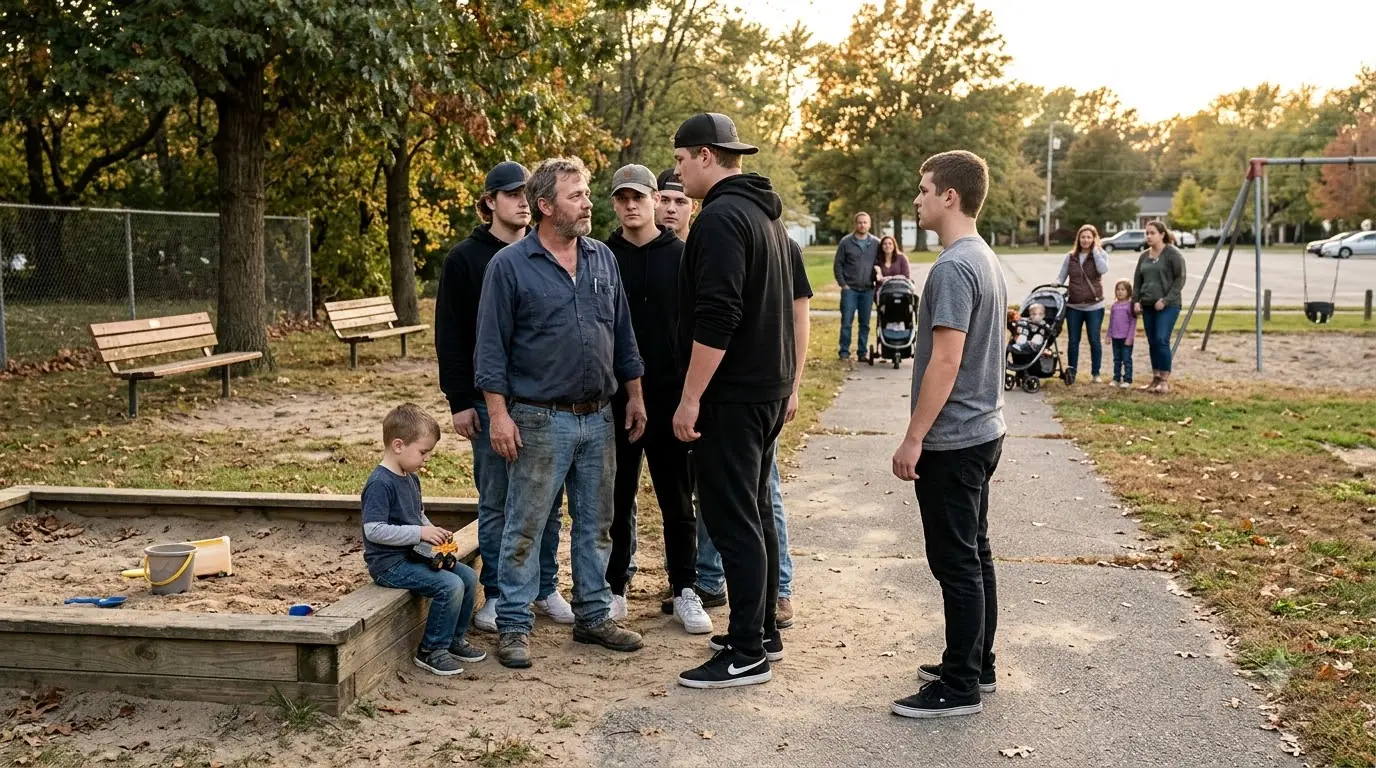
Right now, that focus was entirely dedicated to a bright yellow plastic
dump truck, which he was meticulously filling with sand. The boy didn’t
play like other children. There was no frantic running, no shrieking. He
built. He organized.
He found order in the dirt. Agrippa loved that about him, even as it
worried him. The world wasn’t kind to quiet things. Agrippa rubbed his
jaw, his thick, calloused fingers tracing the faint, jagged line of scar
tissue that hooked under his left eye. A souvenir from a life that felt
like it belonged to another man.
A man who used to step into steel cages under blinding halogen lights,
breathing in the smell of canvas and sweat. A man who understood the
brutal mathematics of human bodies. Now, the only math Agrippa cared
about was calculating if he could stretch his paycheck to cover Larry’s
new winter coat and the rising cost of groceries. He leaned back,
stretching his legs. His left knee popped loudly.
The sound was a harsh reminder of his last professional bout 7 years
ago. A badly checked leg kick that had severed his ACL and essentially
ended his career. He didn’t miss the violence. He didn’t miss the
promoters, the weight cuts, or the taste of blood in the back of his
throat. He just missed the money.
The park was relatively empty. A few mothers sat near the swings,
engrossed in their phones while their toddlers navigated the rubberized
mats. The air was thick with the scent of freshly laid cedar mulch and
the distant hum of rush hour traffic on the interstate. It was peaceful.
Or at least it was supposed to be.
The peace broke with the harsh metallic screech of a dirt bike engine
revving entirely too close. Agrippa didn’t flinch. His eyes simply
flicked toward the sound. A predatory reflex he had spent years trying
to suppress. Five young men crested the small hill leading down to the
playground.
They weren’t riding the bike. One was pushing it. The exhaust smoking
while the others flanked him like a ragged obnoxious honor guard. They
looked to be in their early 20s. Old enough to know better, young enough
to believe they were invincible.
They wore the uniform of suburban boredom. Muscle shirts, backward caps,
expensive sneakers scuffed with intentional neglect. The one in the
center, the one pushing the bike, seemed to be the gravitational pull of
the group. He was tall, thick around the middle, but broad-shouldered
with a loud braying laugh that immediately grated on Agrippa’s nerves.
He carried a half-empty tallboy of beer, swinging it loosely in his
right hand.
Agrippa watched them objectively. He didn’t judge their clothes or their
noise. He judged their mechanics. The leader walked heavy on his heels.
Poor balance.
The two on his left were jittery, talking fast, compensating for
insecurity with excess motion. The remaining two were quiet, lagging
slightly behind. Followers. None of them looked like they had ever taken
a punch. They dumped the dirt bike near the edge of the playground,
right over a bed of marigolds the city had planted in the spring.
The leader, Trent, as Agrippa would soon hear the others call him,
crushed his empty beer can and tossed it into the bushes. “Place is
dead,” Trent announced, his voice carrying effortlessly across the
playground. He looked around, his eyes sweeping over the mothers at the
swings, the empty basketball court, and finally settling on Agrippa and
Larry. Agrippa didn’t look away. He didn’t glare, either.
He just offered a blank, unreadable stare. It was the same stare he used
to give across the referee’s outstretched arm before the bell rang. A
total absence of emotion. Trent smirked, taking the lack of visible
reaction as a sign of submissiveness. He nudged the guy next to him, a
scrawny kid with a neck tattoo that looked like it was done in a
basement.
“Watch this,” Trent muttered. Agrippa sighed, a long, slow exhalation
that ruffled his mustache. He leaned forward, resting his forearms on
his thighs. He didn’t want this. He was bone-tired.
He had a half-eaten sleeve of saltines in his truck and a kid who needed
to eat a real dinner and go to bed. He just wanted the world to leave
him alone for one goddamn hour. He looked over at Larry. The boy hadn’t
noticed the intrusion. He was still meticulously backing his yellow
truck up to a small mound of sand.
Just keep walking, Agrippa thought, his eyes tracking Trent and his crew
as they swaggered closer. Just keep walking and let us be. But the
world, as Agrippa had learned long ago, rarely listened to what a tired
man wanted. They didn’t walk past, they drifted into the playground like
trash blowing across an empty lot, settling exactly where they were most
in the way. Trent hoisted himself up onto the backrest of an empty bench
just 10 feet from Agrippa, planting his muddy sneakers on the seat.
The others leaned against the chain-link fence or squatted on the
plastic border of the sandbox. The atmosphere in the park shifted
instantly. The mothers at the swings exchanged quick, nervous glances.
Within 3 minutes, phones were tucked away, diaper bags were zipped
tight, and toddlers were scooped up. Agrippa watched them leave.
He understood. When the air pressure drops, you get out of the storm’s
path, but Agrippa couldn’t leave. Larry had just found the perfect
rhythm with his truck, and to interrupt him now meant a meltdown.
Agrippa wasn’t going to let five bored kids steal his son’s joy. He
remained on his bench, a monument in faded denim.
Trent pulled a disposable vape from his pocket, taking a long drag and
blowing a thick, artificially sweet cloud of strawberry vapor directly
into the faint evening breeze. It drifted over the sandbox. Larry
stopped playing, coughing softly, waving a small hand in front of his
face. Agrippa’s jaw tightened. The mechanical grinding in his back was
suddenly gone, replaced by a cold, familiar clarity spreading from the
base of his skull down his spine.
“Hey,” Trent said loudly, aiming his voice at Agrippa, “your kid’s
eating dirt.” Agrippa didn’t look at him. He kept his eyes on Larry.
“He’s fine.” His voice was a low, gravelly rumble, betraying nothing.
“Looks.” One of the followers snickered, the scrawny one with the neck
tattoo. Agrippa’s heart rate didn’t spike.
It actually slowed down. This was the moment the cage door locked, the
realization that words were rapidly losing their utility. He shifted his
footing, sliding his right foot back half an inch, planting the ball of
his foot firmly against the concrete. “He’s playing.” Agrippa said,
turning his head just enough to catch Trent in his peripheral vision.
“Why don’t you guys move along?
Park’s closed at dusk, anyway.” Trent hopped down from the back of the
bench. He puffed his chest out, a classic primate display of dominance.
He took three steps toward Agrippa, stopping just outside striking
distance. He was tall, maybe 6’2”, with a good 20 pounds on Agrippa, but
it was soft weight, beer and fast food wrapped in unearned arrogance.
“You telling us what to do, old man?” Trent asked, his tone mocking,
playing to his audience.
The other four chuckled, moving closer, forming a loose, ragged
semicircle. “I’m telling you you’re bothering people.” Agrippa said, his
voice dropping an octave. “And you’re blowing smoke on my son. Move
along.” “It’s a free country, grandpa.” Trent sneered. He took another
step forward.
He was in the zone now, the radius where bad things happen fast.
Agrippa’s eyes mapped the geometry of the situation. Trent was the
loudmouth, but his hands were low, his chin was up. The scrawny kid on
the right had a nervous energy, likely to throw a wild overhead. The two
in the back were non-factors unless things went to the ground.
The fifth guy, standing near the sandbox, was the wildcard. Trent looked
down at Agrippa’s hands. He saw the calluses, the dirt beneath the
fingernails, the cheap digital watch. He saw working stiff, a loser.
“Nice shirt,” Trent said, gesturing to Agrippa’s frayed flannel.
“Get that at the soup kitchen?” Agrippa didn’t respond. He was watching
Trent’s shoulders, the telegraph system of the human body. Trent,
irritated by the lack of fear, decided to push the envelope. He turned
his attention back to the sandbox. He took a few steps toward Larry.
“Hey kid,” Trent barked. Larry froze. He looked up, his large dark eyes
wide with sudden alarm. He pulled his yellow truck tightly to his chest.
Agrippa stood up.
He didn’t jump up. He didn’t aggressively spring to his feet. He simply
rose, unfolding his frame with a fluid mechanical grace that seemed
entirely out of place for a man who had looked so broken moments before.
The movement was so smooth it momentarily confused Trent. He stopped
walking toward the sandbox and looked back at Agrippa.
“Don’t talk to him,” Agrippa said. The gravel in his voice was gone,
replaced by a flat deadened tone. It was the voice of a man stating a
physical law of the universe. Gravity pulls down. Water’s wet.
Do not talk to my son.” Trent’s ego wouldn’t let him back down in front
of his friends. He puffed his chest out further, closing the distance
between himself and Agrippa, stopping just a foot away. He tilted his
head down to look Agrippa in the eye. “Or what?” Trent challenged, his
breath reeking of artificial strawberry and stale beer. “You going to do
something, old man?” Agrippa looked at Trent, really looked at him.
He saw the slight tremor in the boy’s jaw, the rapid blinking of his
eyes, the adrenaline dumping into a system that had no idea how to
process it. Trent didn’t want to fight. He wanted Agrippa to cower. He
wanted the ego trip of making a grown man back down. “There’s a way this
goes,” Agrippa said quietly, almost gently.
“Where you walk back to your bike and you ride away, and you wake up
tomorrow feeling just fine.” Trent let out a loud, incredulous laugh,
turning back to his friends. “Are you hearing this guy? He thinks he’s
John Wick.” The others laughed, emboldened by Trent’s bravado. The
circle tightened. They were encroaching on his space, cutting off the
angles of egress.
“Look at me.” Agrippa said. Trent turned back, a sneer plastered on his
face. “I am asking you as a father to walk away.” Agrippa said. It was a
genuine plea. Agrippa knew what was hiding in his own muscle memory.