"You do not belong in first class. Get out of that seat right now."
Clare Donovan's voice cut through the cabin so sharply that a man in the front row lowered his newspaper before he had finished reading the sentence.
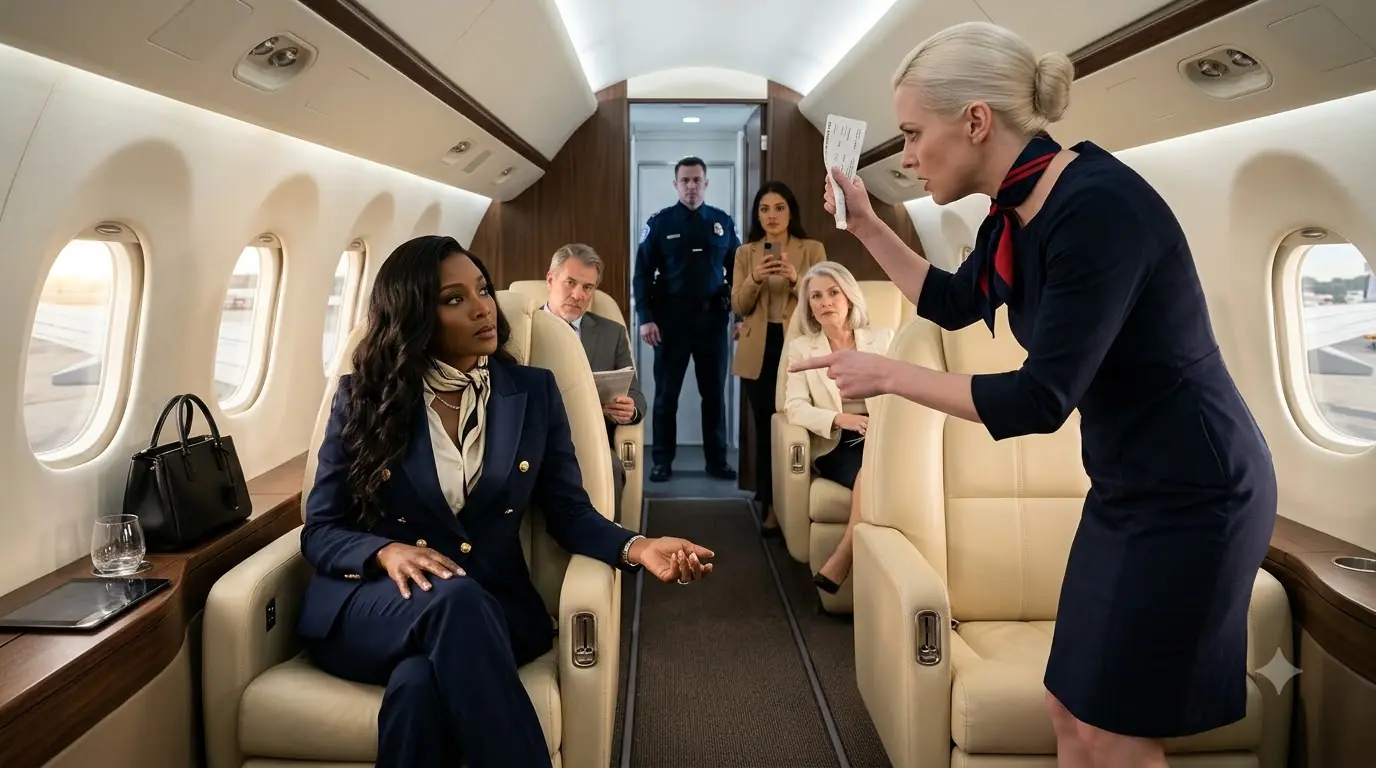
Ice clicked against the side of a glass, a handbag stopped halfway into an overhead compartment, and several passengers turned toward the second row with the same uneasy curiosity that draws people to an argument on a sidewalk.
At the window in seat 2A, Maya Whitfield sat with her shoulders straight, a navy blazer smooth across her back and a boarding pass resting beside her tablet. She had been on the aircraft for less than five minutes, and until Clare spoke, she had done nothing more disruptive than place her briefcase beneath the seat and accept a bottle of water. Yet the uniformed woman towering above her seemed to have decided that Maya's presence required an explanation.
"I'm in my assigned seat," Maya replied, looking up. "Two A."
Clare's eyes narrowed as if the answer itself were an insult. At thirty-six, she had mastered the cultivated elegance that the airline demanded of its senior cabin attendants: blonde hair pinned tightly at the back, makeup applied with exacting care, scarf folded into a perfect line, and a smile she could produce whenever a passenger looked influential enough to deserve it.
The smile was absent now. She stood half a step into Maya's personal space, blocking the aisle with a confidence that suggested she expected the passengers around them to confirm whatever she said next. "This section is for ticketed first-class passengers," she announced, loud enough for the entire forward cabin to hear.
Maya could see their reflections in the darkening window: the woman in uniform standing above, the woman in the seat remaining still, and beyond them a ring of faces pretending to be occupied. She understood the arrangement before anyone said another word. Clare had chosen an audience because she wanted compliance to look like a public demonstration of her authority.
Maya could have reached for a familiar name or a corporate telephone number and ended the confrontation almost immediately. Instead, she reached for the one thing an ordinary passenger would have been expected to produce: the boarding pass that had already been checked at the gate.
Only thirty minutes earlier, the airport had seemed like an entirely ordinary place to Maya. She had walked through a busy terminal with one small leather briefcase, avoiding the private transportation and advance escorts usually offered to executives in her position.
A series of meetings in Boston and an unannounced visit to one of the airlines in her company's portfolio had been enough reason to book the flight herself. She had chosen an afternoon departure and a window seat because she liked watching cities grow small beneath the wing. Nothing about the trip had been arranged to create a confrontation.
Her executive assistant had suggested a recognizable escort and the customary notification to airport management. Maya had declined both, not because she thought those services were inherently wrong but because she knew what happened when employees were warned that someone powerful was coming.