Freya’s Recovery After Being Left Outside a Shelter
Reader Theme:
Font Size:
24px
Freya’s Recovery After Being Left Outside a Shelter
PART 2 — CURRENT CONDITION UPDATE
Freya remains under close veterinary care after receiving an emergency blood transfusion for immune-mediated hemolytic anemia, commonly called IMHA. She is stable and more responsive than she was upon arrival, but her condition remains serious. The next several weeks will determine whether medication can bring the immune destruction under control.
Red blood cells carry oxygen throughout the body. When their number falls rapidly, the heart and lungs must work harder to deliver enough oxygen to the brain, muscles, and organs. A dog may become weak, breathe rapidly, collapse, or develop life-threatening complications.
Freya’s first packed cell volume, a measurement of the percentage of blood composed of red blood cells, was far below the normal range. It continued falling during the first hours of hospitalization despite intravenous support. Her gums became nearly white, and she could no longer stand safely.
The emergency team began a transfusion using blood from a carefully screened donor dog. Compatibility testing was performed first to reduce the risk of a reaction. Freya’s temperature, heart rate, breathing, blood pressure, and behavior were monitored continuously while the blood was administered slowly.
During the first portion of the transfusion, she remained quiet with her head resting on a folded blanket. She did not develop facial swelling, vomiting, hives, fever, or sudden breathing difficulty. Once the team confirmed that she was tolerating the blood, the transfusion continued at the prescribed rate.
The donated red cells did not cure the disease. They provided temporary oxygen-carrying support while medication began suppressing the abnormal immune response. Without that support, Freya might not have survived long enough for the treatment to take effect.
Her red blood cell level rose after the transfusion and has remained above the critical range. It has not returned to normal, but the rate of destruction appears to have slowed. The veterinary team checks her blood frequently because a stable result over only a few hours is not enough to declare the crisis over.
Laboratory examination found evidence that Freya’s red blood cells were being damaged and removed prematurely. Her blood contained an increased number of immature red cells, showing that her bone marrow was trying to replace what had been lost.
A saline agglutination test also showed abnormal clumping of red cells. Combined with the rapid anemia, elevated bilirubin, and changes seen on the blood smear, the results strongly supported immune-mediated destruction.
Freya’s urine was dark when she arrived. Testing showed pigment associated with red blood cell breakdown rather than a large amount of active urinary bleeding. Her urine has become lighter as treatment has progressed, though it is still monitored closely.
Her bilirubin level was elevated, which caused a faint yellow tint along parts of her gums and the whites of her eyes. This occurs when the body breaks down more red cells than the liver can process normally. The discoloration is beginning to fade but has not disappeared completely.
The medical team has started immune-suppressing medication. The initial steroid dose is considerably higher than the dose used for ordinary inflammation because the goal is to stop the immune system from attacking circulating red blood cells.
High-dose steroids can cause increased thirst, frequent urination, panting, restlessness, hunger, and muscle weakness. These effects are expected to some degree, but caregivers must distinguish manageable side effects from signs of a new emergency.
Freya began drinking more within the first two days of treatment. She is offered frequent bathroom opportunities and always has access to fresh water. Water is never restricted because dehydration could increase the risk of complications.
A second immune-modulating medication may be added if her red blood cell count falls again or if the team cannot reduce the steroid dose safely. The choice will depend on her laboratory response, organ function, and tolerance of current treatment.
One of the greatest risks associated with IMHA is abnormal blood clot formation. The same inflammatory process damaging red blood cells can make the blood more likely to clot. A clot traveling to the lungs can cause sudden breathing difficulty or collapse even when the anemia appears to be improving.
Freya is receiving medication to reduce this risk. It does not eliminate the possibility of clotting, so her resting respiratory rate, gum color, heart rate, and comfort are checked regularly.
A sudden increase in breathing effort, unexplained coughing, weakness, collapse, or refusal to move would require immediate assessment. Her caregivers have been told that these signs cannot be watched at home for several hours in the hope that they pass.
So far, Freya’s breathing has remained comfortable at rest. Her oxygen level is stable without continuous supplementation, and chest X-rays did not reveal a visible pulmonary clot. Small clots may not appear on standard imaging, which is why preventive treatment and observation remain necessary.
The veterinary team has also searched for an underlying trigger. IMHA can occur without an identifiable cause, but infections, certain cancers, medications, and other inflammatory diseases may sometimes contribute.
Freya tested negative on the initial panel for common tick-borne infections. A more comprehensive laboratory panel was submitted because she was found outdoors and her previous medical history is unknown. Preventive treatment was considered while results were pending, but all medications had to be weighed against her current condition.
Chest X-rays and an abdominal ultrasound did not reveal an obvious tumor. Her spleen was mildly enlarged, which can occur when the organ is processing damaged blood cells. There was no splenic mass, abdominal bleeding, or enlarged lymph node that could be safely sampled.
Her liver appeared mildly reactive but not structurally damaged. Kidney measurements remained within acceptable limits. These findings allow the team to continue the necessary medications while repeating blood chemistry panels to identify any developing side effects.
No microchip was found, and the shelter has not received reliable medical records for Freya. Her age is estimated at approximately seven to nine years based on her teeth, eyes, and physical condition. Without her history, the team cannot know whether she had previous episodes of weakness or anemia.
At this stage, her disease is being classified as likely primary immune-mediated hemolytic anemia unless additional testing identifies a trigger. That means her immune system may have begun attacking red blood cells without a separate disease that can be removed or cured.
Freya’s appetite was poor during the first day. She smelled several foods but turned away, likely because anemia and elevated bilirubin were making her nauseated. Medication was given to control nausea and protect her stomach during high-dose steroid treatment.
A technician offered small amounts of warmed, easily digestible food by hand. Freya accepted a few bites, then rested her chin against the technician’s wrist. No one forced her to eat a full meal while she was unstable.
After the transfusion, her interest in food improved. She finished approximately one-third of a small serving and drank without assistance. By the following day, she was eating most of each meal.
Freya now receives several moderate portions rather than one large meal. The food provides adequate protein and calories without an excessive amount of fat, which could be difficult for her body to process during illness.
Her increased steroid-related hunger has already become noticeable. She watches food preparation closely and may search the floor after finishing. Her caregivers use part of her measured meal for medication and quiet enrichment rather than adding large numbers of treats.
She has not vomited since the first night, and her stool remains formed. Because steroid treatment can irritate the digestive tract, staff monitor for black stool, visible blood, abdominal pain, or sudden appetite loss.
Freya was mildly dehydrated on arrival but now maintains hydration with drinking and carefully managed fluid support. Excessive intravenous fluids are avoided because severe anemia can place additional strain on the cardiovascular system.
Her body condition is slightly below ideal. The muscles over her hindquarters and shoulders are reduced, though the loss may have developed before this crisis. The veterinary team will not attempt rapid weight gain while her blood values and medications are still changing.
Physical activity remains restricted. Even though Freya appears brighter, her blood does not yet carry oxygen as efficiently as it should. Strenuous exercise could cause weakness, collapse, or excessive cardiac strain.
Her outings are limited to slow bathroom walks using a padded harness. A caregiver remains close enough to support her if her legs begin to tremble. She is not allowed to climb stairs, jump into a vehicle, or walk on slippery floors.
During her first supported outing after the transfusion, Freya stood for less than a minute. Her back legs shook, and she leaned into the sling before returning to her bed.
Two days later, she walked from the treatment area to a small patch of grass with only light assistance. She paused several times but did not collapse. On the return trip, she looked toward the clinic door and continued at her own pace.
Freya can now rise independently on most attempts. She still stands slowly and sometimes needs help placing one rear foot beneath her. The weakness is expected to improve as her anemia stabilizes, though steroid medication may eventually contribute to muscle loss if high doses are required for a long time.
Nonslip mats cover the floor around her bed and bowls. She rests on thick padding that supports her elbows and hips. Her position is checked regularly because she still spends much of the day lying down.
Orthopedic examination revealed mild arthritis in both hips and along her lower spine. There was no fracture or recent traumatic injury. Pain medication options are limited while she is receiving high-dose steroids because some common anti-inflammatory drugs cannot be combined safely with them.
For now, her joint discomfort is managed with supportive bedding, controlled movement, warm compresses, and a veterinarian-approved plan that avoids dangerous drug interactions. More options can be considered once the steroid dose has been reduced.
Freya’s coat concealed several minor skin problems. She had dry, flaky areas along her back, irritated skin beneath her old collar line, and small mats behind her legs. No severe wounds or active mange infection were found.
Grooming has been divided into very short sessions so she does not become tired. A caregiver brushes one area while Freya remains lying comfortably. The heaviest mats were clipped rather than pulled.
Her coat remains dull, but the loose undercoat is gradually being removed. Her skin is less flaky, and she no longer scratches repeatedly at night. Parasite prevention was selected carefully according to her current medications.
Freya’s nails were long and reduced her traction. They were shortened gradually to avoid cutting sensitive tissue. The improvement helps her place her paws more securely during supported walks.
Her mouth showed moderate dental disease, including heavy tartar and inflamed gums. There was no obvious oral mass or urgent abscess. A dental procedure will wait until her anemia is controlled because anesthesia and even minor bleeding would be unsafe now.
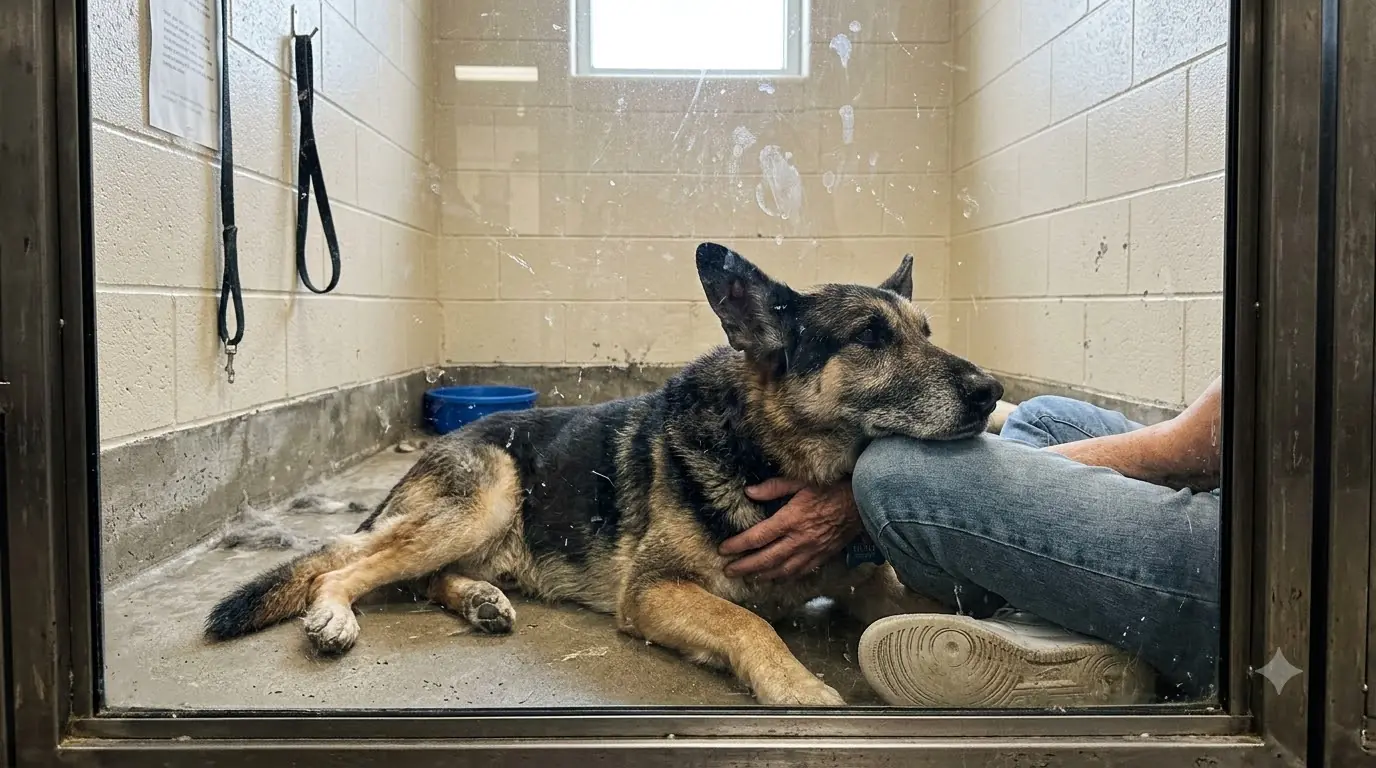
Emotionally, Freya began seeking human contact before her body was stable enough to do much else. When shelter staff first found her, she used the little strength she had to press her head against someone’s leg.
That behavior has continued in the hospital. Freya does not ask for attention by barking or pawing. She shifts closer until part of her body touches a familiar person, then rests.
During the first transfusion, a technician sat beside her kennel. Freya kept her muzzle against the technician’s shoe while the blood entered through the intravenous line. When the technician moved, Freya raised her head and followed the motion with her eyes.
Staff began placing a chair beside her bed during quieter parts of the day. No one demands interaction. They sit close enough for her to make contact if she chooses.
Freya often moves her head onto a person’s ankle or knee and remains there until she sleeps. This need for physical reassurance may reflect her temperament, fear, previous life, or the vulnerability of being severely ill. We cannot know which explanation is correct.
Her caregivers avoid romanticizing the behavior as proof that she understands every medical decision being made. What is clear is that familiar presence lowers her tension. Her breathing slows, her muscles soften, and she rests more deeply when someone sits nearby.
The shelter initially placed a small sign in her room reminding visitors to take all the time they needed. That message became part of her recovery. Freya does not require constant stimulation; she benefits most from someone willing to remain still.
Her first foster transition was delayed because her blood values remained too unstable for discharge. Once the veterinary team felt she could safely leave intensive care, she moved into a medical foster home located close to the hospital.
During the drive, Freya rested on a padded platform secured across the rear seating area. A second person sat beside her and monitored her breathing and gum color. She remained calm and slept through most of the trip.
At the foster home, Freya walked slowly into a quiet room prepared on the ground floor. She examined the bed, water bowl, and open doorway before lying beside her caregiver’s legs instead of using the bed.
The caregiver remained on the floor until Freya fell asleep. Later, a folded blanket was placed beside the chair, allowing her to rest close without lying directly on the concrete or hardwood surface.
Freya now uses her orthopedic bed regularly. She positions herself so she can see the caregiver’s chair and the room’s entrance. At night, she sleeps for several hours without raising her head.
She remains sensitive to departures. If her caregiver picks up keys or walks toward the front door, Freya becomes alert and attempts to stand. Because sudden effort can exhaust her, separation training is beginning with extremely small steps.
The caregiver walks to the doorway, returns, and sits before Freya rises. Over time, the movement will become ordinary rather than a signal that she is about to be left.
Freya can now remain on her bed while the caregiver enters the kitchen for a few minutes. Her eyes follow, but her head often remains down. This reduces unnecessary exertion and suggests that she is beginning to trust the household routine.
She has shown little interest in active toys, which is appropriate during recovery. Her preferred enrichment involves sniffing small portions of food hidden in a loosely folded towel directly beside her bed.
The first time, she watched the towel without moving. After smelling the food, she used her nose to unfold one section. She now begins searching as soon as the towel is placed nearby.
Freya also responds to quiet verbal cues. She has learned to rest her chin on a padded surface for blood draws and medication. This allows staff to perform necessary care with less restraint and stress.
Blood collection will remain frequent during the early stages of treatment. Her packed cell volume is checked alongside bilirubin, reticulocyte count, platelet count, and blood chemistry values.
The team wants to see that Freya’s red blood cell level is not only stable but rising through her own production. Donor cells eventually leave circulation, so long-term recovery depends on stopping destruction and allowing her bone marrow to rebuild the supply.
Her latest result showed a slight increase without another transfusion. Her bilirubin also decreased, and her gum color is visibly pinker. These are encouraging signs that the current treatment may be working.
However, IMHA can relapse suddenly. A dog may appear brighter one day and show a significant decline the next. Freya will continue close monitoring even if several tests are favorable.
If her red blood cell count falls into the critical range again, another transfusion may be necessary. Repeat transfusions require careful compatibility testing because the immune system may become more likely to react after exposure to donor blood.
Once Freya maintains a safe red blood cell level for an appropriate period, the veterinarian will begin reducing the steroid dose gradually. It cannot be stopped suddenly. Tapering may take several months and will be guided by repeated tests.
Reducing medication too quickly could allow the immune attack to return. Keeping the dose excessively high for too long could create serious side effects. Finding the balance requires patience and consistent follow-up.
Freya will remain on anti-clotting medication through the highest-risk portion of recovery. The duration will depend on her blood values, inflammatory markers, mobility, and veterinary assessment.
Her foster caregiver keeps an emergency card listing her diagnosis, medications, transfusion history, and veterinary contacts. A copy travels with Freya to every appointment.
She is not ready for adoption. Her blood count must remain stable, her medication doses must be reduced safely, and her risk of clotting must decline. The rescue team also needs to understand how she functions once the immediate effects of severe anemia have resolved.
A future family will need to give medication exactly as prescribed, attend frequent blood tests, monitor subtle symptoms, and seek care quickly if her gums become pale or yellow, her breathing changes, or her strength declines.
Relapse is possible even after remission. Some dogs eventually discontinue immune-suppressing medication, while others require longer treatment. No responsible prediction can be made from Freya’s first improvement alone.
Today, she can stand, walk outside slowly, finish her meals, and lift her head when familiar footsteps enter the room. Her urine is lighter, her breathing is comfortable, and her red blood cell level has held without another transfusion.
She still becomes tired easily. Her body is healing from a crisis that deprived every organ of adequate oxygen, and the medication controlling the disease creates challenges of its own.
For now, Freya’s progress is measured in stable laboratory results and ordinary moments: walking to her water bowl, sleeping through a closing door, and choosing her bed instead of the cold floor.
She was left outside a shelter when she was too weak to stand. Now, whenever her strength fades, she rests against someone who has time to remain beside her.
Freya’s future is still uncertain, but she is no longer facing it alone.
News in the same category
Rex’s Recovery After Six Months Waiting With His Tennis Ball
Clockwork’s Recovery After 22 Months in the Shelter
A Puppy Stopped to Say Goodbye to His Senior Friend Before Leaving the Shelter
Bella’s Recovery After an Owner Surrender and Medical Crisis

A Tiny Dog Was Found Trapped Above Rushing Water Beside a Highway
Nova’s Recovery After Giving Birth to Six Puppies in a Shelter
Iris’s Recovery After Two Years in a Shelter Kennel
Grace’s Recovery After 202 Days in the Shelter
A Mother Dog and Her Five Puppies Were Abandoned in a Cardboard Box
Atlas’s Recovery After Five Months of Watching Visitors Pass
Lucky’s Recovery After Eight Months in a Shelter Kennel
What's next for Shadow after Jackie's death?
A Starving Dog Was Rescued After Being Trapped Without Food for Days
Captain’s Recovery After Seven Months in a Concrete Kennel
Daily’s Recovery After Losing Her Owner at Age 11
A Frightened Dog Was Found Trapped in a Thorn Bush Beside the Highway
Big Bear's viral eagle Jackie dies after weeks of intensive care