GETTING OLDER CAN CHANGE WHAT “A GOOD DAY” MEANS
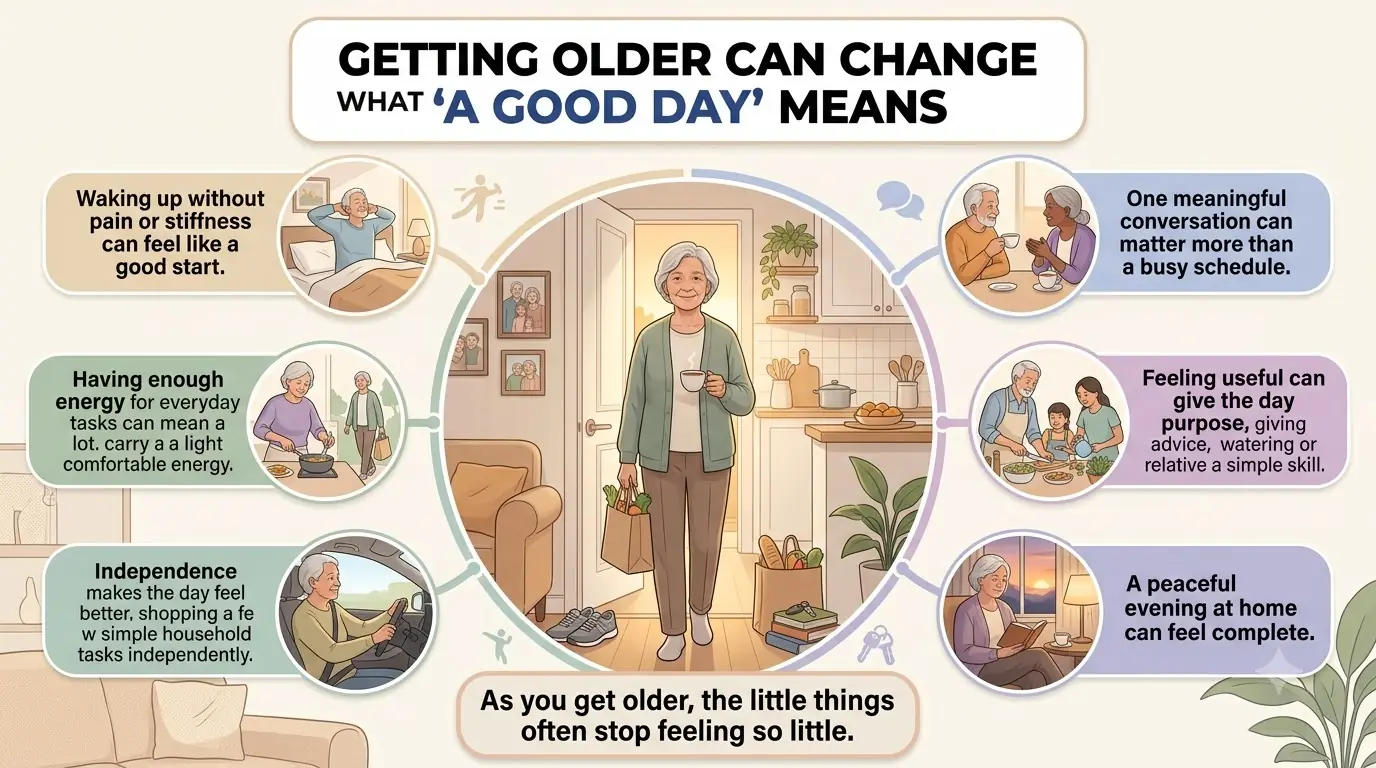
A good day can mean something very different at 70 than it did at 30. Earlier in life, a successful day might have meant finishing a demanding project, attending several social events, traveling somewhere new, or accomplishing as much as possible before bedtime.
Later in life, priorities often shift. Being able to get out of bed comfortably, prepare your own breakfast, drive to the store, take a walk, talk with someone you care about, or simply enjoy a peaceful evening can carry greater meaning.
That doesn't mean older adults stop wanting adventure, achievement, or new experiences. Aging is extraordinarily individual. But changes in health, mobility, energy, relationships, and responsibilities can make ordinary abilities feel more valuable because they are closely connected to something many people want to preserve for as long as possible: independence and quality of life.
Sometimes healthy aging isn't about doing more. It's about continuing to do the things that make everyday life feel like your own.
Why Our Definition of a “Good Day” Can Change With Age
Aging changes more than the body.
Retirement can change daily routines. Children establish lives of their own. Friends may move away or develop health problems. Physical abilities can change, and tasks that once happened automatically may require more planning.
At the same time, many older adults become increasingly aware of what contributes most to their quality of life.
It may not be an impressive schedule.
It may be waking comfortably, having enough strength to remain independent, enjoying meaningful relationships, feeling useful, and ending the day with a sense of contentment.
These seemingly ordinary experiences can represent several important dimensions of healthy aging.
1. Waking Up Without Pain or Stiffness Can Feel Like a Victory
Aches and stiffness become more common with age, although persistent pain shouldn't simply be dismissed as an unavoidable part of getting older.
Arthritis, previous injuries, chronic medical conditions, muscle weakness, and reduced physical activity can all contribute to discomfort.
For someone living with chronic pain, the difference between a difficult day and a good one may begin before breakfast.
Being able to stand comfortably, get dressed, walk through the house, and begin the morning without significant discomfort can influence the rest of the day.
Pain can affect much more than movement.
Persistent pain may interfere with:
- Sleep.
- Physical activity.
- Social participation.
- Mood.
- Concentration.
- Independence.
Someone who hurts when walking may gradually walk less. Less movement can contribute to weakness and poorer physical conditioning, potentially making activity even harder.
This is why ongoing pain deserves appropriate evaluation and management rather than automatically being accepted as “just aging.”
2. Having Enough Energy for Ordinary Activities Can Mean a Lot
Energy affects almost everything we do.
Cooking dinner, cleaning the house, taking a walk, gardening, shopping, and visiting friends all require physical and mental energy.
A person who once completed several errands without thinking about it may eventually need to pace activities throughout the day.
Some change in stamina can occur with age, but persistent or worsening fatigue isn't something to automatically ignore.
Fatigue can have many causes, including:
- Poor sleep.
- Anemia.
- Medication effects.
- Thyroid problems.
- Heart or lung conditions.
- Depression.
- Chronic illness.
- Physical deconditioning.
Sometimes the issue is simply that someone has become less active and consequently lost strength and endurance.
Regular physical activity can help maintain cardiovascular fitness, muscle strength, mobility, and everyday function.
When unexplained fatigue becomes persistent or begins interfering significantly with normal activities, medical evaluation is appropriate.
3. Managing Everyday Tasks Helps Preserve Independence
Driving to the grocery store may not sound particularly meaningful when you've been doing it for 40 years.
Neither does preparing breakfast, doing laundry, paying bills, taking a shower, or walking to the mailbox.
But these everyday activities collectively create independence.
Healthcare professionals often consider a person's ability to perform activities of daily living when evaluating functional health.
These include fundamental tasks such as:
- Bathing.
- Dressing.
- Eating.
- Toileting.
- Moving safely around the home.
There are also more complex activities necessary for independent living, such as shopping, cooking, managing medications, handling finances, and transportation.
A decline in these abilities can substantially affect someone's quality of life.
That's why maintaining strength, balance, vision, hearing, cognitive health, and mobility isn't merely about preventing disease.
It's about preserving the ability to live everyday life on your own terms.
Independence Isn't the Same as Never Accepting Help
There's another important side to this conversation.
Healthy independence doesn't require doing absolutely everything alone.
Someone might stop driving but remain highly independent by using reliable transportation.
They may need assistance carrying groceries while still choosing and preparing their own food.
They may use a cane or walker that allows them to continue going places safely.
Assistive devices and appropriate support don't necessarily represent lost independence.
Sometimes they preserve it.
The goal is to provide enough assistance to make everyday life safer without unnecessarily taking over tasks someone can still perform.
4. One Meaningful Conversation Can Change the Entire Day
A busy social calendar isn't the only measure of social well-being.
For some older adults, one genuine conversation can be more satisfying than hours spent around people without meaningful interaction.
This becomes especially important when social networks change.
Retirement may eliminate daily conversations with coworkers.
Friends may move away, become ill, or die.
Adult children may have demanding careers and families.
Mobility or transportation difficulties may make social activities harder to access.
As a result, ordinary conversations can become more valuable.
A phone call doesn't need to contain important news.
A visit doesn't need to involve an elaborate activity.
Talking about dinner, grandchildren, sports, a television show, family memories, or something that happened during the day can maintain connection.
The quality of social interaction matters.
Someone can be surrounded by family and still feel lonely if nobody genuinely talks with them.
Hearing Problems Can Quietly Affect Social Connection
Sometimes an older adult appears unusually quiet at family gatherings not because they've lost interest, but because they can't clearly hear the conversation.
Hearing loss becomes increasingly common with age.
When conversations become difficult to follow, socializing requires more effort.
Someone may repeatedly ask people to speak louder.
Eventually, they may stop asking.
They sit quietly while everyone else talks.
Over time, this can contribute to social withdrawal.
If an older adult becomes less engaged in conversations, hearing difficulties are one possible explanation worth considering.
Appropriate hearing evaluation and treatment may make communication easier and help someone remain socially engaged.
5. Feeling Useful Can Give the Day Purpose
Older adults don't only want to be cared for.
Many want opportunities to care about—and contribute to—other people.
This can become complicated after retirement or when adult children become fully independent.
Someone who spent decades being needed may suddenly find that other people are constantly asking what they can do for them.
Being supported is important.
But so is having opportunities to contribute.
Purpose can come from many places:
- Helping grandchildren.
- Preparing a family meal.
- Volunteering.
- Caring for plants or pets.
- Mentoring someone.
- Sharing professional knowledge.
- Teaching a skill.
- Participating in a community.
- Helping a neighbor.
- Offering advice when it's genuinely wanted.
Purpose doesn't require having a job.
Nor does someone need to accomplish something impressive every day.
Sometimes knowing that another person appreciates your presence is enough to make the day meaningful.
6. A Peaceful Evening Can Be Enough
Modern culture often treats a full calendar as evidence of a full life.
But busyness and fulfillment aren't necessarily the same thing.
For many people, aging brings a different appreciation of quiet routines.
A peaceful evening might mean preparing a favorite meal, sitting outside, reading, watching a familiar program, listening to music, talking with a spouse, or simply enjoying a comfortable home.
There is nothing inherently unhealthy about enjoying solitude.
The important distinction is choice.
Choosing a quiet evening because it brings contentment is very different from staying home because pain, depression, transportation difficulties, fear of falling, or social isolation have made other options inaccessible.
Healthy aging should leave room for both connection and solitude.
The Little Things Often Represent Bigger Things
Why can seemingly ordinary experiences become so meaningful?
Because they often represent something larger.
A morning walk represents mobility.
Cooking represents independence.
Driving represents freedom.
A conversation represents connection.
Helping someone represents purpose.
A peaceful evening represents security and contentment.
This perspective can be particularly useful for families caring for older parents.
What looks like a small activity from the outside may represent an important piece of someone's identity.
Don't Take Over Too Quickly
Adult children naturally want aging parents to be safe.
Sometimes that instinct leads families to begin doing things their parents can still manage.
They carry everything.
Make every appointment.
Take over cooking.
Handle every financial decision.
Answer questions on the parent's behalf.
The intention may be loving, but unnecessary assistance can sometimes reduce autonomy.
When safety allows, ask:
“Would you like help?”
rather than automatically assuming help is necessary.
An older adult may perform a task more slowly than before without being incapable of doing it.
Preserving independence sometimes means allowing extra time.
Maintaining Strength Helps Protect Everyday Freedom
One of the most practical ways to support independence later in life is to preserve physical function.
Muscle strength helps people:
- Stand up from chairs.
- Climb stairs.
- Carry groceries.
- Maintain balance.
- Walk comfortably.
- Recover from a stumble.
- Perform household activities.
Regular physical activity—including appropriate resistance and balance exercises—can help maintain function as people age.
Adequate nutrition is also important.
Protein provides amino acids needed to maintain and repair muscle tissue, while an overall balanced diet supports general health.
Exercise should be adapted to someone's abilities and medical conditions. People with significant mobility limitations, heart or lung disease, or a history of falls may benefit from professional guidance.
When Changes in Everyday Life Deserve Attention
Some changes happen gradually and can be addressed with appropriate support.
Others may indicate an underlying health problem.
Talk with a healthcare professional if an older adult develops persistent or worsening:
- Fatigue.
- Pain.
- Difficulty walking.
- Balance problems.
- Frequent falls.
- Shortness of breath.
- Memory problems.
- Difficulty managing familiar tasks.
- Loss of interest in previously enjoyable activities.
- Significant social withdrawal.
A noticeable decline in everyday function shouldn't automatically be attributed to age.
Medication side effects, anemia, sleep disorders, depression, infections, cardiovascular disease, neurological conditions, and many other problems can affect function.
Some causes are treatable.
Sudden Changes Are Particularly Important
A gradual change over years is very different from someone suddenly becoming unable to perform activities they managed normally yesterday.
Seek prompt medical attention for a sudden decline, particularly when accompanied by:
- New confusion.
- One-sided weakness or numbness.
- Difficulty speaking.
- Sudden severe dizziness.
- Chest pain.
- Severe shortness of breath.
- Fainting.
Sudden functional changes can indicate a medical emergency and shouldn't simply be explained away as aging.
How Families Can Help Create More “Good Days”
You don't need to organize extraordinary experiences.
Often, supporting quality of life means protecting ordinary things.
Call without needing anything.
Invite an older parent along even if they occasionally decline.
Ask for their opinion.
Let them help when they want to and safely can.
Make transportation easier.
Address hearing, vision, pain, or mobility problems that are limiting activities.
Most importantly, ask what actually makes a good day for them.
The answer may be different from what you expect.
Key Takeaways
- A good day can take on a different meaning as health, mobility, responsibilities, and relationships change with age.
- Comfortable movement can strongly influence everyday quality of life.
- Persistent fatigue or pain shouldn't automatically be dismissed as normal aging.
- Everyday activities such as cooking, shopping, driving, and managing the home can represent independence and freedom.
- Accepting appropriate assistance doesn't necessarily mean losing independence.
- Meaningful conversations can matter more than the number of social activities someone attends.
- Feeling useful and able to contribute can provide an important sense of purpose.
- Enjoying quiet time is healthy when it is genuinely chosen rather than caused by unwanted isolation or physical limitations.
- Maintaining strength, balance, social connection, and access to meaningful activities can help protect quality of life.
As you get older, the little things often stop feeling so little—because many of them represent the independence, connection, purpose, and comfort that make everyday life meaningful.
Medical Disclaimer
This article is for general educational purposes only and is not a substitute for professional medical or mental health advice, diagnosis, or treatment. Aging experiences vary widely, and changes in pain, energy, mobility, mood, memory, or everyday functioning can have many causes. Persistent, worsening, or sudden changes should be discussed with a qualified healthcare professional.