"Another street thug thinks he's Perry Mason." Judge Morrison looked down at the 18-year-old Black defendant and laughed aloud. The packed courtroom watched as Marcus Williams stood in handcuffs, wearing a wrinkled public defender's suit two sizes too big. The judge dismissed him with a theatrical wave, as if swatting away a fly.
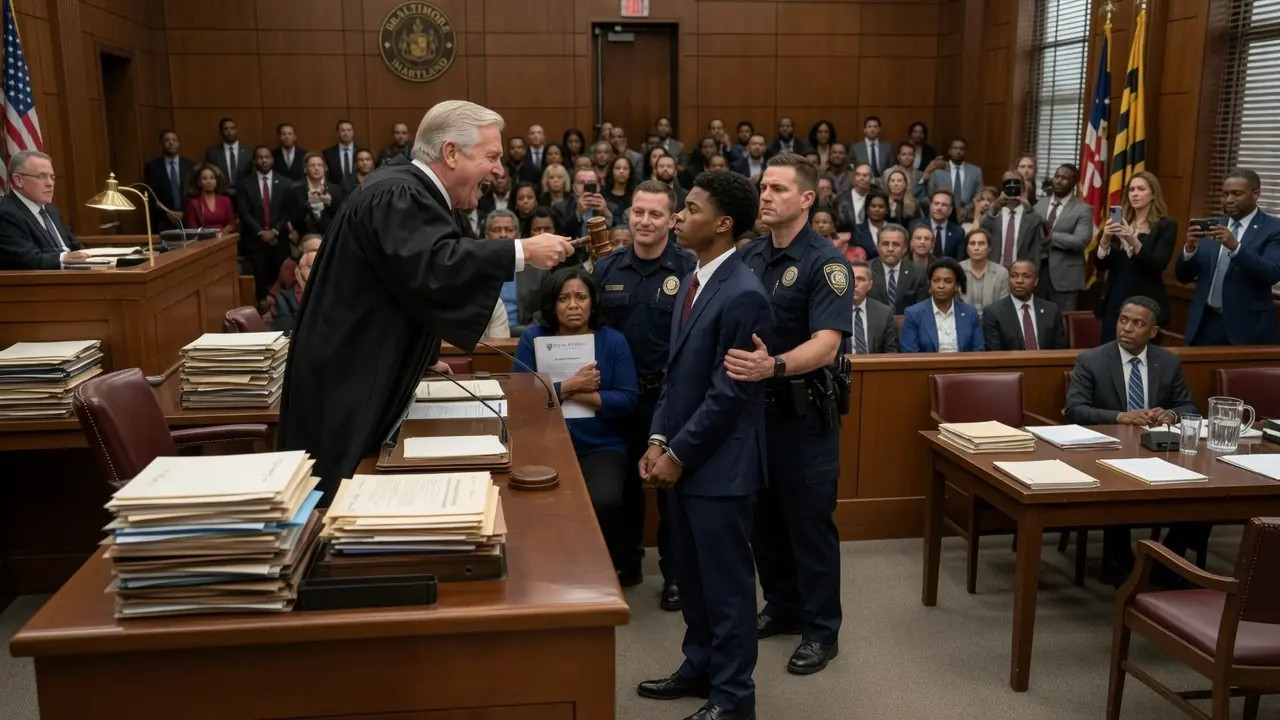
"Son, save the act. This isn't a television courtroom." The prosecutor smirked while court officers shook their heads. Even the bailiff rolled his eyes as Marcus tried to speak. Judge Morrison cut him off mid-sentence.
"You're going to prison, boy. The only question is for how long." Marcus's mother sat frozen in the gallery, watching her Harvard-bound son being treated with open contempt. Her hands trembled as she clutched his acceptance letter. The judge reached for his gavel, ready to destroy the young man's future with a single strike.
Four months earlier, Marcus Williams had stood on a completely different stage.
As valedictorian of Benjamin Banneker High School, he delivered a graduation speech that brought three hundred people to their feet. His voice carried the confidence of someone who had never tasted defeat. "We are not prisoners of our zip code," Marcus declared, gesturing toward the neighborhood, visible through the auditorium windows. "We are architects of our destiny." His Harvard University acceptance letter sat framed on his bedroom wall like a trophy.
It represented a full academic scholarship, a pre-law track, and a direct path toward Harvard Law School. His SAT score of 1580 put him in the top 1% nationally. But Marcus had earned something even rarer: respect from teachers who had watched him transform from a quiet 7th grader into an intellectual force. While his classmates spent summer break at the beach or playing video games, Marcus punched a time clock at East Baltimore Public Library. Forty hours a week shelving books, teaching elderly patrons how to use computers, running reading programs for kids who reminded him of himself at eight years old.
Every dollar went straight into his college fund because, even with a full scholarship, life at Harvard would demand more than his family could provide. The library became his sanctuary. After closing time, when the last patron shuffled out and doors clicked shut, Marcus would claim his favorite spot in the law section. Constitutional law textbooks became his bedtime reading.
Supreme Court cases replaced social media scrolling. He had already mapped his future. He wanted to become a civil rights attorney who fought for people who looked like him and came from neighborhoods like his. His mother, Patricia Williams, made this dream possible through sheer force of will.
As a registered nurse at Johns Hopkins Hospital, she worked three 12-hour shifts every week, plus weekend doubles when the unit needed coverage. She had raised Marcus alone since his father's death from a heart attack when the boy was seven, pouring every ounce of strength into ensuring her son escaped the gravitational pull of their circumstances. "Baby, you're going to be the first attorney in our family," she would tell him, usually while studying for her own nursing certification exams at the same kitchen table where Marcus completed homework assignments that would have challenged college students. East Baltimore wasn't the kind of neighborhood people usually escaped from successfully.
Abandoned row houses sat like broken teeth along streets where corner stores operated behind bulletproof glass and ambulance sirens provided a constant soundtrack. But Patricia Williams had created something miraculous in their small apartment. A place where education was sacred, excuses were forbidden, and dreams were treated like blueprints for the future. Everything shattered on a humid Thursday evening in late August.
Marcus finished his library shift at exactly 9:00, as he did every night. The fifteen-minute walk home took him through streets he had navigated safely for 18 years. He was thinking about a Supreme Court case he had been studying, Miranda versus Arizona, when blue lights suddenly painted the sidewalk behind him. Officer Michael Williams stepped out of the patrol car with his hand already resting on his radio.
He was no relation to Marcus, just one of those cruel coincidences that life throws at you when you least expect it. "Hold up right there," the officer commanded, his voice carrying 30 years of assumed authority. "Good evening, officer," Marcus replied politely, exactly as his mother had drilled into him since childhood. "Keep your hands visible. Speak respectfully. Don't give them any excuse to escalate." Three blocks away, Jimmy Davis's corner store had been robbed at gunpoint twenty minutes earlier. The perpetrator was described as a young Black male approximately six feet tall, wearing dark clothing and a baseball cap. Marcus Williams stood five feet eight inches in his bright yellow library volunteer shirt, carrying textbooks and his employee ID badge. But Officer Williams saw what he expected to see.
"Turn around and put your hands on the car," Officer Williams ordered.
"Sir, I think there might be some confusion," Marcus replied. Store owner Jimmy Davis appeared from around the corner, breathing heavily from running. He took one look at Marcus and pointed a shaking finger. "That's him. That's the one who robbed me." Marcus felt his world tilt sideways.
"Mr. Davis, you know me. I helped your daughter with her college applications last month at the library." But Davis's eyes held something Marcus had never seen before. Not confusion, but certainty. Deadly, absolute certainty.
"I know exactly what I saw," Davis declared. "He fits the description perfectly." The handcuffs clicked shut around Marcus's wrists, cold metal against warm skin. As he was pushed into the backseat of the patrol car, Marcus could see his future dissolving like sugar in rain.
Harvard University, law school, civil rights attorney. All of it disappearing behind a wall of flashing blue lights. The fluorescent lights in the courthouse meeting room flickered like a broken heartbeat, casting harsh shadows across the scratched metal table. Marcus sat across from his court-appointed attorney, David Carter, a man drowning in case files and caffeine addiction.
Carter's tie hung loose around his neck, and his eyes held the glassy exhaustion of someone who had given up fighting the system years ago. "Marcus, listen to me carefully," Carter said, not bothering to look up from the thick folder in his hands. "Judge Morrison sent three kids to adult prison just last week. One of them was an honor-roll student just like you. It didn't matter."
Marcus leaned forward, his voice steady despite the chaos spinning in his chest. "Mr. Carter, I have security footage from the library—timestamped video showing me at the reference desk during the exact time of the robbery." Carter finally looked up, his expression mixing pity with impatience.
"Kid, you think I haven't heard that before? Everyone's innocent. Everyone has an alibi. Everyone has evidence that will magically save them."
"But this is actual proof."
"No." Carter slammed the folder shut, the sound echoing off the concrete walls. "This is an adult felony court. Armed robbery carries a mandatory sentence of three to five years."
Judge Morrison doesn't care about your high school grades or your college dreams; he cares about statistics and his re-election campaign. The public defender pulled out a standard plea agreement form already partially filled out. Eighteen months in state prison, possibly twelve with good behavior.
"Take it and thank me later." Marcus stared at the document that would brand him a convicted felon for the rest of his life. "You're asking me to confess to a crime I didn't commit." "I'm asking you to be realistic about a system that chews up kids like you and spits them out."
Carter's voice carried the weight of a thousand lost cases. "I have 237 active files. I can spend fifteen minutes on your case, or I can spend three hours and watch you get sentenced to five years anyway. Your choice." Marcus felt something cold settle in his stomach.
This wasn't justice. This was an assembly line processing human lives like factory widgets. "I need time to think."
Carter was already packing his briefcase. "You have until tomorrow morning. After that, the offer disappears, and you're facing maximum penalties." The door slammed shut, leaving Marcus alone with the weight of an impossible decision. That evening, Marcus sat at his bedroom desk, staring at his laptop screen. The Harvard University admissions portal displayed a message that felt like a punch to the chest.
"Due to pending felony charges, your admission to Harvard University has been withdrawn, effective immediately." Four years of perfect grades, hundreds of hours of community service, SAT scores that had made guidance counselors weep with joy. All of it erased by a single email notification. His mother appeared in the doorway, her scrubs still wrinkled from a 12-hour shift saving lives at Johns Hopkins.