Hank and Lily’s Recovery After Four Broken Kennel Latches
PART 2 — CURRENT CONDITION UPDATE
Hank and Lily are now together in a medical foster home after Lily underwent surgery to repair a chronic diaphragmatic hernia. Lily is stable and breathing more comfortably, but her recovery remains closely monitored. Hank is physically doing well and continues to provide the calm presence that first helped her leave the back of the shelter kennel.
A diaphragmatic hernia occurs when the muscular wall separating the chest from the abdomen is torn. The diaphragm normally helps the lungs expand during breathing. When it is damaged, abdominal organs can move through the opening and occupy space inside the chest.
Lily’s X-rays showed portions of her liver and small intestine positioned farther forward than they should have been. The organs were pressing against the lungs, particularly on the right side. This explained her rapid breathing and reluctance to lie in certain positions.
The injury did not appear recent. There were no fresh external wounds, and the edges of the defect showed changes consistent with an older trauma. Lily may have been struck by a vehicle, kicked, crushed, or injured in another way before she was discovered. Her history is unknown, so the precise cause cannot be established.
Some dogs compensate for a chronic diaphragmatic hernia until stress, illness, or movement causes the organs to shift further. Lily’s breathing likely became more noticeable after she entered the shelter because fear kept her tense and alert.
The surgical team recommended repairing the defect before trapped tissue lost its blood supply or her lungs became more compromised. The operation carried significant risk because moving the organs back into the abdomen could suddenly change pressure within both body cavities.
Before surgery, Lily received oxygen, intravenous fluids, and medication for pain and anxiety. The medical team avoided unnecessary handling and kept her in a quiet enclosure where she could see Hank through a secure divider.
Hank was not allowed inside her medical kennel, but his bed was positioned nearby. When Lily became restless, she looked toward him and gradually lowered herself onto the blanket.
During surgery, the veterinary team carefully returned the displaced organs to the abdomen. The liver tissue remained viable, and no section of intestine required removal. This was an important piece of good news because damaged bowel would have increased the risk of infection and complicated her recovery.
The tear in the diaphragm was closed with strong sutures. Air was removed from the chest so the lungs could expand normally again. A temporary chest tube was placed to evacuate remaining air and fluid after the procedure.
Lily’s right lung did not fully expand immediately. When lung tissue has been compressed for an extended period, it may take time to recover. She remained in an oxygen-supported enclosure and received continuous monitoring through the first night.
Her breathing was shallow but steady. Staff watched for a sudden drop in oxygen, abnormal heart rhythm, bleeding, or fluid accumulation. The chest tube was checked frequently but produced only a small amount of expected postoperative fluid.
By the following morning, Lily’s oxygen level had improved. Repeat chest imaging showed better lung expansion and no evidence that abdominal organs had moved back through the repair.
The chest tube was removed once air and fluid stopped accumulating. Lily tolerated the procedure with mild sedation and remained comfortable afterward.
She no longer needs continuous oxygen. Her breathing rate remains slightly higher than that of a completely healthy resting dog, especially when she becomes frightened, but it is substantially lower than it was before surgery.
Her foster caregiver records her respiratory rate while she sleeps. Counting while Lily is calm provides a more useful measurement than observing her after someone enters the room. The numbers have remained stable and are slowly trending downward.
A sudden increase in breathing effort, open-mouth breathing while at rest, pale or blue gums, collapse, abdominal swelling, or severe agitation would require immediate emergency care. The foster family has written instructions and direct contact information for the surgical hospital.
Lily’s incision runs along the center of her abdomen. It remains clean, dry, and closed. She wears a soft recovery garment rather than a rigid plastic collar because the cone caused her to panic and breathe more rapidly.
The garment is removed several times daily so the incision can be checked for swelling, redness, heat, discharge, or missing sutures. Lily does not attempt to lick the area when supervised.
Her activity is strictly restricted. She may take only short leash trips outside for elimination. She cannot run, jump, climb stairs, wrestle, or stand on her hind legs while the diaphragm and abdominal incision heal.
Hank’s activity is managed separately so he does not accidentally invite her to play. He walks at different times and remains behind a gate when Lily moves through narrow spaces.
Lily receives pain medication on a set schedule. The team does not wait for obvious crying because dogs often hide discomfort. Her posture, breathing, appetite, facial tension, and willingness to change position are all used to assess pain.
During her first evening after surgery, Lily remained curled tightly and would not eat from a bowl. A technician offered warmed food from a spoon while Hank rested nearby. Lily smelled it several times and eventually accepted two small bites.
The next morning, she ate approximately one-quarter of a meal. Her portions were kept small because her abdominal organs needed time to adjust after being returned to their normal positions.
Lily now eats four small servings throughout the day. She usually finishes them if the caregiver places the bowl near her bed and then sits beside Hank several feet away.
She has not vomited, and her abdomen remains soft. Her stool was delayed after surgery, which was expected after anesthesia and reduced food intake. She has since passed a small, normally colored stool without straining.
Lily was underweight when rescued. Her ribs and hip bones could be felt easily, and there was limited muscle over her back. She cannot begin an exercise-based conditioning program until the surgical repair has healed.
For now, gradual nutritional recovery is the priority. Her food is complete, easily digestible, and divided into portions that do not overfill the abdomen. Her weight is checked weekly.
Lily has gained a small amount, although part of that change reflects improved hydration. The veterinary team will focus on a steady trend rather than attempting rapid weight gain.
Bloodwork before surgery showed mild anemia and changes consistent with stress and poor nutrition. Her red blood cell count fell slightly after the operation but stabilized without a transfusion.
Her kidney and liver measurements remain within acceptable ranges. The portion of liver trapped in her chest did not show evidence of permanent failure, but the values will be repeated during follow-up.
Lily’s paws were worn, and two nails were cracked. No toe was fractured. The damaged nails were trimmed and cleaned, and she now walks on grass or smooth ground during bathroom trips.
Her coat was dusty and contained scattered flea debris. Parasite control was given after the surgical team confirmed it would not interfere with her recovery. Bathing has been postponed until her incision is fully sealed.
Hank’s medical evaluation was much less urgent. His bloodwork, heartworm test, urine results, and major organ values were normal. He is close to an appropriate weight and eats well.
The tips of several teeth are worn, likely from chewing hard objects and repeatedly working at kennel hardware. One lower canine has a small chip, but dental X-rays showed no exposed root or active infection.
Hard chews and abrasive tennis balls have been removed. Hank receives durable but softer enrichment items that are less likely to damage his teeth. A professional dental cleaning can be scheduled after Lily’s immediate recovery period.
Hank also has mild arthritis in both elbows. X-rays showed early degenerative changes but no severe deformity. Months of turning and pacing on concrete may have contributed to his stiffness.
He receives a veterinarian-approved joint supplement and controlled daily walks. An anti-inflammatory medication is available for uncomfortable days, and his kidney and liver values will be monitored if long-term use becomes necessary.
Nonslip rugs cover the foster home’s main paths. Hank rises easily and does not limp during ordinary walking, though he is sometimes stiff after sleeping.
The foster caregiver has started simple strengthening exercises with him in a separate room. These include slow sit-to-stand movements and controlled weight shifts. Sessions are brief so he does not become overly excited and disturb Lily.
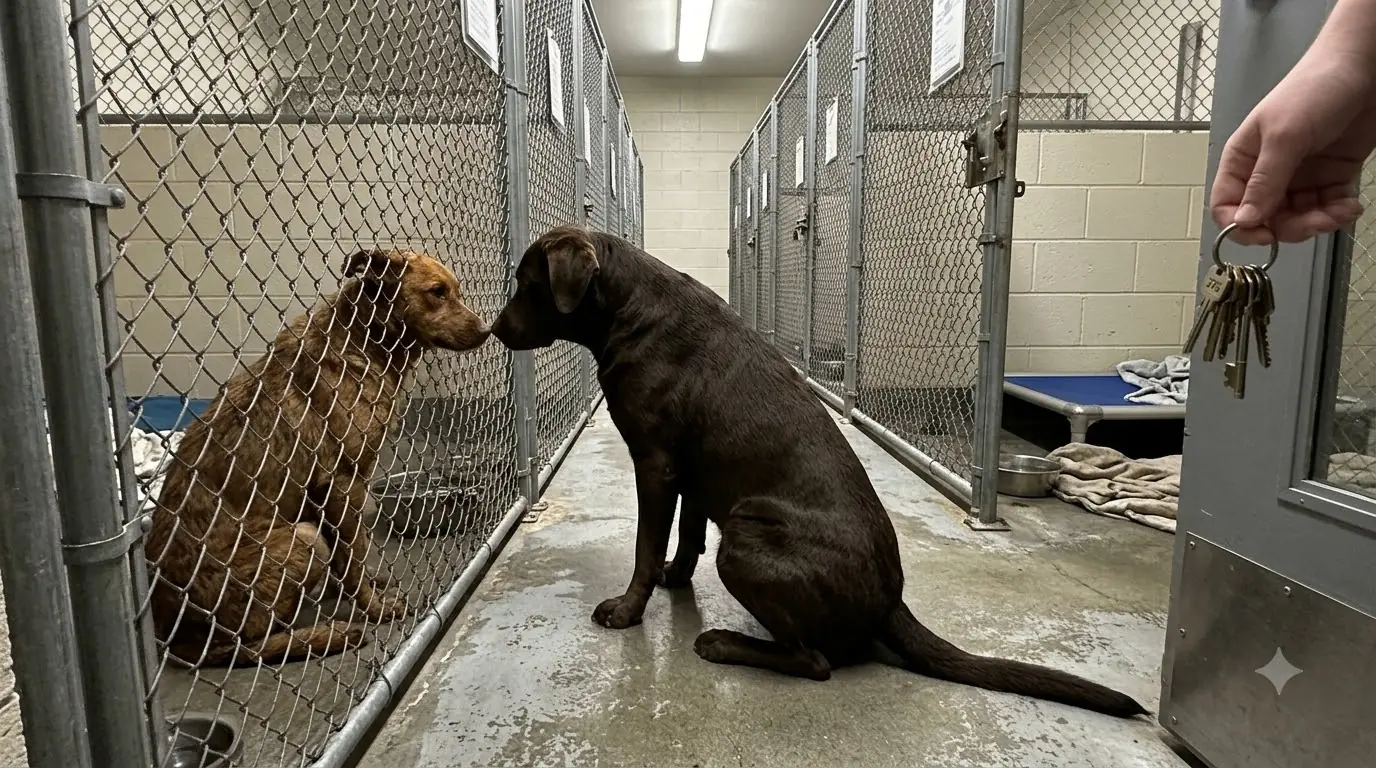
The most unusual part of Hank’s shelter behavior was his repeated opening of the kennel latch. Staff repaired or reinforced it four times. He did not run toward the exit, food-storage area, or another active dog.
Every time he left his enclosure, he went to Lily’s door.
We cannot know exactly why Hank responded to her. He may have noticed her fear, been drawn to a new dog, or simply found comfort in sitting near someone else. It would be inaccurate to claim that he understood her medical condition.
What staff could observe was consistent: Lily ate more, rested closer to the front of her kennel, and recovered from handling more quickly when Hank was visible.
Their relationship has continued outside the shelter. It is close but not frantic. Hank does not constantly lick, climb on, or crowd Lily. He usually chooses a place several feet away and faces the same direction.
During Lily’s first night in foster care, she slept inside a large recovery pen while Hank rested outside it. She woke frequently and looked through the bars. Each time she saw him, she lowered her head again.
Hank woke when she shifted but did not scratch at the barrier. He moved closer once, lay against the outside edge, and remained there until morning.
The foster family has preserved this arrangement. The dogs can see and smell one another, but the barrier protects Lily from accidental contact while her incision heals.
Hank is removed from the room during medication and incision checks if his presence makes the space too crowded. He waits behind a second gate and returns only after the caregiver has finished.
Lily initially panicked whenever Hank disappeared. She stood despite her pain, stared toward the doorway, and began breathing rapidly. The caregiver responded by making separations very short and predictable.
Hank now leaves for his walks while Lily receives a food puzzle or rests beside the foster caregiver. At first, he was gone for less than one minute. The duration increased only after Lily could remain calm.
She can now tolerate his absence for several minutes without standing. Her ears remain focused on the doorway, but she accepts food and sometimes lowers her chin onto the bed.
This training is important because the dogs must eventually function as individuals. Their bond can support recovery, but neither dog should experience severe distress whenever the other receives medical care or leaves the room.
Hank also needs reassurance. His shelter behavior suggests that watching Lily became part of his routine. In the foster home, he initially refused to walk farther than the driveway if she remained inside.
The caregiver used short routes that circled back toward the house. Hank learned that Lily would still be there when he returned. He now walks to the end of the block and comes back without pulling continuously toward home.
When Hank reenters, greetings remain quiet. Excited contact could cause Lily to jump or twist. He is asked to sit outside the recovery pen while she smells him through the barrier.
Lily’s tail now moves when he returns. She does not attempt to climb the pen or push through the gate. These calmer reunions show that both dogs are learning a safer routine.
Hank is affectionate with familiar people. He leans against legs, offers a paw, and follows household movement closely. He does not show aggression around food, toys, or bedding.
He does investigate door handles and gate latches. The foster family uses secure clips on all barriers and provides puzzle toys that allow him to manipulate safe objects with his nose and paws.
One puzzle contains sliding panels that release pieces of food. Hank learned it within minutes. The caregiver rotates similar activities so his problem-solving behavior has an appropriate outlet.
He has not attempted to open an exterior door. All entrances remain secured as a precaution, and Hank wears identification whenever he is outside the house.
Lily remains more cautious with people. She accepts necessary handling from her primary caregiver but moves away from unfamiliar hands. Sudden reaching causes her to lower her body and turn her face aside.
Visitors are limited during recovery. Those who enter are asked to sit quietly, avoid staring, and allow Lily to observe them from the pen. No one reaches through the barrier.
Lily has begun approaching her caregiver voluntarily. During the first week, she accepted contact only when medication or examination required it. She now moves to the front of the pen when the caregiver sits beside Hank.
One evening, Lily placed her chin across the caregiver’s open palm and remained there while Hank slept nearby. Her breathing slowed, and she closed her eyes.
She now allows gentle rubbing along her cheek and upper chest. Contact near her abdomen remains limited to necessary medical care.
The dogs have not resumed direct play. Before surgery, they completed a brief supervised greeting and showed relaxed body language. Hank smelled Lily, then stepped away and lay down. Lily followed and rested several feet from him.
Once the surgeon clears normal contact, they will be reintroduced in a controlled area. The first sessions will remain calm and brief. Their caregivers will not assume that a shelter bond automatically guarantees perfect compatibility in every situation.
Neither dog has been fully assessed with cats. Their history around young children is also unknown. Future placement decisions will consider behavior after both have had time to decompress.
The rescue hopes Hank and Lily may eventually be adopted together, but that decision will be based on their welfare rather than on a sentimental promise. If they remain relaxed, compatible, and mutually supportive, a shared home would preserve an important relationship.
If one dog’s needs ultimately conflict with the other’s, the team will consider carefully managed separate placements. At present, however, there is no reason to separate them beyond the short intervals required for medical recovery and independence training.
Lily’s next surgical recheck will include chest imaging. The veterinarian will confirm that her lungs remain expanded and that no abdominal organs have moved through the repaired diaphragm.
Her incision and breathing will be evaluated before activity restrictions are changed. Even if the skin looks healed, the deeper muscle repair needs more time.
If recovery continues without complications, Lily will begin very short controlled walks designed to rebuild strength. Her pace will increase gradually over several weeks.
If rapid breathing persists after healing, the team may repeat ultrasound or advanced imaging to evaluate lung function, adhesions, or another respiratory problem. Chronic compression may have left part of the lung less functional than normal.
Hank will continue joint care and dental monitoring. He does not require hospitalization or major treatment at this time. His most important needs are predictable exercise, mental enrichment, secure doors, and continued social support.
Neither dog is ready for adoption. Lily must recover from surgery, regain weight, and demonstrate stable breathing. Hank needs further behavioral observation outside the shelter and a clear plan for his relationship with Lily.
Today, Lily can eat, sleep, and breathe without abdominal organs crowding her chest. Her incision is healing, and she no longer remains pressed against the farthest wall.
Hank still sits near her, but there is no chain-link door between them now—only a temporary recovery gate that will open when her body is ready.
Four repaired latches did not stop him from returning to Lily’s kennel. This time, he does not have to open anything. Someone finally chose to bring them both through the door.