He Bought a Gift for His Son and Nothing for My Two Kids… Then Told Me I Was Making It a Bigger Deal Than It Was
PART 1
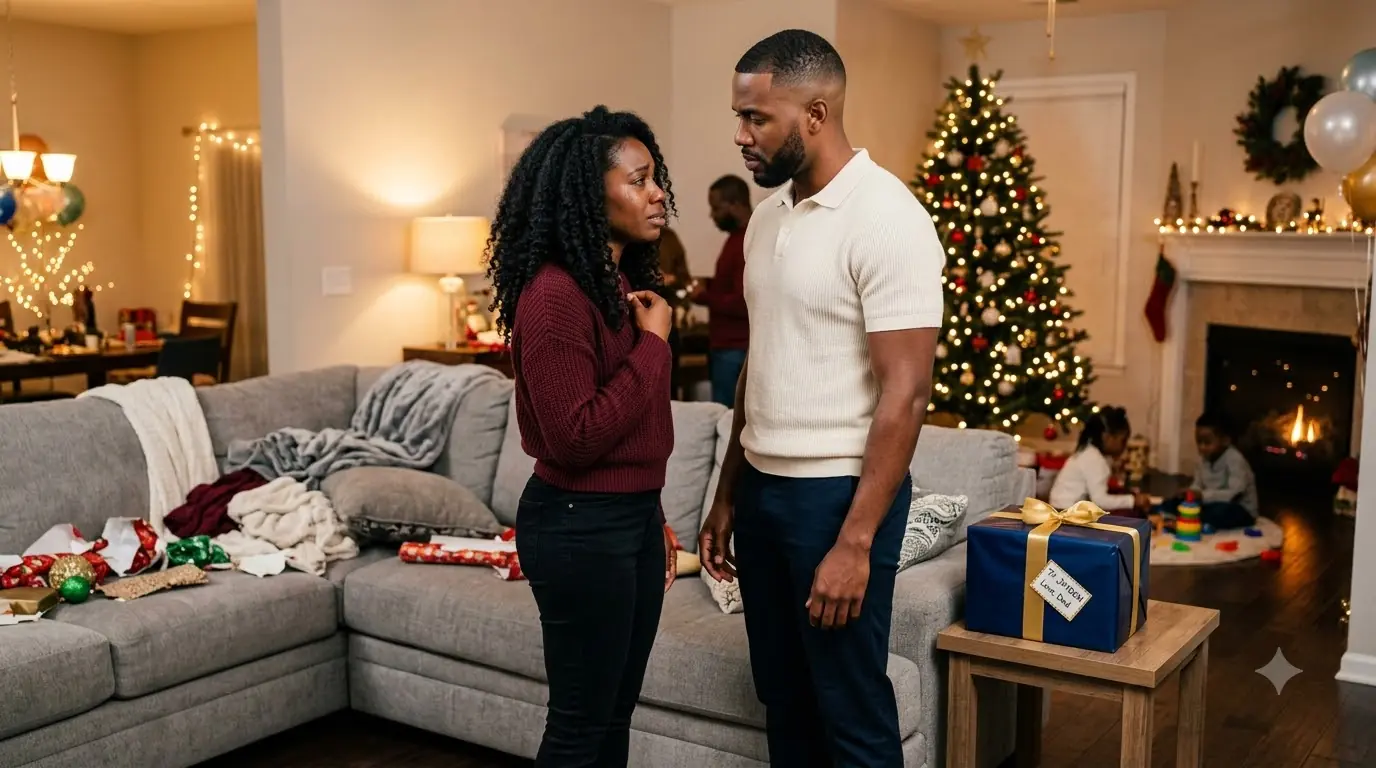
“You bought a gift for your son when you knew I have two kids too?”
Mark stopped tearing the price tag off the box.
His eight-year-old son, Tyler, was already on the living room floor staring at the new gaming console like Christmas had arrived three months early.
My daughter Ava stood near the hallway.
My son Mason was beside her.
Neither of them said anything.
That made it worse.
Mark looked at me.
“It’s not random, Claire.”
I stared at him.
“I can see that.”
“It’s because Tyler got his report card.”
“So did Ava.”
Mark’s expression tightened.
“That’s different.”
My stomach dropped.
There are two words that can destroy a blended family faster than almost anything else.
That’s different.
Ava looked down.
Mason walked toward the kitchen without a word.
I followed him with my eyes.
Mark lowered his voice.
“Can we not do this in front of the kids?”
I almost laughed.
“You already did it in front of the kids.”
His jaw tightened.
“Claire.”
“No. Explain it.”
Tyler was still sitting on the floor.
The excitement had disappeared from his face.
That wasn’t fair to him either.
None of this was Tyler’s fault.
I forced myself to lower my voice.
“Guys, why don’t you take the box upstairs for a minute?”
Mark looked at me.
“Why?”
“Because we need to talk.”
Tyler hesitated.
Then he picked up the console.
Ava moved toward the stairs first.
Mason followed.
I watched all three children disappear upstairs.
The second I heard the bedroom door close, I turned back to Mark.
“What were you thinking?”
His face hardened.
“I told you. Tyler worked hard this quarter.”
“Ava got straight A’s.”
“I know.”
“Mason brought his reading grade up two levels.”
“I know.”
“Then help me understand.”
Mark set the packaging on the coffee table.
“I promised Tyler this months ago.”
“When?”
“Before.”
“Before what?”
“Before we all moved in together.”
There it was.
Before.
Before Mark and I had combined homes.
Before we started calling ourselves a family.
Before Ava and Mason began setting four places at the dinner table without thinking.
Mark and I had been together for almost three years.
We had lived together for eleven months.
I was thirty-four, divorced, with two children.
Ava was ten.
Mason was seven.
Mark was thirty-seven and had Tyler from his first marriage.
Tyler spent every other week with us.
My kids lived with me most of the time and stayed with their father two weekends a month.
Blending our families had not been easy.
Anyone who says love is enough to create a blended family has probably never tried it.
There were custody schedules.
Different rules.
Different bedtimes.
Different expectations around chores.
Three children competing for bathroom space.
Three children quietly wondering whether one parent loved another child more.
And two adults trying desperately not to prove them right.
Before moving in together, Mark and I had talked about everything.
At least I thought we had.
“No forcing the kids to call anyone Mom or Dad,” I told him.
“Agreed.”
“No comparing them.”
“Agreed.”
“No making them feel like visitors.”
“Absolutely.”
He had been especially careful with Ava and Mason.
When we moved into the house, he helped Mason paint his room blue.
He took Ava shopping for a desk because she wanted somewhere to draw.
When Tyler was with his mother, Mark still included my kids in weekend plans.
He came to Ava’s school performance.
He helped Mason build a model volcano.
That was why the console shocked me.
It wasn’t about buying Tyler something expensive.
Mark was his father.
He was allowed to do special things for his son.
I understood that.
What I didn’t understand was bringing a huge gift into the shared living room, handing it to one child in front of the other two, and then acting surprised that it might mean something.
“You promised him before we moved in,” I said.
“Yes.”
“And you couldn’t tell me?”
“I didn’t think I needed permission to buy my son a gift.”
The word permission immediately changed the argument.
“I didn’t ask you to get permission.”
“It sounds like you are.”
“No. I’m asking why you didn’t think about how this would feel to the other kids.”
“They’re not my kids.”
Silence.
Mark’s face changed the moment he said it.
So did mine.
Neither of us moved.
Finally, I said, “Okay.”
“Claire.”
“No.”
“I didn't mean it like that.”
“How did you mean it?”
He rubbed his forehead.
“I mean Tyler is my son.”
“I know who Tyler is.”
“You know what I’m saying.”
“Actually, I’d love for you to explain it.”
He looked frustrated.
“I have responsibilities to Tyler that I don’t have to Ava and Mason.”
I stared at him.
“You asked us to build a home together.”
“Yes.”
“You told my children this was their home.”
“It is.”
“But when it matters, they’re not your kids.”
“That’s not what I said.”
“It is literally what you said.”
He walked toward the kitchen.
I followed.
“Claire, biological parents are allowed to do things for their own children.”
“Yes.”
“Then why are we fighting?”
“Because you keep pretending I’m upset you bought Tyler something.”
“Aren’t you?”
“No.”
My voice rose.
“I’m upset because Ava and Mason had to stand there and watch while the man who tells them we’re a family made it very clear that one child has a different position in this house.”
“He does.”
I went still.
Mark looked exhausted now.
“Tyler is my son.”
“And Ava and Mason?”
“They’re your children.”
Something inside me cracked.
Not because the statement was technically false.
Because I finally understood how differently we had been defining us.
I thought we were slowly creating a family.
Mark thought we were two parents sharing a house with our respective children.
Those were not the same thing.
I folded my arms.
“Do you love them?”
His expression softened slightly.
“Of course I care about them.”
“That wasn’t my question.”
“Claire.”
“Do you love my kids?”
He hesitated.
That hesitation was enough.
My eyes burned.
“You don’t.”
“I didn’t say that.”
“You didn’t have to.”
He looked away.
“I’m still getting there.”
Eleven months.
Maybe that wasn’t long.
Maybe I had expected too much.
But my children had not moved in emotionally halfway.
Mason had started asking Mark to throw a football with him.
Ava had started saving a seat for him at school events.
They had trusted the word family because the adults kept using it.
And suddenly I wondered whether I had allowed them to believe in something Mark had never actually promised.
“What did you tell them?” I asked.
“What?”
“When we moved in.”
His eyes narrowed.
“About what?”
“About us.”
“I told them we were becoming a family.”
“Exactly.”
“That doesn’t mean everything is equal all the time.”
“I never said equal.”
“Then what do you want?”
“Consideration.”
My voice shook.
“I want you to think about all three kids before you create a moment like this.”
Mark laughed bitterly.
“So every time I buy Tyler something, I have to buy three of everything?”
“No.”
“Because that’s what this sounds like.”
“It’s not.”
“Then where’s the line?”
“The line is whether you’re celebrating something privately as his father or making a public family moment that tells the other two where they rank.”
He shook his head.
“You’re projecting.”
My chest tightened.
“Projecting what?”
“Your divorce.”
I stared at him.
“That was low.”
“It’s true.”
“No. Explain.”
He exhaled.
“You’ve always been hypersensitive about the kids feeling rejected because their dad moved on.”
My hands went cold.
My ex-husband, Ben, had remarried two years after our divorce.
His new wife had a daughter.
The first Christmas after they married, Ava came home crying because Ben and his wife had taken the girl to Disney World during a week when my kids were with me.
Ava saw the pictures online.
She asked me one question.
“Why didn’t Dad want us there?”
I had no answer that wouldn’t hurt.
Ben insisted the trip was spontaneous.
Said the schedule didn’t line up.
Said he would take Ava and Mason somewhere later.
He eventually did.
But kids don’t experience love as accounting.
A promised future trip doesn’t erase being absent from the photograph.
Mark knew all of that.
I stared at him.
“You know what happened with Ben.”
“I do.”
“Then you should understand why this matters.”
“I understand why it matters to you.”
I shook my head.
“No. It matters to them.”
We both looked toward the stairs.
That was when we noticed Ava standing there.
Halfway down.
Her face had changed.
I didn’t know how long she had been listening.
“Ava.”
She looked at Mark.
Not me.
“Do you not want us here?”
My heart broke.
Mark’s face went pale.
“What? No.”
She swallowed.
“You said we’re not your kids.”
“Ava, come here.”
He moved toward her.
She stepped backward.
That tiny movement hurt all of us.
Mark stopped.
“I didn’t mean I don’t care about you.”
“But you don’t love us.”
I closed my eyes.
“Ava—”
“No, Mom.”
Her voice shook.
“It’s okay.”
Nothing about it was okay.
She looked at Mark.
“Tyler’s your real family.”
Mark looked like someone had hit him.
“No.”
“Yes.”
“Ava, that's not what I meant.”
She wiped her face quickly.
Then she said something I will never forget.
“Then why did it sound so easy for you to say?”
She turned and ran upstairs.
I followed.
Mason was sitting on his bed.
Ava went into her room and closed the door.
I knocked.
“Baby?”
“I’m fine.”
I almost laughed from the pain of hearing my own daughter use the word adults use when they don't want to explain how hurt they are.
“Can I come in?”
A long pause.
Then, “Okay.”
I entered.
She was sitting against the headboard.
Her eyes were wet.
I sat beside her.
“I’m sorry.”
“For what?”
“For letting that happen downstairs.”
She shrugged.
“It’s his money.”
Again, she was trying to be reasonable.
Ten-year-olds should not have to be reasonable about belonging.
“It’s not about the gift.”
She looked at me.
I almost smiled sadly.
Apparently my daughter understood the argument better than Mark did.
“I know.”
“Are we moving again?”
My chest tightened.
“What?”
“If he only wants Tyler.”
“No.”
I said it too quickly.
Ava noticed.
“Are you sure?”
I couldn’t lie.
“I’m sure nobody is making a decision tonight.”
She looked down.
Then she whispered, “I like Mark.”
“I know.”
“Mason really likes him.”
“I know.”
She picked at a thread on her blanket.
“So if he doesn't love us, should we stop loving him?”
I had no answer.
That was the moment the argument stopped being about me and Mark.
Because adults can negotiate complicated definitions of family.
Children simply attach.
And then they trust us not to make them regret it.
That night, Mark slept in the guest room.
Not because I told him to.
Because he said he needed to think.
The next morning, I found three envelopes on the kitchen table.
One had Ava’s name.
One had Mason’s.
One had Tyler’s.
Mark was sitting nearby.
“What is this?”
“I talked to Tyler last night.”
My stomach tightened.
“What did you tell him?”
“The truth.”
“Which truth?”
“That I handled yesterday badly.”
I looked at the envelopes.
“And these?”
“Not money.”
“Then what?”
“Letters.”
I stared at him.
“Mark—”
“Just let me finish.”
He looked exhausted.
“I kept thinking about what Ava asked.”
Do you not want us here?
His voice broke slightly.
“I never wanted her to feel that.”
“But she does.”
“I know.”
He swallowed.
“And I need to figure out whether what I’m offering you and your kids is actually enough.”
Something in his wording scared me.
“What does that mean?”
He looked directly at me.
“It means you were right about one thing.”
I waited.
“We have been using the word family differently.”
My stomach dropped.
He continued.
“And before I ask your kids to keep trusting me, I need to decide what I actually mean when I say it.”
I felt cold.
“Are you saying you don't want this?”
“No.”
“Then what are you saying?”
“I’m saying I don't know if I can be the father figure you want me to be to Ava and Mason.”
The words hurt.
But what came next hurt worse.
“Because Tyler has been telling me something for months that I never told you.”
I stared at him.
“What?”
Mark looked toward the stairs.
“He thinks I’m replacing him with your kids.”
And suddenly the gift downstairs had a completely different meaning.
It wasn't only about who Mark loved more.
It was about three children quietly wondering whether there was enough love in our house for all of them.
PART 2
“What do you mean Tyler thinks you’re replacing him?”
Mark rubbed both hands over his face.
“He told me a few months ago.”
“And you never told me?”
“I didn't know what to do with it.”
“That’s becoming a pattern.”
“I know.”
That stopped me.
No defense.
Just acknowledgment.
I sat across from him.
“What exactly did Tyler say?”
Mark looked toward the ceiling.
“He said when he's at his mom's house, I still get to be here with Ava and Mason.”
I stayed quiet.
“And when he's here, he feels like he has to share me.”
My anger softened slightly.
Not because what Mark had done was okay.
Because suddenly I could see an eight-year-old boy inside the decision.
“Did he say he doesn't like them?”
“No.”
“He actually said he does.”
Mark smiled sadly.
“He said that's what makes him feel bad.”
My chest tightened.
Of course.
Children can love each other and still fear losing their place.
“He asked if I liked having them here more because they're here all the time.”
I looked down.
“And the console?”
Mark nodded.
“He reminded me that I promised it before we moved.”
“So you bought it because you wanted him to feel special.”
“Yes.”
That made sense.
And it still had been handled badly.
“You should have told me.”
“I know.”
“We could’ve found another way.”
“I know.”
“You could have given it to him during your time together.”
“Yes.”
“You could’ve explained to the other kids that it was something you'd promised him months ago.”
“Yes.”
I stared at him.
“Instead you made me the enemy when I reacted.”
His eyes dropped.
“Yes.”
That was what hurt most.
Mark had a legitimate parenting problem.
He was trying to reassure his son.
Instead of trusting me with that, he acted alone.
Then when the consequences appeared, he defended himself by separating our children into categories.
His.
Mine.
Real.
Not real.
Even if he never used that last word, all three children had heard it.
“What are the letters?” I asked.
He pushed Ava’s envelope toward me.
“I haven't given them out.”
“What do they say?”
“That depends on whether you think I should.”
I looked at him.
“Tell me.”
He took a breath.
“I told Ava that I was wrong to make her feel unwanted.”
My throat tightened.
“I told Mason the same thing.”
“And Tyler?”
“I told him loving Ava and Mason doesn't take anything away from being his dad.”
I studied him.
“That sounds good.”
“There’s more.”
“What?”
“I told all three of them that family doesn't mean everyone gets the exact same things.”
He paused.
“But it does mean nobody should have to wonder whether they matter.”
That was better.
Not perfect.
But better.
Then I asked the harder question.
“What did you mean when you said you don't know if you can be the father figure I want you to be?”
He looked uncomfortable.
“I think I’ve been afraid of making promises I don't know how to keep.”
“Like what?”
“Like loving your kids exactly the way I love Tyler.”
The sentence hurt.
I forced myself to keep listening.
“I don't know if that feeling can be identical.”
“Okay.”
He looked surprised.
“Okay?”
“Yes.”
I wiped my eyes.
“Because maybe that was never a fair expectation.”
We sat in silence.
I had spent months telling myself that successful blending meant no differences.
Maybe that had been unrealistic.
Mark had known Tyler since the moment he was born.
He had held him in a hospital.
Changed diapers.
Sat through fevers.
Learned how to be a father through that child.
He met Ava when she was seven.
Mason when he was four.
Of course the bonds had different histories.
Different did not automatically mean lesser.
But different still required responsibility.
“I don't need you to pretend the relationships are identical,” I said.
He listened.
“I need you to understand that when you enter a home with children, your choices affect all of them.”
He nodded.
“And if you're going to say they're family, you don't get to hide behind ‘they're not my kids’ every time responsibility feels uncomfortable.”
His face tightened.
“You’re right.”
“I also don't want you replacing Ben.”
“I don't want that either.”
“Good.”
I leaned back.
“They have a father.”
“Yes.”
“But you're another adult they trust.”
He looked down.
“And that matters.”
“Yes.”
Mark nodded slowly.
“I think that's where I got confused.”
“What do you mean?”
“I kept thinking there were only two choices.”
He looked at me.
“Either I treat them exactly like Tyler, which sometimes makes Tyler feel threatened…”
I waited.
“Or I make sure Tyler knows he's different because he's my son.”
“And that makes Ava and Mason feel rejected.”
“Exactly.”
He exhaled.
“I've been trying to solve the wrong problem.”
“What’s the right problem?”
“How do I make each child feel secure without making another child pay for it?”
That was the first time since the argument started that I felt like we were actually on the same side.
The solution didn't happen in one morning.
First, we talked to all three kids.
Together.
That mattered.
Mark sat on the couch.
I sat beside him.
Tyler looked nervous.
Ava was guarded.
Mason seemed mostly confused.
Mark started.
“I messed up yesterday.”
Tyler immediately said, “Because you got me the game?”
“No.”
Mark shook his head.
“The gift wasn't wrong.”
I watched Ava.
“The way I handled it was.”
He looked at my kids.
“I promised Tyler that game before we all lived together. He earned it by reaching a goal we had agreed on.”
Ava nodded slightly.
Then Mark continued.
“But I should have explained that instead of making it feel like I was celebrating one person in this family while forgetting everyone else.”
Mason asked, “Are we your family?”
There it was.
No adult language.
Straight to the center.
Mark looked at him.
“Yes.”
Mason frowned.
“But you said we're not your kids.”
Mark swallowed.
“You're not my children in the same way Tyler is because I'm his dad.”
Mason's face fell slightly.
Mark immediately continued.
“But that doesn't mean you're not important to me.”
He moved closer.
“You have a dad. I'm not trying to replace him.”
Mason nodded.
“But I'm still one of the grown-ups in this house who loves you, worries about you, helps take care of you, and shows up for you.”
I looked at Mark.
There was the word.
Loves.
Not cares.
Not likes.
Loves.
Ava heard it too.
Her eyes filled.
“You do love us?”
Mark looked at her.
“Yes.”
He paused.
“I think yesterday I got scared of saying that because I thought loving you meant I had to say I feel exactly the same relationship with all three of you.”
She stayed quiet.
“I don't.”
My chest tightened.
But Mark kept going.
“Because relationships aren't copies.”
He looked at Tyler.
“I've been Tyler's dad his whole life.”
Then Ava.
“I've known you for almost three years.”
Then Mason.
“And you too.”
He smiled slightly.
“But what I feel for you doesn't have to be identical to be real.”
Ava wiped her face.
Tyler suddenly spoke.
“I thought if Dad liked them too much, he might want them instead.”
The room went completely quiet.
Mark's face broke.
He moved toward Tyler.
“Buddy.”
Tyler started crying.
“I know that sounds stupid.”
“It does not.”
Mark pulled him into his arms.
“It doesn't sound stupid at all.”
I looked at Ava and Mason.
Their expressions had changed.
For the first time, they could see Tyler had been scared too.
Ava moved closer.
“You know we're not trying to take your dad, right?”
Tyler wiped his face.
“I know.”
Mason said, “I already have a dad.”
The simplicity of it almost made me laugh.
Tyler gave him a watery smile.
“Yeah.”
Mason added, “But Mark makes better pancakes.”
That finally broke the tension.
Even Mark laughed.
The conversation didn't solve everything.
But it changed the direction.
We started family counseling a few weeks later.
Not because our family was falling apart.
Because we realized love wasn't enough if nobody knew how to talk about the fears underneath it.
The counselor gave us a phrase I still remember.
“Fair does not always mean equal.”
That became important.
Tyler had traditions with Mark that belonged to them.
Saturday morning breakfast when he was staying with us.
Baseball games.
A yearly camping trip.
I stopped treating those things as threats to my children.
They were his history with his son.
Ava had things with me that weren't shared either.
A monthly bookstore trip.
Mother-daughter afternoons.
Mason had his own routines.
The goal was not identical treatment.
The goal was secure belonging.
Mark started creating individual traditions with my kids too.
Not because I demanded equal minutes.
Because relationships need their own roots.
He helped Ava build an art portfolio for a school program.
He started taking Mason to the hardware store on Saturday afternoons whenever they had something to fix around the house.
Nothing dramatic.
No replacement-dad fantasy.
Just consistency.
And we changed how gifts worked.
Parents could absolutely buy something special for their own child.
But big milestone gifts were discussed first if they were happening in the shared home.
Not for permission.
For awareness.
We stopped assuming kids would automatically understand adult context.
They usually don't.
They understand what they can see.
Who gets celebrated.
Who gets invited.
Who gets remembered.
Who gets comforted.
Who gets told, “This is for you.”
Six months later, another test came.
Ava got accepted into an advanced art program.
She came running into the house waving the letter.
“I got in!”
I hugged her.
Mark came out of his office.
“What happened?”
She handed him the letter.
His face lit up.
“Are you serious?”
She nodded.
He hugged her.
Then he stopped.
I saw something cross his face.
He looked at me.
“What?”
“I was going to take her out this weekend to get the tablet she wanted.”
I smiled slightly.
“Okay.”
“But I want to talk about it first.”
That mattered.
Tyler was staying with us that weekend.
So before doing anything, Mark talked to him.
“Ava accomplished something she's worked really hard for.”
Tyler nodded.
“So we're going to celebrate her.”
“Okay.”
“No game for me?”
He was joking.
Mark smiled.
“No game.”
Tyler shrugged.
“Fair.”
Then Mark added something important.
“And when you accomplish something we've agreed deserves celebrating, we'll celebrate you too.”
No comparison.
No guilt.
No buying gifts for everybody so nobody ever experienced difference.
Just context.
Security.
Fairness.
That night, after the kids went to bed, I found Mark cleaning the kitchen.
I leaned against the counter.
“You handled that well.”
He looked at me.
“I'm learning.”
“So am I.”
He smiled.
Then I asked something I had been afraid to ask since the argument.
“Do you still think of them as my kids?”
He turned off the faucet.
“Yes.”
My heart tightened.
Then he continued.
“And also as part of my family.”
I looked at him.
“Both things can be true.”
I smiled faintly.
“I think that's the answer I wanted from the beginning.”
He dried his hands.
“I'm sorry I didn't know how to say it then.”
I nodded.
Then he asked me the same question.
“Do you think of Tyler as my son?”
“Of course.”
“And?”
I understood.
“And part of my family.”
He smiled.
There it was.
No pretending biology disappeared.
No ranking.
No ownership.
Just a larger definition of belonging.
A year after the gaming-console argument, Tyler turned ten.
His birthday fell during his week with us.
Mark bought him a new bicycle.
Ava helped choose the helmet.
Mason insisted on decorating the garage with balloons.
When Tyler saw the bike, he nearly knocked Mark over hugging him.
Nobody asked where their gift was.
Nobody needed one.
Because the gift was no longer carrying the weight of a bigger question.
Do I belong here?
They already knew the answer.
Later that evening, I found Ava sitting on the porch.
“You okay?”
“Yeah.”
She smiled.
“Tyler's bike is cool.”
“It is.”
Then she looked at me.
“Remember when Mark bought him that game?”
I laughed softly.
“Unfortunately.”
“I was really mad.”
“I know.”
“I thought it meant he liked us less.”
My chest tightened.
“And now?”
She shrugged.
“He’s Tyler’s dad.”
Simple.
Then she added, “But he still came to my art show even when he had that work thing.”
Kids keep score differently than adults think.
They remember gifts.
Of course they do.
But eventually, the bigger evidence is who keeps showing up.
Who remembers.
Who listens.
Who keeps their promises.
Who makes room.
That morning with the console, I thought Mark had shown me exactly where my children ranked.
In truth, he had shown me something more complicated.
He was a father terrified that his son felt replaced.
And instead of talking about that fear, he overcorrected in a way that wounded two other children.
His intention mattered.
But intention didn't erase impact.
My reaction mattered too.
I was carrying old fear from what my children had experienced with their father.
And I interpreted one painful moment as proof that history was repeating itself.
Blended families can break under that kind of silence.
One parent protects.
Another becomes defensive.
One child feels replaced.
Another feels unwanted.
Everyone loves someone.
And somehow everyone still feels unsafe.
What saved us wasn't pretending every child was exactly the same.
They weren't.
What saved us was learning that difference does not have to become hierarchy.
Tyler could be Mark's son without Ava and Mason becoming outsiders.
Ava and Mason could love Mark without replacing their father.
I could advocate for my children without demanding that Mark erase the unique bond he had with his own child.
And Mark could reassure Tyler without making my children feel like the cost of that reassurance.
That's what family became for us.
Not equal gifts.
Not identical relationships.
Not pretending biology means nothing.
Family became the promise that nobody in the house would have to earn their right to belong.
And sometimes the smallest choices reveal whether that promise is real.
A gift.
A seat saved at dinner.
A school performance attended.
A birthday remembered.
A child being included when it would be easier not to think about them.
That was why I had looked at Mark that morning and asked:
“You bought a gift for your son when you knew I have two kids too?”
I wasn't asking him to buy three gaming consoles.
I was asking a much bigger question.
When you look at this house, do you see one child who is yours and two children who happen to live here?
Or do you see three children whose hearts are affected by the choices you make?
It took us a painful argument to understand the difference.
But once we did, everything changed.
Because children don't need every relationship to be identical.
They need every relationship to be safe.
And they need to know that when the adults say, “We're a family,” those words still mean something when it matters.