He Dumped a Bucket of Honey on Her in Front of Everyone
Reader Theme:
Font Size:
24px
On the morning of June 14th, 1998, in Lancaster County, Pennsylvania, 22-year-old Emily Carter stood beside a weathered 1958 Farmall 560, wiping grease from her hands with a faded red shop rag while bees drifted lazily between rows of white clover. The tractor's six-cylinder engine had carried three generations of Carter farmers across the same rolling fields, and despite its chipped paint and nearly 8,000 recorded hours, it still started on the second turn of the key every dawn. The only thing louder than its engine that morning was the laughter coming from the neighboring property. Across the split-rail fence stood Richard Harlan, owner of nearly 2,000 acres of commercial farmland, a fleet of brand new green combines, and a reputation for reminding everyone exactly how successful he had become. Workers gathered around him, loading stainless steel drums of fresh wildflower honey onto a flatbed truck.
Richard leaned against the truck, watching Emily coax the old Farmall toward a broken irrigation line. "You still using that museum piece?" he called across the fence. Emily smiled without looking up. "It still works." "It belongs in a parade." "It belongs in a field." The workers chuckled. Richard shook his head.
"You know what your problem is? You're too stubborn to admit when something's finished." Emily simply tightened another bolt. People around Lancaster knew the Carter farm. It wasn't large, barely 120 acres. Corn, hay, clover, a small apple orchard, 47 beehives lined neatly along the eastern pasture.
They also knew Emily, quiet, always working, never arguing, never explaining herself. Few people knew she had spent the previous six years building something far larger than the farm itself. Let me tell you about Emily Carter. When she was 16, while most teenagers spent summers at county fairs, Emily spent her studying pollination patterns, honey production, and agricultural logistics. Her grandfather had taught her something that never appeared in school textbooks.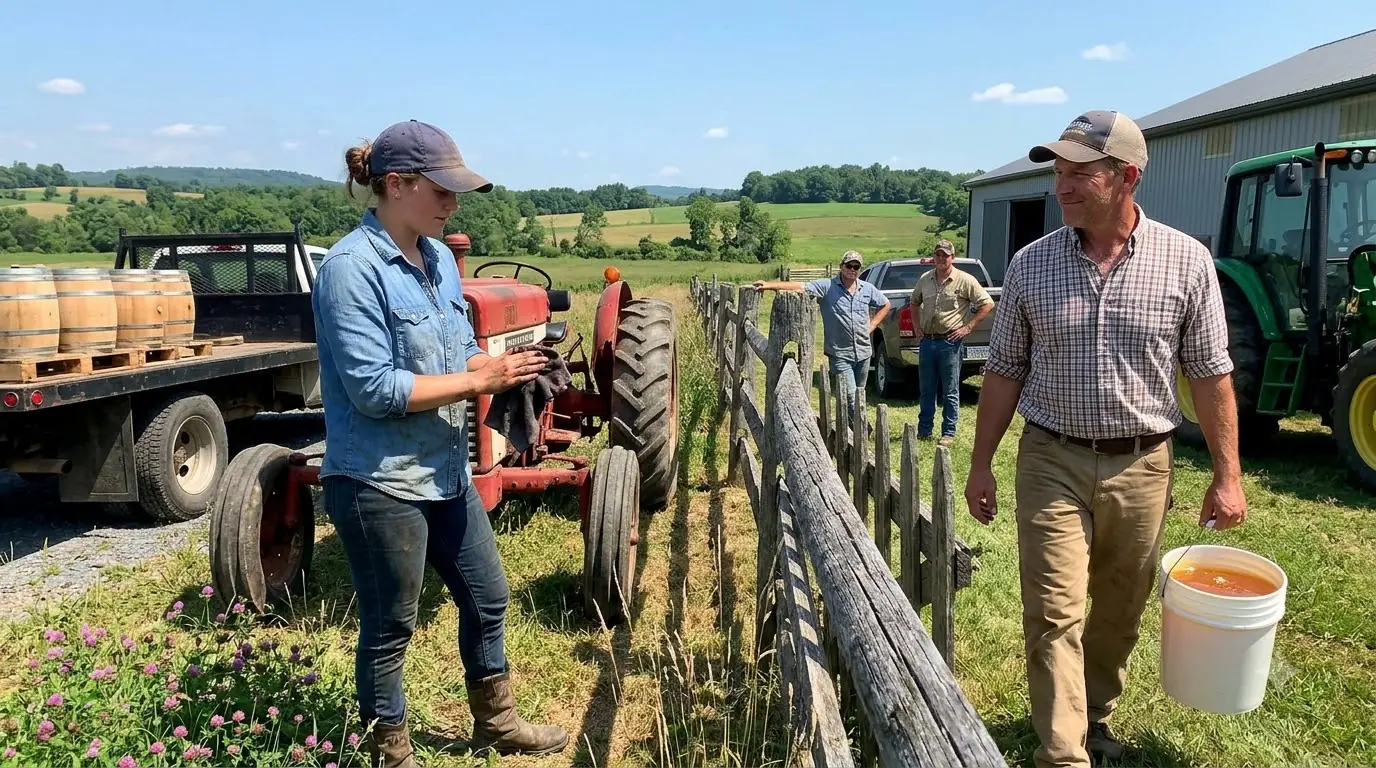
"If you take care of the bees," he used to say, "they'll take care of everything else." He had purchased that Farmall 560 used in 1964 for $3,400, after trading two draft horses and every dollar he had saved from three tobacco harvests. With roughly 60 horsepower, the tractor wasn't the biggest machine in Pennsylvania, but he maintained it with almost religious discipline. Engine oil every 100 hours. Cooling system flushed every spring. Every grease fitting serviced before sunrise on Mondays.
Emily learned those rituals before she learned algebra. By 19, she had quietly launched an agricultural supply software company from an old office above the machine shed. What began as a simple inventory system for local honey producers slowly expanded into logistics software used by distributors across the Midwest. No newspaper covered it. No television station noticed.
Emily preferred it that way. Three weeks earlier, an investment group in Chicago had acquired controlling shares for $1.3 billion. She never changed her boots. She never bought a mansion. She simply returned home and continued repairing fences.
Richard Harlan had absolutely no idea. To him, Emily was simply the girl next door trying to keep an aging family farm alive. Around noon, the temperature climbed past 85°. Richard's workers rolled another barrel toward the loading ramp. One slipped.
The drum slammed onto the trailer. The lid burst open. Golden honey flooded across the steel bed. Richard frowned. Then he looked toward Emily.
An idea crossed his face. The workers laughed before he even spoke. "Bring that barrel over." One man hesitated. "You serious?" "Oh, absolutely." They rolled the leaking barrel toward the fence. Emily looked up just in time to see Richard lift a 5-gallon bucket filled with honey.
"You wanted something old-fashioned." He said loudly enough for everyone to hear. ""Let's make your farm sweeter."" The honey splashed over the fence. It struck across her shoulders. Another bucket followed. Then another. Thick amber honey soaked her shirt, her jeans, even the steering wheel of the Farmall.
The workers erupted into laughter. Some doubled over. Others pointed phones toward the scene. Richard laughed the hardest. It wasn't the quick laugh of someone amused.
It was slow, confident, the kind of laugh people use when they're certain they've won. Emily stood perfectly still. Honey dripped from the brim of her cap onto the dry Pennsylvania soil. A bee landed on her sleeve, then another. She calmly removed her cap, wiped honey from her eyes, and looked directly at Richard.
"I hope," she said quietly, "you've already signed tomorrow's contracts." Richard smirked. "What contracts?" Emily only smiled. No anger, no shouting, no threats. She climbed back onto the Farmall 560, started its engine, and slowly drove toward the bee yards as hundreds of honeybees began circling through the warm afternoon air. Have you ever known something that everyone else mistook for weakness, only to realize much later it was self-control?
Most people never recognize the difference until it's too late. Richard certainly didn't, because less than 24 hours later a black SUV carrying three executives from Chicago turned onto the Carter farm. And the first question they asked would change everything. The black SUV rolled slowly past the weathered mailbox that read Carter Family Farm EST 1949. Gravel crunched beneath its tires as three sharply dressed executives stepped out.
Their polished shoes looking strangely out of place beside the muddy tire tracks leading toward the machine shed. Emily was exactly where she had been every morning for years. Under the farmal, replacing a worn hydraulic hose. One executive adjusted his tie before speaking. "Ms. Emily Carter?" She slid herself out from beneath the tractor, wiped her hands with the same faded shop rag, and nodded.
"That's me." "My name is Michael Donovan, regional vice president for Harvest Link Agricultural Systems. Our board meeting starts in Philadelphia at 10:00." Emily glanced at the old tractor. "I'll be there after I finish this." The executives exchanged confused looks. "Finish that?" She smiled. "Oil leaks don't wait for board meetings." Across the fence, Richard Harlan watched everything unfold through the window of his new John Deere 8300.
Three executives, a luxury SUV, tailored suits. He frowned. One of his employees walked over. You know those people? Richard shrugged.
Probably inspectors, but something felt wrong. The executives weren't carrying clipboards. They were carrying leather briefcases. And every one of them treated Emily with unmistakable respect. Let me tell you about Harvestlink.
Back in 1994, grain elevators across Pennsylvania still relied on paper ledgers, fax machines, and handwritten shipping logs. Farmers often waited days to learn whether a shipment had even arrived. Emily saw something others missed. She realized agriculture wasn't suffering from a lack of production. It was suffering from a lack of information.
Working from an office above her grandfather's workshop, powered by a noisy desktop computer and a dial-up modem, she wrote software that allowed grain buyers, honey producers, trucking companies, and feed suppliers to share inventory in real time. Most investors laughed. One finally listened. Four years later, Harvest Link coordinated billions of dollars in agricultural commerce. Yet, Emily still spent her mornings fixing tractors.
Richard couldn't ignore his curiosity. That afternoon, he drove across the fence line. Emily was tightening wheel bolts. "You got some important visitors." "I did." "What did they want?" "They wanted me at work." Richard laughed. "This isn't work?" Emily rested a wrench on the tire.
"It all depends on how you define work." "You got some office job now?" "In a way." "What kind?" Emily looked toward the bee yards. "I help farmers." Richard nodded dismissively. "Consulting?" "You could call it that." He drove away convinced she had exaggerated everything. The following Saturday brought the annual Lancaster County Agricultural Expo. Farmers from across southeastern Pennsylvania filled the fairgrounds with restored machinery, livestock, homemade preserves, and equipment demonstrations.
Emily entered the Farmall 560 into the vintage tractor display. Richard entered his newest combine. The contrast couldn't have been greater. One machine gleamed beneath fresh wax and chrome. The other carried 60 years of scratches earned honestly in the fields.
Visitors naturally gathered around Richard's display first. It was enormous, air-conditioned, satellite-guided, computer-controlled. Richard enjoyed every compliment. Then he noticed Emily answering questions beside the old Farmall. Children climbed onto its steel seat.
Older farmers smiled as they recognized familiar levers and gauges. Nobody seemed impressed by horsepower. They were remembering fathers, grandfathers, harvests. Let me tell you about old cast-iron. Modern engines often rely on lightweight aluminum alloys designed for efficiency.
They're remarkable machines, but older tractor blocks were cast thick, very thick. They absorbed heat slowly, handled vibration better, and when maintained correctly, those heavy blocks could survive decades of hard labor. Horsepower tells you how fast work can be done. Torque tells you how strongly a machine can keep pulling when conditions become difficult. That's why a 60 horsepower Farmall could sometimes outperform newer equipment in heavy field conditions.
It wasn't stronger. It simply refused to quit. Machines, much like people, often reveal their true value under strain. By mid-afternoon, an announcer climbed onto the fairground stage. "Ladies and gentlemen, we'd like to recognize one of this year's keynote sponsors." Richard smiled.
His company had donated generously. Surely this was about him. "Please welcome Harvest Link Agricultural Systems." Applause echoed across the grounds. Richard straightened his jacket. Instead, Michael Donovan walked onto the stage.
"Before we begin," he said into the microphone, "I'd like to introduce the woman whose vision transformed agricultural logistics across America." He extended one hand toward Emily. She looked genuinely uncomfortable. The audience turned. Richard frowned. No.
Emily climbed the steps quietly. No designer suit, no expensive jewelry, just worn boots still carrying dried mud from that morning's pasture. Michael continued, "When she founded Harvest Link at 19 years old, most investors believed a young beekeeper from Lancaster County couldn't possibly modernize agricultural commerce." He smiled. "They were wrong. Today, our network serves over 18,000 farms across the United States." The crowd erupted into applause.
Richard stood frozen. Michael wasn't finished. "Our founder and majority shareholder." He looked toward Emily. "Ms. Emily Carter." Silence. Then louder applause than before.
Richard felt his stomach drop. The phones that had recorded him dumping honey on Emily only days earlier suddenly took on an entirely different meaning. People nearby slowly turned toward him. Some recognized him. Others remembered the laughter.
One elderly farmer quietly removed his cap. Richard had never felt smaller. Emily accepted the microphone. She could have embarrassed him. She could have told the entire crowd exactly what had happened.
Instead, she simply thanked the farming community for believing in honest work. Not once did she mention the honey. Not once did she mention Richard. That hurt far more than public revenge ever could. As the applause faded, Richard realized something that no amount of money could immediately fix.
Emily had protected his dignity after he had tried to destroy hers. He started walking toward the stage. Every step felt heavier than the last. When he finally reached the stairs, he removed his hat, looked Emily directly in the eyes, and quietly said seven words. ""I owe you more than an apology."" Emily looked at him for a long moment. Then she answered with a question that stopped him cold.
"What are you willing to change?" Richard Harlan didn't answer immediately. The sounds of the county fair seemed to fade behind him. Children laughed near the livestock barns. An antique steam engine let out a long whistle. Somewhere an auctioneer called bids on a line of hay equipment.
But Richard heard none of it. Emily's question lingered. What are you willing to change? For the first time in years, he realized success had made him very good at buying equipment and very poor at understanding people. "I don't know," he admitted quietly.
Emily nodded. "It starts there." She stepped off the stage and walked back toward the old Farmall 560. Richard followed. Not because he wanted something from her. Because he suddenly wanted to understand.
Let me tell you about Richard Harlan. People remembered the confident businessman. Few remembered the frightened 16-year-old boy who had watched his father's dairy farm disappear after a series of bad milk prices and mounting debt in the early 1980s. The bank auction lasted less than 4 hours. His father never recovered from the humiliation.
Richard made himself a promise that afternoon. He would never be poor again. He kept that promise. He bought land, leased more, invested in the latest machinery, expanded until he managed nearly 2,000 acres across Lancaster County. But somewhere along the way he confused wealth with worth.
He measured people by the tractors they drove, the houses they lived in, the size of their operations. Emily measured them differently. She watched how they treated workers, neighbors, animals, machines, especially machines. The next Monday morning Richard parked his pickup beside the Carter workshop. Emily looked up from rebuilding the Farmall's hydraulic pump.
"You here to laugh again?" "No." "You here to argue?" "No." "What then?" "I'd like to learn." Emily stared at him for several seconds before handing him a wrench. "Good." She pointed beneath the tractor. "Then start by loosening those bolts." Richard blinked. "I've got mechanics." ""I know."" "I've never rebuilt one." ""I know."" She smiled. ""That's why you're here."" For 3 hours neither of them spoke much. Richard struggled with rusted fittings, dropped washers, misplaced tools.
Emily never criticized him. She simply showed him again and again until he finally understood. Have you ever been certain you were teaching someone else only to discover you were the student all along? Most lessons don't arrive in classrooms. Sometimes they arrive covered in grease.
Sometimes they arrive wearing muddy boots. Sometimes they arrive after you've embarrassed yourself in front of an entire county. Over the following weeks Richard kept returning. Some mornings they repaired fencing. Other days they inspected beehives.
Emily explained why healthy pollinators increased yields for neighboring farms as well as her own. Richard had never considered bees beyond whether they might sting someone. Now he learned they quietly influenced nearly every harvest around him. One afternoon they stood beside the hives watching thousands of bees return with bright yellow pollen. "You know why I wasn't angry?" Emily asked.
Richard looked surprised. ""I've wondered."" ""Because angry people rarely change other angry people."" She paused. ""But kindness sometimes does."" Richard lowered his eyes. ""I didn't deserve that kindness."" "No." She smiled gently. "But someone once gave it to me." Two months later, Richard invited neighboring farmers to his equipment shed. Many expected another sales presentation. Instead, they found folding chairs arranged in a circle, coffee, homemade pie, Emily sitting quietly near the back. Richard cleared his throat. ""I owe everyone here something."" The room fell silent.
He told them everything, how he dumped honey on Emily, how he laughed, how he judged people by appearances. Nobody interrupted. When he finished, the silence felt even heavier. Finally, an older farmer stood. ""I've made mistakes, too."" Another nodded. ""So have I."" One by one, conversations replaced judgment. Something remarkable happened.
No one laughed, not this time. That autumn, Richard announced a new county initiative. Farmers with older equipment could bring vintage tractors to his maintenance shop every first Saturday of the month. No charge. Young mechanics volunteered.
Retired mechanics shared decades of experience. High school agricultural students came to learn. The first machine through the doors was not a John Deere, not a Case, not an Allis-Chalmers. It was Emily's 1958 Farmall 560. Children crowded around as retired farmers explained how governors regulated engine speed, how mechanical fuel systems worked, and why regular maintenance mattered more than shiny paint.
Emily stood quietly at the edge of the crowd, exactly where she preferred to be. "Let me tell you about legacy. Most people believe it begins after death. They're mistaken. Legacy begins the moment someone changes because they met you.
Sometimes that change spreads farther than either person ever expected. Emily never set out to change Richard. She simply refused to become like him, and that made all the difference. Late one October afternoon, the two neighbors drove side by side across adjoining fields. Richard in his modern combine, Emily on the Farmall.
The setting sun stretched long shadows across rows of harvested corn. Richard slowed his machine. He climbed down and walked toward the old tractor. "I've been thinking." Emily shut off the engine. "That's usually a good sign." He laughed softly. ""A year ago, I would have bought another thousand acres.
And now, I think I'd rather become the kind of neighbor my father would have respected."" Emily looked across the fields. ""That's harder."" ""I know."" She extended her grease-stained hand. Richard shook it. For the first time, neither of them cared who owned more land. At that very moment, a local newspaper photographer raised his camera from across the road. The photograph he captured would appear on front pages across Pennsylvania the following morning.
But it wasn't the picture that changed history. It was the phone call Richard received less than an hour later. A call informing him that the developer who had quietly been buying farms throughout the county had just made an offer on every acre surrounding both of their properties. Richard stared at the letter for a long time before saying a word. The offer came from a national development company based outside Philadelphia.
They wanted nearly 4,800 acres spread across Lancaster County. Warehouses, distribution centers, commercial zoning. The price was unlike anything most farmers had ever seen. Some neighbors accepted within days. Others hesitated.
Richard folded the letter and drove straight to the Carter farm. Emily was repairing a wooden gate. He held up the envelope. ""You got one, too?" She nodded. "This morning." "They're offering enough money that nobody would ever have to work again." Emily drove another nail into the post. "And what would we do tomorrow?" Richard smiled.
Six months earlier, he would have answered without thinking. Now, he wasn't so sure. Over the next several weeks, county meetings filled with anxious farmers. Some argued that selling was inevitable. Others insisted agriculture still had a future.
Emily rarely spoke. She listened. When she finally stood, the room became quiet. My grandfather used to tell me something. She paused.
He said we don't really own farmland. We borrow it. For a little while. And then we decide what kind of condition we'll leave it for the people who come after us. No applause followed.
None was needed. The room understood. Richard made his decision the following Monday. He withdrew every acre of his property from the developers' proposal. The announcement surprised everyone.
Reporters asked why he had rejected one of the largest private land offers in county history. His answer was simple. "Because I finally learned the difference between building wealth and building something worth inheriting." Several neighboring families followed his lead. Within months, enough landowners had declined the offer that the development project quietly collapsed. Fields remained fields.
Beehives remained beehives. The old roads continued carrying tractors instead of freight trucks. Harvest Link continued expanding across North America. But Emily never moved into a corporate headquarters. The company's board eventually built a modern office in Philadelphia.
Emily visited only when absolutely necessary. Her real office remained the same wooden desk overlooking the machine shed. Employees often laughed when new clients asked where the billionaire founder worked. "The farm." They answered. "No." "Yes.
The farm." Five years passed. The first Saturday maintenance gatherings grew larger every season. Retired mechanics taught teenagers how to adjust carburetors, rebuild magnetos, and diagnose engines by sound instead of computer codes. Emily insisted every workshop begin with the same sentence. ""Every machine has a story. So does every person who operated it."" Richard became one of the volunteer instructors.
Whenever someone admired his modern equipment, he smiled politely. Then he walked them toward the old Farmall. ""You'll learn more from that tractor than from anything I own." Let me tell you about the Farmall 561 last time. It was never the fastest machine in Lancaster County. Never the newest. Never the most valuable at auction.
But after nearly half a century of careful maintenance, its original cast-iron engine still started with that familiar steady rhythm every spring. Children who visited the Carter farm learned to drive on it. Veterans rested one hand against its warm hood while remembering harvests from decades earlier. Mechanics pointed to its engine block when explaining why quality craftsmanship could outlive fashion. It became more than equipment.
It became memory made of steel. 10 years later, Richard received an invitation. The Carter family was dedicating a new agricultural education center on a small corner of the farm. Schoolchildren would learn about soil conservation, pollination, vintage machinery, and sustainable farming. Richard stood before the crowd and confessed something that surprised many.
"The greatest investment I ever made wasn't land. It was admitting I I wrong." Emily smiled from the front row. She still wore work boots. Some habits never needed changing. Time, as it always does, kept moving.
Emily eventually handed day-to-day leadership of Harvest Link to a younger generation while remaining its chairwoman. She spent more mornings among apple trees than boardrooms, more afternoons repairing fences than reviewing financial reports. When people asked why she never chased luxury, she always gave the same answer. ""I already wake up where I want to be."" Richard never forgot the day he threw honey across the fence. Not because he enjoyed remembering it, because it reminded him how easily pride can blind a person. Every spring, he donated hundreds of jars of honey to local food banks in quiet recognition of the lesson that had changed his life.
He never spoke publicly about why. Emily knew. That was enough. Years later, after a long, peaceful life, Emily passed away in the farmhouse where her grandfather had first taught her how to listen to bees and care for old machines. Neighbors gathered not because she had been a billionaire.
Many had forgotten that entirely. They came because she had helped them fix tractors, save farms, mentor children, and believed that quiet work still mattered. On the morning after her funeral, Richard walked alone into the machine shed. The Farmall 560 stood exactly where she had left it.
He turned the key. The old engine started on the second revolution, just as it always had. He rested one hand on the steering wheel for a long moment before driving slowly toward the eastern pasture, where the bees were already beginning another season's work. Some things never ask to be admired. They simply keep working until the world finally understands their worth.
END