3:30 in the morning is not when you expect to become a detective. I bolted upright in bed staring at my bedroom window. It wasn't gunshots. It was a red light blinking with mechanical precision every 3 seconds.
I counted. The light was coming from my driveway, not from the street, not from a car, definitely not from anything that belonged there. At 3:30 on a Tuesday morning in Oakwood Estates, where the most exciting thing that usually happens is Mrs. Walsh's cat getting stuck in someone's tree.
I rolled out of bed to the cold hardwood in a house that had echoed since the divorce four months ago. Through the blinds, I saw a small red dot pulsing in the middle of my driveway, too professional to belong there. Now, here's where a normal person might have convinced themselves it was nothing. Maybe a piece of someone's car that fell off.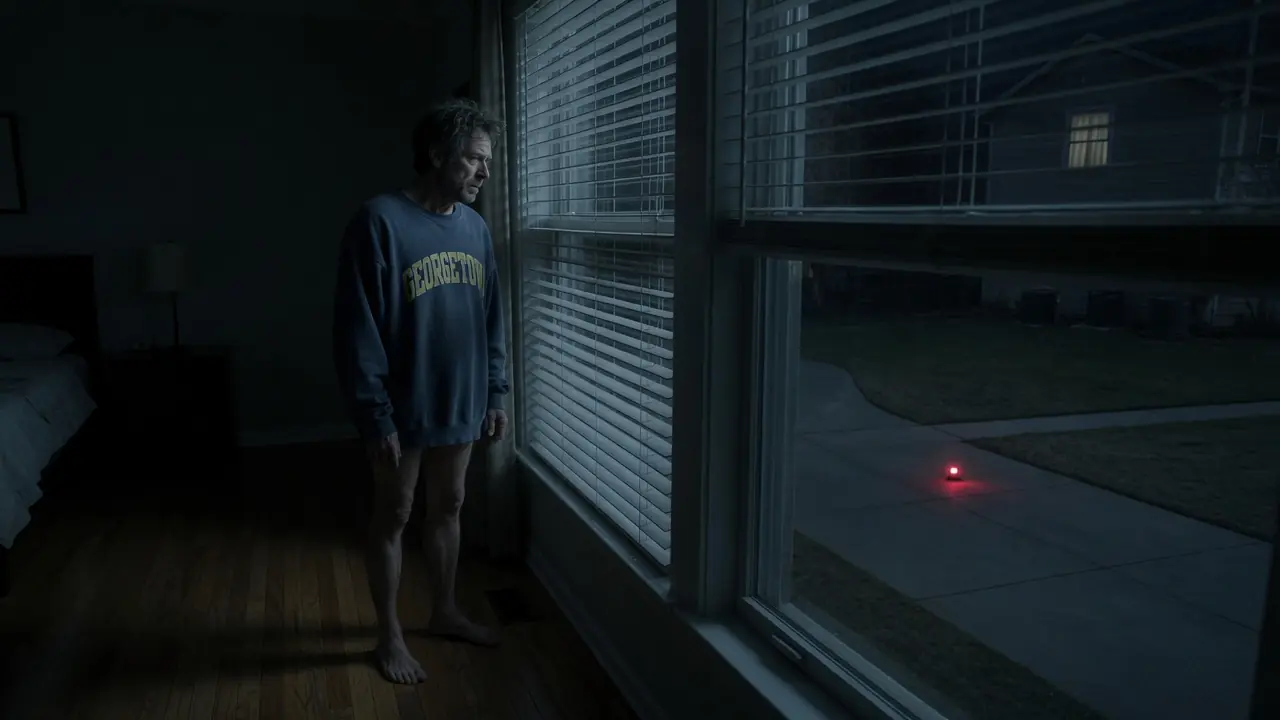
Maybe some kid's toy. Maybe just my post-divorce paranoia is finally getting the better of me. But as I stood there squinting through the Venetian blinds, I heard something that made my skin crawl. Click.
A tiny mechanical click. So quiet I almost missed it. The kind of sound a camera makes when it focuses or when it starts recording. I stepped back and saw Karen Wilson at her upstairs window watching me.
The instant she realized I saw her, the curtain snapped shut. Karen Wilson was a perfectly normal suburban woman as far as I knew. Mid-40s, worked at an insurance company, drove a beige Honda Civic, and had strong opinions about HOA violations that she wasn't shy about sharing at community meetings. She'd lived next door for the two years since my wife and I had bought our house, and she'd always been friendly in that polite keep your property values up kind of way.
But standing at her window at 3:30 in the morning watching my house while a mysterious electronic device blinked in my driveway, that didn't feel normal. That felt like the kind of thing that happens right before you find out your life isn't as boring as you thought it was. I grabbed my phone from the nightstand and turned on the flashlight app. The LED was bright enough to illuminate most of my bedroom, which meant it would definitely be visible from outside.
If someone was watching my house, they'd know I was awake now. They'd know I was paying attention. Good. Let them know.
I pulled on yesterday's jeans and a Georgetown University sweatshirt that had seen better decades, and I walked downstairs to my front door. The house felt bigger at night, emptier, like it was designed for a family and couldn't quite figure out what to do with just me rattling around inside it. Every footstep seemed to echo twice. My hand was on the deadbolt when I paused.
Was this smart? Was walking outside at 3:30 in the morning to investigate a blinking light the kind of thing a reasonable person did, or was it the kind of thing people did right before they became the first victim in a horror movie? But then I thought about Karen's face in the window, the way she'd been watching, the way she'd panicked when she realized I'd seen her. I unlocked the door and stepped outside.
The moment I stepped onto the porch, the red light stopped as if someone flipped a switch the second I moved. I stood there for a full minute letting my eyes adjust to the darkness, listening to the sound of central air conditioning units humming, and the distant whisper of highway traffic. The night felt heavier now, like it was holding its breath. Even the crickets seemed quieter, but the light didn't come back.
Whatever it was, whoever was controlling it, they were done for the night. I looked up at Karen's house. Every window was dark. Every curtain was drawn.
It looked like a house where everyone was fast asleep and had been for hours. It looked like a lie. I went back inside, locked the door, and sat on my couch in the dark for the next two hours watching my driveway through the living room window. The light never came back.
But I had the strangest feeling that I was still being watched. When the sun finally came up, I was going to find out what the hell was going on in my driveway. And I had a feeling Karen Wilson was going to have some very interesting answers. By 7:00, I had coffee and three hours of research behind me, mostly security forums, and a growing certainty that the light was a camera.
The coffee wasn't helping my nerves, but it was keeping my eyes open as I stood at my kitchen window staring out at my driveway like it might suddenly confess its secrets. In the harsh light of a Virginia summer morning, everything looked aggressively normal. My silver Honda Accord sat exactly where I'd left it. My mailbox stood at precisely the regulation distance from the curb.
Because this was Oakwood Estates, and everything had to be regulation distance from everything else. But I knew what I'd seen. And more importantly, I knew what I'd heard. That click.
That mechanical, intentional click that had made every instinct I possessed scream camera. Time for a little field investigation. I grabbed my phone, slipped on my running shoes, and walked outside like a man who was definitely not searching his own property for surveillance equipment at 7:00 in the morning. Just a guy getting his newspaper.
Except I didn't get a newspaper because this was 2024, and newspapers were something that happened to other people. The morning air was already thick with humidity and the promise of another scorching day. Mrs. Walsh watered roses down the block.
I waved and kept my casual inspection moving. I started my casual inspection near the mailbox using my phone's flashlight, even though there was plenty of morning sunlight. The trick to looking like you're not searching for hidden cameras is to look like you're searching for something completely different. Lost contact lens, dropped keys, the meaning of life, anything but surveillance equipment.
It was disguised surveillance gear, not a garden rock. My hands were shaking as I took photos with my phone. Not from fear exactly, but from rage. Someone had put a camera in my driveway.
Someone had been recording me coming and going from my own house. Someone had been watching me take out my trash, get my mail, leave for work, come home from work, and probably timing my bathroom breaks based on when my bedroom light went on and off. But I didn't touch it. Every instinct told me to rip the fake rock out of the ground and mash it against my garage door until it was nothing but plastic fragments and silicon dust.
But I was an engineer, not an animal. Evidence first, destruction later. I traced the power line. It was thin, black, and nearly invisible against the dark soil around my landscaping.
Once you knew what to look for, you could follow that low-voltage feed from the fake rock along the edge of my driveway, through my front flower bed, and right up to the property line I shared with Karen Wilson. The wire disappeared under the fence between our yards. A fence that Karen had insisted we install two years ago for privacy and property value enhancement. A fence that now looked less like a neighborly boundary and more like cover for someone running unauthorized cables through my yard.
I stood up and brushed the dirt off my knees, trying to look casual while my brain processed what I'd just discovered. Professional surveillance equipment hidden in my driveway, connected to my neighbor's property, the neighbor who had been watching me from her window at 3:30 in the morning. This wasn't paranoia. This wasn't post-divorce anxiety.
This was an actual crime being committed against me, and I had photographic evidence. I looked up at Karen's house. Every window was still closed, every curtain still drawn. But I had the distinct feeling that I was being watched.
Not the general feeling you get when you think someone might be looking. The specific feeling you get when you know someone is looking because there's a camera pointed at you and someone on the other end of that camera is paying attention. I waved at the fake rock. Just a little wave.
The kind you give to someone when you want them to know that you know they're there. Then I walked back to my house, my phone full of evidence, and my head full of questions that were about to get very interesting answers. Inside, I poured another cup of terrible coffee and sat at my kitchen table with my laptop. Time for some research.
Because before I called the police, before I confronted Karen, before I did anything that might escalate the situation into something ugly, I wanted to know exactly what I was dealing with. Turns out cameras hidden in fake rocks are a real thing. A really expensive real thing. Professional investigators use them.
Security companies use them. People who have way too much money and way too little respect for other people's privacy use them. People like Karen Wilson, apparently. I was reaching for my phone to call the police when I heard it again.
That soft mechanical click. Coming from outside. Coming from my driveway. I looked out the window.
The fake rock was still there sitting innocently among my landscaping. But now I knew what that click meant. Motion activation. Someone had just walked into range of the camera.
Someone was in my driveway right now. The someone in my driveway was Karen Wilson and she was standing approximately three feet from the fake rock camera staring directly at my kitchen window. Not pretending to get her mail. Not walking her nonexistent dog.
Just standing there watching my house like surveillance was a perfectly normal Tuesday morning activity. We made eye contact through the glass. She held the look for a few beats, then turned and walked back to her house as if the game was over. Time to call in the professionals.
But first I needed to know exactly what I was dealing with legally because confronting your neighbor about their illegal surveillance hobby is the kind of thing that can go sideways very quickly if you don't have your facts straight. And as a software engineer who had spent the last four months learning about divorce law the hard way I'd developed a healthy respect for getting legal advice before doing anything that might end up in court. I called the HOA to confirm there was no approval. If it were legitimate, there would be paperwork.
"Oakwood Estates Homeowners Association, this is Susan Miller speaking. " Susan sounded caffeinated and already in full enforcement mode. "Hi Susan, this is Michael Thompson on Maple Creek Drive. I have a question about surveillance equipment policies.
" Oh, the enthusiasm in Susan's voice dropped about 40°. "What kind of surveillance equipment? " "Cameras. Specifically cameras that might be monitoring residents' driveways without their knowledge or consent.
" There was a pause long enough for me to wonder if Susan had hung up. Then, "Mr. Thompson," are you reporting a violation or asking for permission to install something? " "Reporting a violation.
" "Someone has placed a camera in my driveway without my permission, and I believe it's connected to equipment on a neighbor's property. " That's another pause. "That's definitely not allowed. " All security installations require written approval from the Architectural Review Committee plus notification to affected neighbors within a 50-foot radius.
Who installed this camera? "That's what I'm trying to figure out. But I have photos, and I can trace the wiring to the neighboring property. " "Mr.
Thompson," if someone has installed unauthorized surveillance equipment that's monitoring your private property, that's not just an HOA violation. That's potentially criminal. You need to contact law enforcement. And there it was.
Official confirmation that I wasn't overreacting, wasn't being paranoid, and wasn't making a mountain out of a molehill. Someone was committing crimes against me, and the HOA lady thought I should call the cops. I thanked Susan, hung up, and immediately Googled cameras on private property Virginia law. The results were enlightening in the kind of way that makes you realize you've been way too trusting of your neighbors.
Installing surveillance equipment on someone else's property without their permission, criminal trespass. Recording someone's private activities without their consent, invasion of privacy. Using that recording for any purpose, potential stalking charges. The fake rock in my driveway wasn't just annoying, it was a felony.
Time to call the sheriff. I dialed the non-emergency number for the county sheriff's department because while this was definitely a crime, it wasn't the kind of crime that required sirens and flashing lights. This was the kind of crime that required someone with experience, patience, and the right equipment to trace underground cables. "County Sheriff's Office, Deputy Morrison speaking.
" "Hi, I'd like to report unauthorized surveillance equipment on my property. I believe my neighbor has installed a hidden camera in my driveway without my permission. " "Sir, can you hold for just a moment while I transfer you to someone who handles technology crimes? " Technology crimes, that sounded official.
That sounded like they dealt with this kind of thing regularly enough to have a department for it. "This is Sheriff Grant. I understand you're reporting unauthorized surveillance. " Sheriff Grant's voice had the kind of calm professionalism that immediately made me feel like I'd called the right people.
Not dismissive, not skeptical, just ready to handle whatever weird situation suburbanites had managed to create this week. "Yes, sir. I discovered a camera hidden in a fake rock in my driveway this morning. " It appears to be wireless and motion-activated, and I can trace wiring from it to my neighbor's property.
"How long do you believe this camera has been in place? " "I'm not sure. " I noticed suspicious activity last night around 3:30 a.m., but the camera itself is well disguised. Could have been there for weeks or months without me noticing.
"And you've confirmed this isn't legitimate security equipment installed by your HOA or a security company. " "Confirmed with the HOA this morning. " No permits, no approvals, no notifications. This is completely unauthorized.
There was the sound of typing in the background. "Mr. Thompson," I'm going to schedule a time to come out and document this equipment. Based on what you're describing, we're looking at potential criminal trespass, invasion of privacy, and possibly stalking charges.
Do not touch or move the equipment. Take photos if you haven't already, but preserve the scene. "I've got photos. When can you come out?
" I can be there this afternoon around 2:00. This kind of investigation requires specialized equipment to trace the wiring and document the setup properly. Will you be available? "Absolutely.
" Good. One more question. Have you confronted the neighbor you suspect is responsible for this? "No, sir.
I wanted to talk to law enforcement first. " Smart. Don't confront them until after I've had a chance to document everything. People who install unauthorized surveillance equipment sometimes have complicated motivations.
Better to let us handle the initial contact. Complicated motivations. That was a polite way of saying that people who spy on their neighbors might not react well to being caught. After I hung up, I made myself another cup of coffee and sat back down at my kitchen window.
The fake rock was still there, still recording, still violating my privacy with every passing minute. But now, I knew that by 2:00 this afternoon, Sheriff Grant would be in my driveway with specialized equipment and the legal authority to do something about it. I looked up at Karen's house, still closed up tight, still pretending that nothing unusual was happening. But something unusual was definitely happening.
And in about 5 hours, Karen Wilson was going to find out that her little surveillance hobby had just become a criminal investigation. I worked from home with one eye on my code and the other on the driveway feed I had screen grabbed earlier. Around late morning, a quiet ping from my motion alerts logged movement near the property line, then went still. No visuals, just the telltale timestamp.
I forwarded the alert bundle to Grant. He texted back one line, "Good. Keeps probable cause clean. See you this afternoon.
" Sheriff Grant arrived at exactly 2:00 in an unmarked white SUV that screamed law enforcement, despite its complete lack of visible police equipment. He looked mid-40s with a weathered face that had seen enough suburban crime to be unflinching and methodical movements that said he documented everything twice because details matter in court. "Mr. Thompson.
" He extended a hand that felt like it had spent considerable time shaking hands with people who were having the worst day of their lives. "Sheriff Grant," I understand you've discovered some unauthorized surveillance equipment. "Thank you for coming out, Sheriff. The camera is right over here.
" I led him to the fake rock, which was still sitting in my driveway like the world's most expensive paperweight. "I noticed the red LED blinking around 3:30 this morning, investigated this morning, and found this. " Sheriff Grant knelt down next to the fake rock without touching it, pulling out a small digital camera and a measuring tape. "Professional-grade equipment," he said, taking photos from multiple angles.
"This isn't some home security camera someone bought online. This is the kind of gear that costs serious money. " He stood up and walked back to his SUV, returning with a metal briefcase that looked like it belonged in a spy movie. "I'm going to use specialized equipment to trace the buried low-voltage power line and confirm any wireless transmissions.
Based on what you described over the phone, we're looking at criminal trespass at minimum, but I want to understand the full scope of what we're dealing with. " The first device he pulled out of the case looked like a cross between a metal detector and a radio. "Cable tracer," he explained, turning it on and adjusting several dials. "This will follow the buried power run from your camera to wherever it terminates.
" He held the device near the fake rock and it immediately started beeping. Not loudly, but with the kind of steady electronic pulse that suggested it had found exactly what it was looking for. Sheriff Grant began walking slowly across my driveway, following the signal like some kind of technological bloodhound. The beeping led him along the edge of my driveway, through my front flower bed, and directly to the fence line between my property and Karen's.
"Cable runs underground here," he said, making notes on a small pad, "crosses your property line and continues on to the neighboring property. "That would be Karen Wilson's property," I said, "the neighbor you mentioned on the phone. " Sheriff Grant pulled out his phone and took several photos of the fence line, then consulted what looked like a county survey map on his tablet. "According to county records, this cable is definitely crossing property boundaries without easement rights.
That's equipment trespass, which is a felony in Virginia. " He walked along the fence line toward Karen's backyard, the cable tracer beeping steadily. "Signal continues along your neighbor's property line and terminates. " He stopped near Karen's garage, the beeping reaching a crescendo.
"Here. Whatever this camera is connected to, it's in that garage. " Sheriff Grant put down the cable tracer and pulled out a second device that looked like a small radar gun. "This detects active electronic signals," he explained, pointing it at Karen's garage.
"If there's recording or transmission equipment inside that building, this will pick it up. " The device immediately lit up like a Christmas tree. Not just one signal, multiple signals, strong signals. "Mr.
Thompson," Sheriff Grant said, his voice taking on the kind of professional seriousness that suggested we'd just graduated from neighborhood dispute to actual criminal investigation. "There's a lot of electronic activity in that garage, much more than you'd expect from normal residential use. " "What kind of activity? " The kind that suggests your neighbor has more than one camera running.
He made more notes, took more photos, and pulled out his phone. I'm going to need to get a search warrant for that garage. Based on what I'm seeing here, we're potentially looking at a much larger surveillance operation than just one camera in your driveway. A larger surveillance operation.
That phrase sent a chill down my spine that had nothing to do with the Virginia heat. "You think she's recording other people, too? " "That's what I intend to find out. " But first, I need to document everything we found here and establish probable cause for a search warrant.
Sheriff Grant spent the next 20 minutes taking measurements, photographs, and what seemed like enough notes to write a small novel. The good news is that you've given me more than enough evidence to get that warrant. The bad news is that warrants take time. "How much time?
" For something like this, 24 to 48 hours. I'll file the paperwork this afternoon, and we should have judicial approval by Thursday morning. Two more days of living next to someone who was potentially recording my every move. Two more days of not knowing how long this had been going on, or what Karen Wilson had been doing with whatever footage she'd collected.
Two more days of feeling like a prisoner in my own house. In the meantime, Grant said, "Hold steady. I'll have a patrol swing past, and I'm filing the warrant now. "What if she's watching me right now?
" "She probably is, but that works in our favor. " The more evidence she creates of ongoing surveillance, the stronger our case becomes. Sheriff Grant packed up his equipment with the efficient movements of someone who'd done this many times before. I'm also going to have a patrol car drive by a few times over the next couple days just to maintain a visible law enforcement presence.
As if on cue, Karen's beige Honda Civic turned onto our street. She drove slowly past my house, and I could see her staring at Sheriff Grant's SUV with the kind of expression that suggested she knew exactly why law enforcement was parked in my driveway. "Interesting timing," Sheriff Grant observed, making a note of the license plate number. "Ms.
Wilson seems very interested in our activities. " Karen pulled into her driveway, watched for a long beat, then went inside. "Sheriff," I said, "is that normal behavior for someone who is not guilty of anything? " "Mr.
Thompson," in 15 years working tech crimes, I've learned this. " "If someone hides one camera, they've probably mapped the whole block. It's rarely a one-off. " "Complex motivations.
" The same phrase he'd used on the phone. It was starting to sound less like police jargon and more like a warning. Karen finally got out of her car, walked to her front door, and disappeared inside her house, but not before taking one more long look at Sheriff Grant's SUV and making what looked like a phone call. "Who do you think she's calling?
" I asked. "Could be anyone, family, friends, lawyer. " Sheriff Grant closed his briefcase and headed back toward his vehicle. "Or it could be someone else who's involved in this surveillance operation.
" We'll know more when we execute that search warrant. " Someone else who's involved. The possibility that Karen wasn't working alone hadn't occurred to me, but it made sense. Professional surveillance equipment, multiple electronic signals, the kind of setup that Sheriff Grant described as larger than expected.
That wasn't the work of one bored suburban housewife. That was organized. "Mr. Thompson," I'll call you as soon as I have that warrant.
" Until then, document anything unusual you observe, but don't take any action on your own. If Ms. Wilson approaches you or behaves in a threatening manner, call 911 immediately. " After Sheriff Grant left, I stood in my driveway looking at the fake rock camera with completely different eyes.
It wasn't just a violation of my privacy anymore. It was evidence in what was apparently a much larger criminal investigation. And somewhere in Karen Wilson's garage was equipment that might reveal exactly how large. I looked up at Karen's house.
Every window was closed, every curtain drawn, just like always. But now, I knew that behind those curtains was someone who was probably having a very bad afternoon. Thursday morning couldn't come soon enough. Thursday morning came with the kind of anticipation that makes coffee taste like victory and makes you check your phone every 30 seconds, even though you know the sheriff said he'd call when the warrant was ready.
I'd spent Wednesday evening doing what any reasonable person would do while waiting for law enforcement to search their neighbor's garage for illegal surveillance equipment. I'd researched Karen Wilson. Karen's profiles looked aggressively normal, but threaded with a fixation on neighborhood security. But buried in three years of posts about grocery shopping and weather complaints, I found something interesting.
Karen had a lot of opinions about neighborhood security and suspicious activity. Posts about keeping our community safe and being vigilant about who belongs here. She had shared no fewer than six articles about home security systems in the past year, and she'd commented on a local news story about residential break-ins with the kind of detailed analysis that suggested she'd given the topic considerable thought. My phone rang at 9:15 a.m.
"Mr. Thompson," this is Sheriff Grant. I have the search warrant, and I'm heading to your location now. " Are you available to be present during the search?
"Absolutely. " How long until you get here? " "15 minutes. " I'm bringing Deputy Morrison and a crime scene photographer.
This needs to be documented thoroughly. I spent those 15 minutes pacing around my kitchen and watching Karen's house like it might suddenly confess its secrets. At 9:28, Karen's garage door opened, and she walked outside ostensibly to check her mailbox. Except her mailbox was at the end of her driveway, and she spent most of her time looking at my house instead of looking at her mail.
At half past nine, two county units rolled to the curb, Grant stepping out with the warrant, a crime scene team piling out behind him with cases and tripods. Karen, who had been taking an unusually long time to retrieve what appeared to be a single piece of junk mail, suddenly found herself with a front row seat to what was clearly an official law enforcement operation. Sheriff Grant approached my front door with the kind of purposeful stride that suggested he'd done this before and wasn't particularly interested in small talk. "Mr.
Thompson," we have the warrant. Is Ms. Wilson currently at home? " "She's outside checking her mail.
" I nodded toward Karen, who was now standing in her driveway holding an envelope and staring at us with the expression of someone who just realized her day was about to get very complicated. "Perfect. Deputy Morrison, let's go introduce ourselves. " What followed was the kind of conversation that proves reality is stranger than fiction.
Sheriff Grant walked across the property line to Karen's driveway, held up a folded document, and said the words that every suburban homeowner dreads hearing. "Ms. Wilson, I'm Sheriff Grant with the county sheriff's office. " I have a search warrant for your garage and any electronic equipment contained therein.
Karen's response was immediate and illuminating. "This is about that security camera, isn't it? I can explain everything. " Notice she didn't say, "What security camera?
" She didn't act confused or surprised. She immediately knew exactly what this was about, which meant she'd been expecting this conversation. The only question was what her explanation would be. Ms.
Wilson, rather than discuss this in your driveway, would you prefer to step inside while we execute this warrant? "No, that's fine. I have nothing to hide. " Karen's voice had the kind of forced calm that suggested she was working very hard to appear cooperative.
The camera was installed by a private security company I hired to monitor the neighborhood for suspicious activity. Sheriff Grant pulled out his notepad. "Which security company? " "Metro Security Solutions.
They specialize in residential neighborhood protection. " "And you have documentation of this contract. " "Of course, it's all legitimate. " I was trying to help keep our community safe.
I'd been standing on my porch listening to this exchange, but at the mention of Metro Security Solutions, I couldn't help myself. "Karen, why didn't you mention this security service at the last HOA meeting? " Shouldn't the whole neighborhood know if someone's providing professional security monitoring? Karen turned to look at me with the kind of expression that suggested she hadn't expected me to participate in this conversation.
"It was... it was a trial period. " I wanted to see how effective it was before recommending it to everyone else. Sheriff Grant continued making notes. "Ms.
Wilson, I'll need to see that contract along with the business license for Metro Security Solutions and any permits they obtained for installing surveillance equipment. " "I... they handle all the paperwork. " Everything's done remotely. "I see.
" And this trial period you mentioned, how long has it been running? "Just a few weeks. " Mr. Thompson discovered this camera yesterday morning, but he reported suspicious activity going back several months.
Can you explain that discrepancy? Karen's face went through a series of expressions that could charitably be described as processing and less charitably described as panic. "Maybe the camera was installed earlier than I thought. " The security company handles the scheduling.
By this point, a small crowd had gathered. Tom Stevens from across the street was pretending to work in his garden while obviously listening to every word. Betty Walsh had appeared on her porch with a cup of coffee and the kind of alert expression that suggested she was mentally taking notes for future neighborhood gossip. Even the Miller family had found reasons to be outside, which meant Karen's trial period explanation was getting a live audience of people who would definitely remember if a legitimate security company had been operating in the neighborhood.
Ms. Wilson, Sheriff Grant said, "I'm going to need you to contact this Metro Security Solutions company right now and have them verify the details of your contract. " "I... they don't usually take calls during business hours. " "What kind of security company doesn't take calls during business hours?
" Karen was running out of explanations and you could see it in real time. "They're very exclusive. They only work with select clients. " Deputy Morrison, who had been quietly observing this conversation, spoke up for the first time.
"Ma'am, I'm going to need to see some identification, and then we're going to execute this search warrant. " If you have documentation for this security contract, now would be the time to produce it. " "It's all on my computer in the garage. " "Perfect.
We'll take a look at that when we search the garage. " That's when Karen made her first real mistake. Instead of continuing to insist that everything was legitimate and above board, instead of maintaining her story about Metro Security Solutions and trial periods and exclusive clients, she said the one thing that guaranteed this situation was about to get much worse. "You know what?
I don't think I need to answer any more questions without a lawyer present. " The neighborhood went dead silent. Tom Stevens stopped pretending to garden. Betty Walsh stopped pretending to drink coffee.
Even the birds seemed to pause their morning routine because everyone understood what had just happened. Innocent people who hire legitimate security companies don't suddenly decide they need lawyers when law enforcement asks to see the paperwork. Sheriff Grant folded his notepad. "Ms.
Wilson, that's absolutely your right. " Deputy Morrison will stay here with you while I execute the search warrant. "Mr. Thompson," would you like to observe the search?
" As we walked toward Karen's garage, I could hear her making a phone call behind us. Not to Metro Security Solutions, not to anyone who could verify her story about trial periods and neighborhood protection, but to someone who she apparently thought could help her with what was rapidly becoming a very serious legal problem. Sheriff Grant used a pair of bolt cutters to remove the lock on Karen's garage door. "Mr.
Thompson," I want you to see this because you're going to be testifying about it eventually, but don't touch anything. " Don't move anything, and prepare yourself for what we might find. " And he lifted the garage door, and I immediately understood why he'd said to prepare myself. Karen Wilson's garage looked like something out of a spy movie.
Karen Wilson's garage contained approximately $15,000 worth of surveillance equipment and exactly zero cars. What it did contain was the kind of setup that made Sheriff Grant immediately call for backup and made me realize that my neighbor hadn't just been spying on me. She'd been running a business. Six monitors mounted on the far wall, each displaying a different live video feed.
Professional-grade equipment stacked on custom shelving. Cable management that would make a data center technician weep with envy. And in the center of it all, a desk setup that looked like mission control for suburban espionage complete with multiple keyboards, a high-end computer, and filing cabinets that were labeled with what appeared to be addresses. "Jesus Christ," Sheriff Grant muttered, which I took to mean this wasn't the kind of thing he encountered during routine suburban warrant executions.
The crime scene photographer immediately started documenting everything while Deputy Morrison radioed for additional units because what we were looking at wasn't just illegal surveillance. It was organized illegal surveillance conducted with the kind of professional equipment and systematic approach that suggested this had been going on for a very long time. "Mr. Thompson," can you identify any of these video feeds?
" I walked closer to the monitors careful not to touch anything. The first screen showed a clear view of my driveway recorded from the fake rock camera we'd already discovered, but the other five screens were showing driveways and front yards I recognized. The Stevens house across the street. The Walsh property is three doors down.
The Miller family's front yard. The Johnson house on the corner, and one feed I couldn't immediately identify, but that looked like it might be from the other end of the street. "Sheriff," these are all houses in my neighborhood. " She's been recording at least five different families.
"Six families? " He corrected, pointing to the screen I hadn't recognized. That's the Carter property on Oak Street one block over. Sheriff Grant was making notes with the kind of methodical precision that suggested he had already mentally organized this evidence for court.
Ms. Wilson has been conducting systematic surveillance of multiple residential properties without consent. The computer on the desk was still logged in, which meant we could see exactly what Karen had been doing with all this footage. The desktop was organized with folders labeled by address and date ranges.
1247 Maple Creek Drive, January to March. 1251 Maple Creek Drive, February to April. My address, 1249 Maple Creek Drive, had its own folder with subfolders labeled things like visitor log, schedule analysis, and incident reports. "Sheriff," there are gigabytes of footage here.
" This isn't just recording. She's been analyzing patterns, keeping logs, creating reports. Sheriff Grant leaned over the computer without touching the keyboard. "Open that incident reports folder.
" A digital forensics tech navigated the folders while a body cam recorded the process. I stood back and watched. Inside were dozens of documents with titles like 1249 unusual visitor, March 15, 1247 package delivery schedule change, and 1251 late night activity pattern. "She's been documenting our lives," I said, feeling a combination of violation and rage that I hadn't known was possible.
Every visitor, every delivery, every time someone comes home late from work. But that wasn't the worst part. The worst part was in a folder labeled client communications. "Sheriff," I think you need to see this.
" A client communications folder showed emails with private investigators and divorce attorneys using throwaway domains and prepaid invoices. Karen was selling footage. This is a business, Sheriff Grant said photographing the computer screen. She's been selling surveillance footage to private investigators and attorneys who are building cases against the people she's recording.
One email chain showed Karen negotiating payment for comprehensive activity logs and video evidence for the Miller family with a lawyer who was apparently representing Mrs. Miller's ex-husband in a custody dispute. Another showed her providing visitor documentation and schedule analysis for the Stevens family to someone who identified themselves as a private investigator working on a marital fidelity case. "Mr.
Thompson," look at this. " Sheriff Grant was pointing to an email dated just 3 days ago. Ms. Wilson sent 18 hours of footage from your driveway to someone who paid her $1,200 for evidence of residential activity patterns.
$1,200. Someone had paid Karen Wilson $1,200 for nearly a full day's worth of footage of me leaving my house, coming home from work, getting my mail, and living my life. Someone who apparently thought my residential activity patterns were worth paying for. "Who was the buyer?
" Sheriff Grant clicked on the email address. The account is registered to Marston Investigations, a private detective agency in Richmond. Morrison Investigations. I'd never heard of them, had never hired them, and couldn't think of any reason why anyone would want surveillance footage of my daily routine.
Unless someone was building a case about my life that I didn't know about. Like my ex-wife's divorce attorney who had been very interested in proving that I was hiding assets or income during our divorce proceedings. "Sheriff," I think my ex-wife's lawyer hired someone to spy on me. " "That's actually not uncommon.
" Divorce attorneys sometimes hire private investigators to document lifestyle and spending patterns, especially in high-asset cases. Sheriff Grant was still photographing evidence, but he paused to look at me. "Was your divorce contentious? " "Let's just say that if my ex-wife's attorney found out there was footage available of my daily activities, they'd probably be interested in purchasing it.
" The crime scene photographer had moved on to documenting the DVR equipment, which appeared to be storing months of footage from all six cameras. Industrial-grade hard drives, backup systems, and enough storage capacity to keep detailed records of an entire neighborhood's activities for years. "How long do you think this has been going on? " I asked.
Sheriff Grant was examining a filing cabinet that was locked with a combination lock. Based on the equipment setup and the email timestamps, I'd guess at least 18 months, possibly longer. He tried the handle. "We're going to need to get this cabinet open.
" It probably contains financial records and client information. Deputy Morrison appeared in the garage doorway. "Sheriff," Ms. Wilson is asking to speak with you.
" She says she wants to cooperate fully and explain everything. "I bet she does. " Sheriff Grant looked around the garage command center one more time. Tell Ms.
Wilson that anything she wants to explain, she can explain to her attorney. We've got enough evidence here to charge her with multiple felonies. "What kind of felonies? " Criminal surveillance, invasion of privacy, operating an unlicensed private investigation, business tax evasion, if she wasn't reporting this income, and potentially stalking charges depending on how targeted some of the surveillance was.
Sheriff Grant was counting on his fingers. Plus conspiracy charges if we can prove she was working with these private investigation firms to specifically target individuals. Conspiracy charges. The possibility that Karen's surveillance business was part of a larger network of people who made money by spying on suburban families was somehow more disturbing than the idea that she was just a creepy neighbor with boundary issues.
"Mr. Thompson," I need to ask you something important. " Have you noticed any changes in your routine over the past year? Any times when you felt like you were being watched or when you modified your behavior because something felt off?
I thought about it. "Actually, yes. " I started parking in my garage instead of the driveway about six months ago because I kept feeling like someone was watching me when I got out of my car. And I stopped having friends over as much because I felt like my neighbors were paying too much attention to who was visiting.
"Your instincts were correct. " According to these logs, Ms. Wilson has been documenting your visitor patterns and noting any changes in your routine. She's been studying your life like it was her job.
Because it was her job. Karen Wilson had turned suburban surveillance into a profitable business and I'd been one of her most thoroughly documented subjects. Every time I'd felt like I was being watched, every time I'd felt uncomfortable in my own driveway, every time I'd wondered if my neighbors were paying too much attention to my business, I'd been right. The crime scene photographer finished documenting the monitor setup and moved on to the filing cabinets.
"Sheriff," we're going to need a locksmith for these cabinets and probably a computer forensic specialist for all this digital evidence. Already called for both. Sheriff Grant looked at his watch. "Mr.
Thompson," this investigation is going to take several hours and it's going to get complicated quickly. You should probably call your attorney. "My attorney? Why?
" Because if your ex-wife's legal team purchased surveillance footage of your activities during your divorce proceedings and if that footage was obtained legally, you might have grounds for some very serious civil lawsuits. Civil lawsuits against my ex-wife's attorney, against Karen Wilson, against Morrison Investigations, against anyone who had purchased illegally obtained footage of my private life and used it for legal proceedings. "Sheriff," how much trouble is Karen in? " Ms.
Wilson is looking at multiple felony charges, significant financial penalties, and the possibility of several years in prison. Sheriff Grant was already planning his next steps. But first, we need to notify all the families who were being surveilled, and we need to identify everyone who purchased footage from her. As we walked out of the garage, I could see that the crowd of neighbors had grown substantially.
Word travels fast in suburban neighborhoods, especially when that word involves crime scene photographers and search warrants. Tom Stevens, Betty Walsh, the Miller family, the Johnsons, and at least six other neighbors were standing in various driveways, watching law enforcement dismantle Karen Wilson's surveillance business. Karen herself was sitting in the back of a police car, no longer making phone calls. She was going to need a very good lawyer.
The emergency HOA meeting was scheduled for Saturday morning at 10:00 a.m. in the Oakwood Estates Community Center, and by 9:45, the parking lot looked like Black Friday at Target. Every household in the subdivision had received a certified letter from the HOA board explaining a significant security breach affecting multiple residents, urging attendance, and admitting that the old architectural policy never addressed resident-to-resident surveillance. What the letter hadn't mentioned was that Karen Wilson was required to attend as part of her bail conditions, or that Sheriff Grant would be presenting evidence to the entire community about the scope of her surveillance operation. I arrived early because I wanted to see people's faces when they learned the truth about what had been happening in their own driveways.
The community center was buzzing with the kind of nervous energy that happens when an entire neighborhood realizes they're about to find out something they're not going to like. Tom Stevens and his wife Jennifer had claimed seats in the front row, which made sense since they'd had front row seats to Karen's arrest 2 days earlier. Betty Walsh was holding court near the coffee station, explaining to anyone who would listen that she'd always known something was off about that woman. The Miller family was huddled together in the back corner, looking like they'd rather be anywhere else, which also made sense considering what we discovered about their custody battle.
At exactly 10:00 a.m., HOA board president Margaret Foster called the meeting to order with the kind of grim expression usually reserved for announcing special assessments or major roof repairs. Sheriff Grant kept it plain. He told the room Karen Wilson had been arrested and that multiple households had been monitored without consent over a long span. Then he pivoted from hardware talk to harm, who was inconvenienced where schedules were tracked and how those logs were used to pressure families.
Betty Walsh's coffee cup hit the floor. Tom Stevens said something under his breath that probably wasn't appropriate for a community meeting. The Miller family looked like they wanted to disappear completely. The surveillance operation was not limited to simple recording.
Ms. Wilson created detailed logs of residents' schedules, visitors, and activities, which she then sold to private investigators and attorneys for use in legal proceedings. That's when the room exploded. She sold footage of our family.
Jennifer Stevens was on her feet pointing at Karen with the kind of rage that comes from realizing your privacy has been violated for profit. How much money did she make? This from Jim Miller, whose custody battle had apparently been influenced by Karen's surveillance data. Who else knew about this?
Betty Walsh was demanding answers with the authority of someone who'd lived in the neighborhood longer than anyone else and felt personally responsible for community security. Sheriff Grant raised his hand for quiet. I can answer some of these questions. Ms.
Wilson earned approximately $8,000 over 18 months selling surveillance footage to three different private investigation firms and two divorce attorneys. The buyers included investigators working on custody cases, marital infidelity cases, and asset verification cases. $8,000. Karen Wilson had made $8,000 selling footage of her neighbors' private lives.
That worked out to roughly $450 per month, which meant she'd been making a car payment by spying on people who trusted her. "Sheriff Grant," Margaret Foster asked, "which families were affected? " He named the affected families, six households across Maple Creek and Oak. And you could feel the air leave the room as neighbors realized which front yards had been turned into case files.
"What kind of footage was she selling? " This question came from David Johnson, who looked like he was calculating exactly how much of his family's private life had been turned into Karen's profit margin. He summarized it as patterns for sale, who came when they came, and how those rhythms were packaged for other people's leverage. The room fell silent as everyone processed what that meant.
Karen Wilson hadn't just been recording them. She'd been analyzing them, studying them, turning their lives into data that she could package and sell to people who wanted to use that information against them. "Sheriff," Tom Stevens asked, "Who were the buyers? " Morrison Investigations, a private detective agency in Richmond.
Blackstone Legal Services, which appears to be a divorce attorney's office. And at least three individual clients who were seeking information about their neighbors for various legal proceedings. "Legal proceedings? " Betty Walsh's voice had the kind of sharp edge that suggested someone was about to get a piece of her mind.
"What kind of legal proceedings require spying on your neighbors? " Divorce cases where one party is trying to party is hiding assets or engaging in behavior that might affect custody arrangements. Insurance fraud investigations. Property disputes.
Background checks for employment or security clearances. The implications were sinking in. Karen Wilson hadn't just been running a surveillance business. She'd been running a surveillance business that helped people destroy each other's lives using illegally obtained footage of their most private moments.
"Karen. " Margaret Foster turned to address Karen directly for the first time since the meeting started. Do you have anything to say to this community? Karen Wilson stood up slowly, looking around the room at faces that had once been friendly and were now ranging from disgusted to furious to completely betrayed.
"I was trying to help keep the neighborhood safe. " I was documenting suspicious activities and unusual patterns that might indicate security threats. "Suspicious activities. " Jennifer Stevens was back on her feet.
"You documented my sister visiting our house twice a week and sold that information to someone who was investigating my husband for insurance fraud. " "You recorded our children playing in our front yard and sold that footage to my ex-husband's attorney. " This from Rosa Miller, who looked like she was about 5 seconds away from physically attacking "Karen. " "You turned our private lives into a business.
" Tom Stevens was standing now, too. You made money by violating our privacy and selling our information to people who wanted to hurt us. Sheriff Grant stepped in before the community meeting turned into something that required additional law enforcement. Ms.
Wilson will be facing multiple criminal charges including organized surveillance invasion of privacy, operating an unlicensed private investigation business, and potentially conspiracy charges. She's also facing significant civil liability from the families who were affected. "What kind of civil liability? " This from David Johnson, who sounded like he was already calculating damages.
Ms. Wilson could be liable for damages related to privacy violations, emotional distress, and any negative consequences that resulted from the illegal use of surveillance footage in legal proceedings. Given that she was operating a business, the damages could be substantial. Substantial damages.
Karen Wilson was looking at criminal charges, prison time, and civil lawsuits that could cost her everything she owned. Her surveillance business had just become the most expensive mistake of her life. Sheriff Margaret Foster asked, "What happens next? " Ms.
Wilson's criminal trial will proceed through the courts. The families who were surveilled can pursue civil lawsuits independently, and we're continuing to investigate the private investigators and attorneys who purchased illegal surveillance footage to determine if additional charges are warranted. Additional charges. Karen Wilson wasn't just going to be destroyed by this.
Everyone who had participated in her surveillance business might be destroyed, too. As the meeting broke up, I watched Karen Wilson walk to her car alone while 47 households worth of neighbors watched her with the kind of expressions usually reserved for people who'd betrayed their entire community for money, which when you thought about it was exactly what she'd done. Margaret Foster announced that the community would be implementing new privacy protection bylaws, and that I'd been asked to chair the new residential privacy committee. Karen Wilson's house went up for sale the following Monday.
Six months later, I was standing in my driveway at 7:00 a.m. on a Tuesday morning drinking coffee that actually tasted good and watching my new neighbors move into Karen Wilson's old house. The Williamses were a young couple with a golden retriever and the kind of enthusiastic energy that comes from buying your first house in a neighborhood where property values had mysteriously dropped 15% overnight. Karen Wilson had pleaded guilty to 12 criminal charges, including organized surveillance invasion of privacy, operating an unlicensed private investigation business, and conspiracy to commit fraud. Her sentencing hearing had been standing room only with every affected family in attendance to deliver victim impact statements that painted a comprehensive picture of what it felt like to discover your trusted neighbor had been selling your private life to the highest bidder.
The judge had not been impressed with Karen's explanation that she was trying to help keep the community safe. $25,000 in fines, six months of suspended jail time, two years of supervised probation, mandatory counseling, and restitution payments to six families had been the court's response to Karen's innovative approach to neighborhood security, but the criminal charges had been just the beginning. The civil lawsuits were where the real justice happened. My lawsuit against Karen Wilson, Morrison Investigations and my ex-wife's divorce attorney had settled for $47,000 and a written admission that illegally obtained surveillance footage had been used in my divorce proceedings.
The Miller family had received $62,000 and full custody of their children after proving that Karen's surveillance data had been used to falsely represent Rosa Miller's parenting abilities. Tom and Jennifer Stevens had settled for $38,000 and criminal charges against the insurance investigator who'd purchased footage of their daily routines. Betty Walsh, who at 7three years old had never filed a lawsuit in her life, had hired the most aggressive privacy attorney in Virginia and extracted $85,000 from Karen Wilson's surveillance business. "At my age," Betty had explained at the last HOA meeting, "being violated by someone you trusted isn't something you recover from easily.
But money helps. " The total civil damages had exceeded $300,000, which meant Karen Wilson had lost her house, her savings, her retirement account, and any hope of ever owning property in Virginia again. Her surveillance business, which had earned her $8,000 over 18 months, had cost her everything she'd spent 40 years building. Morrison Investigations had been shut down by the state licensing board.
Two divorce attorneys had been sanctioned by the Virginia Bar Association. The private investigator who'd purchased surveillance footage for insurance fraud cases was facing criminal charges in three counties. Karen Wilson was working at a call center in North Carolina and living in a studio apartment that cost more per month than she used to spend on coffee. Justice, it turned out, was expensive, but watching someone face real consequences for systematic privacy violations was priceless.
The Oakwood Estates residential privacy charter that I'd helped draft had become a model for suburban communities across Virginia. No surveillance equipment could be installed without written consent from affected neighbors. All security cameras had to be clearly marked and registered with the HOA. Private investigation activities were prohibited within community boundaries, and any resident who violated the privacy of their neighbors faced automatic expulsion from the community.
More importantly, the new bylaws included criminal background checks for all prospective residents and a requirement that anyone moving into the community sign a binding agreement that privacy violations would result in immediate legal action funded by a community legal defense fund. The Williamses had enthusiastically signed everything, and they'd paid $23,000 below asking price for a house that had previously been owned by someone who turned her garage into a suburban spy center. Market forces, it seemed, didn't respond well to criminal surveillance operations. "Good morning, Michael.
" Sarah Williams was walking her golden retriever and had the kind of cheerful energy that suggested she genuinely enjoyed living in a neighborhood where she didn't have to worry about her neighbors selling footage of her morning routine to private investigators. "Morning, Sarah. How's the unpacking going? " "Great.
We love the house, and the neighborhood feels so secure. " Everyone's been so welcoming. Secure. That was exactly the right word.
For the first time in two years, Oakwood Estates actually felt secure. Not because someone was secretly monitoring everyone's activities, but because everyone knew that their privacy was protected by people who gave a damn about privacy. My phone buzzed with a text from Sheriff Grant. "Wilson probation violation hearing next week.
" "Apparently, she was caught using a fake name to sign up for social media surveillance services. " "Some people never learn. " Some people never learned. Karen Wilson was apparently one of those people who believed that if a little surveillance was good, more surveillance was better.
Her probation officer had discovered she'd been creating fake profiles to monitor her former neighbor's social media activities, which violated both her probation terms and a restraining order that prohibited her from any contact with Oakwood Estates residents. That probation violation would probably send her to jail for the six months of suspended sentence she'd avoided during her original sentencing. And it would definitely extend her probation for another two years. I deleted the text and finished my coffee.
Karen Wilson's inability to stop spying on people was no longer my problem. She was someone else's problem now living in someone else's state working at someone else's call center and hopefully learning that privacy violations have consequences that compound over time. My new normal included security cameras that were properly installed, clearly marked, and registered with the HOA. Motion-activated lights that actually belonged to me.
And the kind of peaceful morning routine that comes from knowing your neighbors respect boundaries and understand that trust is something you build, not something you violate for profit. The fake rock that had started this whole investigation was on display in Sheriff Grant's office as part of a training exhibit about residential surveillance crimes. New deputies learned about probable cause search warrant procedures and the importance of taking privacy violations seriously by studying Karen Wilson's garage command center, spy center, and understanding how much damage one person could do with $15,000 worth of surveillance equipment and a complete disregard for other people's rights. At the 6-month anniversary HOA meeting, Margaret Foster had asked me to speak about the importance of community vigilance and privacy protection.
I'd ended my presentation with the same line I'd used to open the meeting. "Don't worry, everyone. This meeting isn't being recorded. I've checked.
" The laughter had been genuine, relieved, and thoroughly cathartic. Betty Walsh had bought a bottle of champagne to celebrate the fact that Karen Wilson's house had finally sold. Tom and Jennifer Stevens had hosted a block party to welcome the Williamses and to celebrate the end of what everyone was calling the surveillance era. The Miller family had used their settlement money to install a play set in their backyard where their children could play without worrying about hidden cameras documenting their activities for future custody battles.
Six months after discovering a fake rock with a hidden camera in my driveway, I was living in a neighborhood where privacy was protected, trust was earned, and people understood that security comes from respecting each other, not from spying on each other. It was exactly the kind of community Karen Wilson had claimed she was trying to create. The irony was that she'd had to be completely removed from it before it could actually exist. This morning as I finish my coffee and watch Sarah Williams teaching her golden retriever to fetch in a yard where she didn't have to worry about hidden cameras, I realized that sometimes the best thing that can happen to a neighborhood is discovering that one of your neighbors is a criminal because removing criminals makes room for people who actually belong there.
END