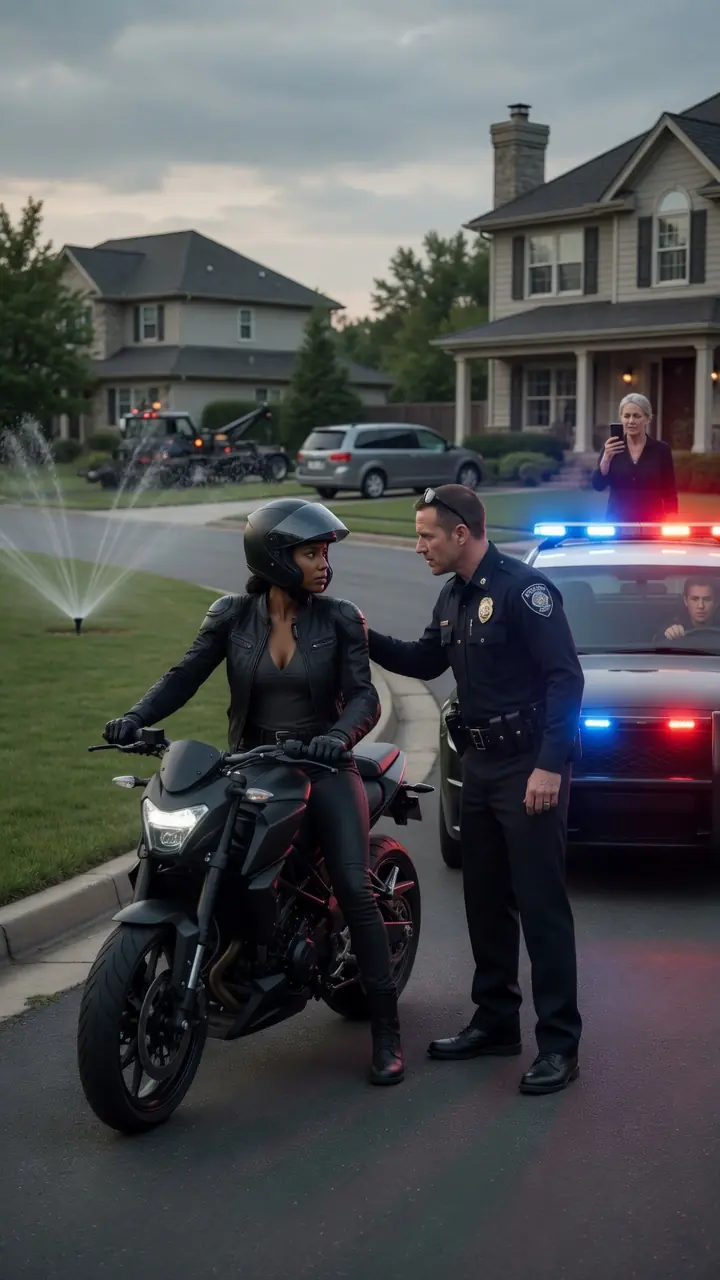
"Get off the bike, now." The voice cracked across the quiet street like a slap before Lieutenant Colonel Renata Mosley had even finished rolling to a stop. She hadn't done anything wrong. She hadn't even unclipped her helmet strap yet, but the patrol cruiser was already behind her lights spinning red and blue against the asphalt, and a man was already out of the car and walking toward her with his hand resting on his belt like he expected trouble he hadn't found yet. Renata kept both hands visible on the handlebars.
Years of training did that automatically now, the same way her body straightened when the national anthem played, the same way her eyes swept a room for exits before she ever sat down. She had taken the bike out for one reason today, to think. The fraud case sitting on her desk back at Fort Callaway had kept her awake for the better part of two weeks, a tangle of missing contract funds and motor pool paperwork that didn't add up no matter how many times she ran the numbers. Riding helped.
The engine noise drowned out the part of her brain that wouldn't stop chewing on numbers, and for 20 minutes at a time she could just be a woman on a road instead of an officer carrying a case nobody wanted solved. The street was the kind of quiet that only existed in places where nothing bad was supposed to happen. Manicured lawns, a sprinkler ticking back and forth across someone's grass two houses down, a minivan idling in a driveway while a woman loaded grocery bags into the back. Renata had chosen this route because it was peaceful, because the road curved gently along the ridge above Cedar Bluff and gave her a few uninterrupted miles before she had to think about anything at all.
She had bought the motorcycle two years earlier after her second deployment on the advice of a therapist who'd suggested she find something that gave her body a sense of forward motion without requiring her to justify the destination to anyone. It had taken her months to admit how much she loved it. The specific lean into a curve, the controlled transfer of weight and throttle, the way it gave her something meetings and briefings and budget reviews never could, a problem with an immediate physical answer. Lean here, brake there, survive the curve.
No politics in it, no ambiguity, just a road, a machine, and a body that knew exactly what to do with both. That peace had lasted exactly four minutes before the lights appeared in her mirror. She eased the bike to the shoulder, killed the engine, and waited with her hands where they could be seen exactly the way she had trained hundreds of young soldiers to handle a stop they didn't understand. Compliance first, documentation always.
Never give a hostile actor a reason to escalate that wasn't already there. In the few seconds before the officer reached her, Renata ran through the same mental checklist she had taught in dozens of classrooms over the years. The specific protocol for any encounter where the other party held more immediate power than you did. Stay visible.
Stay calm. Assume good faith until good faith is no longer a reasonable assumption to make. She had recited this checklist to soldiers preparing for deployments to places where a single misread gesture could end a life, and she had always delivered it with a certain academic distance, confident in its usefulness without ever quite expecting to need it herself. On a quiet residential street less than 10 miles from her own front door.
There was something almost absurd about that thought, she realized, the specific irony of having taught de-escalation as a survival skill for hostile environments only to find herself applying it now in a neighborhood with manicured lawns and a sprinkler still ticking obliviously nearby. The officer who approached was a white man in his 30s, sunglasses pushed up on his head despite the overcast sky, like he wanted his eyes visible so people could see exactly how unimpressed he was. His name tag read Halsey. He stopped a few feet from the bike and looked at it first, then at her, his gaze moving slow and deliberate across the matte black fairings, the aftermarket exhaust, the kind of motorcycle that cost more than most people's first car.
"This your bike?" he asked in a tone that already had the answer it wanted. "Yes, sir," Renata said, keeping her voice level. "Registration and my ID are in the side case. I'm happy to retrieve them." Halsey's mouth twitched almost a smile, the kind men wore when they'd already decided what conversation they were having regardless of what was actually said to them.
"Funny," he said, "because a bike like this doesn't usually belong to somebody who looks like you." The words landed exactly where they were aimed. Renata had heard versions of this sentence her entire adult life wrapped in different uniforms, spoken by different mouths, always carrying the same assumption underneath, that her existence in a nice thing was itself the crime requiring an explanation. She had learned over 20 years of service exactly how to absorb a sentence like that without letting it show on her face. It took practice.
It took the same discipline that kept her steady under live fire during a deployment 11 years ago, the same discipline that let her brief a room of full colonels without her voice shaking even when the news she carried was bad. She ran the numbers in her head the way she ran every difficult situation breaking it into manageable variables instead of letting it become one overwhelming wave. Variable one, the stop itself. No visible traffic violation, no equipment failure.
She was aware of nothing she had done that would reasonably justify a stop on a residential street at 4:00 in the afternoon. Variable two, his tone. Already adversarial, already certain, the cadence of a man who had pulled over plenty of people who looked like her and never once had to answer for how those stops ended. Variable three, the one that mattered most.
She was alone, off-duty in civilian riding gear with no visible rank, no escort, nothing on her body that announced who she was except a small embroidered patch on her riding jacket's inner lining that nobody but her could see. She thought of every classroom of young enlisted soldiers she had taught about de-escalation, about the asymmetry of power in any encounter where one party had a badge and a weapon and the other had nothing but their own composure. She had taught the theory for years. She had never expected to live inside it on a quiet street in Cedar Bluff on an ordinary Tuesday."Sir, I'm not trying to cause a problem," she said."I just need to reach the side case to get my ID." "Don't move." Halsey snapped his hand coming off his belt and landing flat against her shoulder hard enough that her boot scraped sideways against the pavement and she had to grip the handlebar to keep from sliding off the seat entirely.""You do,"n't reach for anything until I say so." "I haven't moved," Renata said."I told you where my identification is.
I'm asking permission before I retrieve it." The street had gone unnaturally still around them, the particular stillness of a neighborhood collectively deciding whether to look or look away. The sprinkler kept ticking indifferent, spraying its same metronome arc across the grass. A pickup truck slowed near the corner, its driver craning his neck before deciding not to stop. Somewhere behind a screen door a shape moved, paused, and didn't come outside.
Renata noticed all of it the way she noticed terrain on an operation, cataloging potential witnesses, potential exits, potential help that might or might not materialize. A neighborhood watching in silence was not the same as a neighborhood intervening. She had learned that distinction a long time ago, and she filed it away now without surprise, only the dull ache of confirmation. Halsey's partner stayed in the cruiser, a younger officer whose name tag, when Renata caught a glimpse of it, read Tully.
He hadn't gotten out. He sat with both hands on the wheel watching through the windshield with an expression that looked less like indifference and more like a man trying very hard not to see something he was already seeing."You military police or something?" Halsey asked, his voice dripping with the particular sarcasm of a man who already knew he wasn't going to believe whatever answer came next, "Because you're talking like you know procedure." "I am familiar with procedure,"," Renata said carefully."I'm a lieutenant colonel in the United States Army stationed at Fort Callaway. My credentials are in the side case along with my registration. If you'll allow me to retrieve them slowly, I can identify myself fully." For a moment, Halsey simply stared at her, and Renata watched something shift behind his eyes, not doubt, not curiosity, something closer to offense, as though the sentence itself was an insult to him rather than a simple statement of fact.
The kind of anger she had trained herself for two decades to keep below the surface of her face. It wasn't humiliation exactly, though there was a thread of that woven through it. It was closer to the specific cold fury of being disbelieved by someone whose entire job depended on accurately assessing the truth of a situation in seconds, and who was choosing deliberately to get it wrong because getting it wrong felt better to him than being corrected by her. Her hands stayed exactly where they were, flat and visible.
Her breathing stayed slow, controlled, the four-count inhale and exhale she had taught to soldiers experiencing combat stress for the first time. But beneath the stillness, every system in her body was lit up and screaming the same physiological alarm that had once kept her alive in a convoy that took small arms fire outside Kandahar. She recognized the feeling. She simply refused to let it drive."I'm not asking you to take my word for it,"," Renata said, her voice steady despite the heat in her chest."I'm asking you to let me show you, that's all." Halsey's amusement drained out of his face as quickly as it had arrived, replaced by something flatter and more dangerous."What I'm not going to do,"," he said, stepping closer, "is let somebody talk her way out of a stop by inventing a rank.
You think that's clever? Pulling out a title the second things don't go your way." "I'm not inventing anything." "Sure you're not. Let me guess. You're also secretly a doctor or a lawyer?
Maybe a senator's daughter? Funny how it's never just a regular person riding a bike they bought with their own money." "I am a regular person,"," Renata said."I'm also a lieutenant colonel. Those two things aren't in conflict, "Officer Halsey." "Hands behind your back." "Sir, I haven't done anything that warrants..." "Hands behind your back." Renata felt the conversation tilt past the point where words were going to fix it. The specific moment in any encounter where de-escalation training ran up against a wall that refused to move.
She had seen this moment from the outside a hundred times in body camera footage during investigations, had analyzed it clinically as a witness reviewing evidence. She had never expected to feel it from the inside the particular vertigo of watching someone make a decision that had nothing to do with the facts in front of them. She lifted her hands slowly, palms open, a gesture of compliance rather than surrender."I'm complying,"," she said."I want that noted. I am complying." It didn't matter.
Halsey grabbed her wrist hard enough to bruise and wrenched it behind her back, and Renata's shoulder screamed in protest as her body twisted against the bike's frame. Across the street, a screen door creaked open. An older woman stepped onto her porch, silver-haired wearing a cardigan despite the warm afternoon, holding her phone up in both hands with the steady grip of someone who had done this before."Officer," the woman called out, her voice carrying clearly across the quiet street."I'm recording this." Halsey's head turned just enough to register her, then snapped back to Renata, his grip tightening rather than loosening."Good," he said loud enough for the porch to hear. "Then everybody can see exactly how compliant she's being." The second cuff clicked shut and the metal bit into Renata's skin with a cold, deliberate pressure that had nothing to do with safety and everything to do with making a point.
In the seconds after the cuffs locked, Renata's mind did something she had trained it to do under far worse conditions than this one. It separated from the pain and began working the problem from a slight protective distance. The same dissociative discipline she'd once relied on while waiting out a roadside device clearance with shrapnel still lodged in her calf. She would not let this moment become only an injury.
She cataloged it instead, mentally stamping a timestamp on every detail before it could blur. 4:11 in the afternoon. Residential street, no sighted traffic violation. Verbal accusation regarding ownership of personal property.
Physical restraint applied before any attempt at identification was permitted to complete. She thought of the dozens of after-action reports she had read over the years describing exactly this kind of moment from the outside, clinical and bloodless on the page, and understood now with a clarity she almost resented, how much those reports left out. They never mentioned the specific, humiliating intimacy of a stranger's hand closing around your wrist hard enough to leave a mark. They never mentioned the strange, suspended quiet of standing on a street you'd ridden past peacefully an hour earlier now transformed into the scene of your own restraint.
She held onto the discipline anyway because the discipline was the only thing currently working in her favor. The first thing Renata noticed once both cuffs were locked was that her motorcycle's engine casing was still warm against her forearm where Halsey had shoved her sideways against it. The second thing she noticed was the tow truck. It came around the corner with a particular unhurried confidence of a vehicle that already knew exactly where it was going.
No hesitation, no scanning for an address. The driver climbed out without asking a single question, glanced once at Halsey and walked straight toward the bike as though he'd been told its location before the stop had even finished happening. Pain radiated up Renata's forearm where the engine casing had scorched a thin red line across her skin. A sharp animal heat distinct from the deeper, duller ache spreading through her twisted shoulder.
The asphalt beneath her boots still held the day's accumulated warmth radiating up through her soles even as a breeze cut cool and indifferent across the back of her neck. She could smell the specific scent of hot metal and her own skin, something faintly acrid that made her stomach turn even as her mind, trained and stubborn, kept working. Behind her the cuffs had drawn just enough blood at one wrist that she could feel a thin warm trickle pooling against the metal. A small detail she filed away with the same clinical precision she'd once used cataloging injuries on a casualty report."That tow company doesn't get called for a routine stop." Renata said watching the lettering on the truck's door panel, Sentinel Recovery and Towing, painted in faded gold script beneath a logo of a shield."Not this fast, not without a report number." "Stolen property gets impounded,"," Halsey said, pushing her toward the cruiser, "simple as that." "It's not stolen.
You haven't run the VIN. You haven't called anything in." Something in the name on that tow truck door snagged against a thread already pulled tight in Renata's memory. And even through the pain radiating up her arm, her mind reached automatically for the case file she'd been buried in for two weeks back at Fort Callaway. Sentinel Recovery and Towing.
She had seen that name before, not on a quiet residential street, but in a stack of contractor invoices flagged by the base's Inspector General Office vehicles reported as surplus and disposed of through a county towing partnership that never seemed to match its own paperwork, missing motor pool equipment, phantom impound fees, a contractor with county police contracts who also happened to hold a side agreement with the installation's vehicle disposal program, an arrangement that on paper looked routine and in practice had swallowed nearly $400,000 over 1eight months with no vehicles to show for it. She had not expected to meet that name in person attached to a truck currently winching her own motorcycle onto a flatbed in front of her. The coincidence felt too large to be coincidence at all.""You do,"n't get to negotiate from the back of a cruiser,"," Halsey said, opening the door and guiding her in with a hand on the top of her head, not gentle. Before he closed the door, he walked back to the bike and popped the side case latch himself, the one Renata had asked permission to open three separate times.
He rifled through it without ceremony, tossing her registration card and military identification onto the passenger seat of his own cruiser instead of returning them to her as though the act of finally seeing her credentials confirmed nothing for him at all. Watching him handle her ID with the same casual disregard he might have shown an expired parking ticket sent a fresh wave of something cold and precise through Renata's chest, sharper now than the earlier flash of anger because this version came with proof attached. There it was finally exactly what she had asked permission to retrieve from the very first minute of the stop, her name, her rank, her photograph, all of it laid out plainly on the card now resting face up on his dashboard. He had seen it.
She watched him see it, watched his eyes move across the lettering, and watched him decide in the space of two or three seconds that it changed nothing about what he intended to do next. That decision told her more than the slur on the street, had told her more than the laugh, more than the grip on her wrist. It told her this wasn't about doubt. It had never been about doubt.
It was about a man who had already decided what story he wanted to tell before any evidence arrived to complicate it, and evidence once it arrived simply wasn't going to be allowed to win. The door slammed. Renata sat in the hard plastic silence of the backseat, her wrists locked behind her, her burned forearm pressed awkwardly against the seat, watching through the window as the tow truck's hook clanked against her bike's frame and lifted the front wheel off the ground. The cruiser pulled away from the curb.
As the car rolled past, Renata watched the street slide by in fragmented pieces through the window glass. Two boys on bicycles had stopped pedaling entirely, straddling their bikes at the curb, watching with the wide, uncertain stillness of children witnessing something adults weren't explaining to them. The woman who had been loading groceries stood frozen with a bag still in her hand, her mouth slightly open, clearly unsure whether what she'd just seen was something she should have stopped or something that was none of her business. And on the porch, the silver-haired woman remained exactly where she'd been.
Phone still raised, her expression unreadable from this distance, but her posture unmistakably resolute. A woman who had positioned herself to witness and had no intention of lowering that phone until the cruiser was out of sight. None of them moved to help. None of them needed to, not yet.
What mattered, Renata thought watching the porch disappear around the bend, was that someone had seen it. Someone had pressed record. In her experience, that single fact had ended careers that nothing else could touch. Renata had every reason to panic in that backseat, and instead she spent the whole ride building a case in her head, piece by piece, the way years of training had taught her to do under far worse conditions.
Officer Tully drove in silence, his eyes fixed on the road ahead with the particular rigidity of a man trying very hard not to be asked a question he didn't want to answer. Halsey in the passenger seat seemed to enjoy the quiet less than the sound of his own voice."Not so confident now, huh, Colonel?" he said, glancing at her in the rearview mirror, drawing the word out with exaggerated mockery."I need medical attention,"," Renata said."My arm was burned against the engine casing when you pushed me into the bike. I want that documented." "You fell,"," Halsey said."You resisted. That's what's getting documented." "There's a witness with video." His smile flickered just slightly before he forced it back into place."People record everything these days,"," he said."Doesn't mean they understand what they're looking at." Renata turned her head slightly toward Tully."Officer," she said quietly, "you saw what happened back there.
I identified myself. I asked permission before reaching for my credentials. I was restrained and injured without justification." Tully's throat moved as he swallowed, but his eyes never left the road. Halsey glanced sideways at him."You got something to add, Rookie?" "No," Tully said too fast.
Renata watched him in the mirror's edge, recognizing something she had seen plenty of times in young soldiers facing their first real ethical test under pressure. Not confusion, not ignorance, but fear. He knew exactly what he had watched. He simply hadn't yet found the courage to say so out loud, and she understood with the patience of someone who had once been a green second lieutenant herself.
That courage like that sometimes took more than a single car ride to arrive. She spent the rest of the drive in silence, cataloging details the way she would compile evidence for an after-action report. The time of the stop, the absence of any cited traffic violation, the specific wording of Halsey's accusations, the speed of the tow truck's arrival, the name on its door, the visible discomfort radiating off the younger officer in the front seat. Every fact mattered.
She had learned a long time ago that the truth by itself rarely won anything. The truth needed structure. It needed documentation, timestamps, witnesses willing to speak, and someone with enough institutional standing to make the structure hold weight when the moment came to use it. The cruiser pulled into the precinct lot and Halsey killed the engine."Walk," he said, opening her door and hauling her out by the arm."I'm walking,"," Renata said evenly, ignoring the fresh stab of pain through her shoulder as she found her footing.
Inside the precinct smelled like burnt coffee and old paper, the particular institutional smell of a building where bureaucracy had long since outpaced any sense of urgency. Fluorescent lights buzzed overhead in a register just barely audible, the kind of sound a person stopped noticing after the first 10 minutes inside any government building and then noticed all over again the moment they were the one being marched through it in restraints. A bulletin board near the entrance still displayed a faded community policing flyer from what looked like several years earlier, its corners curling its promises about trust and partnership rendered almost absurd by the scene currently unfolding a few feet beneath it. Conversations died as Halsey marched her through the bullpen, cuffs visible, her chin level despite everything.
A desk sergeant glanced up from his monitor. Two officers near a vending machine stopped mid conversation, one of them still holding a bag of chips. He'd apparently forgotten he was eating. Renata saw the assumptions settle over their faces before anyone said a word.
A Black woman in handcuffs, an officer behind her, a story they thought they already understood without needing to ask a single question. Then Halsey raised his voice, pitched for the room."Got one here claiming to be a lieutenant colonel," he said, and a ripple of laughter moved through a few of the desks, not everyone, but enough. The desk sergeant, whose nameplate read Pollard, leaned back in his chair with open skepticism. "A colonel," he said.
"That so?" Renata straightened as much as the cuffs allowed. "My name is Renata Mosley," she said clearly. "I am a lieutenant colonel in the United States Army, currently assigned to Fort Callaway. My credentials are in the side case of my motorcycle, which Officer Halsey ordered impounded without a report number.
I am requesting medical attention for a burn injury, removal of these restraints, and a call placed to my installation's Provost Marshal's office and the local FBI field office." The laughter in the room died fast enough that the silence afterward felt almost loud. Pollard's expression shifted from skepticism to something more careful. "Spell your last name," he said. "Mosley.
M-O-S-L-E-Y." His fingers moved across the keyboard, slow at first, almost bored. Then his eyes narrowed at the screen, and his posture changed entirely, shoulders coming forward, jaw tightening as he read whatever had appeared in front of him, not once, but twice. Halsey noticed. "What?" he said.
Pollard didn't answer immediately. "What?" Halsey said again, sharper this time. Pollard turned the monitor slightly, and Halsey leaned over the desk to look for himself. His face going through a series of small adjustments that Renata watched with the detached clarity of someone observing a controlled demolition from a safe distance.
For the first time since he'd pulled her over, Officer Grant Halsey had nothing to say. The silence in the bullpen stretched long enough that someone's phone rang twice in the background before anyone moved to answer it. Pollard cleared his throat and when he spoke again, every trace of his earlier sarcasm had drained out of his voice entirely. "Take the cuffs off her," he said.
Halsey's head snapped toward him. "Excuse me." "Take the cuffs off. Now." "Sergeant, with respect, she was non-compliant during a lawful stop. I'm not undoing restraints because a screen says a name I can't verify." "You can verify it,", Pollard said turning the monitor fully so Halsey had no excuse left not to look.
"It's right there. Lieutenant Colonel Renata Mosley, United States Army, active duty status, Fort Callaway. There's a flag on the file from the installation Provost Marshal's office requesting notification on any law enforcement contact." He looked up. "That flag doesn't go on a civilian's file by accident, Halsey.
Take the cuffs off." The title landed in the room the way Renata imagined a gavel must land in a courtroom final and impossible to argue with after the fact. Not suspect, not liar, Colonel. Halsey's jaw worked for a moment before he found words. "Her rank doesn't change what happened on the street,", he said, though the conviction had already started leaking out of his voice.
"No," Renata said quietly, the first thing she'd said since the cuffs locked that didn't sound strained through pain. "But it changes who reviews it." Pollard stood. "Officer Tully, cuffs." Tully moved fast, faster than he'd moved at any point during the entire stop. His hands trembling slightly as he worked the key into the lock.
The metal released and pain flooded back into Renata's wrists and shoulders as blood rushed into places it had been cut off from for the better part of 20 minutes. She flexed her fingers once slowly and then stopped unwilling to let the room see exactly how badly her hands wanted to shake. Watching Halsey's face change was not satisfying in the way Renata might have expected in the years she'd spent imagining a moment like this one without ever quite believing it would arrive. There was no triumph in it.
What she felt instead was something closer to recognition, the specific almost clinical sensation of watching a man's certainty collapse in real time, his confidence draining out through his expression, the way water drains from an overturned glass, fast at first, and then in slow, stubborn drops he couldn't quite stop. His face had gone the color of old paper. A faint sheen of sweat had appeared along his hairline that hadn't been there moments before. His hands, which had moved with such casual authority when they'd grabbed her wrist, now hung at his sides as if he'd forgotten what to do with them.
Renata had seen this exact transformation before in courtrooms and review boards. The particular physiology of a man realizing that the story he'd told himself about his own righteousness had just been handed back to him as evidence. Pollard saw the marks circling her wrists before she said anything about them. His eyes dropped lower to the way she held her left forearm slightly away from her body."You said you were injured." "I was pushed into the engine casing of my motorcycle,"," Renata said."There's a burn across my forearm.
My shoulder was wrenched when I was restrained. I want both documented before anything else happens." "Get medical in here,"," Pollard said, not looking at Halsey when he said it. Halsey let out a short, disbelieving laugh."This is ridiculous." Renata turned to face him fully for the first time since the cuffs had come off and her voice when she spoke had cooled into something far more dangerous than anger. "No, Officer Halsey," she said.
"What happened on that street was ridiculous. This is procedure. You'll find I have a great deal of respect for procedure when it's actually followed." A door at the far end of the bullpen opened and a broad-shouldered man in a dark uniform stepped through it. His expression already arranged into the careful neutrality of someone walking into a situation he hadn't fully been briefed on yet.
His name plate read Brennan, Commander. He looked at Renata first, then at Halsey, then at the room full of officers who had all very suddenly found reasons to be extremely focused on their own paperwork. "Colonel Mosley," Brennan said, choosing his words with visible care. "I'm Commander Brennan.
I understand there's been some confusion." "There's been an assault,", Renata said, "and an unlawful impound. I'd like those terms used accurately going forward." Brennan's jaw tightened, but he nodded. "Understood. Your chain of command will be notified.
I'll have someone reach the Provost Marshal's office directly." "I want my statement recorded in full,", Renata said. "I want the burn and the marks on my wrists photographed and attached to that statement, not filed separately where they can disappear." I want body camera footage from both officers preserved immediately, not reviewed and then conveniently corrupted. And I want to know who authorized the tow on my motorcycle because there is no report number associated with that that impound, which means there was no legal basis for it. Brennan's pause was brief, but unmistakable.
I'll find out. "Find out now,", Renata said. "Please." The interview room they led her to a few minutes later had the particular flat, beige sterility of a space designed to feel neutral and instead managed only to feel cold. Four walls the color of old bandages, a table bolted to the floor as though someone might otherwise be tempted to throw it, a camera mounted in the upper corner blinking its small red light with the patient indifference of a machine that had recorded a thousand stories exactly like this one and would record a thousand more after it.
A water stain bloomed across one ceiling tile in the shape of nothing in particular, the kind of detail a person only notices when they have nothing else to do but wait and study a room that clearly wasn't designed with comfort in mind. A paramedic arrived with a kit and worked efficiently on Renata's forearm cleaning the burn with careful, practiced hands while a young officer stood near the door taking photographs of her wrists at angles that would later matter more than he probably understood in that moment. Renata watched the camera's blinking light while the paramedic worked and found herself thinking that the room's coldness was for once working in her favor. Bureaucracy applied evenly was sometimes the only kind of justice a system could be trusted to deliver.
Today, for the first time in longer than she could remember, she needed that coldness to hold. "Has the major contacted his office yet about Sentinel?" Brennan asked, glancing toward the hallway as if Okoye might appear simply from being mentioned. "On his way already," Renata said, "he'll want this room secured exactly as it is when he arrives." Brennan moved to comply without further argument, directing two officers to rope off the section of the bullpen where Renata's initial statement had been taken, ensuring nothing would be disturbed before federal eyes could review it. The gesture, small as it was, marked a turning point.
Renata noted carefully a commander who had begun the day defending his department's procedure was now actively preserving evidence that would likely be used against members of that same department. She recognized the shift for what it was, not redemption exactly, but the particular institutional self-preservation instinct that occasionally produced the right outcome for reasons that had little to do with virtue. She had learned not to need virtue from people like Brennan. She only needed compliance, and for now compliance was what she was getting.
When the paramedic finished, Renata gave her full statement on camera, speaking slowly and precisely, the way she had learned to speak in any setting where her words might later be read back to a room full of people deciding whether to believe her. She described the stop, the accusation about the bike, the refusal to let her retrieve her credentials, the grip on her wrist, the shove into the engine casing, the cuffs locked too tight, the tow truck that arrived before any report number existed to justify it. Commander Brennan listened without interrupting. Officer Tully stood near the back wall, pale and silent, his eyes fixed somewhere just past Renata's shoulder.
When she finished, Brennan turned off the recorder."Your chain of command has been notified,"," he said."A Major Okoye from the JAG office returned the call almost immediately. He's on his way." "And my motorcycle?" Brennan hesitated, the pause small but unmistakable."It's at Sentinel Recovery and Towing." The name struck something in Renata's memory with enough force that she sat up slightly straighter, the same sharp click of recognition she'd felt on the street when she'd first read the lettering on the truck's door panel. "Who authorized that tow?" "Officer Halsey." "On what grounds?" Brennan looked down at the folder in his hands and something in his posture told her the answer before he gave it. "Vehicle suspected in connection with a theft report." "What report number?" He didn't answer right away.
"There isn't one, is there?" Renata said. It wasn't really a question. The pieces which had been circling loosely in her mind since the moment she'd read the name on that truck door began locking together with the particular click of a puzzle finally finding its corners. Sentinel Recovery and Towing wasn't simply a company that happened to share a name with something flagged in a fraud file.
It was the same company, the same shield logo, the same gold lettering she'd seen photographed in evidence binders back at Fort Callaway attached to invoices for vehicle disposal that never quite matched the vehicles actually disposed of. A county towing contractor with a side arrangement to handle the base's surplus motor pool vehicles. Missing funds, phantom paperwork. And now an officer in this exact county using that exact company to tow a vehicle with no report number to justify the impound on a stop with no clear cause to begin with.
It wasn't a coincidence stacked on a coincidence. It was the same machine wearing two different uniforms operating on two sides of a fence that was supposed to keep military and civilian law enforcement honest by checking each other. She had walked into this stop already holding half of a case file. She hadn't expected the other half to introduce itself by grabbing her by the wrist.
"I need to make a call,", Renata said. Brennan didn't argue. He simply nodded and stepped out to give her the room. Before she dialed, Brennan returned briefly, his expression unreadable, holding a tablet in both hands."Colonel, I pulled Halsey's body camera footage myself before anyone had a chance to touch it,"," he said."I wanted you to know it's preserved and backed up to a secure server already.
I watched the first two minutes, and I owe you an apology I can't fully give you yet because the investigation isn't mine to run anymore,"," Brennan said."But I watched the footage, Colonel. I know what it shows." Something in Brennan's voice, the particular strain of a man choosing his words with more care than his rank technically required, told Renata that whatever genuine discomfort he felt in that moment was real, even if it changed nothing about what had already happened to her. She had encountered this before in her own chain of command, the specific species of institutional regret that arrived sincerely and far too late to undo any actual harm, useful mainly as a signal that the system, however slowly, had begun correcting itself. She didn't soften toward him.
She simply filed his discomfort away as one more data point, neither forgiving it nor wasting energy resenting it, the particular emotional economy she had learned to practice in any institution large enough to contain both decent people and the conditions that let indecent ones thrive unchecked for years. She dialed Major Felix Okoye's direct line from memory, the number burned into her recall the way certain numbers become permanent after enough late nights spent reviewing the same case files together."Felix," she said when he picked up, "it's Renata. I need you to pull everything we have on Sentinel Recovery and Towing, and I need you to do it before you finish driving here." "I'm already moving," Okoye said. "Brennan's office called 20 minutes ago.
Renata, are you hurt?" "Burn on my arm, bruised wrists, nothing that won't heal." She paused. Felix, the company that just towed my motorcycle off a residential street with no report number, is the same company flagged in the motor pool disposal contracts. There was a brief weighted silence on the line. "Say that again." "You heard me right the first time." "I'll have the file pulled before I'm through the door,", Okoye said.
"Don't sign anything. Don't agree to anything. I'm 15 minutes out." True to his word, Okoye arrived in person less than 15 minutes later, stepping into Brennan's office with a tablet already loaded. Before he said anything else, he turned the screen toward Renata so she could see it for herself.
A map of red pins scattered across Harlow County and the surrounding installation boundary, each pin representing a flagged disposal record, a missing vehicle, and unexplained gap in Sentinel's paperwork trail. The pins clustered most densely around three intersections, one of them less than half a mile from the street where Halsey had pulled her over. "I built this six weeks ago,", Okoye said quietly, trying to find a pattern dense enough to justify pulling Sentinel's federal contract on suspicion alone. "I never had quite enough red pins in one place to convince anyone above me to move faster.
Yesterday gave us the missing pin." Looking at that map, Renata felt the strange vertigo of seeing her own worst afternoon reduced to a single dot among dozens of others, simultaneously deeply personal and entirely interchangeable with every other red pin scattered across the screen. Somewhere behind each of those marks was a person who had lost a vehicle, lost money, lost time arguing with a system that hadn't been built to listen to them quickly. She was not special in this story, she realized not really only fortunate in the specific narrow sense that her stop happened to intersect with a case already moving, already half-built, waiting for exactly the kind of catalyst her own bruised wrists had just provided. The thought didn't diminish what had happened to her, it simply widened it, reframing one bad afternoon as a single thread in something much larger that had been quietly damaging this county for years before she ever turned onto that street.
Outside the precinct doors, the late afternoon sun had dropped low enough to turn the glass entrance gold, and two news vans were already parked at the curb. Their satellite dishes angled skyward with the patient hunger of vehicles that smelled a story before it had fully broken. A young reporter Renata vaguely recognized from the local affiliate stood near the steps rehearsing a stand-up to no one in particular. Her microphone still capped, her producer gesturing at something on a tablet screen.
A handful of onlookers had gathered at a respectful distance drawn by the vans rather than any specific knowledge of what had happened. The particular curiosity of a small town sensing that something larger than its usual rhythm had just occurred within its borders. An older Black woman stood beyond the small cluster of reporters holding her phone in both hands. Silver hair, straight back.
The same cardigan from the porch. Renata recognized her immediately. The woman stepped forward before any reporter could reach her first."Colonel Mosley," she said, "my name is Dorothy Webb. I recorded everything." For the first time since the cuffs had gone on, something in Renata's chest loosened just slightly, a small mechanical release she hadn't realized she'd been holding so tightly until it eased.
Dorothy's voice carried the steady, unhurried cadence of a woman who had said hard things to powerful people before and survived it. And her eyes, when she met Renata's, held neither pity nor performance, only a kind of plain, weathered solidarity. Behind her, the reporters shifted and murmured, sensing a story circling closer without yet understanding its shape, their cameras angling instinctively toward the two women standing together at the edge of the crowd."I worked 31 years delivering mail in this county,"," Dorothy said."I have seen plenty of men like that one think a badge gives them permission to stop seeing people as people. Today, I finally had my phone in my hand fast enough to prove it." "Have you shared the video with anyone yet?" Renata asked."Not yet," Dorothy said."I wanted you to have it first.
My father used to say there are moments when a phone in your hand stops being a phone and starts being a witness. Today was one of those moments." Renata's throat tightened in a way that had nothing to do with the bruises at her wrists."Thank you, Mrs. Webb." "Don't thank me yet, Colonel." Dorothy's expression hardened slightly, dignity layered over something harder underneath it."Use it." By 9:00 that evening, Renata sat at her kitchen table with her forearm wrapped in fresh gauze and a cup of tea long since gone cold in front of her. Her small house on the edge of base housing was quiet except for the low hum of the refrigerator and the soft ticking of a wall clock her mother had given her the day she made captain years ago back when this entire career still felt new enough to be frightening in a different way.
On her laptop screen, Dorothy's video played on a loop that had already crossed several hundred thousand views in under three hours. Halsey shouting, Renata explaining, Halsey laughing, the grip on her wrist, the shove into the bike, the tow truck arriving before any of it had been properly called in. The numbers climbed in real time, refreshing every few seconds. A quiet, relentless arithmetic of attention she hadn't asked for and now couldn't look away from.
Her phone buzzed again, the screen lighting up with another name she recognized, a former student from her early years teaching at the officer basic course, now a captain himself somewhere overseas. She set the phone face down without reading the message fully, not yet ready to absorb how far this had already traveled. One message from her mother stopped her hand entirely. "Baby, call me when you can breathe." Renata stared at those words longer than she'd stared at anything all day.
Then she called. Her mother picked up on the first ring. "Renata." "I'm here, Mama." A long silence followed the particular silence of a parent working hard not to let fear bleed into their voice before they'd confirmed there was no longer a reason for it. "I saw the video,", her mother finally said.
"I know." "Are you hurt?" "My arm's burned, my wrists are bruised. I'm all right." "That is not the same thing, and you know it." Her mother exhaled slowly on the other end of the line."Your father would have been furious." The sentence landed deeper than Renata expected. Her father had spent 30 years as a high school history teacher, the kind of man who wore a tie every day, even after retirement, and believed with the stubborn faith of someone who had lived through worse decades, that the country was always worth holding accountable to its own promises, even when it failed to keep them."He would have told me to write everything down,"," Renata said."He would have told you to eat something first,"," her mother replied."Then write everything down." Renata managed something close to a real smile for the first time all day. After the call, she sat for a while longer with the phone resting in her lap, not ready yet to set it down completely, turning over the particular comfort of a voice that had known her since before she'd ever worn a uniform at all.
There was a version of strength the army had taught her disciplined and procedural, useful in rooms full of strangers deciding whether to believe her account of events. And there was an older version taught at a kitchen table long before any of that, the kind that didn't require procedure at all, only the simple fact of someone who loved her asking whether she'd eaten. Both versions, she realized, had gotten her through the day in roughly equal measure. She warmed soup she barely tasted and opened her laptop to the fraud case file she had been carrying in her head for two weeks, the one that had sent her out on that motorcycle ride in the first place.
Sentinel Recovery and Towing. There it was on page 11, then page 19, then again in an attachment marked as a disposal invoice, the company's name appearing across three separate vehicle write-offs tied to the base motor pool, each one missing a missing the corresponding paperwork that should have confirmed where those vehicles had actually gone. Different vehicles, different paperwork trails, same company threading through all of it like a single dark wire. She opened a fresh legal pad and wrote four words across the top.
Halsey, Sentinel, no report. Then a fifth word underlined twice, pattern. At a quarter past 10:00, the county sheriff appeared on the local news standing behind a podium draped with the county seal. His uniform pressed, his expression arranged into the careful sadness of a man personally wounded by other people's outrage."We are aware of the video circulating online,"," Sheriff Dale Wexford said, his voice smooth and unhurried."While the footage is concerning, it does not capture the full context of a lawful stop involving a vehicle flagged in connection with an active investigation." Renata watched him without blinking, recognizing immediately the particular cadence of a man reading from a script written specifically to survive a news cycle rather than to tell the truth.
Watching Wexford speak with such practiced unhurried confidence produced a strange double sensation in Renata's chest, equal parts disbelief and something close to grim amusement, the specific reaction of someone watching a man build an elaborate explanation for a fire while standing directly beside the gasoline can. He used words like context and active investigation with the smooth, weather-tested ease of a politician who had given dozens of statements exactly like this one before, statements designed not to withstand scrutiny but simply to survive the first 48 hours of public attention before everyone moved on to the next outrage. She found herself almost grateful for his composure in a strange way. A nervous man might have hedged his claims carefully enough to leave himself room to maneuver later.
Wexford, confident that no one in this county had ever successfully challenged him before, spoke with the kind of flat specific certainty that left absolutely no room to laters claim he had been misunderstood. "There is no active investigation,", she said quietly to the empty kitchen. "There's no report number. There's only you." Sheriff Wexford had no idea standing behind that podium with his carefully rehearsed sadness that the woman his department had just handcuffed on a quiet residential street was already three steps ahead of him with a case file open on her kitchen table.
Major Felix Okoye arrived at the precinct just after 11:00 the next morning wearing his Class A uniform instead of the fatigues Renata usually saw him in a deliberate choice she recognized immediately for exactly what it was. Some battles were fought with evidence. Some were fought with the simple visual fact of an institution standing behind one of its own in a way that left no room for ambiguity about whose side the truth was on. Renata had known Felix Okoye for almost six years since a joint training exercise that had put them in adjoining offices for three months and left them with the particular professional shorthand that develops between two people who have reviewed difficult evidence together more times than either cared to count.
He moved through Brennan's precinct the way he moved through every unfamiliar building with the economical efficiency of a man who had learned long ago that wasted motion in an investigation was wasted time and wasted time was the one resource no case ever recovered once it was spent. He didn't pause to acknowledge the curious glances from officers in the bullpen. He didn't need to. His uniform did that work for him, the silent unmistakable signal that whatever had happened here yesterday now had federal attention attached to it.
Attention that wasn't going anywhere quietly. He found her in Commander Brennan's office, a folder already 3 inches thick sitting on the desk between them."Tell me everything." Okoye said, sitting down without preamble, a legal pad already balanced on his knee. Renata walked him through it again, slower this time, focusing less on what had happened to her and more on what she'd pieced together about Sentinel Recovery and Towing. Okoye listened the way he always listened without interrupting, occasionally marking something on his pad in small precise handwriting.
When she finished, he sat back and looked at the ceiling for a long moment."The tow,"," he said."Walk me through exactly what was said when the truck arrived." "No questions asked. The driver went straight for the bike like he already had the address before the stop happened." "And the report number?" "Doesn't exist. Brennan confirmed it himself." Okoye nodded slowly, the particular nod of a man confirming something he had already suspected rather than discovering something new."We opened a preliminary inquiry into Sentinel eight months ago,"," he said."Motor pool surplus vehicles disappearing on paper, reappearing nowhere, invoices that didn't match actual disposal records. We had enough to be suspicious.
We didn't have enough to move." "You have it now," Renata said. "We might." He slid a single sheet of paper across the desk toward her, a list of names, county officers and deputies dates beside each one. "Harlow County has a pattern problem, Renata. Halsey is the freshest and most documented case, but he isn't the only name on this list, and he didn't develop this behavior in isolation." She scanned the list slowly, seven names, multiple complaints stretching back nearly four years, three of them involving use of force incidents against Black residents during traffic stops that bore an uncomfortable resemblance to what had happened to her less than 24 hours earlier.
One entry carried a notation, internal review, no action taken. "How long have you had this list?" "Eight months,", Okoye said. Nothing solid enough to act on until yesterday afternoon. Until yesterday afternoon.
Until a lieutenant colonel with full institutional standing got pulled over on a residential street and connected the dots herself in under an hour. He met her eyes. I'm not going to pretend that isn't exactly what finally moves this. Renata sat with that for a moment, turning it over the way she turned over difficult truths in any investigation, looking for the part that would either comfort her or simply confirm what she already suspected about how institutions actually worked.
It wasn't comforting. "Eight months," of complaints from residents without her rank, without her uniform, without a J. JAG officer who returned their calls within minutes had produced nothing but a quiet notation reading no action taken. It had taken her specific set of circumstances and off-duty stop that happened to intersect with a case she was already working to finally generate enough institutional gravity to move a system that should have moved on its own evidence months earlier.
She thought of every resident whose name appeared nowhere on Okoye's list because no one had ever filed their complaint in a system designed to take it seriously. The unfairness of that asymmetry didn't make her angry, exactly. It made her resolved. If her rank was the lever that finally moved this machine, she intended to use every inch of that leverage before letting it close again."I want this to go further than Halsey," Renata said.
"If Sentinel is the link between county towing fraud and base motor pool fraud, that's not one bad officer. That's a structure." "Agreed." Okoye said, "which is why I already made a call on the drive here." A knock interrupted them. Brennan's voice, careful."Major Okoye, there are some people here who'd like a word." The door opened and two federal agents stepped through it, followed by a third officer Renata recognized from the installation's Inspector General Office. The room already full somehow felt fuller still.
The agents brought with them a particular kind of quiet that Renata had noticed before in rooms about to change permanently. An almost physical pressure shift. Like the air itself had grown denser the moment federal authority entered a building still operating under the assumption that it controlled the outcome of its own investigation. Their shoes were quieter than local officers' boots.
Their movements economical, unhurried in a way that somehow communicated more urgency than rushing would have. One of them carried a slim laptop bag slung across his shoulder. The other set a single folder on the edge of Brennan's desk with a soft, deliberate click that seemed to announce its own importance without anyone needing to say a word."Special Agent Marisol Pena,"," the lead agent said extending a hand to Renata first deliberately. "FBI Public Corruption Unit.
We've had Sentinel Recovery and Towing on our radar for the better part of a year through an unrelated county asset forfeiture complaint. Major Okoyes' call this morning connected pieces we didn't know were connected. The room had taken on a different texture entirely in the span of a few minutes. The air thick with the particular charged stillness of a building realizing it had been hosting something far larger than a single bad traffic stop.
Officers near the bullpen door had stopped pretending to work and were openly watching now. Their postures stiff, their conversations reduced to murmurs. Somewhere down the hall a phone rang and rang without anyone moving to answer it. Sheriff Wexford's name had not yet been spoken aloud in this room, not directly, but everyone present seemed to understand in the particular way institutions understand things before they're officially confirmed that his name was coming."We're going to need everything you have,"," Pena said to Okoye."And we're going to need a statement from Colonel Mosley about exactly how Sentinel's truck arrived at that scene yesterday." "She's already given a full statement,"," Brennan said."Then we'll need her to give it again,"," Pena said not unkindly to people with subpoena power.
Renata gave her statement a third time that day and this version felt different from the first two, not because the facts had changed, but because the room listening to them finally carried the weight to do something with what she said. When she finished, Agent Pena sat down her pen and looked at her directly."Colonel, I want to be transparent with you about the scope of what we're looking at,"," she said. "Sentinel Recovery and Towing holds simultaneous contracts with Harlow County and with Fort Callaway's surplus disposal program. Over the last 1eight months, our preliminary review shows discrepancies totaling close to $400,000 in vehicles reported disposed of that we cannot account for.
We believe Sheriff Dale Wexford has a financial relationship with Sentinel's owner that goes well beyond a standard county contract." Hearing the number spoken aloud, finally confirmed by someone with the authority to make it official, produced a strange, layered sensation in Renata's chest. Something between vindication and exhaustion. She had carried this case in fragments for two weeks, certain something was wrong but unable to fully prove it. The particular loneliness of holding a half-formed truth that no one yet believed was worth chasing all the way down.
Now, the number existed outside her own head for the first time, spoken by a federal agent in a room full of people whose job it was to act on exactly this kind of evidence. There was relief in that. There was also a colder undercurrent beneath the relief, the recognition that it had taken her own body absorbing a burn and a set of bruised wrists to finally make a year-old federal suspicion move at the speed it should have moved at from the very beginning."What's the timeline?" Renata asked."Faster than usual,"," Pena said. "A great deal faster given what happened to you yesterday is now part of the public record with video attached.
We're executing a search warrant on Sentinel's offices this afternoon. We'd like you present when we bring in Sheriff Wexford for questioning, if you're willing. "I'm willing." Agreeing to be present felt less like a decision and more like the natural continuation of something she had already set in motion, the moment she'd recognized the name on that tow truck's door panel. She thought briefly about whether a more cautious version of herself might have stepped back at this point, content to let federal investigators carry the case forward without her direct involvement content to let her own statement stand as sufficient contribution.
But she had spent two decades building a career on the conviction that institutions only worked when the people inside them stayed present for the uncomfortable parts, not just the parts that flattered them. Stepping back now after everything would have felt like abandoning the same principles she'd spent her whole service trying to embody. She wanted to see this through to its foundation, not because she needed the satisfaction of watching it personally, but because she suspected, correctly as it turned out, that her presence would matter to the case in ways she couldn't yet fully predict. The Sentinel Recovery and Towing office occupied a low cinder block building on the edge of town flanked by a gravel lot crowded with vehicles in various states of impound limbo.
When the federal team arrived with their warrant, the owner, a heavy-set man named Kurt Donnelly, came out from behind a cluttered desk wearing the particular forced calm of a man who had clearly rehearsed this moment in his head and was discovering that rehearsal and reality rarely matched. "This is harassment." Donnelly said, his voice climbing half an octave higher than he probably intended. "We have legitimate contracts. Everything's documented." "Then you won't mind us reviewing the documentation,", Agent Pena said, stepping past him toward the filing cabinets with the unhurried confidence of someone who already knew what they were going to find.
Donnelly trailed after her, his protests growing thinner with each step. The particular thinning that happens to a man's confidence once he realizes the people in front of him are not improvising. "You can't just walk in here and start pulling files. I know my rights." "You do,", Pena agreed, not slowing down, "which is exactly why we have a signed warrant, Mr.
Donnelly, and not a polite request." He fell silent after that, retreating to a corner of the office where he stood watching with his arms crossed. The posture of a man trying to project authority over a building that no longer belonged to him in any practical sense. It took less than 40 minutes for one of the junior agents to surface a ledger handwritten, tucked behind a drawer of official invoices, that told a very different story from the official paperwork sitting in front of it. Vehicle numbers that matched the base motor pool's surplus list.
Disposal dates that didn't correspond to any actual sale or scrap record. And besides several entries, initials that Renata recognized the moment she saw them. The same initials that appeared on overtime authorization slips she'd glimpsed once in a routine audit months earlier. DW, Dale Wexford.
Outside the cinder block building, a small crowd had gathered along the gravel lot's edge. Drawn by the federal vehicles and the unmistakable gravity of a search warrant being executed in real time in a town where almost nothing this dramatic ever happened. A few held phones raised recording. One older man Renata recognized vaguely from the hardware store downtown, shook his head slowly muttering something to the woman beside him about always wondering why his neighbor's truck had vanished from Sentinel's lot two years ago without ever being properly explained.
The crowd's collective expression shifted slowly from curiosity to something closer to grim confirmation. The particular look of a community quietly realizing that a suspicion they'd carried privately for years had just been validated in the most public way possible. By late afternoon, Sheriff Dale Wexford was brought in for questioning, not arrested yet, but the distinction felt thinner by the hour. Renata watched from an adjoining room through a one-way window as Agent Pena laid the ledger flat on the table between them."Explain the initials, Sheriff." Wexford's composure, the same polished calm he'd worn behind that podium the night before, cracked slightly at the edges."I have no idea what you're referring to." "DW appears beside 14 separate vehicle disposal entries that don't correspond to any documented sale, scrap, or transfer.
Your initials, Sheriff, on Sentinel's private ledger, not the official one." "This is a setup." "It's a ledger your own contractor kept in his own filing cabinet,"," Pena said."We didn't write it." The moment the full weight of the evidence settled over Sheriff Wexford's face carried a stillness that seemed to spread outward from the small interview room into the hallway beyond it, as though the entire building had quietly inhaled and was waiting to see whether he would exhale first. His hands, which had rested with practiced authority on the table only moments earlier, now lay flat and motionless, knuckles pale against the laminate surface. The color drained from his face in slow stages, first from his cheeks, then from his lips, until what remained was the particular gray pallor of a man watching decades of careful construction collapse in the space of a single sentence. Agent Pena did not raise her voice.
She did not need to. She simply turned the ledger another few degrees, so the light from the overhead fixture caught the handwriting clearly, the initials unmistakable, the dates lining up with a precision that no amount of rehearsed denial could argue against. Five full seconds passed in total silence, the kind of silence that has weight and texture, before Wexford finally looked away from the page, entirely unable to hold his own evidence in his line of sight any longer. Through the one-way glass, Renata watched a man's certainty dissolve into something with no name, yet somewhere between disbelief and the yawning, sickening understanding that the machine he had built to protect himself had just been turned completely inside out, and that every person who had ever doubted their own eyes because of men exactly like him would very soon finally be proven right.
By the time Wexford was formally taken into federal custody 2 hours later, word had already reached the precinct that Officer Tully had asked to speak privately with Agent Pena, unprompted, before anyone had even approached him with questions. Word of Wexford's custody spread through the precinct in the particular hushed electric way that only the largest news travels through a building full of people whose entire profession depends on information moving quickly and accurately. Officers who had laughed at Renata less than 24 hours earlier now moved through the bullpen with their eyes carefully lowered, the specific body language of people recalibrating in real time exactly how much of their previous certainty about this situation had been built on nothing at all. Someone had already taped a printout of a wire story to the break room refrigerator, the headline visible from across the room.
County Sheriff taken into federal custody amid corruption probe. Renata caught a glimpse of it on her way out and felt nothing resembling triumph, only the flat, exhausted satisfaction of watching a slow machine finally produce the outcome its own evidence had always pointed toward. Tully sat across from Agent Pena with his hands clasped tightly enough that his knuckles had gone white. The posture of a young man who had spent the entire previous night arguing with himself about exactly this moment and had finally lost the argument to his own conscience."I should have said something on the street,"," he said before Pena had asked a single question."I should have said something in the car." "Tell me what you saw,"," Pena said.
He told her everything. The lack of any clear cause for the stop, Halsey's escalating language the moment Renata mentioned her rank. The shove into the bike's engine casing that Tully had watched happen and done nothing to stop. "The tow," truck's suspicious speed, which he admitted he'd noticed at the time and chosen not to question out loud because questioning Halsey out loud in this department carried its own quiet professional cost."Why didn't you stop it?" Pena asked, not unkindly but without softening the question either.
Tully was quiet for a long moment, staring at his own hands."Because six months ago I asked a question about a different stop,"," he finally said."Just asked it, didn't even push back hard. I got reassigned to night patrol for two months. Nobody said it was punishment. Everybody knew it was punishment." He looked up."I told myself yesterday that staying quiet kept me safe.
I knew while I was telling myself that it wasn't true. I just wanted it to be true badly enough to believe it for a few more hours." "Has this happened before?" Pena asked. "With Halsey? With other officers?" Tully was quiet for another long moment.
"There's a pattern,", he finally said. "I didn't want to see it as a pattern because seeing it that way meant admitting I'd been part of it just by staying quiet. But yeah, there's a pattern." Renata listening from the next room through the same one-way glass that had framed Wexford's collapse only hours earlier felt something far more complicated than satisfaction settle over her watching Tully finally speak. There was no triumph in watching a young man's conscience finally win an argument it should have won months or years earlier.
What she felt instead was a kind of weary recognition, the specific ache of understanding that institutions rarely change because the people inside them suddenly develop courage on their own timeline. They change because someone forces a moment large enough that silence becomes more costly than honesty. And even then, the change arrives soaked in everything it should have prevented in the first place. She did not blame Tully entirely.
She did not excuse him either. She simply understood with the particular clarity of someone who had spent two decades inside institutions of her own that his confession, however late, however overdue, was still worth more than continued silence. And that the door he had just opened would let in evidence that might finally clear names far beyond her own case. By evening, the story had moved well past the local news cycle and international coverage Dorothy Webb's video playing on a loop across networks that had picked it up within hours of its first viral spread.
Sheriff Wexford's press conference from the night before, the one promising context that didn't even exist now, played as a grim counterpoint beneath every new segment. His composed denial juxtaposed against federal agents walking him out of the Sentinel building in handcuffs less than 20 hours later. The federal investigation expanded quickly. Once Sentinel's full ledger had been processed, Kurt Donnelly facing the prospect of decades in federal prison if he chose to fight the evidence in court, agreed within a week to cooperate fully in exchange for a reduced sentence, providing detailed testimony about exactly how the disposal scheme worked.
How vehicles flagged as surplus from Fort Callaway's motor pool were quietly diverted and resold off the books with proceeds split between Donnelly and Sheriff Wexford through a series of shell invoices designed to look like ordinary towing fees. Halsey was charged separately assault, false imprisonment, and a conspiracy count tied directly to his repeated use of pretextual stops to funnel vehicles toward Sentinel's lot for verification stops that once investigators pulled his full record numbered considerably more than anyone at the department had been willing to acknowledge before Renata's case forced the question. Officer Tully, having cooperated fully and immediately once the moment finally arrived, faced internal department consequences, but no criminal charges, a distinction the federal prosecutors made deliberately and publicly as a signal to every other officer watching that silence carried a cost. But honesty, even late honesty, carried a different one entirely.
In the weeks leading up to the trial, Renata met with the federal prosecutor's office twice to walk through her testimony, a process she found almost soothing in its repetitive precision. Each session sharpening the account further until it carried no excess weight, only fact laid flat and verifiable. Preparing testimony was, in its own strange way, not unlike the after-action reviews she had conducted for half her career, the same discipline of stripping a narrative down to exactly what could be proven and exactly what could not. Resisting the temptation to embellish, even where embellishment might have made the story more satisfying to tell.
She thought more than once during those preparation sessions about every soldier she had ever counseled through a difficult statement, the way she had taught them that the truth delivered plainly almost always outperformed a more dramatic version polished for emotional effect. She applied that lesson now to her own account, refusing the prosecutor's gentle suggestion that she might emphasize the fear she'd felt in the moment, rather than simply the facts of what had happened to her. Fear was real. She had felt it beneath the discipline the entire time, but fear wasn't what would convict Wexford.
The ledger would do that. Her job was simply to confirm clearly and without embellishment the sequence of events that had led federal investigators to that ledger in the first place. Watching Halsey led out of the precinct in cuffs of his own, three weeks later produced none of the satisfaction Renata might once have imagined feeling back when this entire ordeal was still fresh enough that anger felt like the only available response. What she felt instead, standing at a careful distance on the courthouse steps, while cameras flashed around her was something quieter and far more subtle, the specific stillness of a person who has been handed exactly what they needed without ever having had to ask twice for it.
She did not smile. She did not look away, either. She simply watched steady and unhurried as a man who had once told her a woman like her didn't deserve the bike beneath her was walked past that same bike, now released from evidence and parked deliberately where he could not avoid seeing it on his way to a holding cell. The trial, when it came months later, moved with the particular weight of a case that had outgrown its original size many times over.
Wexford's attorneys attempted every available maneuver, motions to suppress motions to dismiss, attempts to characterize the ledger as inconclusive. None of it held against the documented trail Agent Pena's team had assembled, corroborated independently by Donnelly's cooperation and by financial records that traced disposal proceeds directly into accounts Wexford had taken only minimal care to hide. Renata's own testimony came on the third day of trial, and she took the stand with the same measured discipline she brought to every briefing she had ever delivered in 20 years of service. Colonel Mosley, the prosecutor, began, "Walk the jury through the moment Officer Halsey first refused to let you retrieve your identification." She did slowly, in the same plain language she had used in every previous statement, refusing to let the retelling acquire any more drama than the facts themselves carried.
When the defense attorney rose for cross-examination, his strategy was immediately apparent, an attempt to suggest that Renata's account had grown more favorable to her own case with each retelling, that perhaps her rank and her institutional connections had shaped the investigation's direction, rather than simply triggered it."Colonel Mosley," he said, "isn't it true that the moment you mentioned your military rank, the entire tenor of your interaction with these officers changed?" "Yes," Renata said, "it changed from being disbelieved while restrained to eventually being believed once a screen confirmed something I had already told them was true." "I'd ask the court to consider what that says about how seriously my word was taken before that screen existed." A small ripple moved through the gallery. The defense attorney pressed on undeterred."And isn't it possible that without your rank, this case against my client would never have developed at all?" "It's entirely possible,"," Renata said, meeting his eyes steadily. "I've thought about that a great deal. In fact, I had every institutional advantage a person could ask for, and it still took an extraordinary alignment of circumstances to get this far, this fast." "I'd ask the court to consider what that says about the people who don't have those advantages, and how many of them never get the chance to sit in this chair and say what happened to them at all." The attorney shifted tactics, attempting instead to suggest that her prior knowledge of Sentinel Recovery and towing from the fraud case made her an unreliable biased witness, rather than a credible one.
"You came to that stop already predisposed to suspect a connection to your fraud investigation. Didn't you, Colonel?" "I came to that stop on a motorcycle ride to clear my head,", Renata said. I had no idea Officer Halsey existed before he pulled me over. The connection to Sentinel didn't occur to me until I watched their tow truck arrive with no report number to justify it.
"That isn't bias, Counselor. That's recognizing a pattern I happen to already have the professional background to recognize." Sitting in that witness chair, Renata felt none of the nervousness she might have expected from someone testifying in a trial. This significant only a steady settled clarity that surprised her even as she experienced it. She had spent two decades learning to hold her composure under far more dangerous forms of scrutiny than a defense attorney's cross-examination.
And something about finally being permitted to simply tell the truth plainly in a room obligated to listen felt less like a confrontation and more like an overdue correction. She watched the jury's faces as she answered each question, gauging nothing in particular, only noting with quiet satisfaction that several of them were taking notes, that the attorney's attempts to paint her as unreliable seemed to be landing nowhere close to where he'd hoped they would. The defense rested its cross-examination shortly after having gained no meaningful ground against either Renata's account or the documentary evidence underpinning the federal case. On the day of closing statements, Renata gave a brief victim statement, not because the court required it of someone in her position, but because she had decided somewhere in the long months between the stop and the trial that she wanted the record to reflect something beyond her own circumstances.
"I am not asking this court to weigh what happened to me more heavily because I hold a rank,", she said standing steady despite the courtroom's hush. "I am asking this court to recognize that no one should need a rank, a title, or a federal case file already open on their desk in order to be believed when they say they were harmed." I had every institutional advantage available to someone in my position and it still took an extraordinary set of circumstances for the truth to be taken seriously fast enough to matter. Most people don't have those circumstances. Most people simply have the truth.
And the truth on its own has never been enough to guarantee justice in this country. That has to change regardless of whatever happens to the men in this room today. A murmur moved through the gallery quiet as breath. Sentences were handed down that afternoon.
Wexford received the longest term followed by Donnelly, then Halsey. Restitution was ordered for every vehicle owner whose property had passed through Sentinel's books without proper accounting. Sentinel Recovery and Towing's contracts, both county and federal, were permanently voided. A federal monitor was assigned to oversee Harlow County's towing and impound practices for a period of years with mandatory audits and public reporting built into the order.
News of the sentencing reached far beyond Harlow County by the following morning picked up by national outlets eager to follow the thread from a single roadside stop all the way to a federal corruption case large enough to reshape an entire department's oversight structure. Renata avoided most of the coverage declining interview requests that arrived by the dozen in the weeks following the verdict, content to let the documented record speak for itself, rather than offering additional commentary the case no longer needed. The few interviews she did accept, she gave briefly and without embellishment, always circling back to the same point she had made made in her victim statement. That ordinary people deserve the same presumption of honesty she had only received because of an unusual confluence of circumstances most people would never have access to.
None of it undid what had already happened. All of it mattered anyway. Outside the courthouse after sentencing reporters waited again. But Renata walked past most of them exhausted in the particular way that comes only after months of carrying something heavy enough to reshape an entire county's institutions.
At the bottom of the steps a young Black girl in a yellow raincoat stood beside her father watching Renata with the open unguarded curiosity that only children seem to retain past the age when most adults have learned to look away."Go on." her father said gently."Ask her." The girl stepped forward."Are you the lady from the motorcycle?" Renata knelt down to meet her eye to eye ignoring the faint stiffness still lingering in her shoulder from the original injury."I am." she said."Were you scared watching that video?" The girl nodded seriously."A little." "My dad said you weren't scared at all though." Renata considered that for a moment unwilling to let even a small child carry away a version of the story that wasn't entirely true."I was scared." she said."Being brave doesn't mean you aren't scared. It means the fear doesn't get to make the final decision for you." The girl turned that over in her head the particular serious deliberation of a child filing something away for a day she might need it later. Then she nodded once satisfied and let her father lead her back into the crowd. Three weeks after the sentencing, Renata's motorcycle was released from evidence.
Major Okoye drove her to the federal impound facility himself and the bike sat waiting in a corner bay, photographed, documented, and processed so thoroughly across the long months of investigation that it felt less like a vehicle now and more like a witness that had survived its own cross-examination. The impound facility itself carried the particular hush of a building designed for storage rather than people. Rows of evidence vehicles parked under flat fluorescent light, each one tagged with a case number that represented some other version of exactly the kind of day Renata had lived through herself. A technician walked the release paperwork through with brisk efficiency, sliding forms across a counter for her signature.
His manner polite but entirely unceremonious, the ordinary procedural rhythm of a job that processed exactly this kind of release dozens of times a month without much room left over for sentiment. Renata signed where she was told to sign, accepted the keys back into her own hand, and felt the small specific weight of metal that had been out of her possession for far longer than the actual minutes of the original stop. Though it had certainly felt that way at the time. Renata ran one hand along the fuel tank, finding the small scrape near the engine casing where her arm had once been burned.
The mechanic on site offered to buff it out before she signed the release paperwork. She told him no. Some marks weren't damage. Some were simply testimony and she had decided she wasn't interested in erasing the part of the story that proved it had happened.
That evening she sat with her mother on the back porch of the house she'd grown up visiting on weekends, the bike parked safely in the garage behind them. The early evening air carrying the specific quiet of a summer slowly giving way to fall."You riding again soon?" her mother asked."Not tonight," Renata said, "but someday." Her mother studied her for a long moment, then nodded satisfied with the answer in a way that needed no further explanation between them."Good." she said, "don't let them keep the road from you." Sitting beside her mother in the gathering dark, Renata felt something settle in her chest that had been unsettled since the afternoon Halsey's hand first landed on her shoulder. A loosening that had nothing to do with the verdict or the sentencing or even the federal monitor now assigned to Harlow County's towing practices. It had everything to do with this porch, this particular quiet, the specific safety of being known fully by someone who had loved her since before she'd learned to carry herself with the discipline the army had since trained into every part of her posture.
Her mother didn't need her to be a lieutenant colonel here, she only needed her to be her daughter home breathing whole enough to sit on a porch and talk about motorcycles instead of ledgers and federal charges. Renata understood in that moment that this was its own kind of justice, two quieter than a courtroom verdict, but no less necessary. The simple return of an ordinary evening after months spent living inside something extraordinary and exhausting. Renata thought about that long after her mother had gone inside, sitting alone in the gathering dark, turning over everything that had led from one ordinary motorcycle ride to a federal corruption case that would alter the entire structure of a county's towing and impound practices for years to come.
The truth she had learned was never enough by itself. It took a witness brave enough to press record, a young officer brave enough to finally speak even when speaking cost him something, and an institution willing eventually to move at the speed the evidence deserved. Justice, when it finally arrived, hadn't come wearing the clean triumphant shape she might once have imagined. It came slow, imperfect, and scarred, much like the bike resting quietly in the garage behind her, restored but never fully erased, exactly as it should be.
END