"Don't touch him. He'll get you killed just by breathing near you. " Margaret Doyle would remember those words for the rest of her life because they came from the mouth of a dying man half-buried in snow warning the woman trying to save him that saving him was the most dangerous thing she would ever do. The wind came down off Blackwater Ridge like something with teeth and Margaret Doyle had lived 74 years in these mountains long enough to know the difference between an ordinary snowstorm and something that wanted to kill you. This one wanted to kill you. She could feel it in the way the walls of her farmhouse groaned, in the way the old stove pipe rattled against its bracket, in the way the single porch light flickered like it was fighting for its own life against the dark.
She was not supposed to be outside. She knew that. Sheriff Calloway had said it himself just two days before standing in her kitchen with his hat in his hands and that patronizing tone men used when they thought they were protecting a woman instead of talking down to her. "Margaret, you keep those doors locked tonight and every night this week. We got word there's Hells Angels passing through the county.
Bad business follows men like that. You understand me? " She had nodded because it was easier than arguing, but some stubborn part of her, the part that had spent 31 years standing in front of classrooms full of restless children and never once backed down from a challenge had bristled at being told what to be afraid of. Still, she had not planned on going outside that night. She had planned on doing exactly what the sheriff told her. She had banked the fire, checked the locks, and settled into the chair by the window with a cup of tea going cold in her hands and a photograph of her son Daniel on the side table the way she did every night because talking to a photograph was better than talking to no one at all.
That was when she heard it. Not a howl of wind, not the creak of a branch, a sound underneath all of that thin and human carried on a gust that slammed into the side of the house so hard the window shuddered. She told herself it was an animal, a dog maybe lost and confused in the storm. She told herself that for exactly as long as it took to hear the sound again, longer this time, and unmistakably a voice. Margaret set down her tea.
Her hands, she noticed, were shaking and not from the cold. "No," she said out loud to the empty room, to the photograph of her son, to the ghost of her husband who had died in the very chair she was sitting in. "No, Margaret, you are not going out there. " The voice came a third time, weaker now, fading into the wind like it was losing the argument with the storm itself. She was already reaching for her coat. The cold hit her like a wall the moment she opened the door, a physical blow that stole the air from her lungs and turned her breath to ice crystals before it even left her mouth.
The porch light did nothing against the wall of white beyond it. She could see maybe 10 ft in any direction, and beyond that, nothing but the roaring dark. "Hello," she called, and the wind tore the word out of her mouth and threw it somewhere over the ridge. "Is someone there? " Nothing. Just the storm laughing at her.
She almost went back inside. She told herself later that if she had turned around in that exact moment, gone back to her chair and her cold tea and her memories, none of what followed would have happened, and maybe that would have been the safer life. But safety had never been the thing Margaret Doyle chased. She had chased purpose her whole life in the classroom, in her marriage, in the raising of a son who had grown into a man she was prouder of than she ever managed to tell him before he was gone. And something in her, some old surviving ember of that purpose, would not let her walk away from a voice crying out in the blizzard.
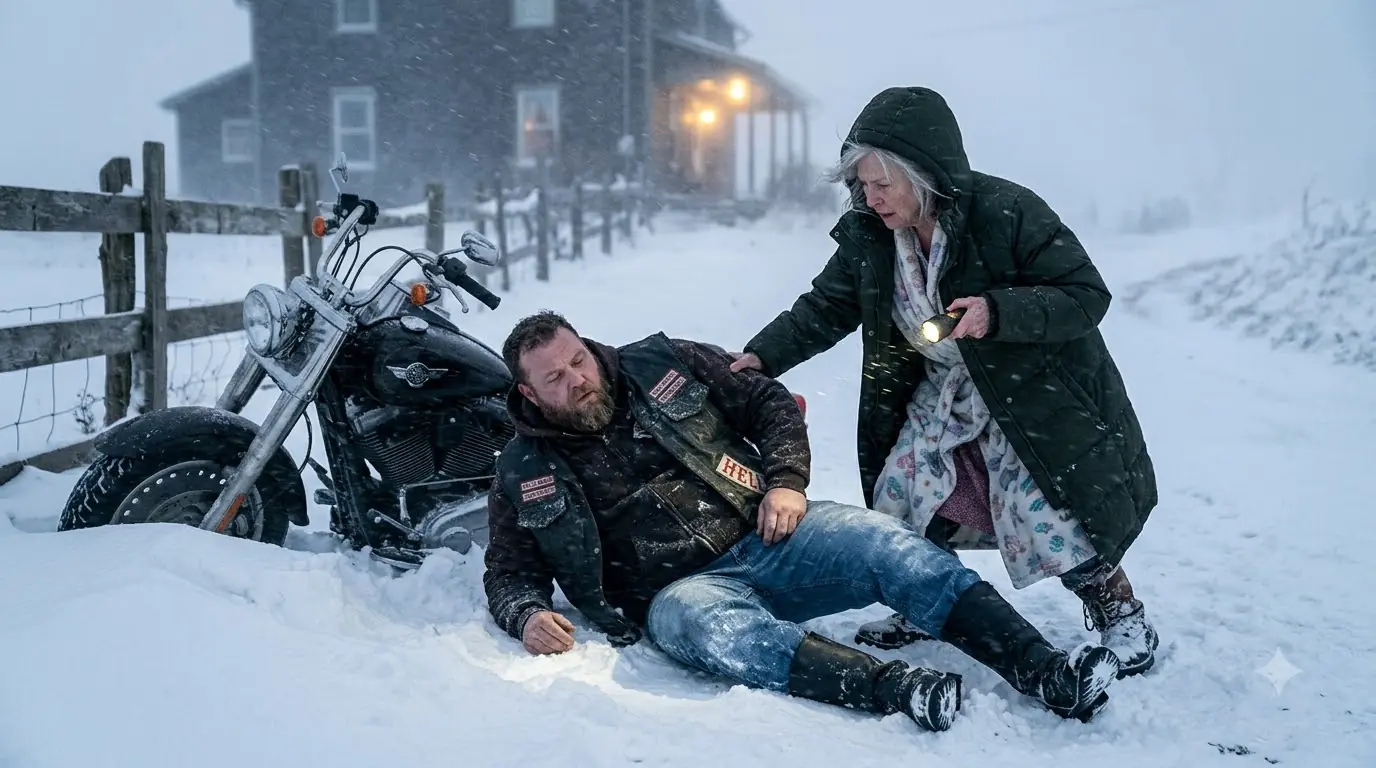
She grabbed the flashlight from the hook by the door and stepped off the porch into snow that swallowed her boots to the ankle. "Hello! " she shouted again, louder, angrier now, as if she could bully the storm into showing her what it was hiding. "If someone's out here, say something! " This time the answer came immediate and close. A groan of pain no more than 30 ft from where she stood, somewhere near the old fence line that marked the edge of her property. Margaret moved toward it before her mind had even finished deciding to.
The flashlight beam swept across churned snow, across the black twisted shape of a motorcycle on its side, half buried in a drift. Its front wheel still spinning uselessly in the wind, and then across a man. He was face down. His leather jacket, she would learn later, it was the wrong kind of leather for weather like this, too. Thin, too torn open at the shoulder where road and metal had shredded through.