Blood on the linoleum used to mean failure. Now, it just means it's Tuesday. You think a black belt makes you a weapon. You think daddy's money buys immunity from the reaper? I've seen kids in the desert with rust bucket rifles who were twice the threat of the entitled brat standing in my VIP ward demanding a brawl because his father's heart was finally giving out.
He wanted to break something to feel in control. He didn't know I used to break things for a living. The seventh floor of Westlake Memorial did not smell like a hospital. That was by design. Down on the second floor where the city brought its gunshot wounds and its overdoses, the air hung thick with bleach, stale sweat, and the sharp coppery tang of desperation.
Down there, the linoleum was scuffed yellow and the fluorescent lights buzzed with a headache-inducing frequency. But the seventh floor was the executive wing. Here, the floors were laid with sound-dampening mahogany laminate. The lighting was recessed and warm. The air smelled faintly of lavender and high-grade ionized filtration.
It was a place designed to make dying feel like a luxury hotel stay. Dougal Marshall hated the lavender. It didn't mask the scent of death. It only confused it. Dougal adjusted the collar of his scrubs, the faded blue cotton soft against the raised jagged scar running across his collarbone.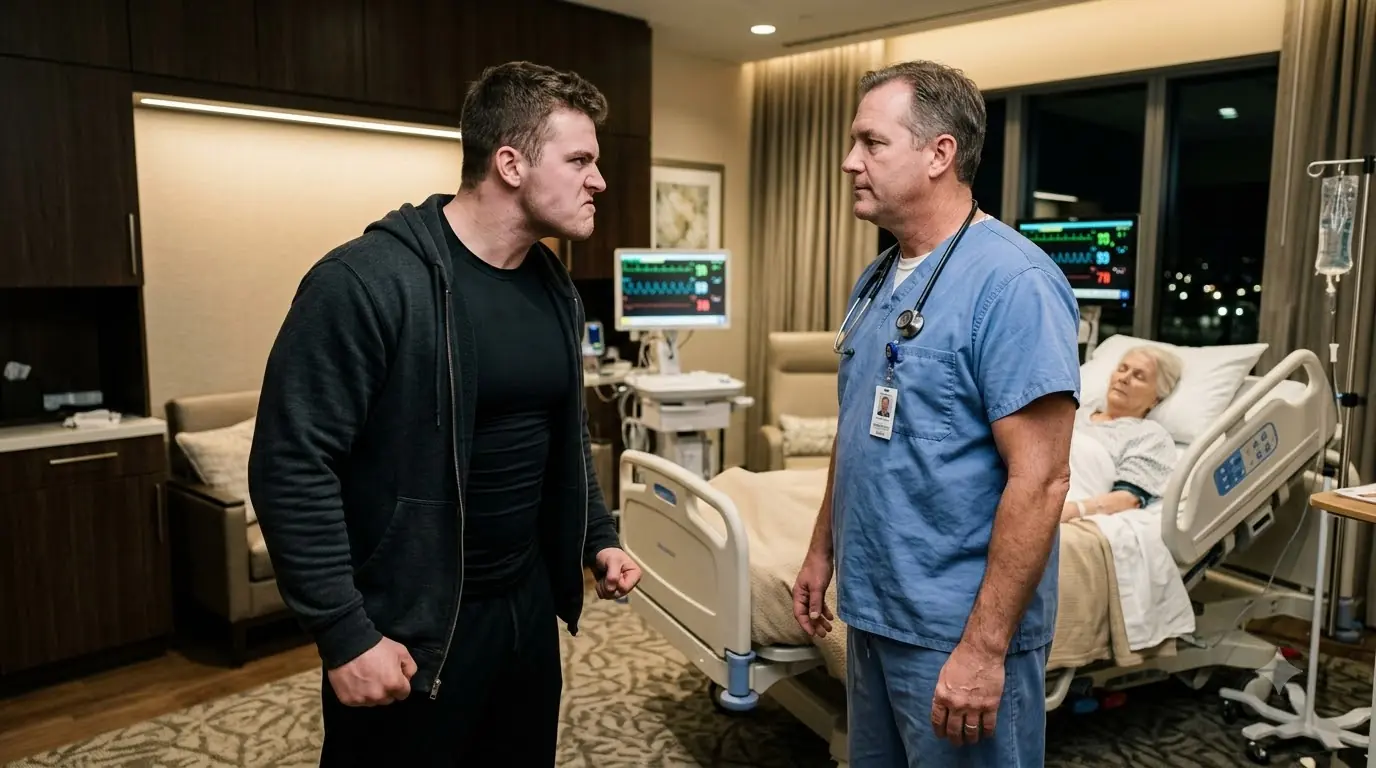
He was 42 years old, built like a cinder block with eyes the color of old concrete, and a demeanor that registered just below a resting pulse. He moved down the hallway with a quiet, deliberate grace that belied his mass. He didn't walk, he glided, rolling his weight from heel to toe, a habit drilled into his nervous system a lifetime ago in places where a heavy footfall meant a sudden, violent end. Now, his biggest threat was a malfunctioning IV pump. He preferred it this way.
He paused outside room 712. The plaque beside the door didn't have a name, just the room number, but everyone on the floor knew who was inside. Raphael Gibson. Real estate magnate, billionaire, and currently a failing vessel of meat and bone succumbing to aggressive pancreatic cancer. The man owned half the commercial property in the tri-state area, but all the leverage in the world couldn't negotiate a truce with his own mutating cells.
Dougal pushed the heavy oak door open. The room was expansive, featuring a sitting area with leather couches and a panoramic view of the city skyline. Its lights glittering like scattered diamonds against the black velvet of the night. In the center of the room, elevated in a state-of-the-art bed, lay Gibson. He looked like a deflated balloon.
His skin was the color of old parchment, pulled tight over the sharp angles of his cheekbones and jaw. Tubes snaked from his arms and his chest, tethering him to a bank of monitors that hummed and beeped, a digital choir singing the song of his fading vitals. "You're late. " A voice rasped from the bed. It sounded like dry leaves scraping across pavement. Dougal checked his watch.
"Shift change was 3 minutes ago, Mr. Gibson. I was getting your chart from the desk. " "3 minutes is a lifetime when you're paying $10,000 a night for a room, Marshall. " Gibson didn't open his eyes. His hands, bruised purple from endless needle sticks, twitched on the high-thread-count sheets. "But then, people in your tax bracket don't understand the value of time.
You just punch a clock. " Dougal didn't sigh. He didn't react. He walked over to the IV pole and checked the drip rate of the morphine. He had spent 12 years in naval special warfare. He'd been screamed at by drill instructors, shot at by insurgents, and had held men as they bled out in the dust.
He scooped crushed ice into a plastic cup, added a tiny plastic spoon, and brought it back. He adjusted the bed, raising Gibson's head just enough so he wouldn't aspirate, and offered the spoon. Gibson knocked the spoon away. It clattered against the bedside table. "I can feed myself, damn it.
I'm not an infant. " "Never said you were," Dougal replied mildly. He set the cup down where Gibson could reach it. Gibson glared at him. The man's eyes were roomy and yellowed, but there was still a spark of vicious intelligence behind them. He was a man who had spent 40 years breaking competitors, hostile takeovers, liquidating assets, firing thousands without a second thought.
He was used to people shrinking from his gaze. Dougal just looked back, his expression neutral, his posture relaxed but anchored. "You're an odd one, Marshall," Gibson wheezed, his hand trembling as he finally reached for the cup, failing to grasp it. Dougal calmly moved it a half inch closer, letting Gibson's fingers find the plastic on their own. "The others flutter.
They whisper. They look at me like I'm already a corpse. You just look at me like I'm a piece of furniture. " "I look at you like you're a patient," Dougal said. He checked the catheter bag at the foot of the bed, noting the output and the dark, concentrated color. Kidneys were shutting down.
It wouldn't be long now. "My job is to keep you comfortable, not to stroke your ego, and not to mourn you. " Gibson let out a dry, hacking laugh that turned into a wet cough. Dougal stepped forward instantly, expertly supporting the man's shoulders, handing him a tissue, waiting until the spasm passed. When Gibson fell back against the pillows, he was panting, a thin sheen of sweat on his forehead. "I like you, Marshall. " Gibson whispered, his eyes closing again.
"You don't care about my money. " "I care about your blood pressure. " Dougal said, noting the drop on the monitor. "Try to rest. " Dougal retreated to the small alcove near the door, settling into the charting chair. He opened the electronic medical record, but his eyes drifted to the window. The city was quiet. He thought about the men he had served with, the ones who came back, and the ones who didn't.
He had chosen nursing when he got out because he was tired of dismantling human bodies. He wanted to learn how they were put back together, how they were maintained, how they eventually wound down. It was a penance, in a way, a counterbalance to a ledger written in red. He didn't harbor any grand illusions about saving the world anymore. He just wanted to make the immediate square foot around him slightly less miserable.
The quiet of the room was suddenly broken by the heavy thud of the suite door swinging open, striking the rubber stopper on the wall with unnecessary force. Dougal didn't jump. His heart rate didn't elevate, but his eyes snapped from the window to the doorway, scanning, assessing, categorizing the threat before his conscious mind even registered a name. Crofton Gibson stepped into the room, and the air pressure seemed to change. He was 28, built like a Greek statue carved out of deeply insecure marble.
He stood 6'2", weighing in at a lean, heavily muscled 200 pounds. He wore a tight black compression shirt under an unzipped designer hoodie, the sleeves pushed up to reveal forearms corded with veins and a tribal tattoo wrapping around his left bicep. The logo on his gym bag slung aggressively over one shoulder belonged to an elite, highly expensive mixed martial arts academy downtown. Crofton moved with a forced swagger, his shoulders rolled forward, his chin tucked. It was the walk of a man desperate to project danger.
Dougal read him in an instant. The heavy asymmetrical footfalls. He favored his right leg, maybe a slight meniscus tear. The way his eyes darted around the room, not taking in details, but looking for an audience. The clenched jaw.
The smell of expensive cologne barely masking the sour tang of pre-workout powder and stale sweat. He wasn't a wolf. He was a very loud, very scared dog trying to convince everyone he had teeth. "Why is it so dark in here? " Crofton demanded, his voice a booming baritone that shattered the carefully maintained peace of the VIP suite. He didn't wait for an answer, dropping his heavy gym bag onto the expensive leather sofa with a loud thud, then reaching for the wall panel to flood the room with glaring overhead light.
On the bed, Raphael Gibson groaned, throwing a frail arm over his eyes. "Turn that off, Crofton. " he croaked. "You need to wake up, Dad. It's depressing as hell in here. " Crofton said, pacing over to the He didn't look at Dougal. He acted as if the nurse were part of the medical equipment.
"I just finished a three-hour session rolling with the black belts. Tapped out two guys who fight amateur circuit. I'm starving. Where's the night staff? We pay enough for this place, they should have a damn buffet waiting. " "Your father was resting, Mr.
Gibson. " Dougal said quietly from the corner. Crofton stopped. He pivoted slowly, as if just realizing someone else was in the room. He looked Dougal up and down, his eyes lingering on the faded scrubs, the unassuming posture, the slight graying at Dougal's temples. Crofton's upper lip curled into a sneer.
"Who the hell are you? " Crofton asked. "Where's the little blonde girl? Chloe? " "Chloe is on meal break. " Dougal replied, his voice remaining level, pitched at a frequency designed not to escalate. "I'm Dougal. I'm the primary on this floor tonight. " "Well, Dougal. " Crofton said, stepping closer, intentionally invading Dougal's personal space.
It was a classic intimidation tactic taught in high schools and bar rooms across the world. "My dad needs better care than sleeping in the dark, and I need a coffee, black. Go get it. " Dougal remained seated. He met Crofton's gaze. There was no defiance in Dougal's eyes, no anger, just a terrifying, bottomless calm.
It was the look of a man who had stared through the optical sight of a sniper rifle for 72 hours straight. "There's a coffee machine at the nurses' station down the hall. " Dougal said reasonably. "Help yourself. I need to monitor your father's vitals. " Crofton's face flushed. The veins in his neck popped.
He was entirely unaccustomed to the word no, especially from someone he viewed as the hired help. He leaned in, planting his hands on his hips, spreading his feet into a fighting stance. "Listen to me, you glorified bedpan cleaner," Crofton said, his breath hot and smelling of artificial cherry energy drink. "Do you know who my father is? Do you know who I am?
I can have your job with one phone call. I can have you blacklisted from every hospital in this state. " From the bed, Raphael coughed weakly. "Leave him be, Crofton. He's doing his job, something you know nothing about. " The words hit Crofton like a physical blow. The anger that had been directed at Dougal suddenly fractured, revealing the deep jagged fissures of a toxic father-son relationship.
Crofton's chest heaved. He looked at his dying father, the patriarch who had never thought he was good enough, strong enough, or smart enough to take over the empire. Crofton had spent his life lifting weights, learning how to choke men unconscious, buying expensive cars, all trying to build an armor against his father's relentless disappointment. And now the old man was dying, and the armor was utterly useless. Crofton couldn't fight pancreatic cancer.
He couldn't put it in a triangle choke. He was powerless, and the powerlessness was driving him insane. Crofton spun back to Dougal, needing a target, needing an outlet. "Don't look at me like that," Crofton snapped, pointing a thick calloused finger at Dougal's chest. "Like what? " Dougal asked, his hands resting easily on his thighs, his feet flat on the floor.
"Like you're pitying me. Like you're something special. " Crofton sneered. He took another half step forward. "I know guys like you, middle-aged losers who peaked in high school, wiping asses for a living because you couldn't hack it in the real world. You think you're tough because you deal with sick people? " Dougal felt a familiar cold stillness wash over him.
It was the feeling that used to precede the breaching of a compound, the sudden narrowing of focus, the stripping away of emotion, leaving only geometry, physics, and probability. He calculated the distance between them, 18 inches. He noted the way Crofton's weight was shifted forward, overcommitted. He saw the slight flare of Crofton's nostrils, the tightening of his right shoulder. Crofton was a striker.
He wanted to throw a punch. "Mr. Gibson," Dougal said, his voice dropping an octave, losing its conversational tone and taking on the hard, flat edge of an order. "I'm going to ask you to step back. You are agitating the patient and you are interfering with my workspace.
"Make me," Crofton challenged, a cruel smile spreading across his face. He puffed out his chest. "Come on, make me step back. I just got my black belt in Brazilian Jiu-Jitsu. I've been doing Muay Thai for five years.
I will break your arm in three places before you even realize we're fighting. " Dougal slowly stood up. He didn't pop up aggressively. He just rose, uncoiling his frame. Even standing, he was an inch shorter than Crofton and seemingly less muscular beneath the loose scrubs. "There isn't going to be a fight," Dougal said softly.
"This is a hospital. Your father is dying. Spend time with him instead of picking fights with the staff. " Crofton laughed, a harsh, jagged sound. "You're a coward, just like the rest of them. Just a weak little man in pajamas. " He reached out and shoved Dougal in the chest with both hands.
It was a hard shove meant to send Dougal stumbling backward into the charting desk, but Dougal didn't stumble. He simply absorbed the kinetic energy, dropping his center of gravity a fraction of an inch, rooting himself to the floor. To Crofton, it felt like pushing against a concrete piling. Crofton looked momentarily confused, his hands dropped. Dougal looked at him, his eyes dead flat.
"That was your one," Dougal said. "Do not touch me again. " For a second, the sheer authority in Dougal's voice penetrated Crofton's rage. A primal instinct, buried deep in the evolutionary hindbrain, warned Crofton that he was standing in front of an apex predator. But the silence stretched and Crofton's bruised ego screamed louder than his survival instincts. He couldn't back down now, not in front of his father.
"Screw you," Crofton spat, and he threw a right hook. The punch was technically sound. It had speed. It had torque generated from the hips. And it was aimed squarely at Dougal's jaw.
In a cage, against an opponent wearing padded gloves and expecting a sporting exchange, it might have been devastating. But Dougal Marshall was not a cage fighter. He didn't fight for points, belts, or applause. For 12 years, his mandate had been violence in its purest, most absolute form. Survival and elimination.
Before Crofton's fist had traveled halfway to its target, Dougal was already moving. He didn't block the punch. Blocking was a waste of energy and a concession of momentum. Instead, Dougal stepped inside the arc of the swing, moving diagonally forward into the left, slipping past the fist with a millimeter to spare. Crofton's punch hit nothing but empty air, carrying his momentum dangerously forward.
In the span of a single heartbeat, Dougal's hands moved with terrifying fluid precision. His left hand snapped up, the web of his thumb striking the sensitive nerve cluster on the inside of Crofton's extended right bicep. It wasn't a strike meant to break bone. It was a strike meant to shut down the circuitry. Crofton felt a blinding electric shock shoot up his arm to his neck.
His hand instantly went numb, his fingers springing open. Before Crofton could even register the pain or the sudden loss of motor function, Dougal's right hand shot forward, cupping the back of Crofton's skull. Dougal didn't strike him. He simply used Crofton's own forward momentum against him, guiding the younger man's head downward in a tight, inescapable arc, while simultaneously hooking his right foot behind Crofton's lead ankle. It was a sweep, but executed with such brutal efficiency that it felt like magic to the uninitiated.
Crofton's feet were ripped from beneath him. The world tilted violently. He had spent hundreds of hours learning how to fall, how to breakfall on thick mats. But there were no mats here, and Dougal wasn't giving him the time or space to fall correctly. Dougal rode him to the floor, maintaining complete structural control.
Crofton hit the mahogany laminate hard, the breath exploding from his lungs in a sharp whoosh. Before Crofton could gasp for air, before he could attempt to bridge or roll, the fight was over. Dougal knelt beside him, pressing the point of his knee squarely into the floating ribs on Crofton's right side. Not hard enough to snap the bone, but with exactly enough pressure to make expanding the lungs agonizing. At the same time, Dougal had control of Crofton's right arm.
It wasn't a standard armbar. Dougal had Crofton's wrist pinned against Dougal's own chest, the elbow hyperextended over Dougal's thigh, with Dougal's free hand resting casually on the back of Crofton's triceps. A single pound of downward pressure would shatter the joint. The entire exchange took less than 2 seconds. There was no scrambling, no yelling, no loud crashes, just the squeak of a sneaker, a heavy thud, and then silence.
From the bed, the monitors continued their steady indifferent beeping. Crofton lay pinned to the floor, gasping shallow ragged breaths. His eyes were wide, filled with a sudden overwhelming terror. He tried to pull his arm back, but it felt as though it were locked in a steel vise. The pain in his bicep throbbed, and the pressure on his ribs made every breath a fiery agony.
He looked up. Dougal was looking down at him. Dougal wasn't sweating. He wasn't breathing heavily. His heart rate hadn't climbed above 80 beats per minute.
His expression remained utterly unchanged, bored almost. "You're very strong," Dougal said quietly, his voice a calm murmur in the quiet room. "You have good technique, but you fight like a man who knows there's a referee to stop it if things go wrong. " Crofton stared at the nurse, his mind frantically trying to process the data. This wasn't happening. This middle-aged guy in scrubs couldn't have just taken him apart like a child's toy.
"Who What are you? " Crofton wheezed, the bravado entirely stripped from his voice. "I'm the guy trying to keep your father alive for another 72 hours," Dougal replied softly. "I'm the guy who's going to change his catheter in an hour and turn him so he doesn't get bed sores. That's who I am. " Dougal leaned in slightly, shifting a fraction of his weight onto the knee pressing into Crofton's ribs. Crofton let out a sharp gasp, his eyes watering.
"Now," Dougal continued, his tone conversational, "I'm going to let go of your arm. I'm going to stand up, and you are going to stay on the floor for exactly 10 seconds to catch your breath. Then, you are going to stand up, pick up your gym bag, and go down to the cafeteria. You will drink a cup of coffee. You will realize that the anger you are feeling right now is actually grief, and you will stop trying to hit people who are just trying to help.
Do we understand each other, Mr. Gibson? " Crofton, trapped, humiliated, and suddenly profoundly aware of his own mortality and frailty, could only manage a frantic nod. Dougal released the lock. He stood up in one smooth motion, stepping back instantly out of range of any counterattack, his hands returning to rest easily at his sides. Crofton lay on the floor for a long moment.
The mahogany felt cold against his flushed cheek. He rubbed his numb arm, pushing himself up slowly, wincing as his bruised ribs protested. He didn't look at Dougal. He couldn't. The shame burned hotter than the physical pain.
He scrambled to his feet, grabbed his expensive gym bag from the sofa, and moved toward the door, his head down, the swagger entirely gone. As he reached the threshold, his father's voice drifted from the bed, weak but remarkably clear. "Crofton. " Crofton stopped in the doorway, his shoulders slumping. "Yeah, Dad. " When you come back, Raphael said, his eyes still closed, don't yell at the staff. They work harder than you ever have.
Crofton swallowed hard, a lump forming in his throat. He nodded once, though his father couldn't see it, and disappeared into the hallway, the heavy oak door clicking shut behind him. Dougal watched the door for a moment, then turned back to his charting desk. He picked up his pen. "Impressive," Raphael murmured from the bed.
"Where did you learn to do that? " "Physical therapy," Dougal lied smoothly, logging into the computer terminal., the billionaire coughed, a faint ghost of a smile pulling at his cracked lips. "You're a terrifying man, Marshall. " "I'm a nurse, Mr. Gibson," Dougal said, clicking the mouse. "Blood pressure is stabilizing. Go to sleep. " The room settled back into its quiet rhythm, the hum of the monitors, the faint scent of lavender, the slow, inevitable ticking of the clock.
Dougal stared at the screen, the adrenaline already flushed from his system, leaving nothing but the familiar heavy silence of the night shift. Hospitals do not sleep, but they do hold their breath. At 3:00 in the morning, the manic energy of the day shift is a distant memory. The visiting hours are long over, the administration has gone home to their comfortable beds, and the hallways stretch out like empty waxed bowling alleys. It is the hour when the veil between the living and the dead feels thinnest.
The body's circadian rhythms dip into a trance, blood pressure drops, and the human machinery decides whether it has the fuel for another sunrise. Dougal Marshall knew 3:00 a.m. intimately. He had known it in the mountains of Afghanistan waiting for exfiltration with ice freezing in his beard, and he knew it now bathed in the glow of an electronic medical record. The heavy oak door of room 712 pushed open. It didn't slam this time.
It clicked open with a hesitant, almost apologetic quietness. Crofton Gibson stepped back into the room. The designer hoodie was zipped up to his chin now as if he were suddenly cold. The aggressive swagger was gone replaced by a hollowed-out exhaustion that made him look a decade older. He was carrying a cardboard tray holding two large steaming paper cups.
He didn't look at the bed right away. He looked at Dougal who was sitting in the corner charting vital signs. Crofton walked over, his steps heavy and flat. He stopped a few feet from the desk and held out the cardboard tray. "Black," Crofton said, his voice raspy.
"Like you said. " Dougal looked at the tray, then up at Crofton's face. The younger man's eyes were bloodshot. The anger had burned off leaving only the charred brittle reality of what was happening in this room. Dougal reached out and took one of the cups. "Thank you. " Crofton stood awkwardly for a moment not knowing what to do with his hands.
He finally walked over to the leather sofa, the same one he had thrown his gym bag on hours ago, and sank heavily into the cushions. He gripped his coffee cup with both hands staring down at the dark liquid. "I didn't go to the cafeteria," Crofton admitted softly. "I walked around the block three times. It's freezing out there. " "Cold air helps clear the adrenaline," Dougal noted, taking a sip of the coffee.
It was burnt, bitter, and entirely perfect. Crofton let out a short, dry breath that wasn't quite a laugh. "My shoulder's throbbing. I think you bruised the bone. " "Just the nerve. It'll ache for a day, then it'll be fine," Dougal said.
He didn't offer an apology. It wasn't required. They sat in silence for a long time. The only sound was the rhythmic hiss of the oxygen concentrator and the slow, erratic beep of Raphael Gibson's heart monitor. The gap between the beeps was widening.
"He's not waking up again, is he? " Crofton asked. He didn't look up from his cup. "His organs are failing," Dougal answered, keeping his tone grounded and factual. No false hope, no soft-pedaling. "The morphine is keeping the pain away, but the body is shutting down its non-essential functions.
Consciousness is one of the first things to go. " Crofton's shoulders hitched. He took a shaky breath. "He built his first company when he was my age. Started with nothing, bought a failing strip mall, and turned it into an empire. " "He used to point at the skyline from his office and tell me exactly which buildings he owned, which ones he was going to buy, and which ones he was going to demolish. " Crofton looked up, looking at the panoramic window at the glittering city. "I don't know anything about real estate.
I don't know how to leverage assets. I just know how to hit things. I spent my whole life trying to be tough, thinking maybe he'd respect a fighter, but he didn't. He just thought I was a meathead, a disappointment. " "Empires are just concrete and glass, Crofton. " Dougal said quietly. "They all crumble eventually.
Every titan of industry, every billionaire, every general, they all end up in a bed like that one, wearing the same hospital gown as the guy who sweeps their floors. Crofton looked at his father. The man who had terrorized boardrooms looked incredibly small beneath the thin white blanket. Hey, how do you do this? Crofton asked, turning back to Dougal.
The question was raw, stripped of all pretense. How do you sit in a room with a dying man and just watch the clock? Doesn't it mess with your head? Doesn't it make you feel useless? Dougal set his coffee down.
He looked at his hands, calloused and thick. He thought of the Helmand province. He thought of the smell of cordite and copper, the chaotic screaming over the radio, the frantic, desperate pressure applied to wounds that would never close. He thought of the profound, crushing uselessness of watching a brother bleed out in the dust because a medevac chopper was 5 minutes too late. "It used to," Dougal said, his voice dropping into a register of profound gravity.
I used to think my job was to fight death, to beat it back with my bare hands. I spent a long time being very angry when I lost. He paused, letting his gaze shift to the monitors above Raphael's bed. But death isn't an enemy, Crofton. It's a mechanic.
It's the closing of a contract, Dougal continued. My job isn't to fight it anymore. My job is to make sure the transition is as quiet, as painless, and as dignified as possible. I can't stop the train, but I can make sure the ride to the station isn't a nightmare. Crofton stared at him.
You were in the military. It wasn't a question. "A lifetime ago. " "Special Forces? " "Navy," Dougal replied, offering no further detail. He didn't need to. Crofton nodded slowly, the pieces finally falling into place.
The spatial awareness, the devastating physical control, the unbreakable calm. "I owe you an apology, Dougal, for earlier. For what I said. " "You were scared," Dougal said simply. "Fear makes people do incredibly stupid things. I've seen men do worse for a lot less. " Crofton put his coffee down and leaned forward, resting his elbows on his knees, burying his face in his hands.
The silence stretched again, but it was no longer tense. It was the heavy shared silence of a vigil. At 4:12 a.m., the tenor of the room changed. It wasn't a sudden alarm. It was a subtle shift in the sound of Raphael Gibson's breathing.
The shallow rhythmic breaths became deeper, followed by a long agonizing pause, and then a rapid flutter. Cheyne-Stokes respiration, the classic undeniable acoustic signature of the end. Dougal stood up immediately. "What is it? " Crofton asked, his head snapping up, panic flaring in his eyes again. "It's time," Dougal said.
Dougal moved to the bedside with practiced efficiency. He checked the IV lines, ensuring the morphine drip was unobstructed, maximizing the comfort for the failing nervous system. He didn't rush. Rushing bred panic, and panic was a virus. Crofton stood paralyzed by the sofa.
He looked like a little boy lost in a crowded mall. "Come here," Dougal said, his voice a steady anchor in the sudden storm of Crofton's grief. Crofton took a hesitant step forward, then another, until he was standing beside the bed. His father's chest was rising and falling in jarring, unpredictable intervals. His skin had taken on a waxy bluish pallor.
"Hold his hand," Dougal instructed gently. Crofton reached out. His hand, thick with muscle and calluses from gripping heavy canvas and fighting GIs dwarfed his father's fragile, bruised fingers. Crofton's hand was shaking violently. "He can't hear me," Crofton choked out, tears finally spilling over his lower lids, tracking through the stubble on his cheeks.
"He doesn't even know I'm here. " "Hearing is the last sense to go," Dougal said, leaning in slightly. It was a medical probability, but in this room it was a necessary gospel. "He feels your grip. He knows you're here. If you have anything to say, say it now. " Crofton stared down at the man who had cast such a massive, suffocating shadow over his entire life, the man who had demanded perfection, rewarded it with indifference.
All the anger, all the desperate need to prove himself, all the years of absorbing physical punishment just to feel something, it all evaporated, leaving only a profound, bottomless sorrow. "I'm here, Dad. " Crofton whispered, his voice cracking. He gripped the frail hand tighter. "I'm right here. You don't have to fight it anymore.
It's okay. You can let go. " Dougal stepped back, retreating into the shadows near the doorway, giving them the space. This was not his moment. He was just the guardian at the threshold. The pauses between Raphael's breaths grew agonizingly long.
10 seconds, 20 seconds. Crofton held his breath during every pause, waiting, praying for the chest to rise one more time. At 4:47 a.m., Raphael Gibson drew a sharp, rattling breath. His chest rose. It fell.
And it did not rise again. The silence that followed was absolute. The heart monitor held a sluggish rhythm for another few seconds, electrical ghosts firing in the dying muscle, before flatlining into a solid, unbroken high-pitched tone. Crofton didn't move. He kept holding the hand, his head bowed, his shoulders shaking as the dam finally broke.
The massive, heavily tattooed fighter sobbed like a child, the sound echoing off the mahogany floor and the sterile walls. Dougal reached up and firmly pressed the silence button on the monitor. The high-pitched tone vanished, returning the room to a sacred quiet. He didn't interrupt Crofton. He let the grief flood the room, letting it wash over the son who was finally free of the father and simultaneously entirely unmoored without him.
Dougal looked out the window. On the horizon, beyond the skyscrapers, the sky was beginning to bleed a dull, bruised purple. Dawn was coming. The brutal, indifferent machinery of the world was continuing to turn. After 10 minutes, Crofton gently laid his father's hand down on the sheets.
He took a step back, wiping his face with the sleeve of his hoodie, leaving dark streaks of moisture on the fabric. "What happens now? " Crofton asked, his voice hollow. "I'll make the calls," Dougal said, stepping forward. "The attending physician will come to officially pronounce it. Then we will prep him for the morgue down in the basement.
You can stay as long as you need to. " Crofton shook his head slowly. "No. No, I think I think I'm done. " He looked at the bed one last time. There was no terror in Raphael Gibson's face anymore. Just slack, empty peace.
The vessel was vacant. Crofton turned to Dougal. He didn't offer to shake hands. The physical barrier between them felt appropriate now, a boundary of respect. "Thank you," Crofton said, and for the first time in his life, he meant it without a trace of irony or expectation.
"For everything tonight, take care of yourself, Crofton. " Dougal replied. "Don't let the anger come back. " Crofton nodded once, pulled the hood of his sweatshirt up over his head, and walked out the door. The heavy oak clicked shut behind him, sealing the silence inside. Dougal Marshall stood alone in the VIP suite. He looked down at his watch.
5:15 a.m. He moved to the bed. With practiced gentle movements, he removed the IV lines, the oxygen cannula, the catheter. He smoothed the blankets, ensuring the body was presentable for the inevitable onslaught of funeral directors and lawyers that the morning would bring. He washed his hands in the small sink, drying them methodically on a paper towel.
He sat down at the charting desk, pulled up Raphael Gibson's electronic file, and began to type the final entry. Patient expired at 04:47. Family at bedside. No signs of distress. Dougal hit save.
He logged out of the system. His shift was over. He packed his stethoscope into his worn canvas bag, cast one last glance at the quiet room, and walked out into the brightly lit hallway. Another night down. Another deployment survived.
He headed toward the elevator, already thinking about the quiet drive home, the promise of a hot shower, and the sweet fleeting oblivion of sleep. Did the raw reality of Dougal and Crofton's encounter hit you hard? Sometimes the toughest battles aren't fought in a cage, but quietly in a hospital room at 3:00 a.m. If this story of grief, redemption, and hidden strength moved you, please leave a like, share it with someone who needs a reminder about what true strength looks like, and subscribe to the channel for more deeply human, grounded storytelling every single week. We'll see you in the next one.