Elizabeth Carter drove the pickaxe into the frozen ground with both hands, her knuckles split open and bleeding into the dirt, the same dirt she'd been told she'd die on. Six years, six winters, six harvests she'd planted while another man collected the profit. She didn't cry. She stopped crying the same year she stopped praying. But on that bitter Tuesday morning in the autumn of 1884, something changed.
A stranger rode through the gate, and he didn't look at her the way men always did. He looked at her like she was still worth saving. Elizabeth Carter had a habit of counting things. She counted the fence posts along the eastern pasture. 43 of them rotted at the base, leaning like old men who'd given up on standing straight.
She counted the steps from the barn to the well. 17, 18 in winter, when the mud froze and she had to drag her boots through it. She counted the years, six of them. Six years since her father's will had been contested, then overturned, then buried beneath a stack of legal documents she wasn't permitted to read. Because as Judge Harlan Price had informed her in the summer of 1878, women did not possess the legal standing to contest a land transfer in the territory of Wyoming.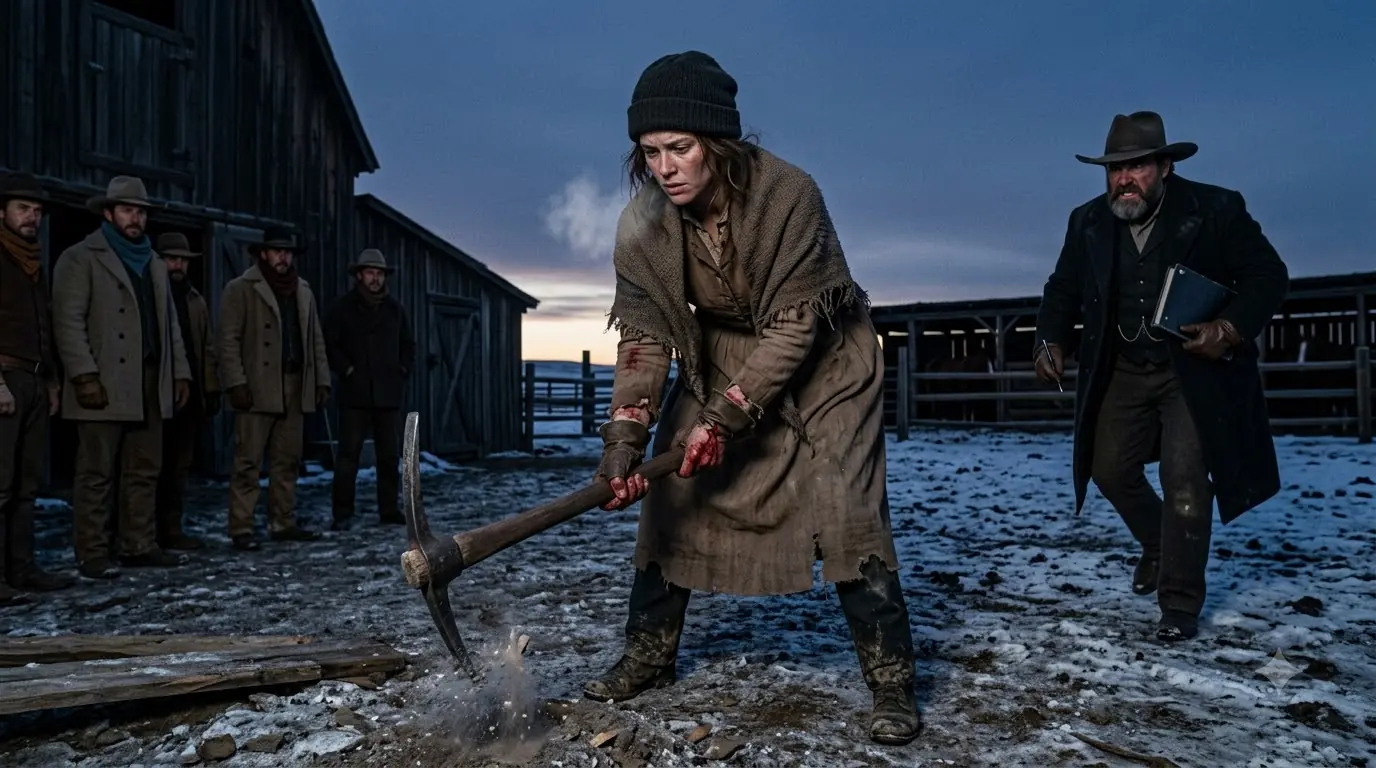
Six years since the land that bore her family's name had become the property of a man named Silas Greer. And six years since Elizabeth had quietly, methodically, invisibly kept that land alive while Silas Greer took credit for every blade of grass that grew on it. She was 26 years old, and she felt like 60. The morning it all changed began the same way every morning began. Before dawn, before the rooster, before anyone in the bunkhouse so much as turned over in their cots.
Elizabeth was already awake, already dressed, already moving through the dark with the kind of efficiency that comes not from energy, but from the complete absence of anything left to lose. She filled the water trough herself because the hired hand, a wiry boy named Clem, had a bad shoulder that flared in cold weather. She did not do it out of kindness. She did it because the horses needed water by sunup, and if the horses went thirsty, Silas Greer would find someone to blame. And the last time he'd found someone to blame for a thirsty horse, he'd docked wages from three men and thrown a tin cup at the wall hard enough to dent it.
Elizabeth had learned a long time ago to solve problems before they became reasons to throw things. She was dragging the second bucket from the well when she heard the horse, not one of theirs. She knew every gate and every particular sound of every animal on Greer's property, the way a person knows the voice of someone they've lived with too long. This was different. A heavier stride, slower, deliberate.
The kind of horse that carried a man who wasn't in a hurry because he'd already decided what he was going to do when he got where he was going. She set the bucket down and straightened. The rider came through the gate without stopping, he was tall in the saddle, the kind of tall that didn't disappear when a man got off his horse. Dark coat, dark hat pulled low, jaw set, like he'd been carved out of the same weathered oak as the fence posts. He rode to the center of the yard and stopped, and his horse stood absolutely still, and he looked around the property the way a man looks at something he's trying to understand.
His eyes landed on Elizabeth. She did not look away. She'd stopped looking away from men years ago. Looking away invited interpretation, and she'd had enough of men interpreting her silence as weakness. He tipped his hat.
Ma'am. We're not hiring, she said. Something shifted in his expression, not quite a smile, not quite surprise, something in between. Wasn't looking for work, he said. Then you're trespassing.
I reckon I might be. He swung down from the horse with the easy unhurried motion of someone who'd spent more of his life on horseback than off it. He was looking at the barn now, at the fence line, at the horses clustered near the far end of the pasture. This Greer land? It is.
You Greer's wife? The word hit her the way certain words do, not painfully, just hollowly, the way a stone hits the bottom of a dry well. I am not, she said. Foreman? No.
He looked at her again, direct, unhurried. Then what are you? Elizabeth picked up her bucket. I'm the reason this operation hasn't fallen apart, she said, and walked toward the trough. She heard him follow, not close, not aggressive, just present the soft crunch of his boots on the frost-hardened ground.
Name's Nathan Walker, he said to her back. I've got a spread about 12 miles north, lost two of my best broodmares to a fever last spring, and I'm looking to replenish my breeding stock. Heard Greer might have some horses worth considering. Greer's horses are worth considering, Elizabeth said, pouring the water. Whether Greer is worth doing business with is a different question.
She hadn't meant to say that. The words came out before she'd checked them, the way words sometimes do when you've held them in so long they find their own exit. She waited for the reaction. Anger, usually. Sometimes amusement, which was worse.
Nathan Walker said nothing for a moment. That an honest opinion or a test? He asked. I don't test people, she said. I don't have the patience.
Fair enough. A pause. What's your name, ma'am? She hesitated. Not because she didn't know her own name, but because there was something about the way he asked it without entitlement, without assumption, that made the question feel strange.
Like it actually mattered what she answered. Elizabeth Carter, she said. He nodded slowly. Miss Carter, is Mr. Greer available this morning? Mr. Greer, she said, is not available until after 10:00 because Mr. Greer does not rise before 9:00 and he requires at least an hour of coffee and silence before he is capable of civil conversation.
Nathan Walker looked at the sky, which was just beginning to lighten at the edges. That's about 4 hours from now, he said. Yes. Mind if I wait? She should have told him to ride on and come back.
That's what Silas would have wanted. No strangers on the property without his say-so. No conversations he hadn't pre-approved. No business conducted in his absence. But Silas Greer was asleep in his house and the horses in the far pasture were standing at an angle that told her the black roan with the white left foreleg, the one she'd privately named Cassidy because she'd needed to call her.
Something was favoring that leg again, which meant the split in her hoof had not healed the way it should have, which meant Elizabeth had an argument to win before Silas woke up and decided to sell Cassidy to a freight company just to spite her for mentioning it. You know horses? She asked. Nathan Walker looked mildly surprised by the question. Spent most of my life around them, he said.
Come with me, Elizabeth said. She didn't wait to see if he followed. She just walked and he came and that was how Nathan Walker first stepped into the life of Elizabeth Carter. Not with grand declaration, not with rescue, but with the quiet matter-of-fact willingness of a man who knew how to follow someone who knew where they were going. Cassidy was worse than Elizabeth had feared.
She stood at the fence and watched the mare move across the pasture, and her stomach dropped when she saw the unevenness in the gait, the slight hitch, the barely perceptible way the horse shifted her weight to protect what hurt. " That black roan," she said quietly, "the one with the blaze on her left foreleg. " Nathan leaned his arms on the top fence rail and watched. " Hoof abscess," he said after a moment. " Cracked hoof wall," Elizabeth said. "
Started 2 months ago. I packed it with pine tar every third day, but Silas wouldn't authorize the farrier because the farrier in town charges twice what the one in Lander does, and Silas said he'd send for the Lander man when he got around to it. " " 2 months is a long time to let that go. " " I'm aware. " She kept her voice flat. "
Silas is not a man who responds well to being told what his animals need. He prefers to reach that conclusion on his own schedule. " Nathan was quiet for a moment. " The mare going to lose the leg? " " Not if someone sees to it today. " "
You told Greer? " " I have told Greer four times in writing and three times in person," Elizabeth said. " The last time I told him in person, he informed me that he didn't need a woman reading him lectures about livestock management, and that I should concern myself with the things that were actually my job. " " And what is your job? " She looked at him. "
According to Silas, my job is to keep records, manage the household accounts, and ensure that meals are served on time. " A beat. " According to reality, my job is to run this operation so that when Silas Greer rides into Laramie and tells people he's one of the most successful ranchers in the territory, the statement is not an outright lie. She said it without anger. That was the thing about 6 years, it burned the anger out of you eventually.
What was left was something harder and colder and more useful. Clarity. The kind of clarity that lets you see exactly what a situation is without flinching. Nathan Walker was watching her with an expression she couldn't quite read. " How long have you been here? "
he asked. " 6 years. " " Your family's land? " " My father's land. " She turned back to Cassidy. "
Silas Greer was my father's business partner. When my father died, Greer produced documents showing that the land had been transferred to him 2 years prior in repayment of a debt. I do not believe those documents were legitimate. I was 20 years old and I had no money and no legal standing and so I could not prove it. " She paused. "
So I stayed because leaving meant losing every connection to the place my father built and I was not willing to do that. " " You stayed 6 years on a dead man's claim. " Nathan said, not a question, something else, something that sounded almost like recognition. " I stayed because I hoped. " she said. "
And eventually the hope became habit and now it's just She stopped, shook her head. Now it's just what I do. " There was a long silence. Somewhere across the yard a door banged open. Elizabeth turned.
Silas Greer stood on the porch of the ranch house in his shirt sleeves squinting against the early morning light, a coffee cup in his hand. He was a broad man, not tall but solid in the way of men who'd been physical in their youth and then gone soft around the edges without losing the underlying impression of size. His hair was gray at the temples and his face was the color of old leather, the kind that's been left out too long and started to crack. His eyes found Elizabeth first, then they found Nathan. His expression shifted. "
Who the hell is on my property? " he called out. Nathan Walker straightened off the fence rail and turned. " Nathan Walker," he said. His voice carried easily across the yard, calm, unhurried, the voice of a man who'd never found it necessary to shout to be heard. "
I've got a ranch north of here, looking to buy a pair of brood mares. You're a slight pause. Miss Carter was kind enough to show me your stock while I waited. " Silas Greer looked at Elizabeth. There was something in his expression that she knew well.
Not anger, not yet. The precursor to it, the calculation, the assessment of how much of this situation he could still control. " Miss Carter," he said, "is not authorized to show anyone my stock. " " My apologies," Nathan said pleasantly. " I asked her.
I was persistent. " Silas stared at him for another moment, then set his coffee cup on the porch railing and came down the steps. Elizabeth stepped back. Not far, not submissively, just enough to remove herself from the center of what was about to happen. " Nathan Walker," Silas said, extending his hand as he approached.
His voice had shifted the businessman's tone, now the one he used with men of presumed equal standing. " I know that name. You've got the Walker spread, good operation. " " Thank you," Nathan said, shaking the hand. " What brings you down this way? " "
Lost two brood mares last spring, fever. Looking to rebuild my breeding stock before winter. " He glanced back toward the pasture with the easy assurance of a man who'd done this before. " I heard you ran good horse lines. " Silas Greer's chest expanded slightly with something that was not quite pride, but adjacent to it. "
Finest in the territory, he said. Come up to the house, have some coffee, and we'll talk. I appreciate that. Nathan turned and met Elizabeth's eyes for just a fraction of a second. One thing though, that black roan with the blaze, I'd want her assessed by your farrier before any sale is discussed.
The hoof wall's showing a crack, needs to be addressed. The expansion in Silas Greer's chest stopped. He looked at Cassidy. Then he looked at Elizabeth. She kept her face perfectly still.
I'm aware of the horse's condition, Silas said carefully. Good, Nathan said. Then you'll want to get your man out here today. A crack that size left another week, you'll lose the leg. A silence.
Elizabeth exhaled slowly through her nose, quietly. So no one could hear. The farrier came that afternoon, which was two months late and considerably better than never. Elizabeth supervised. She always supervised.
Silas disappeared into the house after his morning conversation with Nathan Walker, having scheduled a full property tour for later in the week, and seemingly forgotten that the farrier's visit was something Elizabeth had been requesting since August. She did not remind him of this. She understood by now how selective acknowledgement worked, how men like Silas could absorb a correct idea and reproduce it as their own within hours with no conscious awareness of having done so. She stood at Cassidy's head and talked to the mare throughout the procedure. Low, steady words, nothing important.
Just sound, the kind of sound that tells an animal that the person nearest them is not afraid, which is sometimes the only thing that keeps an animal from bolting. " Easy," she murmured. " Easy now. This is going to feel strange, but it's not going to hurt. It's going to stop the hurt.
That's different. " Cassidy's ears swiveled toward her. " You've been carrying this for 2 months. " Elizabeth said softly, "Walking on something broken, trying not to show it. I know. "
A pause. " I know exactly how that feels. " She didn't realize anyone else was nearby until she heard the quiet shift of a boot behind her. Nathan Walker stood at the edge of the barn doorway watching. He'd stayed on the property.
Silas had offered him dinner, which Elizabeth had cooked, and he'd been shown the bunkhouse for the night since the ride back north was too long to make after dark. He held his hat in his hand, and his expression was the same expression he'd had most of the day, attentive, careful, like a man who'd learned that watching carefully before speaking was worth more than most things he could say. He didn't apologize for being there. He didn't announce himself elaborately. He just said quietly, "She's going to be all right. "
Elizabeth looked at the mare and then at him. " Yes," she said. " She will be now. " A pause stretched between them, comfortable in the odd way that silences between people who don't know each other sometimes are when neither party is performing. " You knew about that hoof in August," Nathan said. "
Yes, and you couldn't get him to act on it until a potential buyer showed up. " " That is a precise summary of the situation. " He was quiet for a moment. " That must be a particular kind of frustrating," he said. Elizabeth considered this. "
It's a particular kind of something," she said. " I've stopped trying to name it. " He turned his hat over in his hands once, twice, the gesture of a man working toward something he hadn't quite decided to say yet. " How many other things on this property are you carrying that shouldn't be yours to carry? " he asked.
The question landed differently than she expected. Not intrusively, not with pity. With she searched for the word weight. Like it mattered what the answer was. Like the answer would mean something to him beyond simple curiosity.
She looked at him for a long moment. " All of them," she said quietly. " Every single one. " Nathan Walker nodded slowly, as if this confirmed something he'd already suspected. " I thought so," he said.
He put his hat back on and looked at the mare one more time. " Get some rest tonight, Miss Carter. You've been up since before dawn. " She blinked. " How do you know what time I was up? " "
Because I rode in at first light," he said simply, "and you were already halfway through your second water haul. " He turned to leave, then stopped. " The horses you keep are better cared for than any I've seen in this territory, and I've covered a lot of this territory. " He glanced back, and there was something in his eyes that she didn't know how to categorize. Not admiration exactly, not sympathy exactly.
Something cleaner than both. " That skill belongs to you, not to whoever owns the land under your feet. " He was gone before she could respond. Elizabeth stood in the quiet of the barn with the farrier working at her side and Cassidy's warm breath against her hand, and she felt something she hadn't felt in so long that it took her a full minute to identify it. Seen.
She felt seen. And she had no idea at all what to do with that. She lay awake that night with the sound of the wind moving through the gaps in the walls she'd never been able to get Silas to have repaired and she thought about what Nathan Walker had said. " That skill belongs to you. Six years of work.
Six years of early mornings and late nights and quietly solving problems before they became crises. Six years of being the invisible mechanism inside an operation that a man she did not trust took credit for at every county meeting and every bank conversation and every dinner in Laramie where Silas Greer stood up and held forth about what it took to run a successful outfit in Wyoming territory. She had never once been introduced at one of those dinners. When she'd attended twice in the early years before she'd understood the unspoken rule Silas had introduced her as his housekeeper. The correction had died in her throat both times killed by the understanding that making a scene would cost her more than the dignity it restored.
She thought about her father. James Carter who had taught her to read a horse's gait the same year he taught her to read who had shown her how to assess soil and predict weather and calculate feed ratios and negotiate with suppliers who had always spoken to her as though she were simply a person in possession of a mind rather than a woman in need of management. Who had died of fever in the winter of 1878 and left her at 20 years old to discover that the world beyond their land did not share his view of her. She thought about the document Silas Greer had produced after her father's death. The transfer deed dated two years prior.
Her father's signature on the bottom. She had stared at that signature for a long time in Judge Price's office. It looked like her father's handwriting. It looked almost exactly like it. Almost.
There was something wrong with the loop in the J. A small thing. A thing she hadn't been able to articulate to a judge at age 20 without sounding like a desperate girl grasping at excuses. A thing she had thought about about every single day for 6 years. She was not grasping at excuses. She knew her father's signature.
She had been watching him sign his name her entire life, checks and letters, and the birthday messages he wrote in the front pages of the books he gave her every year. She knew the particular way he looped his capital letters, the slight left lean of his L's, the way the tail of his G swooped back and undercut the letters behind it. The signature on Silas Greer's transfer deed had none of that. It had been a very good forgery. Good enough to convince a judge who had no reason to look closely and every social and financial reason to accept the simplest explanation.
But it was a forgery. She was certain of it. And for 6 years, she had sat on that certainty like a stone in her boot, unable to remove it, unable to ignore it, unable to do a single thing about it, because she had no money, no lawyer, no legal standing, and no one who would listen. She turned onto her side and stared at the wall. Nathan Walker was only here for a business transaction.
He was going to look at horses, make an offer, and ride back north. And in a week, she would have forgotten the particular quality of his attention and the specific weight of what he'd said to her in the barn. She was almost entirely sure of that. In the morning, she found a note tucked under the edge of the water bucket. It was written on a torn piece of brown paper in a plain steady hand.
If you ever find yourself in need of a different situation, The Walker spread north of here is always looking for someone who knows horses as well as you do. Pay is fair. Nobody throws cups at walls. N. Walker. She read it twice.
Then she folded it carefully and put it in the pocket of her dress in the same small inner pocket where she kept the only thing she'd saved from her father's belongings. A folded letter in his handwriting dated 3 months before his death that began, "My dear Elizabeth, I want you to know that everything I built, I built for you. " She put Nathan Walker's note next to it, and she went to fill the water trough. But her hands, for the first time in longer than she could remember, were not entirely steady. Nathan Walker rode out at sunrise.
Elizabeth heard the horse before she saw it. That same deliberate stride, heavier than the animals she knew moving north through the gate without hesitation. She was at the well. She didn't turn around. She listened to the sound fade into the distance, and then she went back to pulling the rope, hand over hand, the way she'd done 10,000 mornings before this one.
He was gone. That was the correct and expected outcome. He'd come for horses. He'd seen the stock spoken with Silas over two long evenings, eaten the meals she cooked without commenting on them. The way some men commented without entitlement, without performance, just quiet consumption and a single plain thank you both times that had felt more genuine than most compliments she'd ever received.
He'd put his note under the bucket, and he'd ridden north, and she would not think about him again. She thought about him all morning. Not about him specifically. About the note. About the words on it, which she'd memorized without intending to the kind of memorization that happens when something lands in a place you didn't know was empty. "
Pay is fair. Nobody throws cups at walls. " Eight words that described a minimum standard of human decency, as though it were a selling point, which Elizabeth reflected said something profound and depressing about the conditions under which she'd been living. She was tallying the feed accounts when Silas came into the room. She didn't look up. "
Walker made an offer," Silas said. " On which horses? " " Cassidy and the gray mare, the one with the star. " He paused. Good offer.
Better than I expected from a man who saw the hoof situation. He knew the hoof situation was correctable, Elizabeth said. He wasn't going to penalize the horse for your delay in addressing it. The silence that followed was the particular silence of a man deciding whether what he'd just heard constituted insubordination. Watch your mouth, Silas said.
Yes, sir. She turned the page. Are you accepting his offer? Another pause, longer this time. I'm considering it.
He moved to the window. He asked about you. Elizabeth's hand stopped moving across the ledger. Just for a moment, then it resumed. Did he?
She said, not a question. The flat uninflected register she used when she needed to conceal the fact that something mattered. Asked how long you'd been here, what your arrangement was. Silas's voice was thoughtful in a way that made her careful. When Silas Greer thought carefully about something, it was generally because he was calculating how it could benefit him.
I told him you were family of sorts, dependent on the operation. Elizabeth set down her pen. Dependent, she said. It's not untrue. It is precisely untrue, she said, and there was something in her voice she hadn't entirely planned a temperature that surprised even her.
I have never been dependent on this operation. This operation has been dependent on me. Those are not the same thing, and you know it, Silas. She had not called him by his first name in 3 years. She'd been careful about it, careful about everything.
The way you're careful when you live inside a situation where every word can be used against you. But the note was in her pocket, and she'd been awake half the night, and she was tired suddenly and completely in a way that had nothing to do with sleep. Silas turned from the window. His face was doing something complicated. Not anger, not yet.
Something more like recalibration. Like a man who'd looked at a piece of furniture for so long, he'd stopped seeing it, and then someone moved it 3 in and the whole room felt wrong. " You've got somewhere better to be? " he asked. His voice was quiet.
That was the dangerous register, not the shouting, but this. The quiet. Elizabeth met his eyes. " I don't know yet. " she said.
She picked up her pen and went back to the accounts. The letter arrived 11 days later. It came with the regular post from Laramie, tucked between a seed catalog and Silas's bank correspondence addressed in that same plain steady hand to Miss E. Carter Greer Ranch, Sweetwater County, Wyoming Territory. The postmaster's boy left it on the hall table with the rest of the mail, and Elizabeth found it there when she came in from the afternoon feeding. And she stood in the hallway for a long moment, holding it before she took it to her room and closed the door.
She sat on the edge of her bed and opened it carefully. It was brief. " Miss Carter, I spoke with a man in Laramie named Douglas Fitch who practices law in the territory. I described your situation in general terms. He says the statute on land transfer documentation challenges has a 7-year limit.
You have approximately 4 months remaining within that window. I thought you should know. The offer of employment stands unrelated to any of the above. N. Walker. " She read it four times.
Four months. She had known about the 7-year statute. She had read everything she could find in the Laramie library about property law in Wyoming Territory in the two summers when she'd found reasons to visit town alone and spend hours in the reading room before anyone noticed. She had known the window existed. She had also believed with the flat and practiced certainty of someone who'd had every avenue systematically closed that knowing about a window was different from being able to use it.
But Nathan Walker had spoken to a lawyer without being asked, without any claim on the outcome, without anything to gain from it. She folded the letter and put it with his note and her father's letter, the three of them together in the inner pocket, and she sat with her hands in her lap, and she did not know what to do with the feeling that was moving through her chest. Something large and unsteady, like a horse that hasn't been ridden in a long time and has forgotten what it feels like to be asked to move. Hope. She recognized it the way you recognize a person you haven't seen in years.
Changed, older, but unmistakably itself. She went to see Douglas Fitch. She told Silas she was going to Laramie for household supplies, which was true. She needed flour, beeswax, and a new set of hinges for the barn door that had been warping since September. She handled all purchasing for the operation because Silas found accounting tedious, which meant she handled the money, which meant she had access to funds she did not technically control but practically managed.
She bought the flour and the beeswax and the hinges, and then she walked to the address Nathan's letter had included a narrow office above the hardware store with Douglas Fitch attorney at law stenciled on the frosted glass door. Fitch was a small man with careful eyes behind wire spectacles and the slightly compressed quality of someone who'd spent decades arranging large problems into small, manageable components. He looked at her when she walked in, the way very few people looked at her, as though she were simply a person who'd arrived with a matter to discuss. " Miss Carter," he said. " Nathan Walker mentioned you might come. " "
He told you my name. " " He told me everything that was relevant. " He gestured to the chair across from his desk. Sit down, please. She sat.
Tell me about the signature, he said. She looked at him. He told you about that, too? He told me you believed the transfer deed was fraudulent and that the signature was the point of weakness. Fitch folded his hands on the desk.
Is he right? Yes, she said. And then because there was something about this small, careful man with his wire spectacles that felt surprisingly like safety. My father had a particular way of forming his capital letters. A specific loop on the J and the C. I watched him sign his name hundreds of times.
The signature on Silas Greer's deed does not have that loop. It has a close approximation. But the person who forged it didn't know about the loop or didn't think it mattered or assumed no one would look closely enough. Can you prove that? I can demonstrate it, she said.
I have letters from my father, 12 of them that I kept. His handwriting is consistent across all of them spanning nearly 15 years. The loop appears in every signature. Fitch was quiet for a moment. That is not conclusive proof of forgery, he said carefully.
I know. However, he tilted his head. If we can establish the signature inconsistency alongside a pattern of Greer's behavior regarding the property documentation, witness of his management of the land prior to your father's death, any evidence of financial irregularity, it becomes considerably more compelling. He paused. The 7-year statute gives us until the 14th of February.
That's 4 months. I know, she said again. It is not a lot of time. I am aware. He studied her for a moment.
Nathan Walker said you were the most capable person on that operation," he said. " He said if you brought me those letters, I should take the case. " Something moved through her chest again, that large unsteady thing. " He said that," she said, "verbatim. " Fitch opened a drawer and removed a sheet of paper. "
Now, tell me everything you remember about the two years before your father died, and don't leave anything out because you think it's too small to matter. The small things are usually the ones that hold it together. " She talked for two hours. When she left, she walked back to her wagon through the early afternoon cold with her flour and her hinges and the absolutely extraordinary feeling that something had shifted, not dramatically, not yet, not in any way that Silas Greer would notice if she walked in the door right now, but shifted, the way a locked door shifts when someone finally applies the right pressure to the right point and the mechanism inside begins slowly and deliberately to move. The trouble started six days later.
Silas received a letter of his own from the Laramie Bank, and Elizabeth could tell from the way he came to dinner that evening that its contents had not been welcome. He ate in silence, which was unusual. Silas Greer was a man who filled silence with his own opinions the way some men filled a glass. The absence of them was louder than the words would have been. She cleared the plates and said nothing.
After dinner, he called her back. " Sit down," he said. She sat across from him at the cleared table. The lamp between them made his face look older than usual, the shadows deepening the lines that years of sun and dissatisfaction had cut into his skin. " The bank is calling in a portion of my operating loan," he said. "
Thomas Caldwell decided he needs the capital reallocated. " He paused. " Six thousand dollars by the end of January. " Elizabeth was quiet for a moment, running the numbers she already knew against the numbers she'd just heard. " You don't have $6,000 liquid," she said. "
No. " " Your accounts, the operating revenue, less the debt service and the winter feed costs, you're sitting at approximately 4,200. " Silas looked at her. " How do you know that? " " Because I do the accounts," she said. "
Silas, I have been doing your accounts for 6 years. " He was quiet. The calculation behind his eyes was visible. She'd learned to read it the way you learn to read weather, not as a gift, but as a survival skill. He was adding things up, considering options.
Arriving, she suspected, at conclusions she was not going to like. " Walker," he said. " What about him? " " He wants Cassidy and the gray mare. If I add the chestnut stallion to the sale, I can get close to the number. " "
The chestnut stallion is your primary breeding sire. " Elizabeth said, her voice careful and even. " If you sell him, your breeding program is finished. You won't recover that bloodline in under 3 years. " " I don't have another option. " "
You have other options," she said. " They're not comfortable options, but they exist. " His eyes narrowed. " Such as? " " You could sell the eastern 40 acres, the pasture that borders the Hendricks land.
You've never used it effectively. The drainage is poor and it floods every spring. Hendricks has wanted it for 2 years. He'd pay a fair price. " Silas shook his head slowly. "
I'm not selling land. " " Then you're selling the stallion and ending your breeding program," she said. " Or you're finding a third option. " " What's the third option? " She looked at him steadily. "
Ask Nathan Walker for a short-term loan against the horse sale," she said. " He's already in a transactional relationship with you. He's a man of means. It might be worth a conversation. Silas stared at her.
You want me to borrow money from a man I've known for 2 weeks. I want you to keep your breeding program intact, she said. What you do to accomplish that is your business. There was a long silence. Write the letter, Silas said finally.
You're better at that than I am. She nodded and rose, and she was almost to the door when he spoke again. Caldwell's been asking questions, Silas said. His voice had changed lower, tighter. The voice he used when he was warning her, which he did rarely enough that she always paid attention.
She turned. What kind of questions? She said. About you. He met her eyes.
About where you go when you're in Laramie, who you talk to. Elizabeth's face did not move. I buy supplies, she said. I talk to shopkeepers. That's what I told him.
A pause. Make sure it stays that way. She walked out of the room with her heartbeat perfectly controlled and her face completely still. And it was not until she was in the hallway with the door closed behind her that she allowed herself to acknowledge what had just happened. Thomas Caldwell was watching her.
Which meant Thomas Caldwell knew or suspected that she was doing something worth watching. Which meant she had significantly less time than 4 months. Okay. She wrote to Nathan Walker that night. She kept the letter brief and factual because she had no idea what else to do.
She had not been in the habit of writing to anyone in years, had not had anyone worth writing to, and the intimacy of putting words on paper for a specific recipient felt strange and exposing in a way she hadn't anticipated. She told him about the bank situation. She told him about Silas's proposal. She did not tell him about Caldwell. She almost told him about Caldwell.
She sealed the letter and gave it to the post boy in the morning and then she did what she always did. She worked. She patched the three sections of fence line along the north pasture that had loosened in the wind. She treated two horses for early signs of rain rot. She recalculated the feed ratios for winter adjusting for the reduction in grazing availability and the projected increase in hay costs.
She cooked dinner and managed the accounts and went to bed at 9:00 and lay awake until midnight thinking about signatures and statutes and the way Thomas Caldwell's name had sounded in Silas's mouth deliberate like something being placed carefully on a table. Nathan's response came in four days. Four days that felt considerably longer than they were. He would discuss the loan with Silas directly he wrote. Separate from the horse sale which he was prepared to complete on the original terms.
He asked in a postscript that was brief enough to seem casual and specific enough that it wasn't. Did anything change with the situation we discussed previously? I'd appreciate knowing. She wrote back, Caldwell is watching. I may have less time than we thought.
His reply came in three days this time. Then we move faster. Can you get to Laramie on the 12th? She stared at that sentence. We.
She read it again. Just to be certain she hadn't invented it. She hadn't. The 12th fell on a Wednesday. Elizabeth told Silas she needed to go to Laramie for the winter supply order, a legitimate trip overdue easily verified.
She left before sunrise in the supply wagon, made the three-hour drive in weather that was cold but clear, arrived on the main street at half past nine, and found Nathan Walker standing outside Fitch's office as though he'd been there for some time. He hadn't ridden 12 miles in the pre-dawn cold on the chance she might show up. She understood from the way he was standing, settled, patient, without the performance of waiting that he had known she would come because he'd paid attention to who she was, and who she was did not give up or back down or leave things unfinished. It was a strange thing to be correctly understood. " Miss Carter," he said. "
Mr. Walker. " She climbed down from the wagon without waiting for help and tied the horse. " Have you spoken with Fitch? This morning, he's found something. " She looked at him sharply. "
What kind of something? " " Come up," he said. " He should tell you himself. " Fitch was already at his desk when they entered, a folder open in front of him, and his wire spectacles slightly askew in the manner of a man who'd been reading for a long time without noticing the angle of his own face. " Miss Carter. "
He didn't stand, but his attention was immediate and complete. " Sit down, both of you. " They sat. " I've been doing research," Fitch said, "into Thomas Caldwell's business history in this territory, specifically his loan documentation with ranchers in Sweetwater and Carbon counties over the past 15 years. " He paused. "
There is a pattern. " Elizabeth leaned forward fractionally. " What kind of pattern? " " Caldwell identifies properties with legal vulnerabilities, disputed titles, probate complications, deaths without clear succession. He extends loans at favorable terms initially, then restructures the debt under conditions that make default nearly inevitable.
When the property owner defaults, Caldwell acquires the land at a fraction of its market value through a series of shell transactions that obscure his direct involvement. " Fitch looked at her over his spectacles. " He has done this at least seven times that I can document, possibly more. " The room was quiet. " My father's land," Elizabeth said, "is consistent with the pattern. "
Fitch said, "Your father took a business loan from Caldwell in 1873. Three years later, the transfer deed appears. Your father dies two years after that. Greer, who was your father's business partner, and therefore the person closest to the operation, ends up with the property under circumstances that on the surface appear to reflect a debt repayment. " He folded his hands. "
But if Caldwell fabricated the transfer to put the land in Greer's name as a temporary arrangement, knowing Greer would be easier to control than a woman with legal standing, with the intention of eventually calling in Greer's debts and acquiring the property himself, then Greer isn't the architect," Nathan said quietly. " He's the instrument. " Elizabeth sat very still. Six years. Six years she had been looking at Silas Greer as the man who had stolen her father's land, and Silas Greer was what?
A greedy man, certainly. An opportunist. A man who had looked at an arrangement that benefited him and chosen not to ask too many questions about where it originated. " But the hand that had signed the forged deed, the mind that had constructed the scheme, the person who had systematically built a mechanism to steal land from people who couldn't fight back, Caldwell," she said. " Almost certainly," Fitch said. "
I cannot prove it yet, but the circumstantial architecture is significant, and I have a contact in Carbon County who believes he may have a witness. A former bank clerk who left Caldwell's employ in 1880 under unclear circumstances, who may be willing to speak. " " Maybe," Nathan said. " Maybe," Fitch confirmed. " It's not nothing. " "
It's not enough," Elizabeth said. " No," Fitch agreed. " Not yet. " He looked at her. " But here is what concerns me more immediately.
If Caldwell is calling in Greer's loan right now, it may not be a coincidence. He may have learned about your inquiry or suspected that the 7-year window was something you were aware of and is moving to destabilize the property before you can act. He paused. If Greer loses the ranch to debt before the 14th of February, the question of the original land transfer becomes considerably more complicated. The silence that followed was not comfortable.
Elizabeth looked at Nathan. Nathan looked at her. " How quickly can you talk to the Carbon County witness? " he asked Fitch. " 2 weeks, possibly three.
We don't have 3 weeks," Elizabeth said. " If Caldwell is accelerating his timeline, we have days, maybe less. " She thought of Silas's face at the dinner table, the way he'd said, "Caldwell's been asking questions," the careful way he'd warned her. " Silas doesn't know what he's inside," she said slowly. " He thinks he made an advantageous arrangement and he's been benefiting from it.
He doesn't know Caldwell has been planning to take it from him all along. " Nathan was watching her. " You think Greer would cooperate? " he said. " I think," Elizabeth said carefully, "that Silas Greer is a selfish man and selfish men cooperate when their self-interest aligns with cooperation. "
She met Nathan's eyes. " If someone showed him documentary evidence that the man currently calling in his loan is the same man who engineered the entire arrangement from the beginning with the intention of eventually taking everything Silas believes he owns, she paused. He'd burn Caldwell to the ground. Fitch removed his spectacles and cleaned them slowly. " That is a significant gamble," he said. "
Yes," Elizabeth said. " If it goes wrong, you lose any element of surprise. Caldwell would know we're building a case. " " He already suspects," she said. " He's watching me.
We don't have the luxury of surprise anymore. We have the luxury of moving before he finishes what he started. She looked at Fitch. Can you have documentation of Caldwell's pattern ready within the week? Not the whole case, just enough to show Greer what he's really dealing with.
Fitch considered. Five days, he said. Four, Elizabeth said. A pause. Four, Fitch agreed.
Nathan Walker had not spoken during the last several exchanges. Now he stood and there was something in the way he moved, deliberate, committed, the absolute opposite of hesitation, that Elizabeth recognized as the physical expression of a decision already made. I'll stay in Laramie, he said. I've got business with the Cattle Association anyway. If Fitch needs anything run down, I can do it faster than mail.
He looked at Elizabeth. Go back to the ranch. Don't change anything. Act exactly as you always have. I know how to do that, she said.
I know you do. He said it without condescension, without reassurance, just simple acknowledgement, the recognition of a fact. That's why it's going to work. She stood as well. The three of them were quiet for a moment in the small office above the hardware store with the winter light coming through the frosted glass and the sounds of Laramie moving below them.
Three people who had arrived at this point from three entirely different directions, brought together by a forged signature and a farrier appointment and a note under a water bucket. Elizabeth thought about her father. About the way he'd looked at the land, not like it was a possession, but like it was a responsibility, a thing that had been given to him to care for and that he intended to return eventually better than he'd found it. She was going to return it to herself. She was going to go back to that ranch and act exactly as she always had.
Early mornings, heavy buckets, quiet confidence, invisible machinery, and no one watching her would see anything different. No one watching her would know that underneath the unchanged surface, everything had already shifted. She picked up her gloves. " Four days," she said to Fitch. " Four days," he said.
She walked to the door, and Nathan's voice came quietly behind her. " Ms. Carter. " She turned. He was looking at her with that expression she'd started to recognize, the careful, attentive quality of someone who saw things precisely as they were, and did not feel the need to soften or inflate them. " You've been carrying this a long time alone," he said. "
You don't have to anymore. " She looked at him for a moment longer than she intended to. " I'm aware," she said. She walked out into the cold Laramie morning, and the note in her pocket felt warmer than the air around her, and she had four days to do what she'd been unable to do in six years, and she was not afraid. She was, for the first time in longer than she could name, entirely and completely ready.
She drove back from Laramie in the kind of cold that settles into the bones and stays there, and she spent all 3 hours of the return journey running calculations in her head, the way she always ran calculations methodically, without sentiment, forward and backward, until she'd found every possible point of failure. There were several. The most immediate was Silas. Not because he was clever. Silas Greer was not a particularly clever man, but because he was reactive, and reactive men in unstable situations did unpredictable things.
If he sensed that the ground beneath him was shifting before Elizabeth could show him exactly why and in which direction, he might panic. A panicked Silas might go directly to Caldwell. A Silas who went directly to Caldwell would hand him the only warning he needed to move the timeline forward. Call in every debt he held and bury whatever documentation Fitch was still assembling under an avalanche of legal counter motion. She could not let Silas panic.
Which meant she could not let Silas see her differently than he always had. Same mornings. Same silence. Same Elizabeth who showed up early, worked late, solved problems quietly, and never asked for anything. She could do that.
She had been doing that for 6 years. The ranch came into view as the last of the daylight was going, the outline of the buildings dark against the pale winter sky. And she felt what she always felt when she saw it. Something that was not exactly love and not exactly grief, but lived precisely in the space between them. This land.
Her father's fence posts. The specific way the wind moved through the gap between the barn and the old storage shed. A sound she had known since childhood and that still after everything felt like home. She was going to get it back. She unhitched the wagon, stabled the horse, brought in the supplies.
By the time she walked through the kitchen door, Silas was already at the table with a whiskey and the look of a man who'd been sitting with something uncomfortable for several hours. " You were gone a long time. " He said. " Supply order took longer than expected. " She set the flour on the shelf. "
I also stopped at the post. " " Anything for me? " " Seed catalog. " She handed it to him. And a note from Hendricks about the fence line on the eastern boundary.
He wants to discuss the survey. Silas took the catalog and said nothing more, and Elizabeth moved through the kitchen with the same unhurried efficiency she always moved with. And nothing in her face or her hands or the way she occupied the room gave any indication that 4 days ago she had sat in a lawyer's office and begun the process of dismantling the lie that had been his foundation for 6 years. She went to bed and she did not sleep. The four days passed the way days pass when you are waiting for something that matters unevenly with the slow stretches feeling very long and the fast moments feeling like near misses.
She worked. She managed. She cooked and calculated and cared for horses and patched what needed patching and said precisely as much as the situation required and no more. On the second day she found Clem in the barn with a look on his face that she recognized as the precursor to bad news. " Someone was asking around town about you. "
Clem said. He was 17 and serious and had the good sense to tell her things directly which she valued more than she'd ever told him. A man from Caldwell's bank one of his clerks I think asking the shopkeepers how often you came in who you talked to. Elizabeth kept her hands moving on the horse she was brushing. " When? "
she said. " Yesterday afternoon. " " Thank you, Clem. " " Miss Carter. " He hesitated. "
Should I be worried? " " No. " she said and then because he deserved more than that "But if anyone asks you questions about me you tell them I buy supplies and go home. That's all you know because that's all you've ever seen. Do you understand? " "
Yes, ma'am. " " Good. " She paused. " You're a good hand, Clem. I want you to know that. "
He left with the slightly bewildered expression of someone who'd been paid a genuine compliment by a person who didn't hand them out casually and Elizabeth stood alone in the barn and let herself feel for exactly 30 seconds the full weight of what Caldwell's inquiry meant. He wasn't watching anymore. He was moving. She had three days not four. She wrote to Fitch that evening by candlelight with Silas asleep three rooms away, the letter short and plain timeline has changed.
I need whatever you have by Thursday, not Friday. Even incomplete. Send it with Nathan if he's still in Laramie. She folded it, sealed it, and gave it to the post boy before sunrise. Thursday came with fog and the particular stillness of a morning that hasn't decided yet what it intends to do.
Nathan arrived at 9:00. He rode a in the same way he always rode. Unhurried, deliberate, like a man who'd already settled the question of whether he was supposed to be somewhere. He dismounted at the gate, and he was carrying a saddlebag that sat against his hip with the specific weight of papers. And when Elizabeth came out of the barn, he looked at her, and she looked at him, and no words were necessary for approximately five full seconds because they'd both been doing the same calculation since Tuesday, and they both knew what the variables were. "
Fitch," she said. " Send everything he has. " He patted the saddlebag. " It's not complete, but it's enough to show Greer what he's looking at. Caldwell's already asking questions in town. "
Nathan's expression didn't change dramatically, but something behind his eyes sharpened. " How close is he? " " Close enough that we do this today," she said. " Or we lose the initiative entirely. " He nodded once. "
Where's Greer? " " House. He's been drinking since last night. The bank sent another letter yesterday. Not a request this time.
A formal notice of acceleration. He has 30 days. " Nathan exhaled slowly through his nose. " That's not a coincidence," he said. " No," Elizabeth said. "
It's not. " She looked at the house, then back at him. " He's scared. Scared men either fight or fold. I need him to fight, but I need him to understand what he's actually fighting before I ask him to do it.
You want me in there with you. She considered it. She had been turning that question over since she'd written to Fitch, whether to go to Silas alone, which was the version of this she understood, or whether to bring Nathan, which changed the dynamic in ways she couldn't entirely predict. " Yes," she said. " But let me lead. " "
Of course," he said. Like that had never been in question. Silas Greer looked up when they came through the door of the study, and his expression cycled through several things very quickly. Surprise at Nathan. Irritation at Elizabeth for not announcing the visit.
And then, as he read something in the specific quality of how they were both standing, a third thing that was harder to name. A kind of preemptive dread. The instinct of a man who'd spent years making arrangements he'd prefer not to examine too closely, suddenly confronted with people who appeared to have been examining them. " Walker," he said. He did not look at Elizabeth. "
Didn't know you were coming. " " I apologize for not sending ahead," Nathan said. His voice was easy and civil, and completely without apology. " Something's come to my attention that I thought warranted a direct conversation. " " Sit down," Silas said.
They sat. Elizabeth placed the folder she'd been carrying, Fitch's documentation, organized in the order she and Nathan had agreed on during the 10 minutes between his arrival in this room on the table between them, but did not open it. Not yet. " Silas," she said. She used his first name deliberately, the same way she'd used it 2 weeks ago in this same house as a signal that they were past the point where formalities were serving anyone. "
How long have you been doing business with Thomas Caldwell? " Silas looked at her sharply. " What does that have to do with anything? How long? She said.
A pause. 15 years, he said. And in 15 years, have you ever known Caldwell to call in a loan without cause? He has cause, the operating revenue. The operating revenue is manageable, she said.
You know that. I do your accounts. The numbers are tight, but they're not default numbers. Caldwell is accelerating your debt because he wants this property, and he is not doing it for the first time. She opened the folder and placed the first document in front of him.
This is a record of seven properties in Sweetwater and Carbon Counties that Caldwell acquired between 1872 and 1881. Every one of them followed the same pattern. Business loan, favorable terms. Restructured debt, acceleration notice, default. Acquisition at below market value through a third-party transaction that obscured Caldwell's involvement.
Silas stared at the document. His jaw was working slightly the way a jaw works when a man is trying to control the reaction his face wants to have. Where did you get this? He said. A lawyer in Laramie has been building the case, Elizabeth said.
What I need to know right now today is whether you understood from the beginning what your arrangement with Caldwell was. The silence was significant. Because if you did, she continued voice level, then we have a different conversation. But if Caldwell presented you with an opportunity, and you took it without understanding the full structure of what you were inside. She paused.
Then you are as much his victim as I am. Silas Greer looked up from the document. His face had done something she had never seen it do in six years. It had gone uncertain. Not calculating, not reactive.
Uncertain, the expression of a man who has held a story about himself for a very long time and is now in this room watching the foundations of it move. I didn't forge anything, he said. His voice was different, quieter, stripped of its usual expansiveness. The deed was presented to me already executed. Caldwell told me Carter had transferred the land before he died in satisfaction of a debt he owed both of us.
I had no reason to He stopped, started again. I knew James was struggling financially. I knew he owed Caldwell money. When Caldwell showed me the deed and said the land was half mine, I Another stop. You didn't ask questions, Elizabeth said.
The quiet between them was dense with everything that sentence contained, and everything Silas was choosing not to say. No, he said finally. I didn't ask questions. Nathan spoke for the first time since they'd sat down. His voice was quiet and without accusation, the voice of a man stating observable facts.
Caldwell fabricated the deed, he said. Used your name as co-beneficiary to give it credibility, knowing that if anyone contested it, you'd be the visible party and he'd be invisible. Knowing that eventually, when the time was right, he'd call in your debt and take everything, the land he'd already positioned you to hold for him. Silas was very still. The land he wanted was Carter land, Nathan continued.
Your operation was the mechanism, not the goal. Elizabeth watched Silas's face as the full architecture of it became clear to him. It was not pleasant to watch. There was nothing satisfying about seeing a man, even this man, even Silas Greer, who had benefited from her father's stolen land for 6 years, understand that the story he'd told himself about who he was had been written by someone else. He played me, Silas said, very quietly.
Yes, Elizabeth said. Another silence. " What do you want from me? " Silas said. " Your cooperation," she said. "
And whatever you know, every conversation you had with Caldwell about my father's land, every document he showed you, every arrangement he proposed and when, written down, witnessed, and signed. " She leaned forward slightly. " And I want to know if there's anything else, anything at all that didn't feel right at the time that you told yourself was nothing. " Silas looked at her for a long moment. There was something in his face she hadn't expected and couldn't entirely name, something that might in a less complicated man have been shame. "
The witness," he said. " When the deed was signed, Caldwell said it was witnessed by two men. He gave me their names. I didn't know either of them. " Elizabeth looked at Nathan.
Nathan was already reaching for the folder. " Names," he said. Silas told him. Nathan wrote them down and Elizabeth watched him write and the room was very quiet and outside the winter fog was beginning to lift. They worked for 3 hours.
Silas talked and Elizabeth wrote and Nathan organized and by the time the afternoon light was starting to go flat and gray, they had 14 pages of Silas Greer's account of his 15-year arrangement with Thomas Caldwell, including four specific conversations in which Caldwell had provided misleading information about the Carter land. Two documents Silas had retained that Caldwell had apparently forgotten he'd sent and the names of both witnesses to the original deed, one of whom it turned out was the former bank clerk currently residing in Carbon County who was already in communication with Fitch. Not almost enough anymore. Enough. When Silas finally sat back in his chair, he looked like a man who had put down something very heavy after carrying it for a very long time.
He looked, Elizabeth thought, older and lighter simultaneously, which was the specific paradox of a weight you'd gotten used to. " The land," he said. He was looking at Elizabeth. " If the deed is overturned, it goes back to me," she said. " Yes.
I lose this operation. You lose the land that was never legally yours," she said. " The livestock, the equipment, the structures you invested in, those are different questions. There are legal arguments to be made. Fitch will tell you what you're entitled to claim. "
She paused. " I'm not trying to leave you with nothing. I'm trying to get back what's mine. " Silas was quiet for a long moment. " Your father was a good man," he said.
Elizabeth said nothing. " I told myself the debt was real," Silas said. " I told myself he must have agreed to it. I told myself a lot of things. " He looked at his hands on the table. "
I should have asked questions. " " Yes," Elizabeth said. " You should have. " She didn't say anything else. There was nothing else to say that the room hadn't already said, and she had long since learned that a moment which has finished doesn't need to be prolonged.
Nathan packed the documents into the saddlebag with careful hands, and Elizabeth closed the folder, and the three of them sat for a moment in the particular quiet of people who have just done something that cannot be undone. " What happens now? " Silas said. " Now I ride back to Laramie," Nathan said. " Get this to Fitch tonight.
He files the challenge before the week is out. " He looked at Elizabeth. " You stay here. Act normal. " " You keep saying that," she said. "
Because you keep being tempted not to," he said. She almost smiled. " Caldwell will move fast when he hears," Silas said. " He will. " Nathan agreed, "Which is why we move faster. "
He rose, and Elizabeth rose, and Silas stayed in his chair, looking at the table, and Nathan was already at the door when Elizabeth stopped. She turned back to Silas. " The letter," she said. " The bank acceleration notice. When do you need to respond? " "
10 days. " " Don't respond yet," she said. " Let Fitch advise you before you put anything in writing. " A pause. " And Silas, if Caldwell contacts you before this is resolved "I know," Silas said.
His voice was tired. " I won't tell him anything. " She nodded and walked out. Nathan was waiting at the horses. The cold had come back fully sharp and dry, the kind that made every breath visible, and the last light was going fast behind the hills.
He had his horses' reins in one hand, and he was looking at nothing in particular, the expression of a man whose mind is already on the next thing, but who has given himself a moment before moving toward it. He heard her come out and looked up. " Fitch can work with this," he said. " I know. The two witnesses, if one of them talks "I know," she said again. "
Nathan. " She stopped. He waited. " Why are you doing this? " He looked at her. "
You told me once that the skill belongs to the person," she said. " Not to whoever owns the land under their feet. And you wrote to a lawyer before I asked you to. And you rode back here today with documents and stayed 3 hours in a room with a man you have no particular reason to help. " She looked at him steadily. "
I want to understand why. " The quiet between them was different from the quiet in Silas's study. It was warmer, more careful in the way that careful can mean attentive rather than guarded. " I came out here for horses," Nathan said. " And then and then I met you. "
It was not an elaborate answer. He was not an elaborate man. But it landed with the weight of something true. " That's not an explanation," she said. " No," he agreed. "
It's not. " He turned his hat over in his hands once. " My father lost his land when I was 12. Debt. A man who saw it coming and didn't warn him.
I watched my father sign papers that didn't mean what he thought they meant and I couldn't do anything about it because I was 12 and I didn't understand what I was seeing. " He was quiet for a moment. " I understand it now and I happen to be standing in the right place when you needed someone who did. " Elizabeth looked at him for a long moment. " I don't need to be saved," she said. "
I know that," he said. " You're the one saving yourself. I'm just carrying the paperwork. " This time she did smile. It surprised her.
She couldn't remember the last time a smile had surprised her from the inside. " Get to Laramie," she said. " Tonight. I'll be there by midnight. " He mounted with that same easy unhurried motion. "
You'll hear from Fitch within the week. " He looked down at her from the saddle and the last light was catching the line of his jaw and the dark of his hat brim and his expression was the expression of someone who is about to ride away and is taking a moment to make sure the thing they're leaving is going to be all right. " Elizabeth. " Her own name in his mouth. He'd never used it before.
Always Miss Carter. She stood very straight. " Yes," she said. " Don't let him see you different," Nathan said. " Whatever happens this week, Caldwell, Silas, any of it, don't let anyone see you different. " "
I won't," she said. " I know. " He settled in the saddle. That's why it's going to work. He turned the horse and rode north, and she stood and watched him go until the dark took him, which was not very long.
And then she turned and walked back to the barn to do the evening feeding because the horses needed water by nightfall, and Clem's shoulder was bad in the cold, and some things did not stop because the world was rearranging itself underneath her feet. She filled the trough hand over hand, and she counted. Not fence posts this time, not steps, not years. She counted the days since Nathan Walker had ridden through that gate. 18.
In 18 days, she had gone from invisible to inevitable. The thought steadied her in a way she hadn't expected and couldn't entirely explain, and she carried it with her back into the house where Silas was sitting quietly with his whiskey and his new and uncomfortable understanding of his own life. And she put the kettle on, and she did not look any different than she ever had. But she was. She was entirely and completely different in the way that things are different after the decision has been made.
Not changed yet on the outside, still wearing the same face, moving through the same rooms, carrying the same buckets. But inside at the center of it, something had crystallized into a shape that could not be unmade. She had spent 6 years surviving. She was done surviving. What came next was something else entirely.
Fitch's letter arrived on Monday. She was alone in the kitchen when the post boy came, and she took the letter to the window and opened it with hands that were steadier than she expected. The challenge has been filed. Judge Alderman will hear the case on January 30th. Caldwell was served notice this morning.
She read it twice. Then, he will respond. Expect pressure. Hold your ground. Fitch.
And below that different handwriting, the same plain, steady hand she knew by now, "I'll be in the courtroom. " NW She put the letter in her pocket with the others. Three letters. One note. The most important correspondence of her life carried against her ribs every day, pressed close enough to feel like armor.
She was still standing at the window when she heard Silas's boots on the stairs, and she slipped the letter into her pocket with the same seamless motion. She did everything quietly, efficiently, invisibly, and turned to put more wood on the fire. She heard Silas stop in the doorway. She heard him pick up something from the hall table. And then she heard the sound a man makes when he reads something that stops him completely.
Not a gasp. Not a word. Just a specific stillness that has its own acoustic quality. The silence of someone whose breath has paused. She turned.
Silas was holding a letter. Different from hers. His face had gone pale. " Caldwell," he said. His voice was stripped of everything but the fact of it.
Elizabeth crossed the room and took the letter from his unresisting hand and read it. It was brief and precise and catastrophic. Caldwell wasn't waiting for the 30-day notice period to expire. He was calling the entire remaining loan balance due in full. Immediately.
All of it. Not in 30 days. Not in 10. In 72 hours. 72 hours.
Silas couldn't raise that money in 72 years. " He knows," Silas said. " Yes," Elizabeth said. " He's going to take everything. " " He's going to try," Elizabeth said.
Her voice was steady. It was the steadiest she'd heard it in 18 days. " Go saddle your horse. " Silas blinked at her. " What? " "
Saddle your horse," she said again. We're going to Laramie today, right now. She was already moving toward the stairs, already thinking forward, already three steps ahead of where the situation was trying to put her. Caldwell just made a mistake. What mistake?
Silas said. He's got the money. He's got the bank he's got. He moved too fast. Elizabeth said.
She stopped at the bottom of the stairs and looked back at him. He panicked, and panicked men leave evidence. She paused. He accelerated an entire loan in 72 hours, specifically timed to the day after he was served notice of the legal challenge. A judge is going to look at that timeline very carefully.
She held his eyes. Caldwell just handed Fitch exactly what he needed. He just proved intent. Silas stared at her. For a long moment, he looked like the man she'd known for 6 years, reactive, uncertain, searching the room for the version of this situation where he came out ahead without having to risk anything.
And then something shifted, and he looked like something else, something older, something she hadn't seen in him before, resolve. Give me 5 minutes, he said, and went for his coat. Elizabeth went for hers, and for the first time in 6 years, they rode toward Laramie together. Not as employer and employee, not as the man who held the land and the woman who worked it, but as two people who had both been played by the same man and were now finally riding in the same direction. The fog had cleared.
The road north was open and cold and absolutely clear, and Elizabeth Carter rode it like a woman who knew exactly where she was going. They reached Laramie by noon. Elizabeth had not spoken much on the ride, and Silas had not pushed for conversation, which was perhaps the first time in 6 years that his tendency to fill silence with his own voice had served her. She needed the 3 hours to think, and she used every minute of them running the sequence forward, finding the weak points, stress testing the logic of what Fitch had, and what a judge would require, and what Caldwell's countermove would look like when it came, because it would come. She had no illusions about that.
Thomas Caldwell had not built 15 years of systematic land acquisition by failing to respond when threatened. He was not a man who panicked completely. The acceleration notice had been a mistake born of pressure, but he would have recovered his footing by now. He would have a lawyer. He would have a counterargument.
He would have something she hadn't thought of, and the question was whether Fitch had thought of it first. She tied her horse outside Fitch's office and was up the stairs before Silas had finished dismounting. Fitch was not alone. Nathan was there standing at the window with his arms crossed and an expression that told her he'd been there for some time, and that what he'd been doing there was not comfortable. Beside Fitch's desk sat a man she didn't recognize, older, thin, with the specific compressed stillness of someone accustomed to being in rooms where what he said mattered.
He looked up when she came in, and his eyes were sharp and assessing in a way that reminded her oddly of Fitch himself. " Miss Carter," Fitch said. He rose, which he hadn't done when she first visited. The gesture was small, and she noticed it. " This is Arthur Voss.
He was Thomas Caldwell's chief clerk from 1871 to 1880. " Elizabeth looked at Voss. Voss looked at her. " You're James Carter's daughter," he said. " I am.
Sit down, Miss Carter. " His voice was quiet and deliberate, and contained within it the specific weight of a man who has been carrying something for a long time and has finally located the person he's been waiting to put it down in front of. I have been waiting 9 years to talk to someone who would listen. Silas came through the door 30 seconds later and stopped when he saw the room reading it the same way he read most rooms for hierarchy, for threat, for the arrangement of power. His eyes moved from Voss to Fitch to Nathan and then to Elizabeth and she gave him the smallest nod and he closed the door and leaned against the wall and did not speak.
Good, she thought. That was exactly what she needed from him. Fitch sat and folded his hands and looked at Voss. Tell her what you told me, he said. Voss had the manner of a man who had rehearsed this and then decided that rehearsal was less useful than simply stating facts in the order they occurred.
I prepared the original Carter transfer deed, he said. In January of 1876, Caldwell instructed me to date it 1874. He provided what he said was a copy of James Carter's signature from a previous document. I was told it was a legitimate backdated formalization of an existing agreement. The room was very quiet.
You forged it, Elizabeth said. Not an accusation, a statement of fact offered in the same tone she used for account figures. Voss met her eyes. Yes, he said. I was 23 years old and I needed the work and I told myself it was a formalization.
That the agreement was real and the date was a technicality. A pause. I've told myself that for 9 years. It has not gotten easier to believe. Why are you here now?
Nathan said from the window. Voss turned to him. Because Caldwell tried to do it again, he said. 6 months ago, a widow in Carbon County, 60 acres of good grazing land. He came to me, I do independent accounting work now since the bank.
He came to me and asked me to prepare documentation for a transfer. And I looked at the signature he gave me as a model, and I knew this time exactly what I was being asked to do. He paused. I told him no. He told me that if I ever spoke about the Carter transaction, he would ensure I never worked in this territory again.
Another pause. So, I wrote everything down. Every detail I remembered about 1876. What I was given. What I was asked to do.
What I observed. I wrote it down, and I kept it. He looked at Fitch. When Mr. Fitch contacted me through my former colleague in Carbon County, I was already ready. Fitch opened his desk drawer and removed a document.
He placed it on the desk between them. " Arthur's written statement," he said. " Witnessed and notarized in Carbon County 3 days ago. It includes a description of the model signature Caldwell provided, and a specific notation about an anomaly he observed at the time. " He looked at Elizabeth.
He noted that the loop in the capital J was inconsistent with the loop in a second signature he was shown as comparison. Elizabeth stared at the document. She had been right. She had been right for 6 years, and she'd had no way to prove it. And she had known it the way she knew her father's voice and his handwriting, and the specific sound he made when he laughed.
Not as argument, not as evidence, but as the bone-deep certainty of someone who had simply paid attention. She had paid attention for 6 years. " Miss Carter," Fitch said carefully. She looked up. Her eyes were dry.
She had no tears for this moment. She'd used all of them a long time ago in the winter of 1878, in the days after the judge had delivered his ruling, and she'd ridden back to the ranch that had just become Silas Greers, and sat in the barn with the horses, because the horses were the only things that didn't expect her to behave in any particular way. She had used every tear she possessed in those early weeks, and what had grown back in their place was harder and more useful. And it served her now in this room as it had served her every morning for 6 years. " What do we need for the 30th? "
she said. Fitch almost smiled. " We have Voss's statement. We have the signature analysis. I've engaged a documents examiner who is prepared to testify.
We have Greer's account of his communications with Caldwell, which I'd like to get formally documented today. " He glanced at Silas, who straightened slightly under the attention. " We have the pattern documentation from the seven prior acquisitions, and we have the timeline of the acceleration notice, which as you correctly identified, demonstrates clear intent to obstruct the legal challenge. " He paused. " What we do not have is testimony from one of the two witnesses who signed the original deed.
The second name Silas gave us," Nathan said, "the one that wasn't Voss. " " A man named Howard Petty," Fitch said. " I've located him. He's in Cheyenne. I've sent a letter, but have not had a response. " "
How long ago did you send it? " Elizabeth said. " 4 days. " Nathan pushed off from the window. " I'll go to Cheyenne," he said.
Elizabeth looked at him. " Nathan, the 30th is 12 days away. If Petty needs a personal conversation mail isn't going to do it in time. I can be in Cheyenne by tomorrow night. " He said it with the same matter-of-fact directness he said everything, not as an offer, not as a performance of heroism, just as the logical next step. "
You need Petty, or you need to be fine without him. I'll go find out which one it is. " She wanted to argue. Not because she disagreed he was right, and they both knew it, but because there was something uncomfortable about needing him to do this, and the discomfort was not distrust. It was the opposite of distrust, which was its own kind of unsettling. "
Take the documentation of the pattern transactions," she said instead. " If Petty needs persuading, he should understand what Caldwell does to people who stay quiet. " " Already pulled it pulled it," Fitch said and handed Nathan a folder. Nathan took it and looked at Elizabeth. " I'll be back by the 28th," he said. "
You have 10 days. " " Nine's enough. " He held her gaze for a moment, the particular kind of moment that exists between people who have stopped needing to explain things to each other, who have reached the efficient and slightly terrifying place where a look carries the weight of a conversation. " Keep Greer steady. " " I will," she said.
He nodded and was gone. His boots quick on the stairs, and the room felt different with him out of it. Not diminished exactly, but rearranged the way rooms rearrange when a load-bearing shifts position. Fitch was already looking at Silas. " Mr. Greer," he said. "
I need 4 hours of your time and complete honesty. Can you give me that? " Silas looked at Elizabeth. She didn't know what he was looking for, reassurance maybe, or permission, or just the confirmation that the direction he was choosing was the direction she was choosing, which had apparently become the metric by which he navigated. Six years of invisible competence.
It had apparently left an impression she hadn't fully accounted for. " Yes," Silas said and sat down. Elizabeth left them to it and went downstairs to find somewhere to eat and somewhere to think, and she did both for 2 hours in the back of a small restaurant that smelled like coffee and wood smoke, and she sat with the weight of what had just happened in Fitch's office, and she let herself feel it. Really feel it without management, without calculation for the first time since she'd ridden north 18 days ago and found Nathan Walker's note under the water bucket. Her father's signature.
Voss had seen it, had seen the wrongness of it at the time, and had named it to himself, and had then done nothing, had buried it under the convenient story that it was just a formalization, a technicality, a piece of paper rather than a theft. She did not forgive him for that. She wasn't required to forgive him. But she understood something about the way terrible things happened. Not always through the deliberate cruelty of one terrible man, but through the accumulated small decisions of ordinary people who chose convenience over conscience, who told themselves the story that required the least from them, who looked at a wrong thing and said, "Well, it's not my wrong thing. "
and walked away. She had not walked away. She had stayed. On land that wasn't legally hers, caring for animals that weren't legally hers, running an operation for a man who had no rightful claim to any of it. And she had stayed because leaving meant losing the last physical connection to her father.
And because somewhere underneath the exhaustion and the anger and the careful management of everything she had believed, stubbornly, irrationally, with the particular persistence of someone who has inherited not only their father's land, but their father's refusal to accept injustice as permanent, that the wrong thing could still be made right. She had been right about that, too. They rode back to the ranch that evening, Elizabeth and Silas, and the ride was different from the morning. The silence was different. Silas rode with the posture of a man who had spent 4 hours being systematically relieved of every comfortable misunderstanding he'd ever held about his own situation, and Elizabeth rode with the posture of a woman who had spent 19 days accumulating momentum and could now feel for the first time that the momentum was going to be sufficient. "
Fitch is good. " Silas said eventually. " Yes. " Elizabeth said. " This is going to work. " "
Yes. " A pause. " Elizabeth. " He used her first name, she noticed. " When it does, when the land transfers back, I want you to know that I intend to cooperate fully with whatever Fitch determines I'm obligated to provide.
Compensation for the years, the improvements I made. " He paused. " It won't be everything it should be, but it'll be something. " She considered this. " I know. "
she said. " Fitch will handle the details. " " I'm not talking about Fitch right now. " Silas said. " I'm talking to you. "
She looked at him. He looked old in the failing light, older than she'd ever seen him. Not the age of years, but the age of things finally set down. " Your father was a good man. " he said again.
He'd said it before in his study, and she'd said nothing then. " I knew it when we were partners. I knew it when I signed those papers and didn't read them carefully enough. I've known it every year since. " He met her eyes briefly. "
I'm sorry, Elizabeth. " " For what I should have known and didn't. For what I did know and chose not to examine. " The words moved through her in a complicated way, not cleanly, not simply because nothing about six years could move through her simply. But they moved, and she let them, and after a moment she said, "Thank you. "
she said. " For what you did today with Fitch. It mattered. " It was not forgiveness. It was not the end of the accounting.
But it was true, and she'd learned a long time ago that true things, even complicated ones, were worth saying. They rode the rest of the way in silence, and it was the most companionable silence she could ever remember sharing with Silas Greer, which was perhaps the strangest thing that had happened in a week full of strange things. The days between Laramie and the 30th had a particular quality to them, dense and quick and slow all at once, the way time moves when you are waiting for something that will divide your life into before and after. She worked. Of course she worked.
The horses needed water and the accounts needed tallying and the fence posts along the northern boundary had not stopped leaning just because her legal situation was resolving itself. She worked and she waited and she slept badly and woke early and counted days the way she used to count fence posts and steps and years. On the 23rd, a letter came from Nathan. Petty talked. Took most of a day and the full pattern documentation and the plain truth that staying quiet is no longer the safe option.
He'll testify. Coming back the 27th. A pause in the handwriting, the slight irregularity of a pen lifted and replaced. You doing all right? She wrote back the same day.
Yes. Are you? His reply came two days later. He must have written it the moment he received hers. Better now.
Two words. She read them four times and put the letter with the others and went to feed the horses and did not examine too closely what it meant that two words from a man she'd known for less than a month could make the morning feel different. She was examining it though. In the quiet parts. In the space between tasks, when her hands were occupied but her mind wasn't.
She was turning it over carefully, the way you turn over something you found in the ground. Not sure yet what it is, whether it's valuable or just interesting, whether it will hold up to closer examination or crumble. She had not had room in her life for this kind of consideration for a very long time. Six years of compressed survival didn't leave space for it. And now with the machinery of legal resolution moving forward and the weight of what she'd been carrying beginning incrementally to shift.
Now there was space. A small amount. But enough to feel the edges of the thing that had been growing in the space between her letters and his. She was not afraid of it. She was careful with it.
Those were different. Nathan rode back in on the 27th, two days before the hearing. He came into the yard in the mid-afternoon. And she was at the barn. Always at the barn.
He had come to understand the way she had come to understand that he was always straightforward and always on time. And she came out when she heard his horse. And they stood in the yard and looked at each other. And he looked tired in the particular way of someone who has covered a lot of ground quickly and is satisfied with the reason. " Petty is in Laramie," he said. "
Fitch has his statement. " " Good," she said. " Judge Alderman is a fair man from what Fitch tells me. Doesn't like Caldwell. " He paused. "
Doesn't like anyone who games the court's time, either. So Fitch says to keep everything clean and factual. " " That's all it is," she said. " Clean and factual. " He nodded.
And then, because he was Nathan Walker, and he said things directly rather than around, "How are you actually doing? " She considered the question with the seriousness it deserved. " I'm frightened," she said. He didn't respond immediately. He let the statement exist without rushing to diminish it. "
Of what? " he said. " That we've done everything right and it still won't be enough. " She looked at him. " That I've spent six years believing in something and built a case on top of it and walked into that courtroom and it still won't be enough because it has not been enough every time before. "
She paused. " I was 20 years old and I was right about the signature and it wasn't enough. I need to be ready for the possibility that we are right and thorough and it is still not enough. " We have Voss," Nathan said. " We have Voss. "
And Petty. And Petty. And Silas Greer's sworn account. And the pattern documentation. And the timeline of the acceleration notice.
He held her gaze. " Elizabeth, this is not the same as when you were 20. You had nothing then. You have everything now. " " I know," she said. "
But you're still frightened. " " Yes. That's all right," he said. And something in the simple directness of it, not don't be frightened, or you have nothing to worry about, but just "That's all right. " moved through her in a way that was cleaner and more sustaining than reassurance would have been.
He was not telling her the fear was wrong. He was telling her it was allowed. That she was allowed to walk into that courtroom frightened, and that the fear was not evidence of weakness, and not proof that she was wrong. It was just the reasonable response of someone who had been fighting a long time, and knew that the last yard of a long road is not automatically easier than the ones before it. She exhaled slowly. "
Thank you," she said. He tipped his hat, a small gesture, not performed, just genuine, and went to stable his horse. The morning of the 30th was clear and viciously cold. Elizabeth dressed carefully. She had one good dress, dark blue wool high collar, the one she wore to the church in town on the three or four occasions a year when she attended not out of deep faith, but out of the understanding that respectability in a small community was a resource like any other, and needed to be maintained.
She put her hair up with the same pins her mother had used, which she kept in a small tin on her windowsill, and she stood in front of the mirror for a moment and looked at herself. 26 years old. Six years of early mornings and heavy work and small room and accounts she wasn't supposed to know as well as she did. Six years of invisible competence and deliberate smallness of making herself unobtrusive enough to be permitted to stay, of being the mechanism inside an operation while another man held the title. She looked like herself.
She looked like the woman who had filled water troughs in the dark and treated horses at midnight and written letters by candlelight and ridden to Laramie with supplies as cover for the most important legal work of her life. She looked She thought like someone who had been waiting a very long time for something and who was about to find out if the waiting was over. She put on her coat and walked out. Silas was already at the horses, which surprised her. He had not offered to come.
She hadn't asked him to, hadn't known whether having him there would help or complicate, but he was there dressed in his good coat, his expression carrying that new quality. She'd started to recognize the one that had replaced the expansive certainty of his usual manner. Humbler. More honest. Harder to be around actually than his arrogance had been because at least arrogance was familiar. "
I'd like to come," he said, "if that's agreeable. " She looked at him. " Yes," she said. Nathan was waiting outside Fitch's office when they arrived and the four of them walked into the Laramie courthouse together. Fitch slightly ahead, papers under his arm.
Voss and Petty already inside having been brought in the previous evening and Elizabeth walked through the courthouse door with her hands at her sides and her head straight and the letters in her pocket, all four of them pressing against her ribs. Thomas Caldwell was already seated at the opposing table. She had seen him before at county meetings from a distance, the banker's bulk and the practiced ease of a man who inhabited rooms as though they'd been arranged for his comfort. Up close, he was both exactly what she'd expected and slightly different the way people always are when you've built them into something large in your mind and then have to accommodate their actual human dimensions. He was heavy-set, gray-haired with the specific kind of confident stillness that comes from rarely having been contradicted.
His lawyer sat beside him with a stack of papers and an expression that suggested he believed this hearing was a formality. Caldwell looked at Elizabeth when she entered. His expression did not change. That was what she noticed. Most men when they saw her in a context they hadn't anticipated adjusted.
Their face moved. Something flickered. Caldwell's face remained completely still and she understood in that stillness exactly the kind of man she was dealing with someone who had done this enough times that even genuine surprise had been trained into impassivity. Someone for whom other people's lives were problems to be managed rather than realities to be reckoned with. She met his eyes for exactly 1 second and then looked away.
Not because she was intimidated but because she had nothing to say to him with her face. Everything she had to say to him was in the folder on Fitch's table. Judge Alderman came in and the room rose and sat and the procedural language of formal legal proceedings began to move and Elizabeth sat beside Fitch with her hands folded in her lap and listened to the architecture of the case she had spent 6 years and 18 days assembling presented aloud for the first time. Fitch was precise and methodical and entirely without drama. Which was exactly right.
Drama was what Caldwell's lawyer would try because drama invited emotional response and emotional response was harder to follow logically. Fitch gave the judge facts in sequence evidence in order testimony in clear and mutually corroborating lines. The signature analysis first. The documents examiner, a small woman named Charlotte Marsh who wore her expertise the way some people wear expensive clothing without ostentation, just naturally walked the court through the capital. J, the specific loop.
15 years of James Carter's authentic signature against the one on the transfer deed. And when she finished the absence of that loop in the contested deed, sat in the courtroom like a thing with weight. Caldwell's lawyer objected to the methodology. Alderman listened, overruled, then Voss. Arthur Voss walked to the stand with the deliberate step of a man who had made a decision and was going to live inside it completely.
He stated his name and his former position and the date in January 1876 and every detail of what he had been instructed to do and what he had done. His voice was steady throughout. He did not embellish. He did not qualify. He stated facts with the precision of a man who had been organizing them in his memory for 9 years against exactly this moment.
When Caldwell's lawyer rose for cross-examination, he was aggressive in the way lawyers are when the testimony has landed well and they need to damage its source. Mr. Voss, isn't it true that you were dismissed from Caldwell Bank in 1880 under allegations of financial misconduct? I resigned, Voss said. And the allegations were made by Mr. Caldwell after I declined to prepare fraudulent documentation for a second time. The lawyer paused.
Just fractionally. No further questions, he said. Then Petty. Howard Petty was 63 and had the look of a man who hadn't slept well in 9 years. And when he confirmed his name as a witness to the original deed and stated that he had been instructed by Thomas Caldwell to sign a document he had not been given time to read.
The courtroom was very quiet. Did you understand what you were witnessing? Fitch asked. No, sir, Petty said. I was told it was a routine land transfer.
I was told to sign and ask nothing. He paused. I signed. I have regretted it since. Caldwell's lawyer was on his feet again, but whatever he intended to ask something in Petty's expression stopped him.
The man on the stand was not performing. He was not calculating. He was simply finally telling the truth, and truth in a courtroom has a texture that cross-examination cannot usefully challenge. " No questions. " Caldwell's lawyer said.
Then Silas. Elizabeth had not fully known until this moment whether Silas would hold. He had been solid in Fitch's office. He had been solid on the ride to Laramie. But Silas Greer was a man who had structured his entire self-understanding around a version of events that this testimony was dismantling, and she had not been certain when it came to the moment whether that self-understanding would hold him upright or pull him down.
He walked to the stand and sat down and looked at the courtroom with the expression she'd seen in his study, the new one, the humble one, the one she didn't entirely trust yet and was watching. Fitch asked him about the deed, about Caldwell, about the conversations and the documents and the 15 years of an arrangement Silas had chosen not to examine too closely. Silas answered everything directly, without deflection, without the expansive self-justification she would have expected from him 6 months ago. He answered as a man answering for something not a man defending against it, and the distinction was audible. When Caldwell's lawyer asked him why he had waited 6 years to come forward with this information, Silas said, "Because I didn't know I had anything to come forward about.
I believed the arrangement was what Caldwell told me it was. The person who helped me understand what it actually was He paused. was someone I had badly underestimated for a very long time. " He did not look at Elizabeth when he said it. He didn't need to.
The courtroom knew who he meant. Elizabeth sat with her hands folded and her face still, and she let the words exist without reacting to them. Then Fitch presented the pattern documentation, the seven prior acquisitions, the consistent methodology, the timeline that showed Caldwell's accelerated loan call arriving within 24 hours of being served the legal challenge notice. Your Honor, Fitch said, "the defendant's own actions in accelerating this loan without contractual basis, contrary to his own bank standard procedures on a timeline that cannot be explained except as a direct response to this legal challenge, constitute the clearest available evidence of consciousness of guilt. A man who believed his claim was legitimate does not destroy it the moment it is examined. "
The courtroom was quiet. Caldwell's lawyer made his argument. It was competent. It challenged Voss's credibility, challenged the signature analysis, emphasized that the deed bore all the hallmarks of legitimate documentation, and that the testimony against it came from men with demonstrated reason to deflect blame. It was the best case that could be made from the available materials, and Elizabeth listened to it carefully and found it hollow, not because it was poorly constructed, but because hollow things have a specific acoustic quality that she had learned to identify in six years of listening to the accounts of a man who had been telling himself comfortable stories.
Judge Alderman listened to both sides. He asked four questions. Two to Fitch, one to Charlotte Marsh about the documents examination methodology, one to Caldwell's lawyer about the basis for the acceleration notice. Then he called a recess. 30 minutes.
Elizabeth stood in the corridor with Nathan beside her and Fitch on her other side and Silas a few feet away and the 30 minutes passed at the speed of geological formation. Nathan didn't speak. He stood close enough that she was aware of his warmth, which was a specific and grounding thing. The warmth of someone who was there because they had chosen to be there, not because they were obligated, not because they had anything to gain, but because they had looked at a situation and decided it mattered and had not looked away from that decision since. She thought about what he'd said in the yard 2 weeks ago.
I happen to be standing in the right place when you needed someone who did. She thought he was wrong about that. Not the fact of it, he had been in the right place, but the implication that it was accidental, that it was mere geography, that any other person in the same position would have done what he'd done. She had lived among people for 6 years. She knew exactly how many of them standing in that yard that morning would have looked at a woman fixing a fence without permission and seen incompetence or intrusion rather than capability.
How many would have ridden on without a note? How many would have seen the situation with Caldwell and Voss and Petty and calculated whether involvement was worth the cost? It was not accidental. It was character. She was still turning that thought over when the courthouse door opened and the bailiff called them back in.
Judge Alderman returned to his seat and the room stood and sat and settled into the particular gravity of a moment that knows what it is. This court has reviewed the evidence presented in the matter of Carter versus Greer and Caldwell, Alderman said. His voice was the voice of a man who had reached a conclusion before the recess and was now delivering it with appropriate deliberateness. The signature analysis corroborated by direct testimony from the individual who prepared the contested document constitutes clear and convincing evidence that the 1876 transfer deed was not executed by James Carter. The pattern evidence further demonstrates that the defendant Caldwell has engaged in a systematic practice of fraud against landowners in this territory.
The timing of the loan acceleration notice demonstrates an intent to obstruct this proceeding. He paused. The transfer deed of January 1876 is hereby invalidated. The Carter land in Sweetwater County is restored to the estate of James Carter with Elizabeth Carter as sole heir and claimant. He said something else after that.
About Caldwell. About the referral to the territorial attorney's office. About the pending question of Silas Greer's improvements and the separate proceedings for compensation. Elizabeth did not hear most of it. She heard the Carter land is restored and then she heard a sound that was very far away and she realized after a moment that it was the blood moving in her ears.
Which happened sometimes when something very large shifted very suddenly when the weight you've been bracing against for so long releases all at once and your entire body has to recalibrate for the absence of it. Fitch was saying something to her. Nathan was on her left. She turned to him because he was the thing she wanted to turn to, which was itself a new and notable fact that she would examine later and his face was not triumphant, not dramatically relieved, just settled. The expression of a man who had believed in an outcome and was now watching it arrive. "
It worked. " she said. Her voice came out quieter than she intended. " Yes. " he said. "
It worked. " she said again and she didn't mean it as repetition. She meant it as the beginning of understanding the first pass at processing something that was going to take considerable time to fully comprehend. He put his hand over hers where it rested on the bench between them. Not a grand gesture, just that.
His hand over hers warm and certain and the courtroom moving around them with Fitch already engaged in conversation with Silas about the compensation question, and Caldwell's lawyer gathering papers with the particular efficiency of defeat. And Elizabeth Carter sat in the Laramie courthouse on the 30th of January 1885 with her father's land restored and a man's hand warm over hers. She did not cry, but she closed her eyes for exactly 5 seconds. And in those 5 seconds, she thought about her father, about the morning he'd shown her how to read a horse's gait, about the letter in her pocket that began everything I built, I built for you. And she thought not in words exactly, but in the way that certainty sometimes arrives, that he would have been glad.
Not just for the land, for the person she'd become in the years she'd spent fighting for it, for the patience and the precision and the refusal to accept permanent what was only circumstantially true. She opened her eyes. The courtroom was still there. The land was hers. And Nathan Walker's hand was still warm over hers.
And she turned her hand over so their palms met and she held on. She held his hand for exactly as long as the courtroom required her to be still. Then Fitch said her name and she released it and stood and the work of winning began immediately, which was, she would later reflect, exactly right. There was no pause built into justice. The gavel came down and the world moved on and the question was only whether you moved with it or stood there waiting for the feeling to catch up with the fact.
She moved. Fitch needed her signature on three documents. The formal acceptance of the court's ruling, the initiation of the estate transfer process. A third document she read twice before signing because she had learned definitively and at great cost never to sign something she hadn't read. She signed all three with the same pen in the same hand with the same loop in the capital C that her father had taught her that she had inherited from him, the way she'd inherited the land, not through any document, but through the simple and unbreakable fact of having been his daughter.
Across the room, Caldwell was being spoken to by two men Elizabeth didn't recognize, but whose posture she understood the territorial attorney's representatives from the look of it. Caldwell's face was doing something she had not seen it do in the brief time she'd been watching it. It was moving. The stillness she'd observed when he'd looked at her upon entering the trained impassivity of a man who had never truly been caught was gone replaced by the particular mobile quality of someone calculating very quickly and finding no good numbers. She watched him for exactly 1 second, then she looked away and did not look back.
He was not the story. He had never been the story. He was the obstacle, the mechanism of injustice, the man who had built his prosperity on the accumulated losses of people who couldn't fight back. He would face his own proceedings now, his own accounting, and she would not spend another moment of her attention on him when there was so much else in front of her. " The compensation question," she said to Fitch.
Fitch was already organized for it. " Greer's legitimate improvements to the property structures, fencing, breeding stock development will be assessed by a neutral party. He has a reasonable claim to compensation for the value he added distinct from any value the land held prior to his possession. " Fitch looked at her over his spectacles. " It will not be a small number, but it is a different question from the land itself, and the law is clear on the distinction. " "
I know," she said. " Handle it fairly. I don't want to be the kind of person who punishes a man for having been used. " A pause. " He cooperated.
That matters. Fitch nodded, making a note. " There's one more thing," he said. He hesitated, a thing she had not previously observed Fitch doing, and the novelty of it caught her attention. " The territorial attorney is going to want your testimony about the full scope of Caldwell's operations.
Everything you observed during your time at the property. Every transaction you processed, every communication you were party to, every financial irregularity you may have noted in the accounts. " He met her eyes. " It's going to require time, and it's going to put you in a visible position. People are going to know who you are and what you did. "
Elizabeth was quiet for a moment. She had spent six years being invisible, deliberately, methodically, as a survival strategy. Being known had meant being vulnerable, being targeted, being the woman who was too stubborn to accept the situation she was in. She had learned to exist in the margins because the margins were safer. " Good," she said.
Fitch blinked. " I want people to know," she said. " I want every rancher in this territory who's being squeezed by a bank loan they don't fully understand to know that the accounts can be examined and the documents can be challenged and the people who build these schemes are not as untouchable as they appear. " She held his gaze. " Visibility is a different kind of protection than silence.
I've tried silence for six years. I'm ready to try the other thing. " Fitch looked at her for a moment with an expression she hadn't seen from him before, either. Something warmer than his professional manner. Something that in a different man she might have called admiration. "
Your father would have been proud," he said. She received it simply. " Yes," she said. " He would have been. " They stood on the street outside the courthouse, Elizabeth and Nathan and Silas and Fitch, an unlikely four who had built something improbable out of a note under a water bucket and a farrier appointment and nine years of Arthur Voss's guilty conscience.
The cold was still sharp and the street was moving around them with the ordinary business of a Laramie afternoon. Silas shook Fitch's hand and then turned to Elizabeth. He extended his hand to her. She looked at it. Then she shook it firmly.
The way her father had taught her to shake hands, not tentatively, not performing anything, just the direct and uncomplicated contact of two people reaching an agreement. " I'll have my people off the property by the 15th," Silas said. " Except Clem. The boy's got nowhere to go and he's good with horses. " " I know," Elizabeth said. "
I'll keep Clem. " Silas nodded. He looked like he might say something more, then didn't, which was perhaps the most restrained she had ever seen him. He tipped his hat to her, not to Nathan, not to Fitch, to her specifically, which was its own small thing, and walked to his horse. Fitch excused himself with the particular brisk efficiency of a man who already had the next three hours organized in his head.
And then it was just Elizabeth and Nathan on the street and the afternoon moving around them and the cold. " Well," Nathan said. " Well," she said. A pause. " You did it," he said. "
We did it. " " I carried paperwork," he said. " You built the case. " " You found Petty," she said. " Without Petty, we would have won anyway," he said. "
Maybe slower, maybe harder, but you had Voss and the signature and the pattern documentation and Silas. You had enough. " He looked at her with the direct attention she had come to expect and had not stopped noticing. " I want you to understand that, so that when you walk back onto that land, you know that what made this possible was what you did, not what anyone did for you. She looked at him for a long moment.
Why does that matter to you? She said, that I understand it that way. He considered the question with the seriousness he gave most questions. Because you're going to have to run that operation alone, he said. And the way you understand how you got it back is going to determine how you run it.
If you think you needed saving, you'll always be waiting to need saving again. If you know you won this, he paused. Then you'll know you can do the next thing, too. Elizabeth stood with the cold moving around her and the courthouse behind her and her father's land an hour south waiting. I know I won this, she said.
Yes, he said. You do. Another pause, longer. The kind of pause that has weight. What happens now?
She said. And the question was larger than the words and they both knew it. Nathan turned his hat over in his hands once. I go back to my ranch, he said. 12 miles north.
The brood mares are settling in. Well, Cassidy especially. She's putting weight back on. He paused. And I reckon if you were willing, I might ride south sometimes to see how the Carter operation is coming along.
That's a significant ride for a status report, she said. I've made longer rides for worse reasons, he said. She looked at him. The particular quality of his attention. The way he occupied a situation completely without performance, without the constant self-positioning she'd spent 6 years managing around in other men.
The way he had said we move faster and meant it. The way he had held her hand in the courtroom for exactly as long as she'd needed it and released it when she needed to stand. Come for supper, she said. When the property is transferred, give me 2 weeks to get the house in order and then come for supper. She paused.
And bring something to talk about besides horses. Something shifted in his expression. Not a broad smile. He was not a broadly smiling man, but the specific contained warmth of someone whose face is doing exactly what they wanted to do. I think I can manage that, he said.
The 2 weeks that followed were the hardest and the best of her life, which was a combination she had not previously known was possible. Hard because the work of taking legal possession of a property after 6 years of someone else's occupation was considerable. There were inventories and assessments and the careful methodical process of Silas's people departing and their things departing with them. There were mornings when she walked through the house room by room and touched the walls and the door frames and tried to square the feeling of the place with the fact of the place that it was hers, now legally and formally and finally, and that no document could be produced to say otherwise. Hard because there were nights when she sat in the kitchen her father had built and the weight of the 6 years that had happened inside it pressed down on her in a way she hadn't anticipated.
Not grief exactly, not anger, but the specific exhaustion of someone whose long tension has finally been allowed to release. Her body did not know what to do without the constant low-level preparation for threat. It was like a hand that has been clenched for years suddenly being open the ache of the new position, the strangeness of it. She cried twice. Both times in the barn with Cassidy's warm neck under her hand and the mare's ear turned toward her with the attentive patience of an animal that understands on some essential level that a person sometimes needs to not be performing anything for a while.
You've been waiting, too, she told Cassidy the second time. All of us waiting for the thing that was supposed to happen to happen. She stroked the mare's neck. It happened. Cassidy shifted her weight and pressed her nose briefly against Elizabeth's shoulder and then went back to eating, which was the horse's version of yes, I heard you now.
Let's move on. And Elizabeth laughed. Actually laughed. A sound that surprised her from the inside, the same way the smile had weeks ago and wiped her face and went back to work. Best because the work was hers.
Every fence post she assessed. Every animal she checked. Every account she opened and tallied and organized according to the system she'd built in her head over 6 years. The system that had been running Silas Greer's operation without his knowledge or appreciation. It was hers now.
The decisions were hers. The mornings were hers. When she looked at a problem, she was solving it for herself and the specific equality of that, the absence of the filter, the intermediary, the man whose approval she'd needed to channel every good idea through was something she hadn't known she'd been missing because she'd never in her adult life had it before. It felt like breathing fully. Like discovering at 26 that you'd been taking shallow breaths for 6 years and you were just now finally filling your lungs.
Clem stayed as agreed and proved his usefulness immediately by fixing the drainage issue in the eastern pasture that had been a problem since before Elizabeth could remember. He didn't ask many questions, which she appreciated. He worked and she worked and at the end of the first week he said without preamble, this is better and she said yes, it is and they went back to work. The letter from the territorial attorney's office arrived on the ninth day. Her testimony was scheduled for March.
They were building the case against Caldwell, six counts of fraud, potentially more and they wanted everything she knew. She wrote back that she would be there, and she would tell them everything, and she was not afraid. She was not afraid of any of it. On the 14th day, she found something she hadn't been looking for. She was going through the storage room at the back of the house, the one that Silas had used for old documents and broken equipment, and the accumulated material of a man who never threw anything away when she found a box on the back shelf.
Wooden, small, latched with a simple brass hook. Her name on the top. Not Greer's handwriting. Her father's. She sat down on the floor of the storage room and held the box in her lap for a long moment before she opened it.
Inside, a letter. Longer than the ones she'd kept. Many pages folded together. Dated 3 weeks before his death. She read it in the storage room on the floor with the cold coming through the walls and the sound of Clem working somewhere outside.
Her father had known about the debt to Caldwell. Had known it was larger than he could easily service. Had written to her. Written this letter, apparently intending to give it to her directly, and then losing the time to do it, explaining everything. The loan, the terms, the way Caldwell had restructured it twice.
His suspicion stated plainly that Caldwell intended to use the debt as a means to acquire the land. His intention stated just as plainly to fight it. And at the end, I don't know if I will have the time to fix this before it becomes your problem. I hope I do. But if I don't, Elizabeth, I need you to know that this land is yours.
Not because of any document. Because you were born on it, and you know it, and you have the intelligence and the stubbornness to keep it if you choose to. Whatever Caldwell does or tries to do, the land is yours. Fight for it. I am sorry I couldn't do more of the fighting myself.
She sat on the floor of the storage room, and she read it three times, and she understood finally, completely, the thing she had perhaps known, but not been able to articulate, that she had not been fighting against Silas or Caldwell, or the law, or the territory, or the particular and pervasive contempt of a world that did not take women seriously. She had been fighting for her father, for the man who had taught her to read a horse's gait and a legal document with the same attention, who had spoken to her as a person her entire life, who had looked at the land and seen a responsibility and passed that understanding to her as deliberately as he'd passed her his handwriting. She had been fighting to be worthy of having been his daughter. She folded the letter carefully and put it in her pocket with the others. Five letters now.
The correspondence of her whole life. She stood up. She went back to work. Nathan came on the 15th day, which was not 2 weeks exactly, but close enough, and he came at supper time the way she'd asked, and he brought a bottle of good wine from Laramie, and a book he'd thought she might like, a history of land law in the western territories, which made her laugh in a way that also made her eyes sting slightly. " That's not exactly a light supper topic," she said, taking it. "
You told me to bring something to talk about besides horses," he said. " I tried to find a middle ground. " " Land law is your middle ground between horses and everything else. " " I figured it was on your mind," he said. " And I was right. "
She set the book on the table and looked at it and then at him. " Come in," she said. " I made rabbit stew. It's not fancy. " " I didn't come for fancy," he said.
He came in. She had set the table the way her mother had taught her properly, with the cloth her mother had kept folded in the drawer, which she'd found in the same drawer it had always been in when she'd gone through the house on the first day. Some things Silas Greer had not touched because he hadn't known they were there. And the discovery of each of them, the cloth, a particular cup, a small painted box on a windowsill, had been its own specific and quiet restoration. Nathan sat at the table and looked at the room and did not comment on the cloth or the cup or the fact that this was her father's kitchen and she had reclaimed it.
He just sat in it like a man who understood that some spaces required no commentary, just presence. She brought the stew and the bread she'd made that morning and sat across from him and they ate and the conversation found its own level, the way conversations between people who have been through something together tend to do. Not starting from the beginning, not requiring setup, just continuing from wherever the last real thing had been said. " The territorial attorney wants my testimony in March," she said. " I know.
Fitch told me. " He looked up. " Are you ready for that? " " Yes," she said. And then because he deserved more than the short answer, "I'm not looking forward to it, but I'm ready for it.
There's a difference. " He nodded. " Caldwell's already trying to move assets," he said. " Fitch heard from the attorney's office. He's been transferring property to a brother-in-law in Colorado. "
Elizabeth's jaw tightened. " Can they stop it? " " Working on it. " He paused. " The seven families from the prior acquisitions, some of them are coming forward.
Two of them have hired Fitch directly. The Carbon County case, the widow, she wants her land back, too. " She set down her spoon. " How many? " she said. "
Fitch thinks potentially four full cases, maybe more if the attorney's investigation surfaces additional victims. " He looked at her. " What you did, the case you built, the way Fitch assembled it, it cracked something open. Those people had no case before. Now they have a template.
She sat with that for a moment. Four families, four other people who had spent years inside an injustice they couldn't prove carrying the weight of something taken from them by a man who had counted on their inability to fight back. Tell Fitch I'll talk to any of them who want to understand how the case was structured, she said. What we did with the documentation, the pattern evidence, if any of it helps them. I'll tell him, Nathan said.
She picked up her spoon. They ate in silence for a moment, the comfortable kind, the kind that exists between people who have nothing to prove to each other. I found a letter, she said. My father's, in the storage room. Nathan waited.
She told him about it. Not all of it. Some of it was too specific and too interior to say aloud to anyone, yet maybe ever. But the shape of it. Her father's knowledge of Caldwell's intentions.
His instruction to fight. He knew you would, Nathan said when she finished. He hoped, she said. He knew, Nathan said. You don't write a letter like that to someone you think is going to fold.
You write it to someone you're counting on. He looked at her steadily. He was counting on you. She breathed in slowly. Yes, she said, he was.
The evening moved around them, the fire, the wind outside, the sound of Clem finishing up in the barn for the night. At some point the stew was finished, and she made coffee, and they moved from the table to the chairs beside the fire, and the conversation moved, too. Loosening into something less structured, more personal. Not the logistics of legal proceedings, but the other things. His ranch.
The brood mares. The loss he'd mentioned once briefly, the woman he'd been going to marry, killed in a robbery on the road to Cheyenne 7 years ago, which he spoke about now with the measured openness of someone who had processed the grief into something he could carry without being carried by it. She listened the way she always listened, completely without interrupting, without the anxious need to fill space that some people had. She'd learned to listen from her father, who had believed that hearing something accurately was the first requirement of responding to it usefully. " You don't talk about yourself much," Nathan said at one point. "
I talk about what's relevant," she said. " To me," he said. " What's relevant to me is you. " A pause. Not awkward.
He was not an awkward man. Just the natural pause of someone making sure the words were the right ones. " What you want for this operation? What comes next? What you" He stopped.
Started again more directly. " I've been writing down here in my head for 2 weeks, since the courtroom, working out what I wanted to say when I got here. " She looked at him. " And," she said. " And I got here and it all seems obvious," he said. "
Which is either a good sign or I'm not as prepared as I thought. " " Say the obvious thing," she said. He looked at her across the fire with the expression she'd first identified in the barn 3 weeks and a lifetime ago. The careful, precise attention of someone who saw things as they were and found no need to soften or inflate them. " I'd like to court you," he said. "
Properly, if you're willing. " The fire moved. Elizabeth looked at him for a moment. This man who had ridden through her gate looking for horses and found something entirely different, who had written to a lawyer without being asked, who had ridden to Cheyenne in winter for a witness, who had held her hand in a courtroom and released it when she needed to stand, who had come to her kitchen with land law and rabbit stew and said, "I carried paperwork" when she tried to give him credit. She thought about what she'd told Fitch.
Visibility is a different kind of protection than silence. She thought about her father's letter. Fight for it. She thought about the specific and unglamorous truth of what Nathan Walker was not a rescuer, not an idealization, but a man of demonstrated character who had looked at a complicated situation and made simple choices consistently in the direction of what was right. " You should know," she said, "that I am not an easy person. " "
I know that," he said. " I have opinions about everything. I do the accounts my way. I will argue with you when I think you're wrong. " " I'm counting on it," he said. "
I am not going to need you," she said. " I'm going to want you. That's different. And I need you to understand the difference. " He held her gaze. "
Elizabeth," he said, "I have watched you run a legal case, manage a panicking rancher, coordinate three witnesses, identify a systematic fraud, and make rabbit stew. I know exactly who you are. I'm not asking you to be anything different. A pause. I'm asking if you're willing to let me be around while you're being exactly that. "
She looked at him. She thought about the note under the water bucket. Eight words that had described a minimum standard of human decency as a selling point. Pay is fair. Nobody throws cups at walls.
And how she'd folded it carefully and placed it next to her father's letter because something in her had recognized even then that it meant something. That the person who wrote it was different in a way that mattered. " Yes," she said. " I'm willing. " He nodded.
Not with relief. He hadn't been uncertain exactly. With the quality she'd come to understand as his particular version of satisfaction, quiet, complete, requiring nothing further. " Good," he said. And they sat by the fire in her father's house on her father's land, the wind working at the walls outside, and they talked until the fire burned low, and it was ordinary and extraordinary simultaneously, the way the best things are.
Spring came to Sweetwater County, the way it always came, gradually. Then, all at once, the cold releasing its hold in stages before finally giving way to the particular green of Wyoming in April that had no equivalent anywhere Elizabeth had ever heard described. The Carter operation in the spring of 1885 was not yet what it would become, but it was moving in that direction with a speed that surprised even Elizabeth, who had planned for it carefully and still found the reality exceeding the plan. She hired two hands in addition to Clem, a woman named Ruth, who had been running her deceased husband's small spread alone for 3 years and knew livestock management with the same bone-deep competence that Elizabeth knew accounts, and an older man named Pike, who had been cowboying since before Elizabeth was born and whose knowledge of horse breeding was the kind that doesn't come from books. She paid them fairly.
She told them exactly what the operation was and what she expected and what they could expect in return, and she did not soften any of it, and both of them stayed. The testimony in March had gone exactly as Fitch had predicted, long, detailed, and difficult in the specific way that being required to be completely precise about things you've spent years trying not to dwell on is difficult. She had testified for two full days. She had answered every question without deflection and without embellishment. And at the end of the second day, the territorial attorney had shaken her hand and said without flattery, "Ms. Carter, this testimony is going to matter. "
And she had said, "I know," and walked out of the building into the March cold and stood on the street for a moment just breathing. Nathan had been there. He'd waited both days outside with his horse and his patience and a kind of quiet steadiness that she was beginning to understand was not simply his manner, but something he did deliberately. The choice to be steady made daily, the same way she made the choice to be precise. Caldwell's trial was scheduled for June.
Three of the four families Fitch had identified had filed formal cases. Two had already received preliminary rulings in their favor. The widow in Carbon County, a woman named Helen Marsh, no relation to Charlotte. The documents examiner had gotten her 40 acres back in February, and the letter she'd sent Elizabeth afterward was three pages long and barely coherent with relief and gratitude. And Elizabeth had read it twice and then put it carefully in the box where she kept her father's letters.
Not because it was the same as those letters, but because it belonged with things that had weight. Nathan rode south on the first Sunday of every month and increasingly on other days when the excuse presented itself, and by April the pretense of needing a specific reason had worn thin enough that neither of them maintained it. He came because he wanted to be there. She was there because she lived there. These facts had arranged themselves into a pattern that the people of Sweetwater County observed with the particular attention that small communities give to anything worth noticing, and the observations were mixed in the way that most things worth noticing produce mixed observations.
There were people who said it wasn't proper. There were people who said it was about time. There were people who had known Elizabeth's father and who saw something in the situation that they didn't have adequate words for something about restoration, about rightness, about the specific satisfaction of watching a wrong thing become slowly, methodically, undeniably right. Old Henderson at the feed store, who had known James Carter since before Elizabeth was born, stopped her in town one April morning and held her hand in both of his ancient leathery ones and said, "Your daddy always said you were going to be something, Elizabeth. He said it from when you were this high. "
He gestured at a height that suggested she'd been approximately five. " I told him he was getting ahead of himself. " A pause. " I was wrong. " She squeezed his hands. "
You were," she said and smiled. The conversation with Nathan that mattered most happened on a Tuesday in late April, which was unremarkable, except that unremarkable days are often where the important things find their space. She was doing accounts at the kitchen table, the accounts of her own operation, which she had now organized into a system of such clean and elegant efficiency that Fitch had asked her twice if she'd consider doing accounts work for other ranchers in the area, and Nathan was reading the land law book he'd brought, which they had apparently both been working through in parallel without mentioning it. And the kitchen was warm, and the horses were settled, and Clem and Ruth and Pike had gone home, and it was just the two of them in the particular quiet of a shared evening. " I want to expand the breeding program," she said without looking up. "
How? " he said without looking up, either. " Cassidy's first foal from the breeding season is going to be exceptional. I can feel it in the bloodline. If I get two or three mares of comparable quality," she paused, running figures. "
Within three years, the Carter operation could be producing the best breeding stock in Sweetwater County. " A pause. " Better than Walker Ranch," Nathan said. She looked up. He was looking at her over the top of the book with an expression that was the most openly amused she'd ever seen on him. "
Yes," she said. " That is an aggressive claim. " " I am an aggressive person," she said. " You said you were counting on it. I was, he said.
He set the book down. I have two mares at the Walker spread that I've been trying to decide what to do with. They're not quite what I need for my program, but they'd be exactly right for yours. She studied him. How long have you been sitting on that?
She said. Since January, he said. I was waiting to see if you were actually going to build what I thought you were going to build. And you're building it, he said. So.
He looked at her steadily. I'll bring them down next month. Call it a contribution to the Carter breeding program. I'll pay you, she said immediately. We can argue about that, he said.
We will, she said. He almost smiled. I know, he said. She looked at him across the table. This man in her father's kitchen, reading her land law book, offering her mares for her breeding program, and felt the full and somewhat vertiginous quality of where she was.
Not just in this room, in this house, on this land, but here a person who had survived 6 years of compression and was now daily discovering the dimensions of what she was when she was allowed to take up space. Nathan, she said. Mhm. Thank you, she said. Not for the mares.
For she stopped looking for the right words, which were harder to locate than legal arguments and account figures, because they required something different of her. For seeing what I was before I had the room to be it. He put the book all the way down. He looked at her with the expression she had learned to read by now, the full undivided attention of someone who never looked at her sideways or glanced away or waited for his turn to speak. Someone who looked at her the way her father had looked at the land, not as a possession, but as something worth understanding completely.
Elizabeth, he said. " I didn't see something that wasn't there. I just looked. " " Most people didn't," she said. " Most people weren't paying attention," he said.
She held his gaze for a moment. " I'm paying attention, too," she said, "in case that wasn't clear. " Something moved through his expression. Warm, certain, the specific quality of someone receiving something they'd hoped for without being sure they deserved it. " It's clear," he said.
She nodded and looked back at her accounts. He picked up his book, and the fire moved, and the wind was outside, and the horses were settled in the barn that her father had built on the land that was hers, and Elizabeth Carter sat in the warm kitchen of her own life and did her accounts and was not invisible, and was not afraid, and was not surviving. She was at last, and completely, and without qualification, home. The same town that had watched her arrive at Judge Price's door with nothing but a 20-year-old's certainty and her father's letters would watch her build something they had not expected and could not have predicted, not because she was remarkable in ways they hadn't seen before, but because they had simply never looked. She had always been exactly this.
She had always been enough. And the Carter land in the spring of 1885 bloomed like it had been waiting.
END