The neighborhood was tranquil, filled with the scent of fresh coffee and gentle morning sun, until the piercing chirp of a police siren shattered the calm. A man was soon slammed against his own front door and handcuffed for nothing more than relaxing on his porch. The arrogant officer making the arrest had no idea that he had just put cuffs on a sitting federal magistrate judge. By the time he learned the truth, the damage to his career had already been done.
Saturday mornings in Oakmont Estates followed a sacred, unspoken rhythm. Lawn mowers hummed in the distance, sprinklers clicked across bright green yards, and golden retrievers barked behind white fences. Elmwood Drive was lined with large homes set far back from the road, surrounded by manicured hedges, broad porches, and driveways filled with late-model luxury SUVs. Arthur Pendleton had lived at 412 Elmwood Drive for twelve years.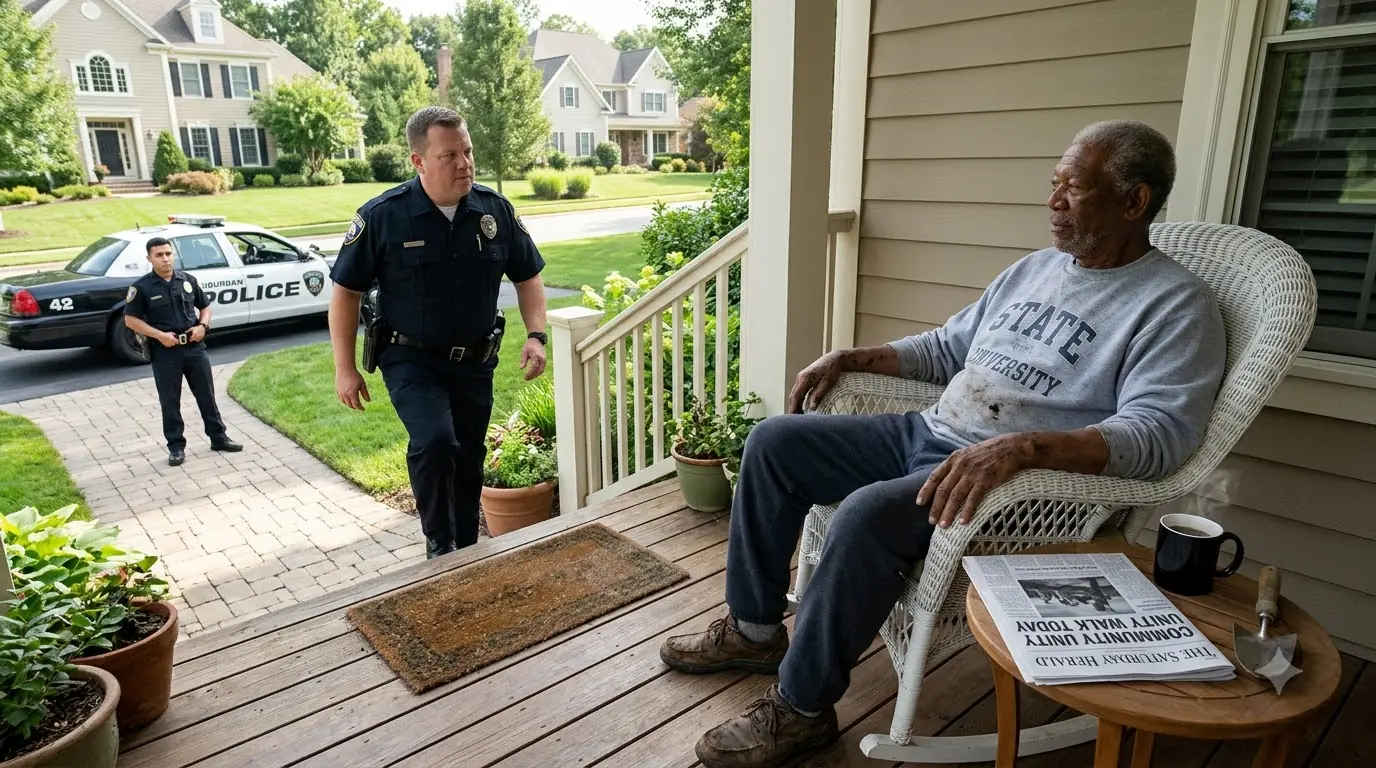
At sixty-two, Arthur appreciated quiet whenever he could find it. He had begun his career as an overworked public defender, later became a sharp and uncompromising federal prosecutor, and had spent the past ten years serving as a federal magistrate judge for the United States District Court. His weekdays were consumed by gavels, thick legal briefs, hearings, and decisions that could alter the course of a person's life. His Saturdays, therefore, were fiercely protected.
On this particular morning, Arthur was not wearing judicial robes or a tailored suit. He wore a faded Georgetown University sweatshirt stained with soil, gray sweatpants that had seen better decades, and scuffed gardening clogs. A fine layer of dark topsoil covered his hands after an hour spent repotting a stubborn Boston fern that his wife, Sarah, insisted needed more sunlight. He lowered himself into a white wicker rocking chair, lifted a mug of black coffee, and let out a long, contented sigh.
Then a white-and-blue police cruiser turned onto Elmwood Drive. Arthur barely noticed at first because patrol cars occasionally passed through Oakmont Estates. This one, however, slowed directly in front of his property and rolled partly onto the edge of his driveway. The vehicle stopped, and two officers stared through the windshield at him.
Officer Derek Chaffins sat behind the wheel. He was a five-year veteran with a stocky build, a buzzed haircut, and a personnel file already thick with complaints about excessive force and discourtesy. A protective union representative had helped him escape meaningful discipline more than once. His passenger was Officer Brian Miller, a rookie only six months out of the academy who still believed most situations could be calmed with patience and a respectful voice.
Chaffins killed the engine and continued staring at Arthur. Arthur raised his coffee mug in a polite neighborly greeting, then returned his attention to the newspaper on the table beside him. The driver's door opened, and Chaffins stepped out while adjusting his utility belt. One hand rested deliberately near the grip of his service weapon.
"Hey, you," Chaffins barked loudly enough to make Mrs. Higgins, the neighborhood gossip three houses away, part her living-room blinds.
Arthur looked over the top of his reading glasses. "Can I help you, Officer?"
His voice was deep, calm, and naturally authoritative, the voice of a man accustomed to commanding federal courtrooms. Chaffins pointed toward the sidewalk with a rigid finger.
"Come down here."
Arthur did not move. He took another sip of coffee and studied the officer. He knew the Constitution, police procedure, and the exact boundary between a voluntary encounter and an investigative detention.
Chaffins's jaw tightened. He interpreted calm resistance as disrespect. He walked up the driveway and stopped at the foot of the porch steps while Miller hurried out of the passenger side and followed him.
"We received a call," Chaffins said. "A report of a suspicious person lurking around properties on this street and casing houses."
Arthur gave a dry, quiet chuckle. "I can assure you that no one is casing houses here. I imagine Barbara Higgins saw me fighting with that fern and allowed her imagination to run away with her again."
"I did not ask for a comedy routine," Chaffins snapped. "I need to see identification."
Arthur placed his coffee mug on the table. The relaxed neighbor disappeared, and the federal magistrate began to show through his casual clothes. His voice dropped slightly and became precise.
"Under what legal authority are you demanding my identification? Have you observed me committing a crime? Do you have reasonable, articulable suspicion that I have committed or am about to commit one?"
Chaffins crossed his arms. "I have a suspicious-person call matching your description. Black male, dirty clothing, sitting on a porch. Give me your identification before this becomes complicated."
Arthur's expression hardened. "Being a Black man in sweatpants on a Saturday morning in Oakmont is not a crime. Sitting on private property does not create reasonable suspicion. Under the Fourth Amendment, I am not required to identify myself or continue this conversation."
He picked up his newspaper, snapped it straight, and resumed reading. It was a complete dismissal, and Chaffins's fragile ego could not tolerate it. Miller leaned toward his partner and spoke quietly.
"He is sitting on his own porch. We could run the plate on the Mercedes and verify the address."
"Shut up, Miller," Chaffins hissed.
To Chaffins, Arthur had already become a suspect simply because he had challenged an order. The careful legal language irritated him even more. He stepped onto the first porch stair.
"Listen carefully. You will give me identification right now, or I will detain you for obstructing an official investigation."
Arthur lowered the newspaper and looked at Chaffins's boots resting on his property. "I am going to give you the best advice you will receive in your career. Turn around, return to your cruiser, and drive away."
It was the wrong thing to say to a man like Derek Chaffins. He climbed the remaining steps and closed the distance until he stood over Arthur. The peaceful porch suddenly felt narrow and dangerous.
"Stand up," Chaffins ordered, releasing the retention strap on his taser holster.
Arthur did not rush. He placed the newspaper carefully on the table and rose to his full height, nearly two inches taller than the officer. His hands remained visible at his sides because he had reviewed enough body-camera footage in court to know how quickly an innocent movement could be called a threat.
"You are on private property without a warrant, probable cause, or exigent circumstances," Arthur said. "You are violating department policy and my civil rights. Stop and think about what you are doing."
"You are detained," Chaffins barked.
He lunged forward, seized Arthur's left wrist, and twisted the arm behind his back. Arthur winced as thick fingers dug into his skin. Chaffins then shoved him face-first against the heavy oak front door, and the impact echoed across the quiet lawns.
"Stop resisting!" Chaffins shouted, even though Arthur stood completely still.
"I am not resisting," Arthur answered, his voice muffled against the wood but remarkably controlled. "I am submitting to an unlawful show of authority."
The first steel cuff closed tightly around his wrist. Chaffins forced the other arm behind him and ratcheted the second cuff down until the metal pinched the nerves in both hands. Miller remained at the bottom of the porch steps, one hand hovering near his radio.
"Chaffins, are you certain about this?" Miller asked. "We did not see him do anything."
"He is obstructing," Chaffins shouted while conducting an aggressive pat-down. "He refused a lawful order. He may be trespassing himself. Look at him, Miller. Do you think a man dressed like this owns a two-million-dollar house?"
Before Arthur could answer, the front door was pulled open from inside. He stumbled backward into Chaffins as Sarah Pendleton appeared in the foyer wearing an elegant silk robe and holding a watering can. She stared at her husband, a federal judge who possessed the authority to sign search warrants, handcuffed and pressed against their own doorway by a red-faced patrol officer.
Sarah did not scream or drop the watering can. After thirty-five years of marriage, she possessed the same glacial control Arthur did. Her eyes narrowed.
"Arthur, what exactly is happening on my porch?"
"This officer has decided to arrest me for sitting in my rocking chair, dear," Arthur said over his shoulder.
Chaffins pointed at her. "Ma'am, step back inside. This man is under arrest."
Sarah looked from the officer to the nervous rookie and then back at her husband. "Would you like me to call the precinct?"
Arthur shook his head as much as the position allowed. "Do not call the desk sergeant. Call Chief Reynolds on the private number saved in my contacts. Tell him that his officers are taking me to Central Station and that he should meet us there. Then call Thomas Albright at the firm and tell him I may need a ride."
Chaffins laughed and yanked Arthur toward the steps by the chain between the cuffs. "You are calling the chief of police? That is a good one, Grandpa. Tell him Officer Chaffins says hello."
"I will pass along your regards," Arthur replied softly.
By then, neighbors had begun watching. Mrs. Higgins stood at the edge of her driveway clutching her necklace, while a man walking a golden retriever held up a phone and recorded the scene. Arthur kept his head high and memorized everything: the time on his watch, Badge 4882 on Chaffins's chest, Car 14 printed on the cruiser, and Miller's failure to intervene.
"Watch your head," Chaffins said mockingly before forcing Arthur into the hard plastic rear seat.
Arthur folded his tall frame into the cramped space. The cuffs dug deeper into his wrists when the door slammed, trapping him behind the thick Plexiglas partition. Outside, Miller looked increasingly alarmed.
"Derek, what if he really knows the chief?" Miller asked. "Did you see the ring on his hand? It looked like a law-school class ring. And the woman inside did not look confused at all."
Chaffins laughed and slapped him on the shoulder. "The man is a squatter or a handyman caught snooping. They all claim to know the mayor, the chief, or some lawyer. It is a bluff. We are booking him for loitering, obstruction, and failure to identify."
"We never even ran his name," Miller said.
"We will run his fingerprints at Central. The booking system will tell us who he is. I guarantee he has warrants."
Miller climbed into the passenger seat and glanced through the partition. Arthur was not shouting, kicking, or pleading. He sat perfectly still and watched both officers through the rearview mirror with such composed intensity that the rookie felt a cold shiver move down his spine.
"Next stop, Central Booking," Chaffins announced. "Let us see how much of a lawyer he is from a holding cell."
Arthur closed his eyes. He was no longer thinking only about his own bruised wrists or the humiliation of being displayed before his neighbors. He thought about the frightened young men who had appeared in his courtroom after encounters like this, people who did not know the precise law, did not have a chief of police in their contacts, and did not possess the calm that came from decades inside the justice system. Some had panicked, some had argued, and some had been given additional charges because an officer interpreted fear as resistance. During the fifteen-minute drive, Arthur began mentally drafting a federal civil-rights complaint, a request for departmental records, and the litigation that would soon descend on the city. For Derek Chaffins, those fifteen minutes were the final moments of the career he knew.
The cruiser entered the gated sally port at the Central District Precinct. Heavy metal doors closed behind it with a final clang, cutting off the bright morning and replacing it with concrete walls and fluorescent light. Chaffins looked satisfied, as though entering the secure building proved that every assumption he had made on Elmwood Drive was correct. Miller, by contrast, kept glancing at Arthur and then toward the station doors, silently hoping someone inside would stop what he had failed to stop. Chaffins opened the rear door and pulled Arthur out by the handcuff chain.
"End of the line, Grandpa."
Arthur's shoulders ached, and deep red marks had formed beneath the cuffs, but he kept his posture upright. He allowed Chaffins to lead him through the double doors into Central Booking, a bright, noisy space that smelled of stale coffee, floor wax, and nervous sweat. Officers filled out reports while an intoxicated man sang badly from a nearby holding cell.
Behind the bullet-resistant intake window sat Desk Sergeant Michael O'Malley, a twenty-year veteran with little patience for nonsense. He was typing an incident report with two fingers when Chaffins approached with Arthur.
"Hey, Sarge," Chaffins called. "I brought you a live one. John Doe refused to identify himself. We caught him in Oakmont Estates. Loitering, obstruction, resisting arrest - the whole package. We will need fingerprints to learn who he is."
O'Malley kept looking at the computer. "Put him on the bench, Derek. I have three domestic-violence reports to finish before I deal with your John Doe."
"Come on, Sarge. This man was a real piece of work. He used a lot of lawyer language and claimed he was calling the chief."
That caught O'Malley's attention. He sighed, lowered his reading glasses, and finally looked through the scratched glass at the prisoner. The color drained from his face. His jaw fell open, and the pen he had been idly turning between his fingers dropped onto the keyboard.
"Judge Pendleton?" he stammered.
Chaffins frowned. "Judge? What are you talking about, Mike? This man is a vagrant who wandered into Oakmont."
O'Malley shot out of his chair so quickly that it fell backward. He rushed to the security door and fumbled with his access card.
"Take those cuffs off him right now!"
Every person in the booking area turned. Even the man in the holding cell stopped singing.
"Sir, he resisted-" Chaffins began.
"I said remove the cuffs, Chaffins! Do you have any idea who you brought in here? That is the Honorable Arthur Pendleton, a federal magistrate judge for the United States District Court."
Chaffins froze. His smirk disappeared as confusion turned into panic. He looked at Arthur's stained Georgetown sweatshirt, gardening shoes, and calm expression as though the clothes might somehow change the truth.
"I received a suspicious-person call," he stammered.
Arthur did not smile or gloat. He looked at O'Malley. "Sergeant, Officer Chaffins appears to be having difficulty with his keys. Perhaps you could assist him."
"Yes, Your Honor. Immediately."
O'Malley's hands shook as he took the key from Chaffins's belt and unlocked the cuffs. Arthur brought his arms forward slowly and winced as circulation returned to his hands. The red grooves were already darkening, and one wrist had begun to swell where the metal had been ratcheted too tightly. He began massaging the marks while every officer in the room avoided his eyes. The silence was no longer the silence of routine police work. It was the silence of people realizing that the abuse they had learned to ignore had finally reached someone capable of forcing the institution to answer for it.
Miller leaned against a cinder-block wall, looking sick. His instincts had warned him repeatedly that the stop was wrong, but he had remained silent when it mattered. Now the full consequence of that choice stood in front of him.
"Judge Pendleton, I cannot apologize enough," O'Malley said. "I have no idea what these officers were thinking, but we will sort this out immediately."
Arthur raised one hand. "You did not place the cuffs on me. Do not apologize for conduct you did not commit. However, I believe we are about to have company."
The double doors opened violently before O'Malley could respond. Chief of Police William Reynolds entered wearing a golf shirt and khaki pants, but there was nothing leisurely about his expression. Beside him walked Thomas Albright, Arthur's oldest friend and the managing partner of one of the city's most formidable civil-litigation firms, carrying a leather briefcase.
Reynolds scanned the room and saw the raw marks around Arthur's wrists. He closed his eyes for one painful second, then marched across the booking floor as the entire precinct fell silent.
"Arthur, are you injured?"
"I will need ice and perhaps some ibuprofen, William. My wrists, however, are the least of your concerns."
Reynolds turned toward Chaffins. The officer looked like a man watching an executioner reach for the lever.
"Chief, I can explain. We had a suspicious-person call. He refused identification and became combative."
"Combative?" Thomas Albright stepped forward. "Are you claiming that a sixty-two-year-old federal judge assaulted you while repotting a fern? If that is your official account, I will make certain the FBI considers perjury when it investigates this deprivation of civil rights."
"Silence," Reynolds ordered without taking his eyes off Chaffins. "You answered a vague, uncorroborated call, entered private property, and demanded identification without reasonable suspicion. When the resident asserted constitutional rights that he applies in federal court every day, you assaulted him, unlawfully detained him, and transported him here."
Desperation overpowered Chaffins's judgment. "Chief, he was wearing dirty sweatpants. He did not look like he belonged in that house."
The room became suffocatingly quiet. Arthur stepped forward, his voice level but sharper than any shout.
"The Fourth Amendment does not contain an exception for people wearing sweatpants. It does not allow officers to suspend civil liberties because gardening clothes offend their expectations. You believe a badge grants supreme authority over the citizens you are sworn to protect. It does not. It makes you a servant of the law, and you profoundly misunderstand that law."
Chaffins looked down at his boots. Arthur continued.
"You relied on racial profiling. You saw a Black man on a porch in an affluent neighborhood, and you concluded without evidence that he must be a criminal. You ignored de-escalation, probable cause, and basic procedure because your ego could not tolerate a citizen refusing an unlawful command."
Arthur then turned toward Miller. "You knew it was wrong. I watched you hesitate and question your partner. When you had a legal and moral duty to intervene, you stood paralyzed. Cowardice in uniform can be just as dangerous as malice."
Miller lowered his head, tears in his eyes. "I am sorry, Your Honor."
"Save your apology for Internal Affairs," Thomas said as he opened his briefcase. "Chief Reynolds, Judge Pendleton's counsel is now present. We are preparing a civil-rights action under Section 1983 against Officer Chaffins, the department, and the city. We will challenge any assertion of qualified immunity and request federal review of the precinct's profiling and training practices."
Reynolds looked physically ill. He understood the consequences: federal oversight, public hearings, civil damages, and a permanent stain on the department. His voice became cold and formal.
"Officer Chaffins, surrender your badge, firearm, and radio to Sergeant O'Malley. You are stripped of police authority effective immediately, pending termination."
Chaffins's hands shook as he removed the radio, unholstered the firearm, and placed his badge on the desk. The silver shield that had fed his arrogance for five years no longer protected him. In a matter of minutes, he had gone from dominating a stranger's porch to facing unemployment and possible federal charges.
"Officer Miller," Reynolds continued, "you are suspended without pay. Go home and wait for Internal Affairs to contact you."
The chief turned back to Arthur. "Please let my driver take you home. We will handle everything from here."
Arthur adjusted the sleeves of his Georgetown sweatshirt, wincing when the fabric brushed his bruised wrists. "Thomas will drive me. I still have a Boston fern to repot, and afterward I have a considerable amount of paperwork to begin."
He walked toward the exit without looking back. The heavy doors opened, and he stepped into the warm Saturday sunlight. Justice often moved slowly, but Derek Chaffins had just learned that when it finally arrived, it carried enormous weight.
Arthur refused to let the incident disappear into a short news cycle. He did not hold a theatrical press conference or seek applause. Instead, he used the legal process with the same care he demanded from everyone who entered his courtroom. He filed a detailed civil-rights complaint with the Department of Justice, bypassing the precinct's compromised internal system.
Federal investigators reviewed Chaffins's history and uncovered a disturbing pattern. During fifteen years in law enforcement, he had faced eleven complaints involving excessive force or selective targeting in affluent neighborhoods. The reports described stops that began with vague claims of suspicious behavior and escalated after citizens questioned his authority. Every complainant had been a person from a minority community, and every case had been quietly dismissed or reduced to informal counseling. A former police-union representative, now serving on the city council, had helped suppress the records, pressure supervisors, and keep damaging body-camera footage from receiving outside review.
The incident was no longer one unlawful arrest. It had exposed a systemic cover-up. Faced with a federal investigation, public outrage, and pressure from the judicial bench, the police department terminated Derek Chaffins and revoked his pension eligibility. The district attorney also opened a grand-jury inquiry into possible criminal deprivation of civil rights under color of law.
Arthur's response was not limited to punishment. One week later, Brian Miller was summoned to the federal courthouse. The rookie entered Arthur's private chambers in his formal uniform, trembling as he stood before the same man he had watched being pushed against a door.
Arthur sat behind a large mahogany desk wearing his black judicial robe. He allowed the silence to remain for a long moment before closing the file in front of him.
"You hesitated," Arthur said. "I saw your face when your partner grabbed me. You knew the detention was wrong and that he had violated policy, but you did nothing."
"I was afraid, Your Honor," Miller admitted. "He was my training officer. I did not know how to stop him."
"Fear is human," Arthur replied. "Complacency is a choice. A badge and firearm give you the power of life and death over the public. If you cannot find the courage to stop a bully inside your own patrol car, you have no business wearing the uniform."
Miller looked down as tears formed in his eyes. "Am I being fired?"
"No. I spoke with Chief Reynolds. You will spend six months on desk duty. During that period, you will complete forty hours each week at the Eastside Community Center's youth-outreach program. You will learn about the people you police, speak to them without a weapon on your hip, and understand the fear created when authority is abused. If you complete the assignment and demonstrate that you learned from it, you may return to patrol."
"Yes, Your Honor," Miller whispered. "Thank you."
"Do not thank me. Earn the opportunity. You are dismissed."
The arrest on Elmwood Drive triggered reforms throughout the county. Arthur used the public attention to require independent bias training, stronger body-camera rules, clearer intervention duties for officers, and outside review of complaints involving selective enforcement. Supervisors could no longer close serious complaints with a handwritten note, and rookies were taught that loyalty to a partner never outweighed their oath to the public. The department was also forced to reopen older cases that had once been dismissed without meaningful investigation, contact the affected families, and preserve footage that might support new civil claims.
Arthur did not pursue those reforms merely because he had been humiliated. He acted for every teenager walking home in a hoodie, every father repairing a car on a dark roadside, and every resident who lacked a judicial title capable of forcing officials to listen. He took one degrading encounter and transformed it into a permanent protection for others.
True justice is not only the punishment of wrongdoing. It is the willingness to hold powerful institutions accountable and to repair the systems that allowed the abuse to continue. Arthur Pendleton proved that constitutional rights belong to everyone, regardless of clothing, neighborhood, profession, or skin color. A badge does not place anyone above the law, and arrogance behind one can cost a person everything.