
Her Father Tried to Hand Her to a Cruel Earl — Then the Man in the Shadows Spoke
The rotting Duke said, "Whoever marries you will be lucky." And she replied, "I accept your proposal." Most romances begin with a glance. Daphne's began with a bargain no one expected her to survive. In a glittering ballroom full of chandeliers, whispered judgments, and the cold mathematics of marriage, she was being handed to a cruel old lord like property. Then she stepped onto a moonlit terrace, spoke one reckless sentence, and accepted a proposal from the one man society called the rotting Duke.
But Arthur Pemberton was not the monster people muttered about behind fans and velvet gloves. He was quiet, wounded, and far more dangerous to Daphne's future than any scandalous rumor could explain because he saw her when no one else did. And Daphne, sharp as a needle and unwilling to be broken, was never meant to fall for the man she had just agreed to marry. She only meant to save herself.
Except some marriages are not built from duty. They are built from defiance, secrets, and the dangerous hope that love might bloom in the last place anyone would ever think to look. ONE The music inside the assembly rooms of Bath was the kind that made people forget their troubles. It curled between the silk gowns and powdered wigs, wound through the golden blaze of the chandeliers, and pressed against the tall windows where October frost had begun to form on the glass.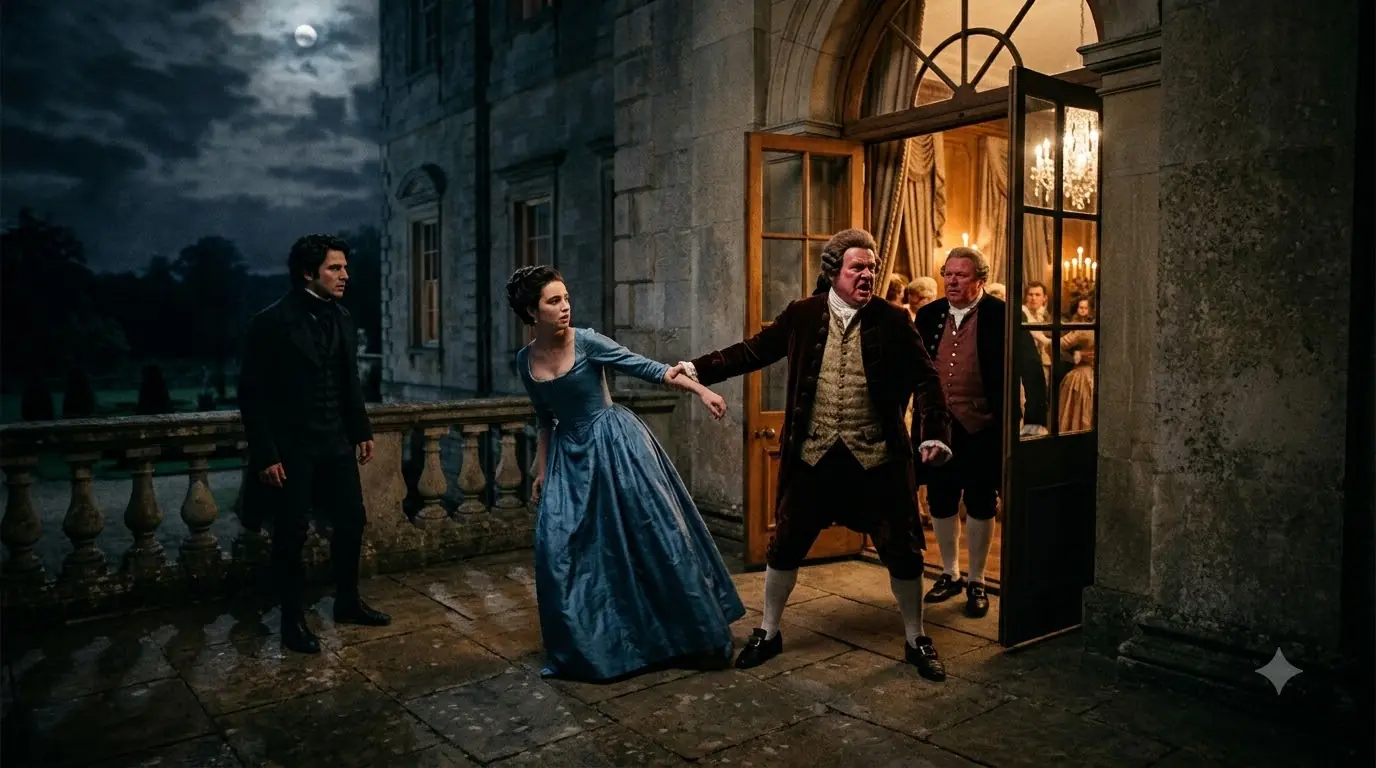
In 1772, there was no finer stage in England for the business of marriages, alliances, and the slow, polished cruelty of polite society. Lady Daphne Ashworth did not hear the music, not truly. She stood near the far wall with a glass of ratafia she had not touched, watching the dancers spin in perfect formation, and all she could hear was the sound of her future closing like a heavy iron door. 30 minutes ago, her father, Lord Ashworth, had gripped her elbow and steered her behind the curtained alcove near the east corridor.
He had not asked. He had announced. She was to be betrothed to Earl Cranbrook, a man of 53 with a red face, small wet eyes, and a reputation for temper that even his own servants whispered about. The alliance would secure the Ashworth family's crumbling debts and strengthen her father's seat in Parliament.
"You will smile," her father had said, in the tone that left no room for argument. "You will be gracious, and you will not embarrass me." She had smiled. She had been gracious. She had nodded while the Earl lifted her gloved hand to his lips and looked at her the way a man looked at furniture he intended to purchase.
Now, standing in the crowded, glittering room, Daphne could no longer breathe properly. She set her untouched glass on a passing tray, smoothed her blue silk skirts, and walked with controlled steps toward the tall French doors at the back of the room. Nobody stopped her. Nobody noticed.
She was already becoming invisible, which, she supposed, was the entire point. The terrace garden met her like cold water thrown in the face. The night air was sharp with autumn, carrying the smell of damp stone and the last of the season's roses. Daphne exhaled for the first time in an hour.
She pressed her palms against the stone balustrade and looked out at the moonlit garden below, dark hedges, pale gravel paths, the quiet geometry of a world that did not care who she was marrying. She thought she was alone. She was wrong. "You might want to lower your voice," said someone quietly from the shadows.
"The doors are not entirely thick." Daphne spun. A man was sitting on a stone bench at the far end of the terrace, half hidden in the shadow cast by climbing ivy on the wall behind him. He was angled slightly sideways, his left side tucked into the darkness, as though he had chosen that particular bench with deliberateness. In the pale moonlight, what she could see of him was remarkably handsome, strong jaw, dark hair, a stillness that was not unfriendly but was not warm either.
His coat was well cut. His posture held a tension that had nothing to do with rudeness. "You let me stand here thinking I was alone," she said. "You were clearly in need of a moment," he said.
"I did not want to interrupt a very dramatic internal crisis." Under different circumstances, she might have turned around and gone back inside, but the image of Earl Cranbrook's wet eyes rose up behind her, and she found she had no interest in returning to any of it. "I have just been handed to an old cow," she said, to nobody in particular. "A controlling, ancient gargoyle of a man who has buried two wives already, and my father is in there smiling as though he has done me a great favor." She laughed, but it came out brittle and strange. "I would have been better off marrying the rotting duke himself than that wretched earl.
At least the rotting duke has the decency to stay isolated and bother nobody." There was a pause. Then the man on the bench let out a laugh, low and warm and entirely unexpected. Daphne turned with narrowed eyes. "I fail to see what is funny." "Forgive me," he said, though he was still smiling.
"I am not laughing at your pain. I am laughing at the particular cruelty of the universe." He rose from the bench. It was a slow movement, careful, and she noticed the way his weight shifted as he straightened, a stiffness on his left side he had clearly long since learned to manage. He was taller than she had expected, and he looked at her with a directness that was almost startling.
"My name is Arthur Pemberton. I am the Duke of Blackwood." A brief pause. "Though I believe you may know me by another name." The night air felt colder. Daphne stared at him.
She looked at his face, strong and dark and very much not rotting. She thought about the rumors. Blackwood never comes to London. Blackwood is diseased, decaying.
They say you can smell him from the hall. She had just called him an old cow's preferable alternative to his face, in a garden. "Oh," she said. "Yes," he said.
The French doors at the back of the terrace flew open. Her father stood in the doorway with a face dark with fury, and Earl Cranbrook was a wide red shape just behind his shoulder. "Daphne, come inside. Now." Arthur did not flinch.
He turned to look at her father with a calm, unhurried authority that made her father's fury look small. "I believe," Arthur said quietly, "that the lady is already spoken for." Daphne looked at Arthur's dark eyes, at the steadiness in them, at the way he was watching her and not her father, as if what she decided in the next 5 seconds was the only thing that mattered. She thought about the Earl's hands. She thought about two buried wives.
She thought about iron doors closing. She lifted her chin. "In that case, your grace," she said clearly, "I accept your proposal." Her father made a sound like a man who had swallowed something sharp. The Earl went the color of an old beet.
Arthur looked at her for one long moment, and something shifted in his expression, surprise, and then something warmer and more careful than surprise. "Then," he said quietly, "I am the luckiest man alive." TWO the scandal was instantaneous and total. A duke's public declaration, witnessed by no fewer than 11 people crowded behind her father in the doorway, could not be quietly undone. Arthur outranked the Earl.
A verbal agreement made before witnesses carried weight that a betrothal contract did not easily overrule. Earl Cranbrook raged. Her father threatened. Arthur's solicitor appeared the very next morning and began the paperwork with the efficiency of a man who had been waiting for something to do.
Within a fortnight, Daphne Ashworth became Daphne Pemberton, Duchess of Blackwood. The ceremony was small, formal, and held in the cold stone chapel of Blackwood Hall. She signed her name with a steady hand, though her heart was doing something uncomfortably fast. Blackwood Hall rose out of the late October fog like something from a painting, old gray stone, wide wings spreading on either side of the entrance, rows of tall windows reflecting the overcast sky.
It was enormous, and it was severe, and it did not smile. She found she preferred it to her father's gilded London townhouse, which had always smiled too brightly and meant very little by it. That first evening, Arthur came to her in the drawing room and sat across from where she stood near the fire. He looked at her with the same directness she remembered from the garden.
No pretense. "There are things I should have told you before the ceremony," he said. "I will tell you now." He told her plainly the wound he had taken during the war 11 years ago to his left leg and side. It had refused to heal properly, plagued by persistent deep infection.
The physicians had tried everything they knew. Nothing had worked. Hence the nickname. Hence the isolation.
I stepped in because I watched you for the better part of an hour in that ballroom," he said. "You were kind to the wallflower girl near the pillar when no one else noticed her. And then I watched the Earl take your hand, and I watched your face." He paused. "I thought it was a very great waste." Daphne studied him.
He was telling her this without drama, without asking for anything. That mattered. "What are you offering me?" she asked directly. "A marriage of convenience, if that is what you want," he said.
"Your own rooms, your own income, absolute freedom to live as you choose. I brought you here to give you safety, not to replace one cage with another." He paused. "Or, if you choose to stay truly, friendship and the possibility of something more in time, if it comes to that honestly. I gave my word," Daphne said, "in front of witnesses, and in that chapel.
I don't run from things I have agreed to." She looked at him steadily. "And I do not find you entirely disagreeable, which helps." Something shifted in his expression, careful, warm, held back. "Arthur," he said. "My name is Arthur." "Arthur," she said.
They shook hands on it, which was probably the most sensible way two strangers had ever begun a marriage. She asked Mrs. Holt to show her the library. It was extraordinary, two floors of shelves, a rolling ladder, a fireplace large enough to stand in. She ran her fingers along the spines and felt, for the first time in weeks, something close to peace.
The peace lasted three days before the arrangement became complicated. It began with furniture. The front drawing room chairs faced a cold wall instead of the window. She rearranged them.
Arthur appeared in the doorway, looked at the chairs, and said, "I had those placed there for a reason." "What reason?" she asked. He thought about it. "I cannot currently remember," he admitted. "Then they stay here," she said cheerfully, "where the morning light is better." He stood in the doorway a moment longer, watching her.
She did not look at him, but she felt the weight of it, quiet and steady, and found she did not mind it at all. That, she recognized with some alarm, was precisely the problem. She was not minding things she should probably mind. The sound of his voice reading aloud in the evenings, the way his face changed when she made him laugh, the brief warm weight of his hand on her arm on the stairs.
She began minding, very much, that she was starting to care for him. Caring for someone who was running out of time felt like building a house in a flood plain, beautiful, foolish, and likely to end in ruin. She decided to find him a cure. She simply did not tell him yet.
THREE High society, upon learning that the rotting duke had taken a wife, reacted the way high society always reacted to unexpected things, with collective, loud disapproval. Invitations did not arrive. Neighbors left cards without calling. At a church service in the village, two women in the pew behind Daphne whispered that the new duchess would be a widow before the spring.
She smiled at them on the way out. They looked away. The dismissal had one significant advantage. It left her with a great deal of uninterrupted time.
Tucked behind the medical texts on the library's second floor, she found what most visitors to Blackwood Hall had clearly treated as untouchable, a collection of old apothecary journals bound in cracked leather, filled with cramped handwriting in English and Latin. Daphne had loved medicine since she was 12, when her mother's physician visited weekly and she had read every book he left behind. It was not a fashionable interest. Her father had called it peculiar.
She had continued anyway. The journals were slow going. Her Latin was good but not perfect and some of the compounds required cross-referencing with three other texts before she understood what she was reading. She began keeping notes in a small leather book, filling it with observations, questions, the names of plants and their properties.
She worked each morning and each afternoon and in the evenings she brought her notes to dinner and asked Arthur questions across the table. He answered with genuine engagement. He had studied some natural philosophy at Cambridge before the war. Their dinners stretched long.
She told herself it was because the conversation was useful. In the fourth week of November, his wound flared. She heard it first, the rapid steps of Mrs. Holt, the clipped voices of people managing something they did not want to alarm anyone with. She was in the library when it started.
She was at his bedroom door in 4 minutes. The valet tried to stop her. His grace has asked not to be disturbed. Yes, I imagine he has, she said pleasantly and walked past him.
Arthur was in bed, propped against the pillows, pale and sheened with fever. His jaw set in the expression of a man enduring something he had decided not to complain about. You should not be in here, he said. Almost certainly, she agreed.
She sat down beside him and opened the top most journal. How long has it been like this? Two days, said the valet quietly. Since before he told me, she said, not quite to anyone.
Then, directly at Arthur, the physicians who have treated you, what have they used? He told her. She listened with the focused patience she gave difficult Latin texts and as he described the treatments, something tightened in her chest. The things they had used were wrong.
Not merely unhelpful, actively harmful. Certain poultices she had read about, when applied to deep tissue wounds over long periods, could impede the very healing they claimed to encourage. They had been slowing him down for years. She did not say this yet.
She needed to be certain first. Sit still, she told him instead, and began unwrapping the outer bandaging with careful hands. "I do not require—" "Arthur." She looked up at him. I am trying to help you.
Please cooperate. He looked at her. Something flickered in his expression, surprise at the use of his name, and then something else, quieter. He sat still.
She worked methodically, inspecting the wound, comparing what she observed against her notes. She rewrapped it cleanly, more firmly than before. You should rest, she told him. I am already in bed, he pointed out.
Rest with intention, she said. Sleep if you can. She gathered her books. Daphne.
She stopped. He rarely said her name. When he did, it had a particular quietness, like he was being careful with it. Why are you doing this?
He asked. She looked at him in the candlelight, at the tired, honest face of a man who had managed his pain alone for years, and had not expected help from anyone. Because you did not leave me to the Earl, she said simply. And because I don't intend to leave you to this.
She returned to the library after he slept and worked past midnight. Around 2:00 in the morning, she found it buried deep in the oldest journal. In dense Latin, she translated twice to be certain. An apothecary in 1693 had described a case nearly identical to Arthur's.
A deep infected wound that conventional treatment had worsened. The compound he described was specific extracts from certain mold growths combined with particular herbs prepared in a particular sequence applied as a poultice over several days. She read it three times. Then she sat back, pressed her hands flat on the table, and felt with absolute clarity that this was the answer.
Three nights later, while she changed the cool cloth on his feverish brow, Arthur caught her hand. Not roughly, gently, as if he were not entirely sure he was doing it. The candlelight was low. His fever had broken slightly, leaving him lucid in the fragile way of people cooling after a long burn.
He looked up at her, and the careful distance he usually kept around himself was entirely gone. "You should not be kind to me," he said quietly. "It is not a safe thing to do. I am not going to get better, Daphne.
I have accepted that. But you are young. You have a great deal of life still. I will not have you waste it staying close to someone who is going to Don't," she said.
"Don't say it." He looked at her. She was too close, the kind of close that people who were not in love could not quite justify, and the space between them was very small and very warm. For one long second she thought, he turned his face away deliberately, with the care of a man making a decision that cost him something. "Go to sleep, Daphne," he said very quietly.
She stood up slowly. She picked up her candle. She was going to find him a cure. That was all there was to it.
FOUR She had been working on the compound for nine days when the carriages came. The morning was bright and cold, one of those November days when frost stayed on the grass until noon. She was in the still room off the kitchen, which she had taken over for her work. The compound required precision, mold extract sourced from an apothecary in Bath, herbs gathered from the kitchen garden, the preparation done in the exact sequence the journal described, left to mature over several days.
She checked her notes against the text every time she moved to the next step. She was measuring when she heard the horses. Through the entrance hall window, she saw two carriages rolling up the gravel drive. She recognized the crest on the first one, her father's.
The wide red shape descending from the second was Earl Cranbrook. Behind them, a third man with a physician's bag, Dr. Felton, royal physician, appointed, she learned, at someone's request. They assembled in the grand hall. The Earl stood in its center with the air of a man who believed every room belonged to him by right.
"We are here on a matter of law," he said, without greeting. "It has come to our attention that the Duke of Blackwood is physically and mentally unfit to have entered into a valid contract of marriage. The lady was coerced under conditions of duress." "I was not coerced," Daphne said. "And we are prepared to seek a court order dissolving the marriage on grounds of the Duke's incapacity." There was a sound on the staircase.
Arthur came down slowly, dressed formally, his face composed. He had insisted on being present when Daphne told him what was happening. She had said he should rest. He had said, "This is my house," and she had not argued because he was right.
He stood at the foot of the stairs and the authority in his bearing was so complete that the Earl stopped talking. "You have a court order," Arthur said calmly. "We have the process to obtain one," her father said. "Dr. Felton will examine you, and if he confirms the physical deterioration." "I know what you are doing," Arthur said.
He looked at the Earl with steady dark eyes. "You want the ducal assets assessed as belonging to an incapacitated man's estate, which requires the marriage dissolved first. Cranbrook's red face went darker. Daphne stepped forward.
She had been doing calculations since she heard the carriages, standing perfectly still while the unwanted visitors were shown inside. The calculations were not in her favor, and that was simply information she intended to work with. "By what measure will Dr. Felton assess my husband?" she asked pleasantly. "The Duke's physical state," said Dr. Felton carefully.
"And if he is not visibly deteriorating," she said. She watched the Earl look at Arthur, standing still and controlled at the foot of the stairs. She watched him calculate. "The infection is long-standing," he said. ""The Duke's condition is documented by physicians who have been applying treatments that prolong rather than resolve deep infection,"" Daphne said.
"I have been reading the apothecary literature thoroughly, my lord. I have also been preparing a treatment compound based on research from 1693, which I am in the process of completing." She looked at Dr. Felton. "Are you familiar with Dr. Holden's work on deep tissue infection? Third volume, 1693." The doctor stared at her.
"No," he said. "The compound he describes draws out deep infection from tissue that has become resistant to conventional treatment," she continued. "Which is precisely my husband's situation. The physicians who have treated him have been using the wrong method for the wrong type of infection consistently for 11 years." She looked at Cranbrook.
"I will need 1 week. If at the end of 1 week my husband shows significant, visible improvement, your court order will be built on a false premise, and I will make that clear in any proceeding you bring." The Earl looked at her. He looked at Arthur. Arthur was watching Daphne with an expression she had never seen on his face before.
"Five days," said Cranbrook, needing to win something. "And the physician stays in the house." She glanced at Arthur. He gave the smallest nod. "Five days," she said.
"Doctor Felton is welcome. The Earl and my father are not." That night, she administered the first application of the compound. Arthur sat in the chair by his fire and let her work without complaint, which she chose to take as a vote of confidence. "You did not tell me you were working on this," he said quietly.
"I did not want to raise your hopes before I was certain," she said. "And are you certain now?" She looked up at him. She thought about three weeks of cramped Latin at 2:00 in the morning, about the absolute clarity she had felt when she read that passage for the third time. "Yes," she said.
"I am." He looked at her for a moment. "All right," he said simply, and turned so she could reach the wound site. She worked carefully. He was quiet.
Outside, the November wind pressed against the windows, and she was aware with every careful movement that the next five days would decide a great deal more than a court order. She did not sleep much. The compound required twice daily applications. She charted everything, the wound's appearance, the fever's behavior, the reduction of the persistent heat around the infection site.
By the second day, the difference was clear, not dramatic, not the way cures appeared in novels, but in the specific, measurable way of real medicine. Less redness at the wound's edge, the fever lower by evening, his face slightly less drawn. By the third day, he walked the length of the upper corridor without stopping. By the fourth evening, he came down to dinner without his cane.
On the morning of the fifth day, Doctor Felton examined the wound in complete silence for four minutes. Then he cleared his throat and said the improvement was, medically speaking, remarkable. That the infection appeared to be responding to a treatment he was not familiar with and would like to examine further. That he would need to note in his records that the Duke was demonstrably not incapacitated.
Daphne thanked him, gave him a copy of her notes and a transcription of the relevant passages from the journal, and went to find Arthur. FIVE She found him in the garden. She had gone first to the library, then to his study, then to the drawing room where the chairs now faced the right window. Mrs. Holt told her, with a carefully neutral expression, that his grace was in the south garden.
Daphne pulled her shawl around her shoulders and went outside. The late November morning held a thin, pale kind of sunlight that made every edge very sharp and cast long shadows. The frost had melted from the grass. At the center of the south garden's path, half sheltered by a bare climbing rose that still held a few brown hips, stood a stone bench.
It was the same shape as the bench on the bath terrace, she thought, though this one was older and worn smoother. Arthur was not sitting. He was standing near it, his weight carried easily on both feet, the constant careful management she had watched him perform for weeks simply gone. He heard the garden door and turned, and the winter light fell across his face, and she saw what was different.
She had grown used to his face, or thought she had. But what she had grown used to was his face under the weight of his illness, the controlled reserve, the steady endurance of a man bracing constantly against something. What stood in front of her now was the same face with something lifted away from it. He looked like a man who had stopped waiting for the worst.
She walked down the path toward him. Neither of them spoke until she was close. "Doctor Felton has confirmed what I already knew," she said. "Yes," he said.
"He told me." A pause. "As did Mrs. Holt, and Thomas, who overheard and then told the footman. So, the whole house knows. The whole house has known for 3 days that you were going to save me," he said.
"They were simply waiting for the formality." She looked at the stone bench. She looked back at him. "Cranbrook and my father?" she asked. "Left this morning once the doctor's assessment was clear.
Something moved in his expression. They will not be back. My solicitor is already filing the legal response to any future challenge. Cranbrook has no grounds." He paused.
"Your notes, by the way, were extraordinary. Dr. Felton asked if he might share them with the Royal Society." "He may," she said. "The research belongs to Dr. Holden. I only applied it." "You only" He stopped.
He looked at her with something close to exasperation. "Daphne, you spent 3 weeks translating 17th-century Latin apothecary journals past midnight, synthesized a medical compound from primary sources, administered it correctly, charted the results, and then argued the theory in front of a royal physician and two hostile witnesses without a single note in your hand." He paused. "You only applied it." She felt her face doing something she was trying to control. He closed the small distance between them deliberately, carefully, in the way of a man who has made a decision and is being thoughtful about it.
He stopped close enough that she could see the fine lines at the corner of his eyes, the gray threading through his dark hair at the temple. He looked at her, and the careful reserve was still there, but worn through in places, thinner than it had ever been. "I told you on that terrace," he said, "that whoever married you would be lucky." "You did," she said. "I believe I accepted a proposal on the basis of it." "It was not a proposal," he said.
"It was an observation. A very accurate one." Then, slowly, he lowered himself to one knee on the damp grass. The movement was careful in a new way—not the movement of a man fighting his body, but of a man being deliberate. He took both her hands in his.
His hands were warm. They had always been warm. She had noticed this early and remembered it often. "Daphne," he said, looking up at her with dark eyes that held nothing back.
"The world called me the rotting duke. They were not entirely wrong to say that I was broken. He paused. But you walked into a sick man's house and looked at it the way you look at everything, clearly, without flinching, without flattery, and decided it was solvable.
You gave me a future." His hands tightened slightly around hers. "I have been in love with you since approximately the second week, when you told me that my furniture arrangement was irrational and then explained, with full citation, why you were correct." She laughed. She had not meant to, but it came out of her, warm and real. "You are no longer bound to me by a desperate bargain," he said.
"The emergency is resolved. You are free to define what this is on any terms you choose. His dark eyes were steady. But I'm asking you, with everything I am and nothing held back, will you do me the honor of staying by my side as my true wife?
Freely, knowing fully what you are choosing." The winter light fell across his face. A bird moved somewhere in the bare rows above them. Daphne looked at this man, quiet, difficult, proud, extraordinary, who had gone to a gathering he hated and noticed a girl by the wall being kind to someone nobody else was watching, and had found that interesting. Who had intervened not because it was logical, but because he could not bear the waste of it.
Who had offered her every possible exit and not once pressured her to stay, even when she could see that he wanted her to. Who had sat still in a chair by his fire and trusted her with medicines from old books because she had said she was certain and he had simply believed her. She thought about iron doors, about rooms that shrank, about her father's voice telling her who she was going to become. She thought about this house, its cold stone and its extraordinary library, its chairs now in all the right places, about dinners that ran 2 hours longer than they needed to because neither of them wanted to stop talking, about warm hands and a low unexpected laugh she had somehow come to depend on.
"Arthur," she said, "Yes, I already accepted your proposal," she said, "in front of 11 witnesses in a terrace garden in October. I signed my name in a chapel 3 days later. I do not break contracts." She looked at him with everything she had, all the clarity she usually saved for difficult Latin and hard conversations. "I am already your wife.
I have been your wife. What I am telling you now is that I intend to remain so because I want to, which is the only reason that matters. And also because I love you, which I have been refusing to say for approximately 3 weeks on the grounds that it seemed premature and I am a practical person." He stared at her. Then he stood quickly, without hesitation, without stiffness, and she laughed again at that, at the simple beautiful fact of it.
And then his hands were on either side of her face and he kissed her with all the feeling of a man who had been holding something very carefully for a very long time and had finally been given permission to set it down. They stayed in the garden until the winter sun had shifted and the shadows had grown long and Mrs. Holt sent a footman out with hot tea on a tray, with which Daphne privately understood as a pointed suggestion that they come inside. That evening, they sat in the library. Arthur read aloud.
Daphne had her notes open in her lap because Dr. Felton had asked if she would write up the compound method in full, and she intended to do it properly. The fire was high. Outside, the first real snow of winter was beginning to fall, soft and quiet, pressing light shapes against the windows. "You are writing while I am reading aloud to you," Arthur observed.
"I am listening," she said, without looking up. "Your pacing is good tonight." "My pacing is always" He stopped. "You are insufferable," he said. "You are reading too slowly in the second canto," she said.
"It loses the momentum." There was a brief pause. Then he continued reading at a marginally better pace, and she continued writing her notes, and the snow fell outside, and neither of them said anything else for a long while because nothing else needed to be said. They had both, against considerable odds and through the specific application of stubbornness and honesty and very good research, managed to build something real. Something that had started with a wild, desperate I accept your proposal in a moonlit garden and had arrived here at a fireside on a snowy November evening as quietly and certainly as a wound finally, properly healed.
The rotting duke was not rotting. He never had been, not in the way that mattered. And the woman who had walked into his dark house with a stack of old medical journals and an absolute refusal to accept the story everyone else had already decided was true had known it from the beginning. She had simply needed to prove it, and she had.
END
Tags:
News in the same category

A Cocky Boxer Dared an Old Janitor to Dodge One Punch — Biggest Mistake of His Life

A Millionaire Challenged a Black Waitress With a $100K Bet — Her Reply Changed Everything

A Cocky Boxer Mocked an Old Janitor and Offered One Free Punch — Then Nobody Was Laughing

"Dodge Just One Punch," the Boxer Smirked at the Old Janitor — Then the Gym Fell Silent
My Wife Said I Had Trust Issues — Then The Condo Guard Told Me About Her “Massage Therapist”
CHAPTER 2:"Dodge Just One Punch," the Boxer Smirked at the Old Janitor — Then the Gym Fell Silent

CHAPTER 3:"Dodge Just One Punch," the Boxer Smirked at the Old Janitor — Then the Gym Fell Silent
I Told My Husband I Was Working Late — Then He Put The Hotel Receipt Beside My Wedding Ring

"She Can't Speak Chinese," the Millionaire Laughed — Then the Entire Room Stood Up

A Cocky MMA Fighter Offered an Old Farmer $500 to Take Free Punches — Then Everything Changed
I Packed One Suitcase to Leave My Husband... But He Thought I'd Be the One Walking Away With Nothing

A Millionaire Mocked a Black Waitress With a $100K Bet — Her First Words Left Everyone Standing

My Husband Secretly Filed for Divorce the Day Before My Promotion... He Never Expected Me to Become His New CEO

CHAPTER 2: A Millionaire Mocked a Black Waitress With a $100K Bet — Her First Words Left Everyone Standing
My Future Father-in-Law Threw My Engagement Ring Away... He Had No Idea I Secretly Owned Everything He Was Trying to Protect
CHAPTER 3: A Millionaire Mocked a Black Waitress With a $100K Bet — Her First Words Left Everyone Standing

The Champion Shoved the Quiet Reader to the Floor — Then the Entire Gym Went Silent
A Millionaire Bet $100K a Black Waitress Couldn't Speak Chinese — Then the Whole Room Rose to Its Feet

A Poor Black Girl Sang at a Talent Show to Save Her Mom — She Never Knew One Judge Was Her Father
News Post
A Cocky Boxer Dared an Old Janitor to Dodge One Punch — Biggest Mistake of His Life
A Millionaire Challenged a Black Waitress With a $100K Bet — Her Reply Changed Everything
A Cocky Boxer Mocked an Old Janitor and Offered One Free Punch — Then Nobody Was Laughing
"Dodge Just One Punch," the Boxer Smirked at the Old Janitor — Then the Gym Fell Silent
My Wife Said I Had Trust Issues — Then The Condo Guard Told Me About Her “Massage Therapist”
CHAPTER 2:"Dodge Just One Punch," the Boxer Smirked at the Old Janitor — Then the Gym Fell Silent
CHAPTER 3:"Dodge Just One Punch," the Boxer Smirked at the Old Janitor — Then the Gym Fell Silent
I Told My Husband I Was Working Late — Then He Put The Hotel Receipt Beside My Wedding Ring
"She Can't Speak Chinese," the Millionaire Laughed — Then the Entire Room Stood Up
A Cocky MMA Fighter Offered an Old Farmer $500 to Take Free Punches — Then Everything Changed
I Packed One Suitcase to Leave My Husband... But He Thought I'd Be the One Walking Away With Nothing
A Millionaire Mocked a Black Waitress With a $100K Bet — Her First Words Left Everyone Standing
My Husband Secretly Filed for Divorce the Day Before My Promotion... He Never Expected Me to Become His New CEO
CHAPTER 2: A Millionaire Mocked a Black Waitress With a $100K Bet — Her First Words Left Everyone Standing
My Future Father-in-Law Threw My Engagement Ring Away... He Had No Idea I Secretly Owned Everything He Was Trying to Protect
CHAPTER 3: A Millionaire Mocked a Black Waitress With a $100K Bet — Her First Words Left Everyone Standing
The Champion Shoved the Quiet Reader to the Floor — Then the Entire Gym Went Silent
A Millionaire Bet $100K a Black Waitress Couldn't Speak Chinese — Then the Whole Room Rose to Its Feet
A Poor Black Girl Sang at a Talent Show to Save Her Mom — She Never Knew One Judge Was Her Father