At exactly 6:30 p.m., Evelyn Parker stepped through the glass doors of Marlowe’s Steakhouse with a small gift bag in one hand and hope in the other. It was Logan and Chloe’s tenth anniversary, and Evelyn had spent the afternoon choosing a silver picture frame for them, something simple but elegant enough to match Chloe’s taste. Chloe had confirmed the time twice, once by text and once by phone, telling Evelyn not to be late because the restaurant was strict with reservations. Evelyn had dressed carefully in a navy blazer, cream blouse, and low heels, wanting to look respectful without drawing attention to herself.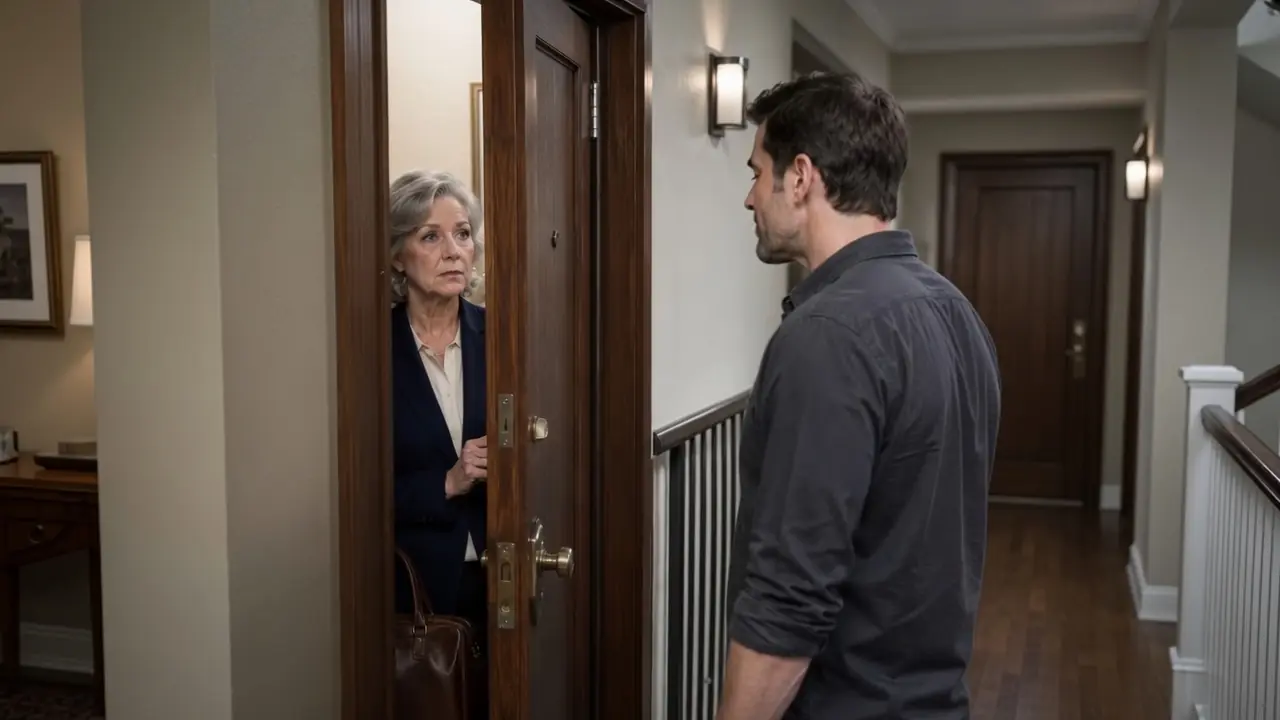
But when the hostess led her to the private dining room, Evelyn stopped just inside the doorway. The dinner was over. Fourteen empty plates sat across the long table, streaked with sauce and crumbs. Half-finished wine glasses caught the light, and dessert spoons rested beside folded napkins like the final act had already ended without her.
Everyone looked up at once, and for a second, nobody spoke. Logan sat near the head of the table in a charcoal suit, his face tightening the moment he saw his mother. Chloe, elegant in a pale satin dress, leaned back in her chair with a slow smile that carried no surprise at all. Evelyn’s fingers tightened around the gift bag as she looked from the empty plates to her son.
“Oh, Evelyn,” Chloe said, drawing out the words as if greeting a late employee. “You actually made it.”
Evelyn forced herself to breathe. “Wasn’t dinner supposed to start at six-thirty?”
Logan looked down at the table. “We moved it to five.”
“Nobody told me,” Evelyn said quietly.
A few relatives shifted in their seats, but nobody corrected Logan. Chloe reached into her designer purse and pulled out a long folded receipt. She slid it across the table with two polished fingers, as casually as if she were handing Evelyn a grocery list. “We figured you’d cover tonight’s bill,” she said.
Evelyn stared at the receipt before picking it up. The total was printed in dark ink at the bottom. $2,243.50. For a moment, she could only hear the low hum of conversation from the main dining room beyond the door.
Then Chloe smiled. “You’re basically the family ATM anyway.”
A few people laughed. Not loudly, not bravely, but enough. The kind of laugh people give when they want to please the cruelest person in the room. Evelyn looked at Logan, waiting for one word, one objection, one sign that the boy she had raised still remembered who she was.
He said nothing. He did not reach for the receipt. He did not tell Chloe to stop. He only stared at the table, jaw tight, as if silence could keep him innocent.
That silence did something the insult could not. It reached into Evelyn and broke a cord she had spent years pretending was still strong. Chloe had humiliated her, but Logan had allowed it. Permission from your own child cuts deeper than cruelty from anyone else.
Evelyn placed the gift bag on the edge of the table. Inside was the silver frame, wrapped in soft white tissue paper. She looked at the fourteen faces around the table and realized they had not invited her to celebrate love, marriage, or family. They had invited her wallet.
Without a word, Evelyn tore the receipt in half. Then she tore it again, and again, until the pieces fell over the white tablecloth like ugly confetti. Chloe’s smile vanished.
“Evelyn,” Logan said, finally speaking.
But it was too late. Evelyn set the torn pieces down, turned around, and walked out of the private room. Nobody followed her.
Outside, the evening air was cool and sharp. Evelyn stood under the restaurant awning for a moment, letting the noise of traffic steady her. She did not cry. Tears would come later, if they came at all, but right then she felt something colder than sadness.
Clarity.
It settled over her shoulders like a coat.
For years, she had called it helping.
Now she understood it had become feeding.
Logan and Chloe lived upstairs in the duplex Evelyn owned, rent-free. It had started as temporary help after Chloe lost her job and Logan’s commission checks slowed down. “Just six months, Mom,” Logan had said. That was six years ago.
Since then, Evelyn had paid for roof repairs, plumbing emergencies, new appliances, school supplies for the grandchildren, insurance gaps, car repairs, holiday gifts, and “temporary” cash transfers that were never mentioned again. She had covered utility bills when Chloe said they were short. She had bought groceries when Logan said things were tight. She had quietly handled problems so her son could keep feeling like he was standing on his own.
When Evelyn got home, she locked her apartment door behind her. The downstairs unit was small, neat, and warm, filled with bookshelves, framed family photos, and the soft ticking of an old wall clock. For the first time in years, she noticed how often she had left the door unlocked for Logan. He used to walk in without knocking, calling, “Mom, you home?” like the house still belonged partly to him.
That night, Evelyn turned the deadbolt and slid the chain into place.
Then she went to her office.
The gray binder sat on the second shelf, labeled in black marker: FAMILY SUPPORT.
As a retired bank manager, Evelyn documented everything.
She opened the binder and began adding. There were bank transfers, canceled checks, receipts, repair invoices, insurance payments, credit card statements, and handwritten notes taped to pages. Logan had once laughed and told her she kept records like the IRS was coming for Thanksgiving. Evelyn had laughed too, but she had still kept every page.
Car payments. Utility bills. Groceries. Medical copays. Furniture. School clothes. Birthday parties. Emergency plumbing. HVAC replacement. Roof patching. Yard cleanup. Phone bills. Gas money.
The calculator total climbed with each entry. Evelyn kept pressing the buttons, her face calm while her stomach slowly turned. When the final number appeared, she sat back and stared at it. $58,412.30.
Nearly sixty thousand dollars.
Not including rent.
Not including the value of the upstairs apartment.
Not including the cost of being taken for granted.
Her phone buzzed. Chloe’s name appeared on the screen. Evelyn almost ignored it, but then she opened the message.
“You embarrassed us tonight. Let us know when you’re ready to apologize.”
Evelyn read it twice. Then she laughed softly, not because anything was funny, but because the arrogance was almost impressive. Chloe had insulted her, handed her a bill, called her the family ATM in front of relatives, and still believed Evelyn was the one who owed an apology.
Within the hour, Evelyn canceled the automatic monthly transfers she had been sending to Logan’s account. She deactivated the emergency credit card Chloe carried for “family needs.” She removed Logan as an authorized user from two accounts and changed every password Chloe might have guessed. Then she blocked both of their numbers.
After that, she blocked the relatives who had laughed at the table. She did not make a public announcement. She did not post anything online. She simply closed the doors they had been using to enter her life whenever they wanted something.
For three days, the house was quiet. Logan and Chloe moved around upstairs, their footsteps sharper than usual, but neither came down. Evelyn made tea, worked in her garden, reorganized her pantry, and slept better than she had in months. She was surprised by the peace.
On the fourth day, the rumors began. An old neighbor named Mrs. Halpern stopped Evelyn by the mailboxes and asked gently if she was “feeling more like herself.” Evelyn smiled politely. “I beg your pardon?”
Mrs. Halpern flushed. “Chloe said there had been an incident at a restaurant. She said you seemed confused and emotional.”
“I see,” Evelyn said.
The lie did not shock her. What interested her was the speed of it. Chloe needed the world to believe Evelyn was unstable because the truth made Chloe look greedy. It was a familiar tactic, especially to someone who had spent decades working in banking and watching people dress financial dependence in respectable language.
That afternoon, Evelyn built a spreadsheet. Not the emotional binder, but a formal accounting document. It listed every dollar spent on the upstairs unit since Logan and Chloe moved in. Roof repairs, HVAC replacement, plumbing, landscaping, appliances, maintenance, insurance increases, pest control, and utility coverage.
She added rent estimates based on comparable apartments in the neighborhood. Six years of fair market rent. The number that appeared at the bottom made the restaurant bill look childish. Evelyn printed the spreadsheet, placed it in a clean folder, and waited.
The knock came a week later, just before eight in the evening. It was not polite. It was three hard hits against the apartment door, followed by the rattle of the handle.
“Mom,” Logan called. “Open up. We need to talk.”
Evelyn sat in her chair for a moment, listening.
He knocked again.
“Mom, Chloe couldn’t even put a deposit down on our new couch today.”
Evelyn stood slowly and walked to the door. She looked through the peephole and saw Logan in the hallway, one hand braced against the wall, his face tired and irritated. For the first time in his adult life, he could not simply walk into his mother’s home.
She unlocked the door but kept the chain in place. The door opened only a few inches. Logan blinked at the chain, then at her.
“Seriously?” he said.
“Yes,” Evelyn replied. “Seriously.”
“We need things back to normal.”
Evelyn looked at him through the narrow gap. “Normal for whom?”
Logan exhaled sharply. “Mom, this has gone too far. Chloe was embarrassed at the restaurant. Everyone was embarrassed.”
“I was embarrassed before I arrived,” Evelyn said. “I just didn’t know it yet.”
He looked away. “She shouldn’t have said that.”
“No,” Evelyn said. “She shouldn’t have. And you shouldn’t have let her.”
His face tightened. “I froze.”
“You watched.”
“That’s not fair.”
Evelyn’s eyes hardened. “Neither was a $2,243.50 bill handed to a woman who had not been allowed to eat.”
Logan rubbed his forehead. “Can we come inside and talk like adults?”
Evelyn unhooked the chain, opened the door, and stepped back. “We can talk like adults if you are ready to hear adult numbers.”
He entered, glancing around the apartment like it had changed. It had not. Evelyn simply no longer looked like someone he could interrupt. She pointed to the kitchen table where the folder waited.
Logan sat down. Evelyn remained standing.
She opened the folder and placed the first page in front of him.
“What is this?” he asked.
“An accounting.”
He scanned the page, frowning. His expression shifted from irritation to confusion, then to discomfort. Evelyn watched him reach the total. $58,412.30.
“That can’t be right,” he said.
“It is.”
“Mom, some of this was gifts.”
“No,” Evelyn said. “Some of it was framed as emergencies. Some of it was called temporary. Some of it was requested with tears. Some of it was demanded with silence. But very little of it was treated like a gift.”
Logan lowered the page. “Why are you doing this?”
“Because your wife called me the family ATM,” Evelyn said. “And for the first time, I realized she was only saying out loud what all of you had been treating as true.”
He flinched. “I never thought of you that way.”
“You benefited like you did.”
That landed. Logan sat back, his mouth opening slightly, then closing. For a moment, Evelyn saw the little boy who used to hide broken toys behind his back and hope she would not be disappointed. But this was not a broken toy. This was years of broken respect.
“What do you want from me?” he asked quietly.
“Rent,” Evelyn said.
His head snapped up. “What?”
“You and Chloe have lived upstairs for six years without paying rent. That ends next month.”
“Mom, we can’t afford market rent.”
“Then you cannot afford the apartment.”
Logan stared at her. “Are you evicting your own son?”
“I am giving my adult son thirty days to sign a lease, pay rent, or find another place to live.”
“That sounds like eviction.”
“It sounds like boundaries.”
He stood suddenly, anger returning because shame had nowhere else to go. “You’re punishing us because Chloe made one bad joke.”
Evelyn’s voice stayed even. “No. I am ending six years of unpaid dependence because your wife told the truth in the ugliest way possible.”
“She’s stressed.”
“So was I, when I worked forty years to build a retirement that your household has been draining one emergency at a time.”
Logan turned toward the door, then stopped. “You’re really doing this.”
“Yes.”
“What about the kids?”
“I love my grandchildren,” Evelyn said. “That is why I will continue contributing to their education accounts directly. But I will no longer send money through two adults who spend it before thanking me.”
Logan looked back at her. That answer stripped away the argument he had been preparing. He could not claim she was abandoning the children. She was protecting them from the same entitlement that had swallowed him.
He left without apologizing. Evelyn closed the door behind him and locked it again. Her hands shook afterward, but not from regret. From the strain of finally becoming someone she should have been allowed to be years ago.
The next morning, Chloe posted a vague message online about “toxic family members” and “protecting peace.” Evelyn saw it because a cousin sent it to her with three question marks. She did not respond. By noon, two relatives had called, but both went to voicemail.
By evening, Evelyn wrote a short letter. She sent it only to Logan and Chloe. It stated the new terms clearly. Lease agreement required. Rent due on the first of the month. Utilities divided fairly. No emergency credit cards. No monthly transfers. No unannounced entry into her apartment. No public lies about her health or mental state.
At the bottom, Evelyn added one final line. “Financial help without respect is not family support. It is permission to be used.”
Chloe answered first, from a new number. “You’re destroying this family over money.”
Evelyn read the message while standing by the kitchen sink. Then she blocked the number.
Logan emailed two hours later. “I need time to think.”
Evelyn replied, “You have thirty days.”
The house changed after that. Upstairs, there were arguments. Evelyn heard muffled voices, doors closing harder than necessary, furniture shifting as if Chloe were rearranging the world to regain control. Evelyn did not go upstairs. She did not listen at the ceiling. She went about her life.
On the tenth day, Logan came down again. This time he knocked once. When Evelyn opened the door, he looked different. Not fixed, not transformed, but tired in an honest way.
“Can I come in?” he asked.
“Are you here to blame me?”
“No.”
She let him in.
He sat at the kitchen table without being invited, then seemed to realize the mistake and stood again. “Sorry.”
Evelyn pointed to the chair. “Sit.”
He sat.
“I looked at the numbers,” he said. “The spreadsheet.”
“And?”
“And I didn’t know it was that much.”
Evelyn folded her hands. “You did not want to know.”
He nodded slowly. “Maybe.”
That “maybe” was small, but it was more than he had offered before. He told her Chloe was furious, that she believed Evelyn was trying to control them, that she had already called three relatives to tell them Evelyn had changed. Logan said the last part quietly, as if he were finally hearing how absurd it sounded.
“I did change,” Evelyn said.
Logan looked at her.
“I stopped paying for disrespect.”
His eyes filled then, unexpectedly. “I’m ashamed,” he said. “Not just about the dinner. About all of it.”
Evelyn did not rush to comfort him. She had learned that immediate comfort sometimes steals the lesson from pain.
“You should be,” she said.
He nodded, and one tear fell.
Over the next two weeks, Logan began moving through consequences. He sold his second car. He canceled a golf membership Evelyn had not known she was indirectly funding. He picked up consulting work on weekends. Chloe hated all of it.
At the end of the month, Logan signed the lease alone. Evelyn noticed Chloe’s name was not on it. She did not ask immediately. Logan slid the papers across the table and said, “She’s staying with her sister.”
Evelyn looked at him for a long moment. “And you?”
“I’m staying upstairs for now,” he said. “If that’s still allowed.”
“If you pay rent, follow the lease, and knock before entering my home, yes.”
He almost smiled, but it broke into something sadder. “That seems fair.”
Months passed slowly. Logan paid rent on the first. Sometimes he left the check in the mailbox with a short note. Sometimes he brought it downstairs and stayed for coffee. They did not return to what they had been, but Evelyn no longer wanted that version.
One Saturday, her grandson Noah came downstairs carrying a school project. “Grandma, Dad says we have to ask before coming in now.”
Evelyn smiled. “That’s right.”
“Can I come in?”
“You may.”
He stepped inside with great seriousness, as if entering a museum with rules.
That small moment meant more to Evelyn than any apology Chloe could have performed. Respect had to be taught somewhere. If Logan was finally teaching it at her door, then perhaps some good had come from the night everything snapped.
Chloe returned once, two months later, standing in the hallway with crossed arms and a mouth full of unfinished accusations. Evelyn opened the door halfway, the same way she had opened it for Logan that first night. Chloe looked at the chain lock and laughed bitterly.
“You really think you won,” Chloe said.
Evelyn studied her. “No, Chloe. I think I stopped losing.”
“You made Logan choose.”
“No. I made Logan pay rent.”
Chloe’s face reddened. “You’re cold.”
“I was warm for years,” Evelyn said. “You mistook it for weakness.”
Chloe had no answer that could survive the truth. She left without saying goodbye. Evelyn closed the door and felt no need to lock it quickly this time. She still turned the deadbolt, but not from fear.
A year after the restaurant dinner, Evelyn met Logan for lunch at a small cafe near the park. He arrived early and stood when she came in. It was such a simple gesture that it almost made her cry.
“I ordered after you got here,” he said.
Evelyn sat across from him. “Good choice.”
He looked embarrassed, but he smiled. “I learned from my mistakes.”
“Some of them,” she said.
He laughed softly. “Some of them.”
Halfway through the meal, Logan took an envelope from his jacket. Inside was a check. Not for everything, not even close, but enough to matter.
“It’s the first repayment,” he said. “I know I can’t fix all of it fast.”
Evelyn looked at the check, then at her son.
“No,” she said. “You can’t.”
His face fell slightly.
“But you can keep going.”
He nodded. “I will.”
For the first time in a long time, Evelyn believed him.
That evening, Evelyn returned to her apartment and opened the gray binder. She did not remove the records. She did not tear them up or pretend the past had not happened. Instead, she added a new section labeled REPAYMENTS.
The first check went there, copied and dated. Beneath it, she wrote one sentence in careful handwriting. “Respect began when the door stayed locked.”
Then she made tea and sat by the window as the upstairs floorboards creaked gently above her. The sound no longer felt like someone taking over her life. It sounded like a tenant moving through his own responsibilities.
Evelyn had lost the illusion that love meant endless rescue. She had lost the comfort of pretending her son’s silence did not hurt. She had lost the role of family ATM, emergency fund, invisible landlord, and woman everyone expected to forgive before anyone apologized.
But she gained something quieter and stronger. A locked door. A clear ledger. A son learning late, but learning. A home that finally belonged to her again.
And if anyone asked what changed that night, Evelyn would not mention the bill first. She would mention the moment Chloe laughed, Logan stayed silent, and fourteen people waited for an old woman’s credit card. Then she would smile and say the truth plainly.
“The machine stopped working because the woman finally woke up.”