The snow had been falling since before dawn. Soft, quiet, indifferent. The kind of snow that settled over everything, chimneys, hedgerows, stone garden walls, and made the world look clean, peaceful, like nothing terrible could ever happen in it. It lied.
Sophia Hurst stood at the edge of the upper balcony of Ashford Manor, the family estate where she had once played as a child, where her father had once laughed with her, where everything she loved had slowly been taken from her. The morning air was sharp. Her breath came out in small, white clouds. Her hands, gloved, trembling, rested on the curve of her belly.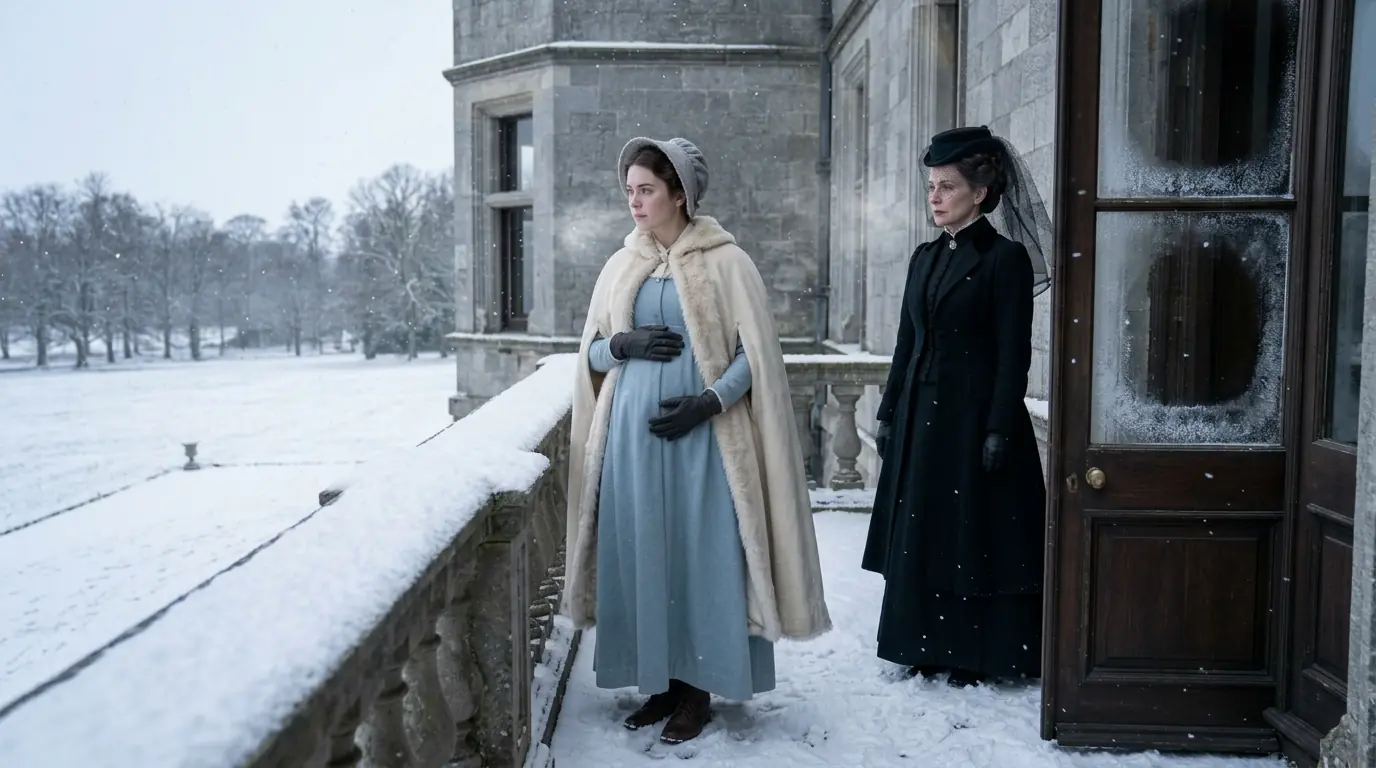
Seven months along. Seven months of carrying the most important thing she had left. She had come back for the reading of her father's will. But Victor Charlton was gone three weeks now, and the estate had grown cold in a way that had nothing to do with winter.
Charlotte Charlton moved through every room like she already owned it, like she had already won. Sophia had felt it the moment she arrived. The way Charlotte's eyes swept over her swollen belly, not with warmth, not even with indifference, with calculation. She had told herself she was imagining it.
She was not imagining it. Behind her, she heard footsteps, unhurried, certain. She turned, and there was Charlotte, dressed in black, always in black these days, gloved hands clasped in front of her. That particular stillness about her that Sophia had learned to fear more than any raised voice.
"You should not be out here in the cold. " Charlotte said. "Not in your condition. " The words were gentle.
The eyes were not. "I needed air. " Sophia replied. "Of course you did.
" Charlotte stepped closer. "You always did prefer to be alone. " Sophia turned back to the grounds below. The drive was empty.
The snow was undisturbed. She thought about her father. The real Victor Charlton. The man before Charlotte had sunk her influence into him.
And she thought about the will reading scheduled for 11:00. And she thought about her unborn daughter. And she told herself that in a few hours everything would be settled. She felt the hands a half second before they made contact.
Flat. Deliberate. Between her shoulder blades. No stumble.
No accident. A push. The world tilted. The balcony railing caught her hip.
Not enough. And then the cold air swallowed her completely. And she was falling. And four floors of Ashford Manor rushing past her in a blur of gray stone and white snow.
And the only thought in her mind. The only thing that existed in the entire world in that moment was my baby. "My baby. " Please, God.
She did not scream. There was no air to scream with. She clutched her belly with both hands and braced for the end. Above her on the balcony she had just left, Charlotte Charlton stood at the railing.
She did not cry out. She did not call for help. She watched Sophia fall the way a person watches a clock waiting for it to finish. Then, impact, but not the ground.
And then a voice, deep, urgent, close. "Someone get Alfie Clayton. Now, move. " Alexander Blackwood, the Duke of Bedford, had not intended to be at Ashford Manor that morning.
He had ridden out from the inn at Greywood at first light, not for sentiment, not for nostalgia, but to inspect the eastern boundary of his own landholdings, which ran adjacent to the Charlton estate. A tenant dispute, fence lines, the sort of tedious grinding business that came with a dukedom nobody had asked for. His carriage was the nicest thing on that road at 6:00 in the morning. Lacquered black, brass fittings, a matched pair of dark bays.
His coachman, old Thomas, had slowed to navigate the slick bend near the manor gates when the thing fell out of the sky. That was the only way Alexander could describe it later, when he tried to describe it at all. A woman falling, arms wrapped around her belly, white gown spreading like wings. Thomas had no time to stop the horses.
The figure struck the carriage roof squarely, a sound like the world splitting open, and the whole rig lurched sideways before Thomas hauled the reins and brought the bays under control with the kind of calm that only very old, very experienced coachmen possess. Alexander was out the door before the carriage stopped moving. She had slid from the roof to the running board to the snow. She lay there, pale as the ground beneath her, utterly still.
One gloved hand still pressed against her belly. Her hair was everywhere, dark against the white. Her gown, fine wool, lace at the collar, was torn at the sleeve. He dropped to his knees beside her.
"Can you hear me? " He pressed two fingers to her throat, a pulse, rapid but there. "Someone get Alfie Clayton. Now.
Move. " His man, Reeves, was already running toward the manor gate. Alexander looked at the woman's face and stopped breathing. He had not seen Sophia Hurst in four years.
She had been a girl of 21 when he last looked at her. "No. " Not a girl. That was never fair.
She had been composed and bright and entirely herself, and losing her had been the quietest devastation of his adult life. He had not known she was married. He had not known she was with child. He had not known she was here.
He had not known until this moment how much none of that mattered compared to the fact that she was breathing. Sophia. His voice came out rougher than he intended. He took her hand, the one at her belly, and held it.
"Sophia, stay with me. " Her eyelashes fluttered. Her lips moved. No sound.
Don't try to speak. He looked up the face of the manor wall, four floors, and something cold and precise settled in his chest. This was not an accident. No one fell from a balcony like that.
No one landed with their hands still pressed to their belly, still trying to protect something, unless they had known they were falling long enough to choose. She had chosen her child over bracing herself for impact. He looked at the balcony above. A figure in black stood there, quite still, quite composed, looking down.
Then the figure stepped back from the railing and disappeared inside. Alexander filed that away. Every detail of it. Alfie Clayton arrived with his black bag and his unflappable manner, 12 minutes after Alexander's man knocked on the servants' entrance of Ashford Manor.
He was young for a physician, barely thirty, with spectacles that perpetually slid down his nose, and the careful, methodical hands of a man who had seen a great deal and learned not to flinch. He had served the Charlton household for two years, which he had found increasingly to be a complicated position. He crouched beside Sophia in the snow, worked quickly, and then looked up at "Alexander. " "We need to move her, carefully, to the carriage.
Can you clear the back seat? " "Already done," Alexander said. They brought her inside, not into the manor, which Alexander refused to allow, but to the Greywood Inn, three miles down the road, where two clean rooms were secured, and the innkeeper's wife, a stout woman named Mrs. Barber, took charge of warming them.
Edward Barber, her son, stood in the corridor with his hat in his hands and asked if there was anything he could do. "Keep everyone away. " Alexander told him. "Everyone from that manor, especially.
" Edward nodded and stationed himself at the bottom of the stairs without another word. Alfie worked for two hours. He came out of the room with his sleeves rolled to the elbow and found Alexander standing at the window. Still in his coat, still in his riding gloves, not having moved.
"She is alive," Alfie said, "fractured left wrist, two cracked ribs, bruising along the entire left side. By all logic," he paused, "by all logic, the fall should have done considerably more damage. The carriage roof absorbed most of the force. She is fortunate beyond what I can account for medically.
" "And the child? " Alexander kept his voice even. Alfie removed his spectacles and polished them. A habit Alexander had already noticed that the physician employed when gathering himself.
"The child is alive. Heartbeat strong. I have concerns as one always has in situations of significant physical trauma and she must remain completely at rest. But," he put his spectacles back on.
"She is seven months. The child is well positioned. I am cautiously hopeful. " Alexander exhaled just once.
Then he nodded. "She will ask for her husband when she wakes. " Alfie said, watching Alexander carefully. "No.
" said "Alexander. " Alfie raised an eyebrow. "Her husband," Alexander said, "is Dominic Hurst, the Duke of Redmond. " He is, from what I know of him, not a man she should be reaching for right now.
A pause. "I see. " said Alfie quietly. And from the expression that crossed his face, careful, professionally neutral, it was clear that he already knew more than he had said.
Sophia woke three hours later. The first thing she did was press her hand to her belly. The second thing she did was cry. Not aloud, not with drama, but the deep, helpless way people cry when they have been holding something too long, and the body simply releases it.
Mrs. Barber sat beside her and held her hand and said nothing, which was exactly right. When the tears slowed, Sophia looked toward the window. "Where am I?
" "Greywood Inn, Your Grace. " Mrs. Barber's voice was warm and direct. "You are safe.
The physician has seen you. Your baby is safe. " Sophia closed her eyes. Two words moved across her lips, soundless.
"Thank God. " Then her eyes opened again, and behind them was something else. Something that had not been there before the fall, or perhaps had always been there, quietly waiting. Clarity.
She learned he was there when Alfie came to check on her that evening. He mentioned it carefully, professionally, with the tone of a man who knew he was stepping into something larger than medical notes, that the Duke of Bedford had arranged the rooms, had refused to leave the inn, and had asked after her twice. Sophia was quiet for a long moment. "Alexander Blackwood.
" She he Not a question. "Yes, Your Grace. " She turned her face toward the window. The snow was still falling outside, softer now.
The last gray light of the afternoon dissolving into dusk. She thought about the last time she had seen him. Four years ago, a drawing room in London. The formal goodbye that had not been formal at all on her end, that had cost her more than she had ever told anyone.
She had not chosen to leave him. She needed to be fair to herself about that, even now. She had not chosen any of it. Charlotte had managed everything.
It had begun two years after Victor Charlton had married Charlotte. Sophia was 17 then and grieving her mother and not yet capable of seeing what Charlotte was doing. Charlotte had moved quietly, methodically, the way she did everything. She had found Alexander Blackwood, the Duke of Bedford, young, wealthy, but already well-regarded.
And she had decided that he was the wrong match for her stepdaughter. Not because he was unsuitable, precisely because he was not. A man like Alexander, principled, sharp-minded, genuinely devoted, would never be managed, would never be guided, would take Sophia out of Charlotte's orbit entirely and leave Charlotte with no hold over the Charlton estate at all. So, Charlotte had found Dominic Hurst instead.
He was a duke, which satisfied propriety. He was handsome enough, which satisfied appearance. And he was, beneath the title and the address, weak in the particular way that people with fragile egos are weak, easily flattered, easily wounded, easily led. Charlotte had seen it in five minutes.
She had spent the next eight months working on Victor Charlton until he believed that the match was his own idea. But Sophia had been 22 when they married. She had stood at that altar and told herself it was fine. It was duty.
It was sensible. She had told herself a great many things in the years since. Dominic was not cruel in the way stories warned you about. Not loud, not violent, not obvious.
He was cruel the way neglect is cruel. The cold rooms, the canceled engagements, the way he looked through her at dinners as if she were part of the furniture he had stopped noticing. And behind it all, always, Charlotte's hand. A word in his ear here, a letter there, a quiet suggestion that Sophia was difficult, ungrateful, beneath the attention he was giving her.
Sophia had endured it until she found out she was expecting, until something shifted in her, some deep, immovable thing, and endurance no longer felt like enough. She had come to Ashford Manor for the will reading, telling herself it was the last piece. After this, she would take what was hers, and she would build something for herself and her child, and she would be free. Charlotte had apparently had the same thought and arrived at the opposite conclusion.
Charles Franklin arrived at the Greywood Inn the following morning. He was the magistrate of the county, a broad-shouldered man of 60 with a white beard and the particular steadiness of someone who had spent four decades watching people lie to him and had gotten very good at spotting it. He had been notified of the incident by Edward Barber, who had sent word the previous evening. Alexander received him in the downstairs sitting room over tea that neither of them drank.
"You were present at the scene," Charles said. "She landed on my carriage," Alexander replied. "I was the scene. " Charles wrote something in his notebook.
"And you observed the balcony. " A woman in black standing at the railing watching. She withdrew when I looked up. " "You can identify her?
" "Charlotte Charlton," Alexander said. "Stepmother of the woman who fell. Widow of Victor Charlton. Resident of Ashford Manor.
" Charles put his pen down briefly. Then he picked it back up. The will reading proceeded that afternoon by necessity in the inn's dining room with Sophia propped against pillows on a daybed that Mrs. Barber had carried downstairs herself.
Alfie stood at the back of the room. Edward Barber stood near the door. Alexander stood near Sophia, not beside her, not close enough to be remarkable, but close enough that she could see him if she turned. She did not turn.
But she knew he was there. Charlotte arrived with her daughter, Lucy Morris, a pale, delicate girl of 19 who had her mother's eyes and, it seemed, her mother's habit of revealing nothing. They sat across the table. Charlotte's expression was composed, the expression of a woman who had prepared for this.
The solicitor was a thin man named Hargreaves, who read quickly and without inflection, which was perhaps merciful. Victor Charlton, the document stated, had left the London townhouse and an annual income to Charlotte sufficient for a comfortable life. He had left a modest sum and the personal effects of her rooms to Lucy. He had left the entirety of the Ashford Manor estate, the landholdings in three counties, the Charlton family investment accounts, and 80% of his liquid assets to his daughter.
To Sophia. The room was very quiet. Charlotte's composure did not crack. It simply went very, very still, but the kind of stillness that precedes something.
Lucy looked at her mother. Sophia looked at the document in Hargreaves's hands and thought, "He knew. " Whatever else Charlotte had done to him, whatever hold she had over him in those final years, he had known enough to do this. He had been trying, in the only way left to him, to protect his daughter.
She felt a grief so clean and sudden it nearly took her breath away. "My father," she said, and her voice held steady. "was a good man. " No one responded.
But across the table, Charlotte's gloved hands tightened just slightly on the arms of her chair. The investigation moved deliberately, the way proper things move when the person directing them knows what they are doing and is not in any hurry to be wrong. Charles Franklin was methodical. He spoke to everyone.
He wrote everything down. Or he asked the same questions multiple times in multiple ways and listened for the spaces between the answers. He came to Sophia on the third day. She was sitting up by then, ribs still aching, wrist splinted, but upright, which felt like a small, significant victory.
Alexander had arranged for a maid to come from Greywood Village, and Mrs. Barber continued to appear at intervals with broth and biscuits and brisk, cheerful reports on how well the weather was clearing. Charles sat across from Sophia and asked her, gently and without drama, to tell him everything she knew. She told him.
She started not with the balcony, but with the beginning. Charlotte arriving at Ashford Manor as her father's wife, the slow erosion of Victor Charlton's independence, the engineering of her marriage to Dominic Hurst, the years of quiet diminishment. Yet, she told him about Dominic, not with anger, which surprised her, but with the flat clarity of someone describing a weather pattern. He was what Charlotte had made of him.
He had not been strong enough to choose otherwise. "He knew she was pushing him toward cruelty," Sophia said. "I think some part of him did. He simply found it easier to comply.
" Charles wrote that down. He had already, he told her, spoken with two members of Ashford Manor's senior staff. Both had given accounts that aligned with hers, Charlotte's management of the household, her influence over Victor in his final year, her insistence on controlling who had access to him. One of them, an older housemaid named Henry, who had served the Charlton family for 30 years and was apparently done protecting anyone in it, had provided written testimony voluntarily.
"Poor Henry," Sophia said, surprised. "31 years of service," Charles said, almost warmly. "He said, and I am quoting here, that he would not spend 32 in the employ of someone who pushed a pregnant woman off a balcony and then went in for breakfast. Sophia almost laughed.
It surprised her. The laugh. The fact that she could still find something like it. Then Alfie Clayton submitted his report.
It was precise, thorough, and written in the careful language of medicine, which somehow made it more damning than plain anger could have. The injuries were consistent with a directed fall from a height, not a stumble, not an accident. The force and trajectory indicated a push. The position of Sophia's fractures told a story, Alfie wrote, and it was not the story of a woman who lost her footing.
Charlotte, for her part, had told Charles she had been in her rooms all morning. Lucy Morris had confirmed it. Olivia Craig, the parlor maid who had been polishing the third floor sconces, had also confirmed something. She had seen Mrs.
Charlton step onto the upper balcony at approximately half past six. She had said nothing until Charles Franklin asked her directly, at which point she had answered without hesitation, and then asked quietly if she was going to lose her position. Charles told her that her position was the least of anyone's concerns. The day Dominic Hurst arrived at Greywood, it had been a week since the fall.
He rode up to the inn's door in his own carriage, the Redmond crest on the door, the horses perfectly matched, and the sight of it made Sophia's stomach tighten in a way that had nothing to do with the baby. She had been warned he was coming. Alexander had told her that morning, standing just inside the doorway of her room, hat in hand, not presuming anything, which was somehow more reassuring than anything confident he might have said. "You don't have to see him," Alexander said.
"You don't have to do anything you don't choose. " She looked at him for a moment. Four years. She had spent four years telling herself that what she had felt for him was youth, was sentiment, was the kind of feeling that didn't survive real life.
She was beginning to think she had been remarkably, spectacularly wrong. "I'll see him," she said. Dominic came in looking the way he always looked, handsome, polished, slightly wounded in a way he seemed to wear as an identity. He stopped when he saw her.
His eyes went to the splint on her wrist, to the careful way she was sitting, to her belly. Something crossed his face. It was not what she expected. It was not anger, not calculation.
It was something closer to shame. "Sophia—" "Don't. " Her voice was quiet, firm. "Don't apologize for her.
Don't explain her. Don't tell me you didn't know. " He sat down heavily in the chair across from her. For a long moment he said nothing.
"I knew she didn't like you," he said finally. "I knew she managed things. I told myself it was just" He stopped. "I told myself it wasn't serious, that she was merely protective of her position.
" "She pushed me off a balcony," Sophia said. "I was seven months pregnant. " He flinched. She watched him do it.
She felt no satisfaction, only the clear, settled recognition that whatever she had once hoped he might become, she was done waiting for it. "I will cooperate fully. " Dominic said. "Whatever Franklin needs from me, I will tell him everything I know about Charlotte.
"All of it. " It was, she supposed, the most useful thing he had ever offered her. "Thank you. " She said.
And she meant it, even if she could not make it warm. The thing about speaking the truth after years of silence is that it does not feel like relief at first. It feels like dismantling a house you have lived in. The walls come down, the rooms open to sky.
And for a moment, you just stand in the rubble and wonder what on earth to do next. Sophia had always been careful with her words. Years of Charlton's household had trained her to it. The constant awareness that the wrong sentence, the wrong tone, the wrong moment of visible feeling could be weaponized later, could become something that was turned back on you.
She had learned to speak in managed portions, to hold the rest behind her teeth. When Charles Franklin asked her to give a full formal account, not just a conversation, but a document in her own words that would be entered into the proceedings, she sat for a long time with the blank paper in front of her. Then she picked up the pen and began. She wrote for three hours.
She wrote about Charlotte's arrival in the Charlton household and the thing that changed in her father after it. The way his opinions slowly became Charlotte's opinions. The way his decisions began to bear Charlotte's fingerprints. She wrote about the demolition of her engagement to Alexander Blackwood, how it had been managed so smoothly, she had believed for a year that it was simply circumstance.
She wrote about the marriage to Dominic and the marriage within the marriage, the one Charlotte had arranged from the outside, the cold rooms, the missing attention, the years of being made to feel like a nuisance in her own home. She wrote about the morning of the will reading, the balcony, the hands between her shoulder blades, the choice in free fall to curl around her child. She did not write with anger. She had been angry privately for a very long time.
Anger was familiar territory. This was different. This was testimony. When she finished, she read it back once.
Then she signed it, folded it, and sent it downstairs with Edward Barber, who was still, remarkably, stationing himself at various points in the building as though he had decided personal security was his calling. That evening, Alexander knocked on her door. He did not come in. He stood in the corridor with a small bunch of winter roses, white from the innkeeper's garden, slightly frost-damaged and entirely impractical, and held them out with the expression of a man who was not entirely sure of his welcome, but had decided the uncertainty was worth it.
"Mrs. Barber told me you like white flowers," he said. "Mrs. Barber has been conspiring against me," Sophia said.
But she took the roses. He smiled. It was the same smile she remembered. It had not changed at all, which seemed impossible and was also the most destabilizing thing about this entire situation.
"How are you sleeping? " he asked. "Better than expected," she said. "You?
" "Not especially. " He glanced down at his hat, which he was turning in his hands. "I find myself checking the corridor at odd hours. " She understood what he meant, that he was making sure no one came.
"Alexander. " She said his name carefully, feeling the weight of it. "Thank you. " "For everything.
" "All of it. " He looked up. "I didn't know it was you," he said, "when I jumped out of the carriage. " I want you to know that.
I would have done it for anyone, but knowing it was you. " He stopped. "I'm very glad the carriage was there. " She looked at him for a moment that stretched just slightly past comfortable and settled into something honest.
"So am I. " She said quietly. Charlotte was summoned to a formal hearing at the Greywood Courthouse on a Thursday morning, 12 days after the fall. She arrived in her black carriage, Lucy Morris beside her, and walked into the building with the posture of a woman who had decided, whatever the circumstances, to maintain the performance.
The gray wool coat, the pinned hair, the expression that said nothing while suggesting everything was beneath her. She had retained a solicitor from London, a clever man named Geoffrey Slade, who had the confident, well-fed look of someone accustomed to making problems disappear. He was about to have a difficult morning. The hearing room was full.
That was the first thing that surprised Charlotte visibly, the number of people in the room. This had not, she had presumably calculated, been meant to become a public matter. Charles Franklin presided from the head of the room. Alfie Clayton sat with his report in front of him.
Olivia Craig was in the third row, hands folded, face determined. Henry, the housemaid who had served 31 years and was apparently done with all of it, sat in the second row with written testimony already submitted. Edward Barber stood near the wall. Dominic Hurst sat near the back, quiet, pale, while looking like a man who had recently taken stock of himself and found the inventory unsatisfactory.
Alexander Blackwood sat beside Sophia, not close enough to touch, close enough that she was not alone. Charles began methodically. He presented the timeline. He presented Alfie's medical report.
He presented Olivia Craig's account. The balcony, the time, the figure in black stepping onto it. He presented Henry's written testimony about Charlotte's management of Victor Charlton in his final months. The restricted visitors, the controlled correspondence, the steady erosion of the man's own judgment.
Charlotte's solicitor objected at intervals. Charles acknowledged each objection and continued. Then Charles turned to Charlotte directly. "Mrs.
Charlton," he said, "you stated that on the morning of the 24th, you were in your rooms from rising until breakfast. That statement has been contradicted by the testimony of a household employee who observed you on the upper balcony at half past six. It has been further contradicted by the medical evidence regarding the nature of the injury sustained. What do you say to this?
" Charlotte's expression did not change. "I say," she said very clearly that a serving girl's account and a young physician's speculation do not constitute evidence. In the third row, Olivia Craig's jaw tightened, but she said nothing. She had already said everything she needed to say.
Then Charles said, "I would also like to enter into the record a statement from Dominic Hurst, the Duke of Redmond. " Charlotte turned very slightly toward the back of the room. Dominic did not look at her. He looked at his hands a lot and then at Charles, and then he read his statement in a flat, steady voice that was, Sophia thought, probably the most courageous thing he had managed in years.
He described Charlotte's systematic influence over him since his marriage to Sophia. The letters she had sent suggesting how to handle his wife, the conversations that had shaped his behavior, that had made him cold and distant and compliant with Charlotte's plan to make Sophia miserable enough to leave, or to simply stop mattering. He described the moment 3 months before the fall when Charlotte had said with chilling directness that it would be a great deal simpler for everyone if Sophia did not have the child. The room was very quiet.
Charlotte's solicitor said in a strained voice, "Your Honor," "this is hearsay. " "It is a duke's sworn account," Charles said simply. Hargreaves kept writing. The verdict was not dramatic.
That was the thing Sophia had not anticipated. She had imagined it would feel like a thunderclap, some loud, conclusive moment with weight to it. What it actually felt like was the gradual removal of something very heavy that you had been carrying so long you had stopped noticing its weight until it was gone. Charles Franklin delivered his findings on a Friday afternoon, 11 days after the hearing.
Charlotte Charlton was formally charged with attempted murder. The evidence, the testimony of Olivia Craig, the medical account of Alfie Clayton, the corroborating statement of Dominic Hurst, Alexander's account as a direct witness to the aftermath, and Sophia's own formal testimony was, in Charles's considered view, more than sufficient to proceed, She would be remanded to custody pending trial. Charlotte stood and heard this with the same composed expression she had worn throughout. But something had gone out of it.
The performance was still there, but there was no one behind the eyes performing it with any real conviction anymore. When the constables moved toward her, Lucy Morris stood up suddenly. "Mama. " Charlotte looked at her daughter.
Something passed across her face that was, briefly, entirely unguarded. A real thing. Possibly the only real thing she had allowed herself in years. "Sit down, Lucy.
" she said, very quietly. "This is not your part to play. " And then she walked out with the constables, and the room let out a collective breath. And that was that.
Dominic approached Sophia afterward. He looked, she thought, looked like a man who had been taken apart and was not entirely sure what the rebuilt version would be. "I know an apology is not sufficient. " he said.
"No. " she agreed. "but thank you for the truth. It mattered.
" He nodded. They looked at each other. Not enemies, exactly. Not strangers, entirely.
But something that had to no clean name and needed none. "I will not contest the legal arrangements. " He said, "Whatever you require. I have spoken with my solicitor.
" "I know. " Sophia said. "Charles told me. " He nodded once more, put on his hat, and left.
She watched him go and felt a nothing but a mild, impersonal sadness. The kind you feel not for a person, but for a story that could have gone differently and didn't. Behind her, she heard Alexander's voice. "Are you all right?
" She turned around. He was standing three feet away. Coat collar up against the January cold coming through the courthouse door, watching her with the careful attention he had maintained since the day she landed on his carriage. Not pressing.
Not asking for anything. Just present. "I'm better than I've been in years. " She said.
And she meant every word of it. Eleanor Sophia Hurst came into the world on the 14th of February, which nobody had planned for, and which Mrs. Barber declared loudly to be the most romantic thing she had ever personally witnessed. She was eight pounds, six ounces, and entirely healthy, which Alfie Clayton pronounced with the particular satisfaction of a physician who had worried about something for weeks and been proven wrong by the best possible outcome.
"Strong heartbeat. " He said, for the third time, to no one in particular. "Strong. " But Sophia held her daughter and understood for the first time what it was to feel completely certain.
Not happy in the giddy surface way, though that was there, too, burning clean and bright in her chest, but certain. Like every single thing that had happened, every hard year, every cold room, every morning she had endured, it had all been the road to this room, this moment, this small, warm weight in her arms, looking up at her with her father's dark eyes. Victor Charlton's eyes. Her father's eyes.
She pressed her lips to Eleanor's forehead. "We're going home," she whispered. "Ashford Manor is ours. We're going home.
" Alexander was in the corridor when Alfie came out to tell him. He was doing the thing he had been doing for seven weeks, standing a respectful distance from whatever room Sophia was in, maintaining a steady, undemanding presence that the entire Greywood village had noticed and made various knowing comments about. He took the news with a composed expression that lasted approximately 4 seconds before something lit behind his eyes that he did nothing to conceal. "Both well?
" he asked. "Both exceptionally well," Alfie said. And then, because he was a physician and not entirely without humor, "You may go in, Your Grace. " I think the patient would like to see you.
" He knocked. He came in quietly, hat in hand, and stopped two feet inside the doorway. Sophia looked up at him. She was tired, brilliantly, genuinely tired, the honest exhaustion of someone who had done something enormous, but her eyes were clear and she was smiling, which was the most complete thing he had seen in years.
"Come and see her," Sophia said. He came over. He looked at Eleanor, this small, serious person with her dark eyes and her perfect miniature fingers, and felt something happen in his chest that he had no interest in being reasonable about. "She has your eyes," he said.
"She has my father's eyes," Sophia said. "He would have loved her. " "He'd have been very proud of you," Alexander said quietly. She looked at him.
He looked at her. Eleanor made a small, inconclusive sound and waved one fist. "Alexander," Sophia said. "I have been thinking.
" "That seems consistent with your character. " "I have been thinking," she continued with dignity, "that Ashford Manor has a great deal of room. It is a large estate, and I understand that the Duke of Bedford's landholdings border the Charlton estate on the eastern side. " He studied her face.
A slow smile. "That's true," he said. "The boundary runs along the old mill creek. It would be practical," she said, "for someone with interests on both sides of that boundary to have a reason to be around frequently.
" "Practical," he agreed. "Very sensible. " "Good. " She held Eleanor a little closer.
"I thought you'd see it that way. " He laughed. She laughed. Eleanor opened her eyes wide at the sound of it.
And in the corridor outside, Mrs. Barber, who had definitely been listening, made a satisfied sound and went to put the kettle on. But the trial of Charlotte Charlton concluded on a warm afternoon in July. The verdict was guilty.
The sentence, delivered by the presiding judge with the brisk efficiency of a man who had seen enough equivocating in his career and was not interested in more, was five years imprisonment and the permanent revocation of any remaining claims to the Charlton estate. Charlotte received it the way she received most things, without visible expression. Whatever she felt, she kept it behind her composure until the end. It was, Sophia thought, listening to the verdict from the public gallery, possibly the most consistently maintained performance of her life.
She could not even find it in herself to be angry about it anymore. Anger required energy she had better uses for. Lucy Morris had, in the weeks following the hearing, written Sophia a letter. It was careful and short and full of the kind of language people use when they are trying to separate themselves from something they should have separated themselves from much earlier.
She said she had not known. Sophia believed her, mostly. Lucy had not known the full extent. She had known enough to look away, which was its own accounting to live with.
Sophia wrote back. She was not warm, but she was fair, which was more than the situation strictly required, and she thought more than sufficient. Dominic Hurst had removed himself to his estate in the north. The legal dissolution of their marriage had proceeded without contest, as he had promised.
He had sent a gift for Eleanor, a small silver rattle, monogrammed, and a note that said nothing much, but said it sincerely. So, Fear had put the rattle in Eleanor's room and wished him, but in the private inventory of her heart, a better second attempt at his own life than his first. Ashford Manor in summer was something she had forgotten. The roses along the eastern wall, the way the light came through the library windows in the late afternoon, the kitchen garden her mother had planted, which had been badly neglected, and which she was in the process of restoring with an attention that felt, she thought, like a conversation with someone she had lost.
Eleanor was five months old, opinionated about everything, and the clear, unchallenged center of the entire household's universe. Mrs. Barber, who had relocated from Greywood Inn to become Ashford Manor's housekeeper with the decisive efficiency of a woman who knows when something is meant to be, declared her the finest baby she had encountered in 60 years, which was possibly hyperbole and possibly not. Alexander came to Ashford Manor on a Thursday evening in late July, as he had come most Thursdays since March, ostensibly to review the boundary matters he had been reviewing for months, and actually to have dinner and sit in the garden and talk for three hours about everything and nothing, the way people talk when they are both aware of something large between them and are content for the moment to approach it at the pace of something real.
He had Eleanor in his arms. She had decided with her customary authority that she approved of him when he said quietly that he had been thinking about something. "That also seems consistent with your character," Sophia said. He laughed.
He looked at Eleanor, who was examining his coat button with the concentration of a scholar. Then he looked at Sophia. "I would like," he said, "to ask for something that I should have asked for four years ago and didn't. Not because I didn't want to, because it was taken from both of us before I had the chance.
" She looked at him steadily. Her hands were still in her lap. The garden was very quiet around them. "I'm asking now," he said, "if you'll let me." She was quiet for a moment. Then, "You're already here every Thursday," she said. "I'd like to make the rest of them as well." She reached over and took Eleanor back from him.
Eleanor objected briefly, then reconsidered and settled. "Ask me properly," Sophia said. "Eleanor should hear it done correctly." He knelt in the garden of Ashford Manor with the roses along the wall and the last of the summer light going gold in the sky.
Alexander Blackwood, the Duke of Bedford, had asked Sophia Hurst, the Duchess who had fallen from a balcony and landed on his carriage and survived everything that should have broken her, if she would do him the profound honor of becoming his wife. Eleanor considered the situation and appeared to find it acceptable. Sophia said yes.
END