Hershey is still waiting for a permanent home, and his stainless-steel food bowl has somehow become one of the most recognizable parts of his daily routine.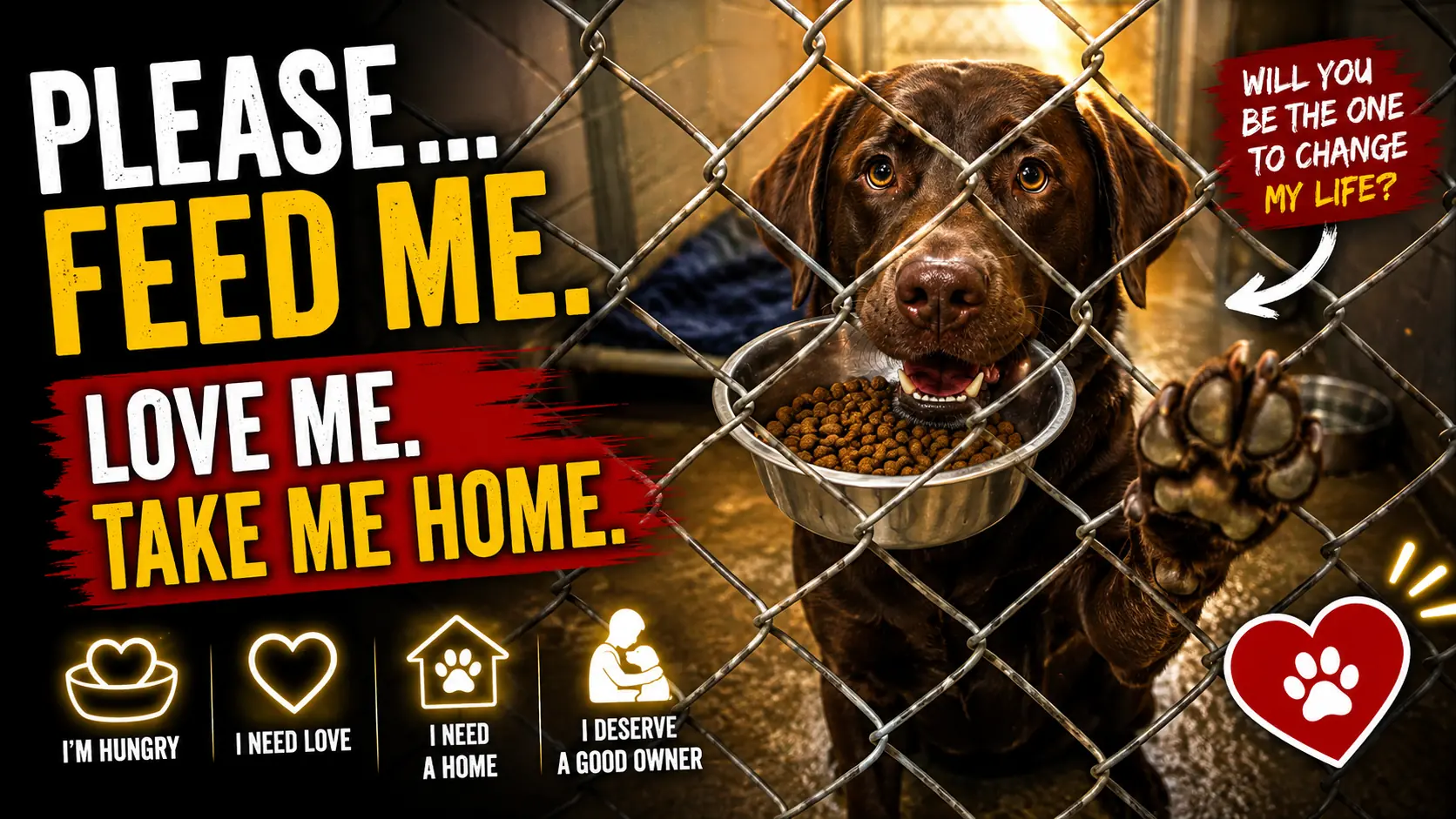
Most dogs finish a meal and forget about the bowl until the next one arrives.
Hershey often does something different.
After eating, he may pick the bowl up by the rim and carry it toward the front of his kennel. Sometimes a few pieces of kibble remain inside. He sits directly behind the chain-link gate and watches people moving through the hallway with the bowl held carefully between his teeth.
If someone slows down, his attention sharpens.
His tail begins moving.
Then, with the bowl still in his mouth, Hershey occasionally lifts one front paw and gently scratches at the gate.
Sometimes once.
Sometimes twice.
Then he waits.
It is an unusual behavior, but there is nothing medically concerning about the way he carries the bowl. Our team has checked his mouth and teeth, and he appears comfortable picking it up and putting it down.
We cannot say he is literally asking visitors for food or adoption. Dogs do not attach those human meanings to objects in the same way we do.
The simplest explanation may be that Hershey discovered carrying his bowl attracts attention.
And Hershey likes attention.
That has become increasingly clear as we have gotten to know him.
Physically, Hershey is in generally stable condition. His complete veterinary examination showed a normal heart and lung assessment, comfortable mobility, and a healthy interest in food. His body condition is being monitored closely because Labradors can gain weight quickly in a kennel environment where activity is limited.
Right now, his meals are measured carefully so he receives appropriate nutrition without unnecessary excess calories.
That sometimes makes the sight of him carrying his bowl toward visitors especially funny.
Hershey has eaten.
He is not starving.
But anyone unfamiliar with his routine might think he is presenting evidence that somebody has forgotten to feed him.
Our volunteers know better.
They still usually stop.
During his initial blood work, one liver enzyme was mildly elevated. Hershey was not showing symptoms of significant liver disease, and the rest of his examination was reassuring, so our veterinary team chose to monitor the value rather than immediately assume a serious diagnosis.
Repeat testing is planned.
At this stage, he is eating normally, drinking normally, and maintaining appropriate energy. If the value remains elevated or additional symptoms develop, his veterinarian may recommend further testing.
For now, there is no reason Hershey cannot continue being considered for adoption.
His larger challenge is the emotional reality of spending day after day in a kennel.
Hershey is a social dog.
He watches people.
He recognizes familiar volunteers.
When someone he knows enters the hallway, his reaction is noticeably different from the way he responds to strangers.
The tail moves faster.
His body becomes more animated.
Sometimes the bowl gets picked up almost immediately.
One volunteer jokes that Hershey believes nobody should be greeted empty-mouthed.
Once the kennel opens, however, the bowl is usually forgotten.
Hershey wants to be close to the person.
He enjoys having his chest scratched and frequently leans into familiar caregivers. He is affectionate without needing constant physical contact, and after the initial excitement of leaving the kennel, he usually settles well.
Outside, Hershey becomes more interested in exploring.
He enjoys slow sniffing walks around the shelter property. He investigates trees, grass, fence posts, and almost anything that another dog has recently examined.
Those walks are important for both his physical and emotional health.
They give him exercise.
They provide mental stimulation.
And, most importantly, they give him time when there is no chain-link fence between him and another person.
When Hershey returns to his kennel, he often drinks water and settles on his bed.
Then the hallway becomes active again.
Someone approaches.
Hershey gets up.
Sometimes he grabs that bowl.
And the routine starts again.
Our behavior team has been working on calmer greetings because constant pawing at the kennel can become frustrating for dogs if it never produces the interaction they want.
Hershey is learning quickly.
When someone approaches, volunteers wait for all four paws to return to the floor before opening the gate.
He has started understanding that sitting quietly can make good things happen.
Some days he remembers immediately.
Other days, excitement wins.
The paw comes up.
Scratch.
Then another.
He looks through the fence as though he cannot understand why humans are making such a simple process unnecessarily complicated.
We give him time.
Long-term success matters more than perfect behavior inside a shelter.
His appetite remains excellent, which is useful during training.
Hershey responds well to food rewards, and part of his daily meal is sometimes used for enrichment exercises.
Instead of receiving all his kibble in one bowl, he may search for pieces hidden in a food puzzle or work through simple training cues.
He enjoys having something to solve.
Perhaps ironically, the dog famous for carrying his bowl does not actually need the bowl to enjoy his food.
He just seems to prefer having it when an audience is available.
His sleeping behavior is also encouraging.
Hershey has a raised bed and blanket inside his kennel. During busy hours, he remains relatively alert because hallway activity interests him.
Once the building quiets down, however, he settles.
Staff members doing evening rounds frequently find him stretched comfortably across his bedding.
That ability to rest matters.
Although Hershey likes people and enjoys interaction, he is not spending every hour in a state of distress.
He can relax.
He can sleep.
He can occupy himself.
Those are important qualities for a future home.
What Hershey has not yet experienced is the predictability of belonging to one household.
A rescue facility can provide structure, but it is shared structure.