The morning they sealed the road, I was standing in a driveway that had only been mine for six weeks, holding a cup of coffee that never made it past lukewarm.
Three men in fluorescent vests with the Ashwood Hollow HOA logo printed across their backs were driving steel posts into the shoulder of Miller’s Gap Road.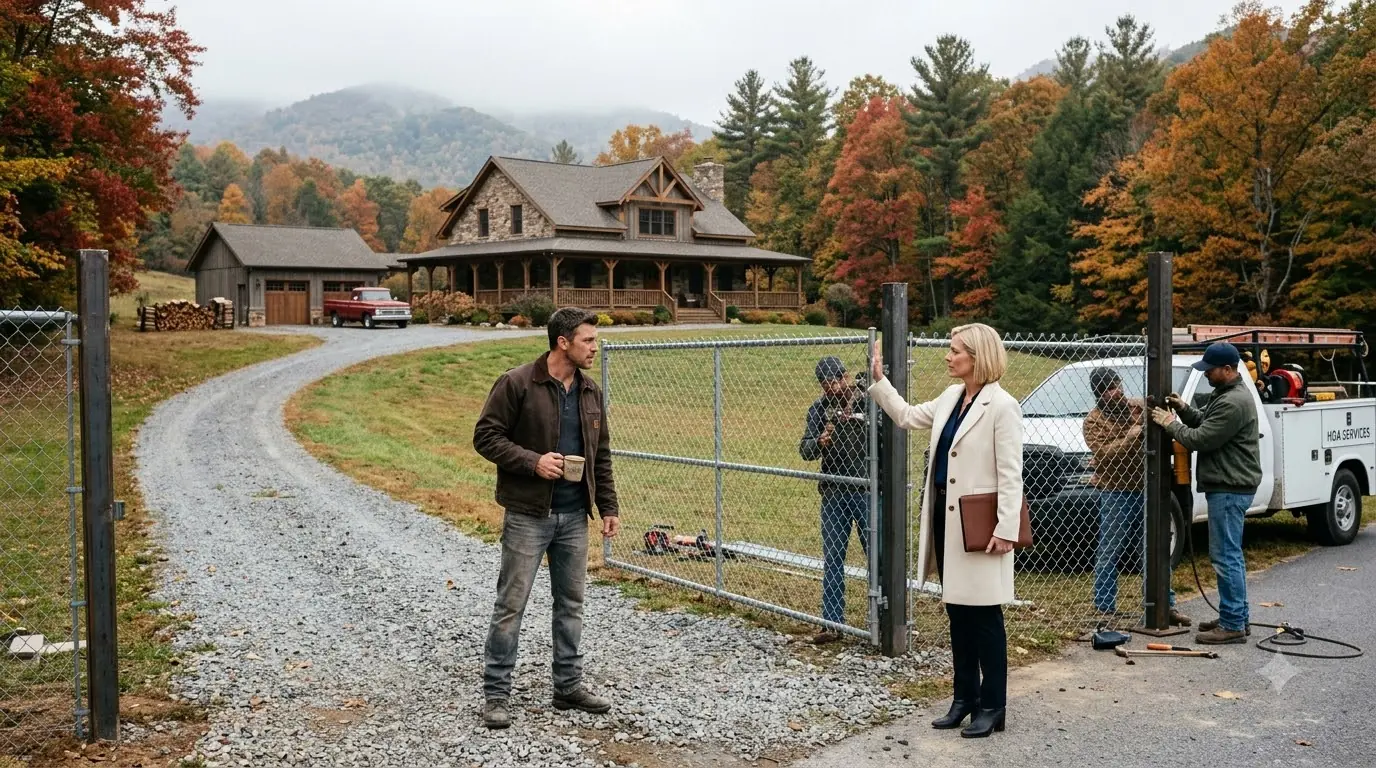
At first I assumed they were repairing something.
Then a flatbed truck arrived carrying chain-link panels.
Twenty minutes later, the road was blocked.
Not narrowed.
Not marked for construction.
Blocked.
A steel gate stretched from one shoulder to the other.
The crew attached a laminated sign to the center with four plastic ties.
PRIVATE ROAD MAINTENANCE CORRIDOR
RESIDENT ACCESS PROHIBITED
PENDING REVIEW
Pending review.
Two harmless-looking words doing the work of a padlock.
I walked down the driveway wearing jeans, an old flannel shirt, and house shoes because I had not expected my morning to include a territorial dispute.
The foreman saw me coming.
He stopped tightening one of the hinges.
“Morning.”
“What are you doing?”
He glanced at the obvious gate.
“Closing the road.”
“I can see that.”
He waited.
“Miller’s Gap is how I get to my house.”
“I was told residents have alternate access.”
I looked over my shoulder at the eleven acres behind me.
“Do you see another road?”
He frowned.
“That’s above me.”
“Who ordered this?”
“HOA.”
“Vanessa Croll?”
He checked his clipboard.
“Work order says Ashwood Hollow Homeowners Association.”
“Why?”
“Structural review.”
I looked at the gravel beneath our feet.
Miller’s Gap Road was hardly beautiful, but it was not collapsing.
There were no washouts.
No failed culverts.
No trench.
No visible damage at all beyond the same potholes everyone had been driving around for years.
“What structure?”
The foreman shrugged.
“Call the office.”
“Can I leave through here?”
“Not once we lock it.”
“What about coming back?”
“Same answer.”
“You understand my driveway ends thirty yards from this gate.”
“I understand.”
“No, I’m asking if you understand that you’re cutting a residence off from the nearest county road.”
The man’s expression softened.
He was not enjoying the conversation.
“I’m just installing what they hired us to install.”
That was fair.
I had spent enough years around job sites to know the person holding the wrench was rarely the person who wrote the contract.
“What’s your name?”
“Sam.”
“Sam, can you give me a copy of the work order?”
He hesitated.
“I can give you the contractor number.”
“Fine.”
He wrote it down.
I went back to the house.
Called the HOA office.
A recording answered.
“You’ve reached the Ashwood Hollow Homeowners Association. Our administrative office is currently closed. Please leave a message or email…”
Closed.
Of course.
I left a message anyway.
Then another with the property management company.
By nine-thirty, the gate was locked.
My house had been mine for six weeks.
The land had belonged to my family for almost fifty years.
And somehow a woman I had spoken to once had just made my normal route to the grocery store illegal with a laminated sign.
My name is Cole Ashworth.
I was thirty-seven when this happened.
My daughter, Emma, was eight.
The property had belonged to my grandfather, Owen Ashworth.
Eleven acres tucked against the western edge of Ashwood Hollow, where the manicured subdivision gave way to older land, woods, rock, and the ridge.
My grandfather bought the acreage in the late 1970s.
He built the house himself.
Not metaphorically.
Actually built it.
Foundation.
Framing.
Roof.
Cabinets.
He was a carpenter by trade and stubborn by temperament.