They called the sheriff because I lowered the water level in my own lake.
Not a neighborhood pond. Not some decorative retention basin built by a developer fifteen years earlier.
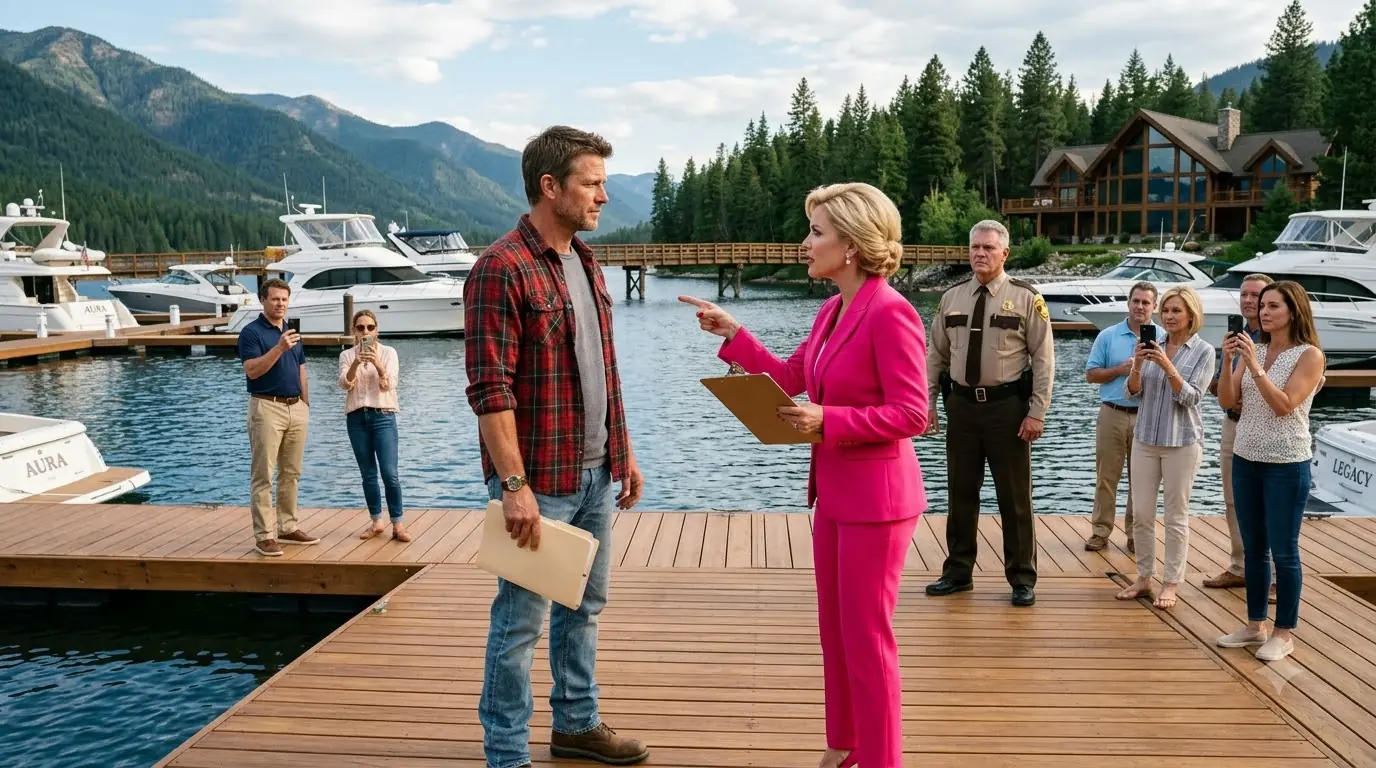
Mercer Lake had been part of my family’s land for seventy-two years, a three-hundred-acre body of cold mountain water surrounded by pine forest, limestone shelves, and the western Montana peaks I had known since childhood.
My grandfather owned the lake bed. My father owned the shoreline. Our family trust held the registered water rights, the old control structure, the northern access road, and nearly every strip of ground touching the water below the original elevation line.
Silver Pines Estates owned the hillside above it.
That distinction was about to become very expensive.
By the time I returned home after my father’s funeral, the Silver Pines Homeowners Association had spent almost two million dollars building a polished cedar marina, private yacht slips, a long floating bridge, landscaped waterfront paths, and a glass-fronted lake villa for wealthy residents.
They sold memberships.
They sold boat access.
They sold permanent slip rights.
They advertised Mercer Lake as an exclusive amenity belonging to Silver Pines residents.
There was only one problem.
They had never purchased Mercer Lake.
They had never purchased the shoreline beneath their marina.
They had never purchased the land beneath the glass villa.
And the document they were using to justify all of it carried my father’s signature from a week when he had been recovering from a stroke and could barely hold a spoon.
The first time Patricia Whitmore confronted me, she stood on my family’s dock in a bright pink suit and matching heels and told me I needed to stop living in the past.
“Maybe if you spent less time digging through old paperwork, Mr. Mercer,” she said, “you’d understand this community has moved on.”
I looked at the marina behind her.
At the yachts.
At the clubhouse.
At the residents drinking wine on land she had never bought.
Then I nodded.
“You know what, Patricia?”
Her smile widened.
“You’re absolutely right.”
She thought I was surrendering.
I went home and started reading.
My name is Ethan Mercer.
I was forty-six years old when all of this happened, a third-generation contractor who had spent twenty-five years building roads, repairing bridges, pouring foundations, moving earth, and learning that land never cares how confidently somebody describes it.
I stood an even six feet, weighed a little over two hundred pounds, and had the sort of broad shoulders that came less from the gym than from spending decades lifting things incorrectly because there was no one else around to help.
My hair was brown with a little gray beginning at the temples.
My hands stayed rough year-round.
There was a pale scar running across my left thumb from a sheet-metal edge when I was nineteen and another along my forearm from a snapped winch cable.
Most days I wore the same uniform without calling it one.
Red-and-black plaid flannel over a gray T-shirt.
Jeans.
Brown work boots.
My father’s stainless-steel wristwatch.
It lost four minutes every month.
I never had it repaired.
My wife, Emily, died nine years earlier after a fast and merciless illness that took less than eleven months from diagnosis to funeral.
We never had children.
Afterward, work became easier than home.
I grew Mercer Contracting from six employees to twenty-three, bought two excavators I probably did not need, and filled every week with enough jobs that I could return to an empty house too tired to care that it was empty.
My father knew what I was doing.
Silas Mercer rarely gave advice directly.
He would just say things like, “You know a man can hide inside work just as easily as he can hide inside whiskey.”
Then he would take another sip of coffee and pretend he had not said anything important.
Silas was seventy-four when cancer finally took him.
He had been tall and lean most of his life, though illness narrowed him until his old work shirts hung loose from his shoulders.
He had close-cropped gray hair, long hands, and a quiet expression that made strangers underestimate how stubborn he could be.
My father knew every survey monument around Mercer Lake.
He remembered which fence corners my grandfather moved after the flood of 1974.
He knew where the original county road crossed the southern meadow before the state rerouted it.
He remembered handshakes made before I was born.
And when somebody tried arguing with him about land, Silas had one question.
“Show me the paper.”
Usually that ended it.
Mercer Lake began with my grandfather, Samuel Mercer.
He returned from World War II in 1946 with a bad knee, two hundred dollars, and no interest in ever wearing another uniform.
Over the next few years, he bought mountain acreage outside Cedar Hollow whenever neighboring families moved away.
In 1952, he acquired the basin that later became Mercer Lake.
A small water-control structure already existed near the northern end, built originally for irrigation and seasonal flood management.
Samuel improved it.
The county inspected it.
Water slowly spread through the low basin until the lake became what I knew growing up.
By the time my father inherited the land, Mercer Lake had become part of Cedar Hollow’s identity.
Not public property.
Not a municipal park.
But Silas never ran it like a private fortress.
Locals fished with permission.
School groups visited.
Volunteer firefighters trained there.
During dry summers, ranchers sometimes drew permitted water downstream.
My father believed ownership created responsibility before privilege.
That philosophy became important later.
The Silver Pines development arrived around fourteen years before his death.
A regional developer bought the wooded hillside west of the lake and proposed forty-two luxury homes.
Silas did not object.
The homes sat above the established shoreline.
The subdivision had its own roads.
Its own wells.
Its own common areas.
Early planning documents described Mercer Lake correctly.