That morning, I stood at my fence and looked at the windmill my family had kept turning for almost eighty years, lying broken in the middle of my pasture.
The tower had been folded down like somebody had taken a giant pair of shears to it.
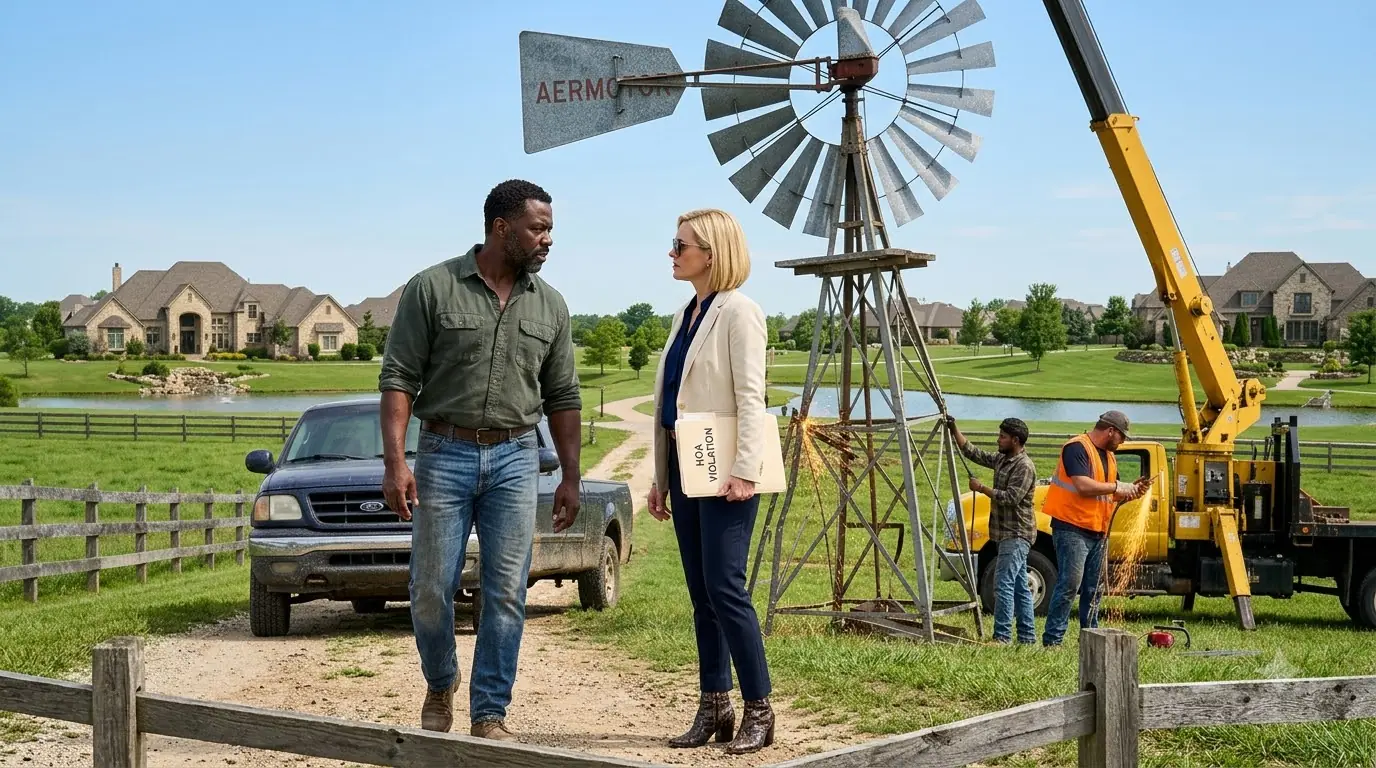
The sixteen-foot wheel was resting crookedly in the grass. Several sails were bent beneath its own weight, the tail vane had snapped away at the mounting bracket, and two lengths of the drive shaft lay on the ground with bright silver cuts where steel had been separated less than an hour earlier.
Vanessa Wickham stood on the other side of the damage with her arms folded.
She looked satisfied.
Not excited.
Not angry.
Satisfied.
Like she had finally completed a difficult landscaping project.
“The association removed a hazard because you were unwilling to do it yourself,” she said.
I didn't argue.
I didn't shout.
I looked at the severed drive shaft.
Then I looked at her.
“Vanessa, do you know what that windmill ran?”
She actually laughed.
“A windmill, Darius?”
I stared at her for another second.
Then I nodded.
“All right.”
That was all I said.
Two hours later, her phone started ringing.
It did not stop for the rest of the day.
My name is Darius Boone.
I was forty-eight years old when all of this happened, and I lived on nine acres of what had once been a two-hundred-acre family farm.
On county maps, the parcel still carried the name BOONE ACRE, even though calling nine acres an acre had always bothered me.
My grandfather, Isaiah Boone, bought the original ground in the mid-1940s.
Nobody considered it valuable then.
The county appraisal described parts of it as scrub pasture.
There was a shallow creek at the south end, black walnut along the northern line, several rocky rises, and enough uneven ground to make large-scale row cropping inconvenient.
That was exactly why my grandfather could afford it.
He had come out of the war with savings, mechanical experience, and an almost unreasonable belief that land was the one thing nobody could manufacture more of.
People told him he was buying weeds.
He bought two hundred acres.
He raised cattle.
Cut hay.
Grew vegetables where the ground allowed it.
Built a barn with friends and relatives.
Dug drainage.
Put up fence.
And in 1947, he installed the first version of the windmill.
The tower stood twenty-six feet to the platform.
The wheel measured sixteen feet across.
The original galvanized tower came from a farm equipment dealer that no longer existed by the time I was born.
My grandfather used to paint the tower white every few years.
He did it himself until his hands became too stiff to climb safely.
My father, Leonard Boone, took over after that.
Then I did.
People driving past Red Willow Estates assumed the windmill was decorative because that was the only kind of windmill they had ever seen.
A little ornamental tower beside an entrance sign.
Something put there to make a subdivision feel rural.
Ours was not ornamental.
It was a machine.
And it worked every day.
The wheel turned a vertical rod inside the tower.
That rod drove a gearbox near the base.
From there, a horizontal shaft entered a concrete pump house built into the hillside.
Inside that pump house sat the part nobody in Red Willow ever bothered to look at.
Pressure gauges.
Mechanical linkage.
A transfer pump assembly.
Pilot valves.
A controller older than I was.
A small auxiliary generator driven through the windmill shaft whenever wind conditions were sufficient.
And a line running north beneath the walnut trees toward an old transfer well.
The system had been modified over the years.
The original equipment my grandfather built was designed primarily for farm irrigation and livestock water.
My father modernized it.
Electric pumps were added.
A larger transfer line.
New controls.
Pressure protection.
Backup systems.
But the windmill remained part of the arrangement because it performed several low-demand jobs continuously without requiring the electric pumps to cycle.
It maintained movement through the old well system.
It provided mechanical assistance to the transfer side.
And, through the auxiliary generator, it supplied reference power to the controller and held several pilot valves in their normal operating position.
That last part would eventually become very important.
There was a logbook hanging from a nail beside the pump house door.
The oldest pages still in the book dated to 1962.
My grandfather's handwriting occupied the first section.
My father's came after.
Mine began in the 1990s.
Granddad's handwriting was square and careful.
Dad's leaned slightly to the right.
Mine looked like somebody had written during an earthquake.
Every fourteen days, I greased the fittings.
Checked the bearings.
Inspected the tower.