The excavator bucket was already raised when I drove into my back field.
For one second, I honestly thought I had taken the wrong turn.
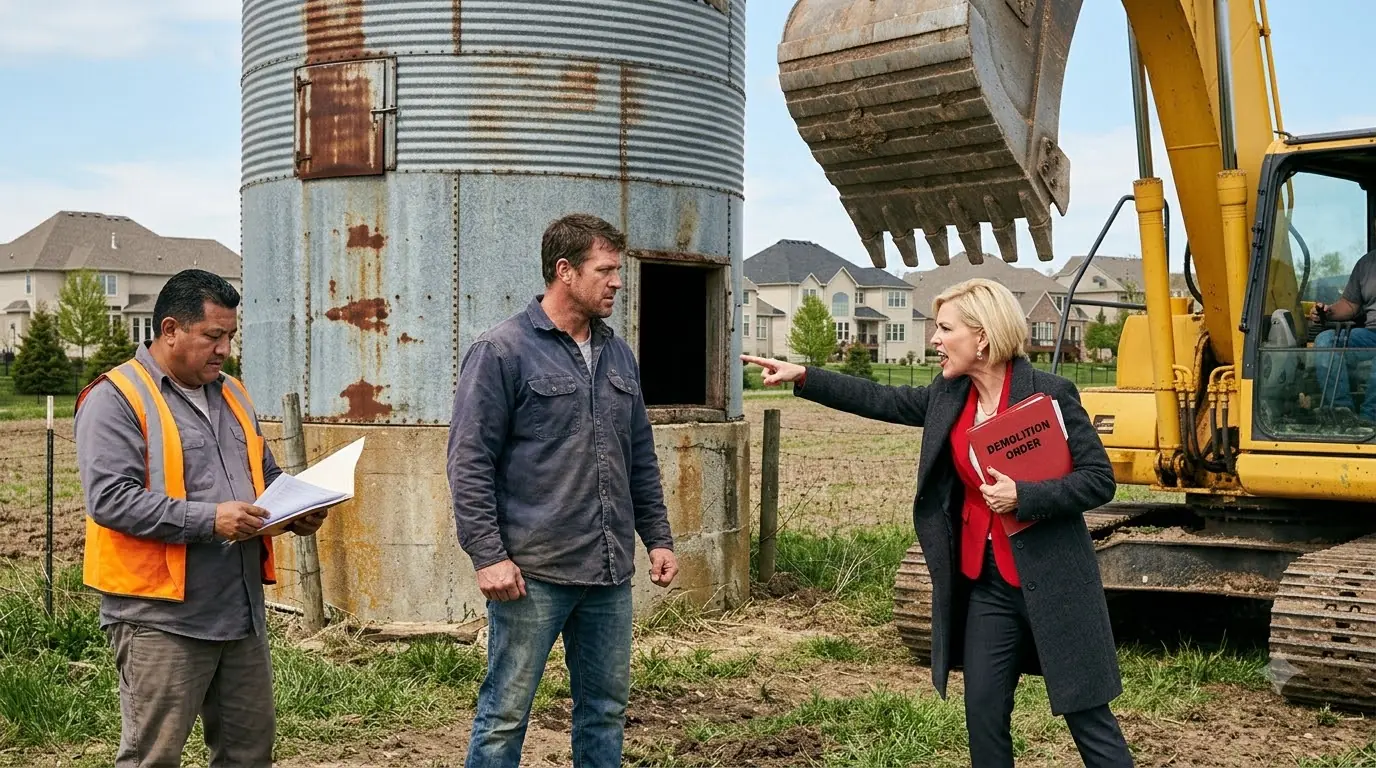
A yellow tracked excavator sat thirty yards from the grain silo my father had built when I was a kid, its engine idling low enough that I could feel the vibration through the floor of my pickup before I even opened the door.
Two demolition workers stood near a stack of temporary safety fencing, another man was looking through a permit folder on the hood of a white work truck, and Rachel Voss stood beside the machine in a bright red blazer as though she were supervising construction on property she had owned all her life.
The bucket rose another few feet.
I hit the horn.
Everybody turned.
I drove straight across the field, stopped between the demolition crew and the silo, and got out before the dust had settled around my tires.
“What the hell are you doing?”
Rachel didn’t flinch.
That bothered me more than if she had.
She simply held up a red folder.
“That silo comes down today.”
Behind her, the excavator engine continued idling.
I looked at the operator.
“Lower the bucket.”
Rachel turned toward him.
“Do not stop.”
The operator froze.
He looked toward the man standing beside the work truck.
That man closed the permit file.
Then he walked toward me.
He was about fifty, compact and broad-shouldered, with graying hair beneath a hard hat and an orange safety vest over a faded gray work shirt. His boots had the dull, permanent coating of dust that belonged to people who spent their lives around demolition sites.
“Luis Ortega,” he said. “Ortega Demolition Services.”
“Ethan Hail.”
I pointed toward the silo.
“And that’s mine.”
Luis looked back at the permit folder.
Then at Rachel.
Rachel stepped closer.
“The board has already authorized removal.”
Luis opened the file again.
“I have the board authorization.”
He tapped one page.
“I don’t have his.”
Rachel’s jaw tightened.
“You don’t need it.”
Luis did not argue immediately.
He read something.
Turned a page.
Then frowned.
“The county application asks for authorization from the record property owner.”
“I’ve explained the covenant authority.”
“I understand what you told me.”
He looked at me.
“Mr. Hail, are you the record owner of this parcel?”
“Yes.”
He turned the folder so I could see.
There it was.
PARCEL OWNER: ETHAN HAIL.
Below my name was an empty signature line.
OWNER AUTHORIZATION.
Unsigned.
The demolition contract attached behind the application named Oak Crest Homeowners Association as the client. The scope described the work in clean, professional language.
Removal of one obsolete agricultural grain silo.
Debris haul-off.
Site grading.
Minor backfill.
No mention that the “obsolete” structure stood on privately owned farmland outside the HOA’s title.
No mention that I had never asked for it to be removed.
No mention that I still used the bottom level for fencing supplies, irrigation fittings, spare pump components, seed spreaders, and enough old farm hardware to stock a small rural store.
I looked at Luis.
“How much did they hire you for?”
He hesitated.
Rachel cut in.
“That is association business.”
Luis answered anyway.
“Thirty-six thousand including mobilization, disposal, and rough grading.”
I looked at Rachel.
“You hired a demolition company for thirty-six thousand dollars to tear down something on my land.”
“The silo has been abandoned for years.”
“It hasn’t stored grain.”
“Exactly.”
“That doesn’t mean abandoned.”
Rachel gave me the look she used at HOA meetings when someone had just made a point she intended to ignore.
“The structure no longer serves its original agricultural purpose.”
“It serves mine.”
Her mouth flattened.
Behind us, the silo stood forty yards away.
It was not pretty.
I had never claimed it was.
The galvanized panels had faded to a soft gray after decades of sun and winter. Rust streaks ran beneath several old bolt heads. The upper ventilation cap leaned slightly where a storm had bent its bracket years earlier. A lower ladder section needed repainting.
But it was upright.
Sound.
Useful.
And mine.
My father had put it there when I was nine years old.