I stood in the pouring rain, staring at an eight-foot wrought-iron gate that had not existed when I left home eight days earlier.
Behind it was my bridge. Behind the bridge was my house.
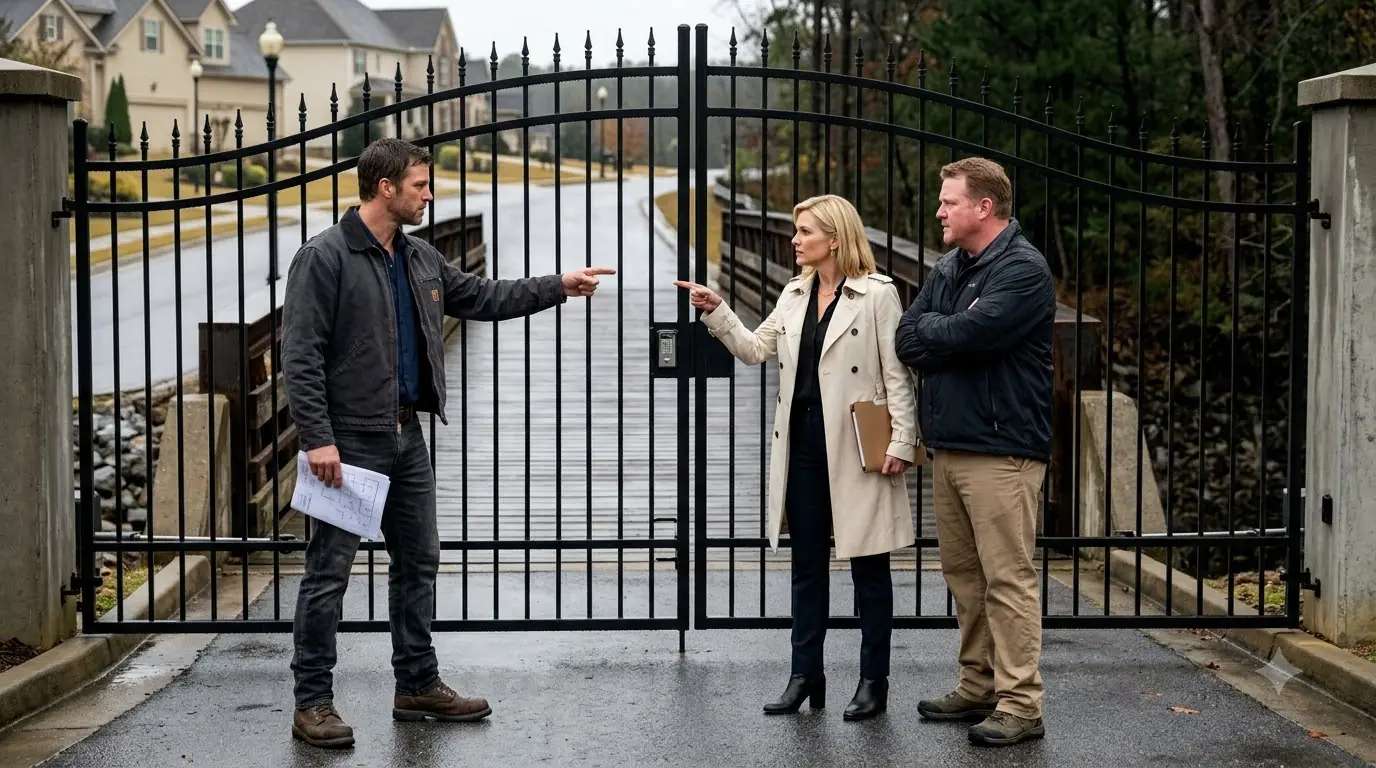
And zip-tied to the center bars of that gate was a laminated notice informing me that if I wanted to reach the property my family had owned since the 1970s, I first needed to pay the Oak Creek Estates Homeowners Association $15,420.
I read the number twice because the first time my exhausted brain refused to accept it.
Fifteen thousand four hundred twenty dollars.
For a gate I had never requested.
For fines I did not owe.
For a homeowners association I had never joined.
And for access to a bridge my grandfather had built with his own money nearly forty years earlier.
Rain ran off the brim of my cap and down the back of my neck.
My truck idled twenty feet behind me, headlights reflecting from black iron and wet asphalt.
For several seconds I simply stood there.
Then I started laughing.
Not because anything was funny.
It was the kind of laugh that comes when anger gets so large your body has to find somewhere else to put it.
My name is Noah Collins.
At the time, I was forty-one years old and worked as an independent heavy-equipment contractor. I cleared land, dug foundations, built retaining systems, repaired access roads, and did the sort of work people called when the ground itself was fighting whatever they wanted to build.
I understood dirt.
I understood steel.
I understood drainage, load paths, grades, excavators, cranes, and what happened when someone tried to force a structure to do something it had never been designed to do.
What I did not understand was how Brenda Carmichael had convinced herself she could place a gate between me and my own home and then send me a bill for the privilege.
To understand that, you need to understand the land.
My grandfather, Walter Collins, bought twelve wooded acres outside the county in 1974.
Back then there was nothing around it except forest, hay fields, two gravel roads, and Miller’s Creek, which cut through the bottom of a steep ravine along the property’s eastern edge.
Granddad wanted privacy.
He got it.
The house sat almost half a mile beyond the creek, surrounded by oak, hickory, and pine. In the mornings you heard birds, wind moving through the canopy, and rushing water below the ravine.
At night there were no streetlights.
No subdivision entrances.
No landscape crews starting leaf blowers at seven in the morning.
No committees.
Just woods.
The problem was access.
The creek was narrow during dry months, but during spring storms and wet autumns it became violent. Granddad initially used an old timber crossing farther upstream, but two floods damaged it badly.
So in 1985, he built something permanent.
Granddad had spent most of his working life supervising structural steel crews.
He did not believe in building lightly.
The bridge he designed looked less like a residential driveway crossing and more like something the Forest Service might have used for logging equipment.
Two massive steel girders spanned the ravine.
Heavy timber decking crossed them.
Reinforced concrete abutments anchored both ends.
The structure was designed to carry fully loaded work trucks because Granddad used equipment on the property and believed that if you were going to build something once, you should build it so your grandchildren would not have to build it again.
He was right.
For decades, dump trucks crossed it.
Concrete trucks crossed it.
My excavator crossed it on a low trailer.
Storm after storm hit Miller’s Creek, and that bridge remained.
When Granddad died, the property eventually passed to my father.
When Dad died, it came to me.
I had grown up there.
I knew every bend in the creek.
Every old logging trail.
Every place wild turkeys crossed in November.
The bridge was more than access.
It was part of the family.
Then Oak Creek Estates arrived.
Three years before the gate incident, a regional developer purchased roughly two hundred acres of farmland directly across Miller’s Creek.
Within eighteen months, fields where cattle had grazed became curved streets lined with large beige houses.
The developer planted ornamental pear trees.
Installed decorative streetlights.
Built a clubhouse.
Created two artificial ponds with fountains.
And named everything after trees that had mostly been bulldozed during construction.
Willow Court.
Maple Terrace.
Chestnut Lane.
Sycamore Drive.
Sycamore Drive happened to terminate directly opposite my bridge.
That was not accidental.
The developer approached me before road construction began.
A man named Russell Keane came to my house with drawings showing what he called an “integrated circulation opportunity.”
What he wanted was simple.
He wanted me to grant Oak Creek Estates a permanent easement across my bridge and the first hundred yards of my private driveway.
It would provide an emergency secondary entrance for the subdivision and potentially allow future development on land farther west.
He offered $35,000.
I said no.
He came back with $55,000.
Still no.
The bridge was the only controlled entrance to my property.
I did not want neighborhood traffic crossing it.
I did not want strangers driving past my house.
I did not want an easement attached permanently to land my grandfather had gone to great trouble to isolate.
Russell eventually understood.
The developer redesigned the subdivision.
Sycamore Drive still ended near the creek because the road had already been engineered that way, but the asphalt stopped at the recorded boundary.
My bridge began immediately beyond it.
The county survey showed the distinction clearly.
Oak Creek on one side.