"Tow it. The registration is in my son's name now."
That was what Hadley Lockwood shouted across my cul-de-sac on a Saturday afternoon, with two police officers standing beside my open garage and the afternoon sun gleaming off the pearl-white hood of my 1968 Mustang.
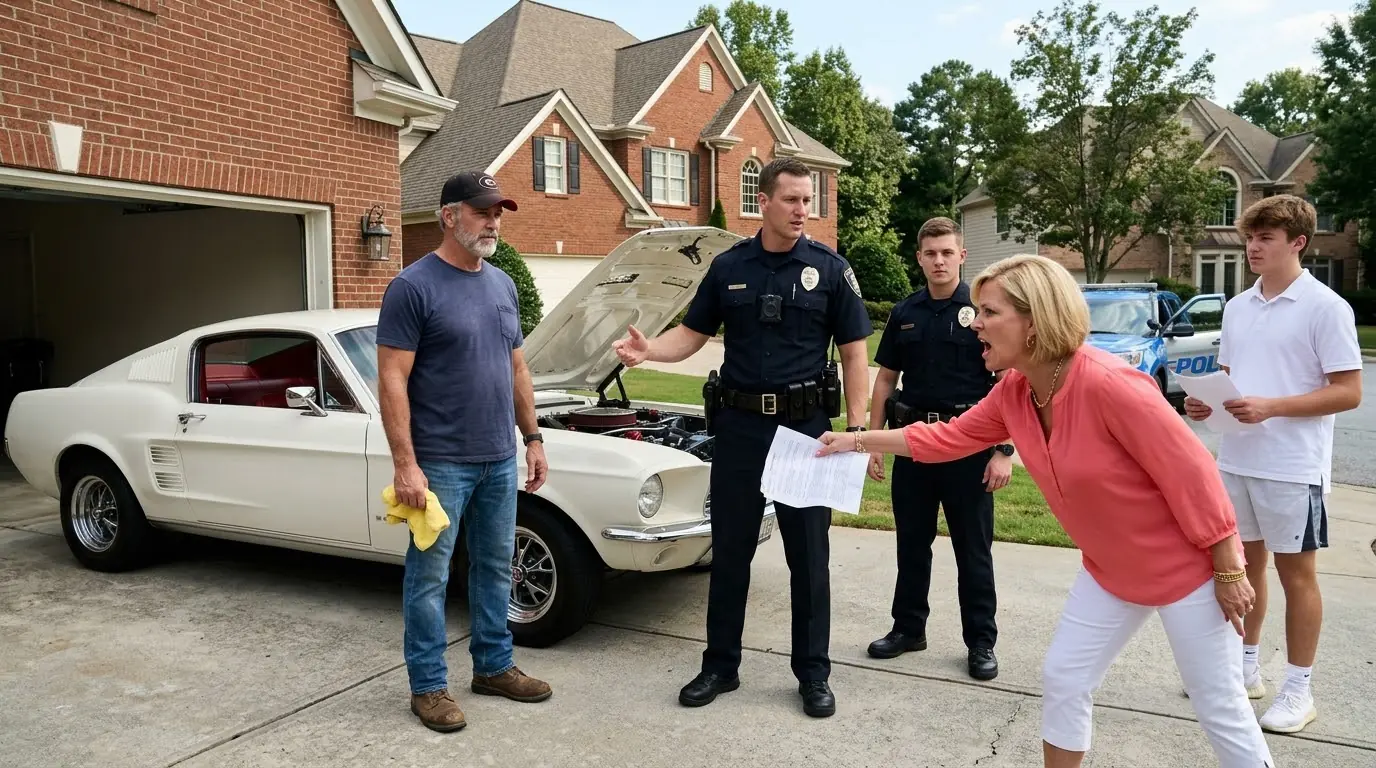
She held a sheet of paper above her head as if paper could change what had happened, or who owned the car, or what a man and his family had put into it. Her son Bryson stood behind her, wearing tennis shorts and an expression that had not yet caught up with the trouble he was in. Neither of them had noticed the way Sergeant Tucker Brennan had stopped moving when I took off my faded University of Georgia cap.
"Chief Halloran, sir," Brennan said, straightening before he could help himself.
Officer Lane Murchison, who had been in the department barely fourteen months, followed his sergeant's lead and saluted. I returned the salute because it was instinct, then lowered my hand and asked them to relax. I had spent six years as their chief, and this was the first time either had seen me standing in my driveway with a polishing cloth in one hand and engine grease on the other. Across the street, Hadley's voice died in the middle of another demand.
I did not smile. There was nothing funny about a false accusation involving a car that my dead wife had chosen and my son had grown up restoring. Nor was there anything funny about the other families whose financial troubles had made the Lockwoods rich. What I remember most about that moment is how the silence spread, slowly enough for Hadley to understand that the officers had not come to take my car merely because she said they should.
My name is Sterling Halloran, and I was fifty-six years old that autumn. For thirty-two years I had worn a badge, first in Atlanta, later with the Forsyth County Sheriff's Office, and finally in Cederville, Georgia, a growing town north of Atlanta that still pretended to be smaller than it was. There were forty-one sworn officers in my department, a handful of marked patrol vehicles visible around town at any given hour, and more late-night calls involving family problems than most outsiders would guess. I had been chief since 2018.
I learned long ago that the important part of police work almost never looks like television. It looks like an officer writing down an exact time instead of saying approximately. It looks like returning a telephone call to somebody whose story sounds unlikely and asking what documents they have kept. Most of all, it looks like refusing to let a uniform turn an opinion into a fact.
I was not always so patient. Back in 1992, when I began patrolling Atlanta's Zone Three, I had the quick temper of a young officer who believed every problem could be met by standing straighter and talking louder. A sergeant named Wallace Price taught me otherwise after a disturbance at an apartment building where a frightened mother kept refusing to open her door. He told me afterward that courage was knowing when to be quiet enough for someone else to speak. It took me another ten years to understand how often he had been right.