They killed Big Bertha before sunrise.
I knew something was wrong before I reached the dock because the lake did not smell like itself.
For seventy years, the water behind my family's house had carried the same clean mineral scent, cold and faintly sweet where the spring pushed up through limestone beneath the western bank.
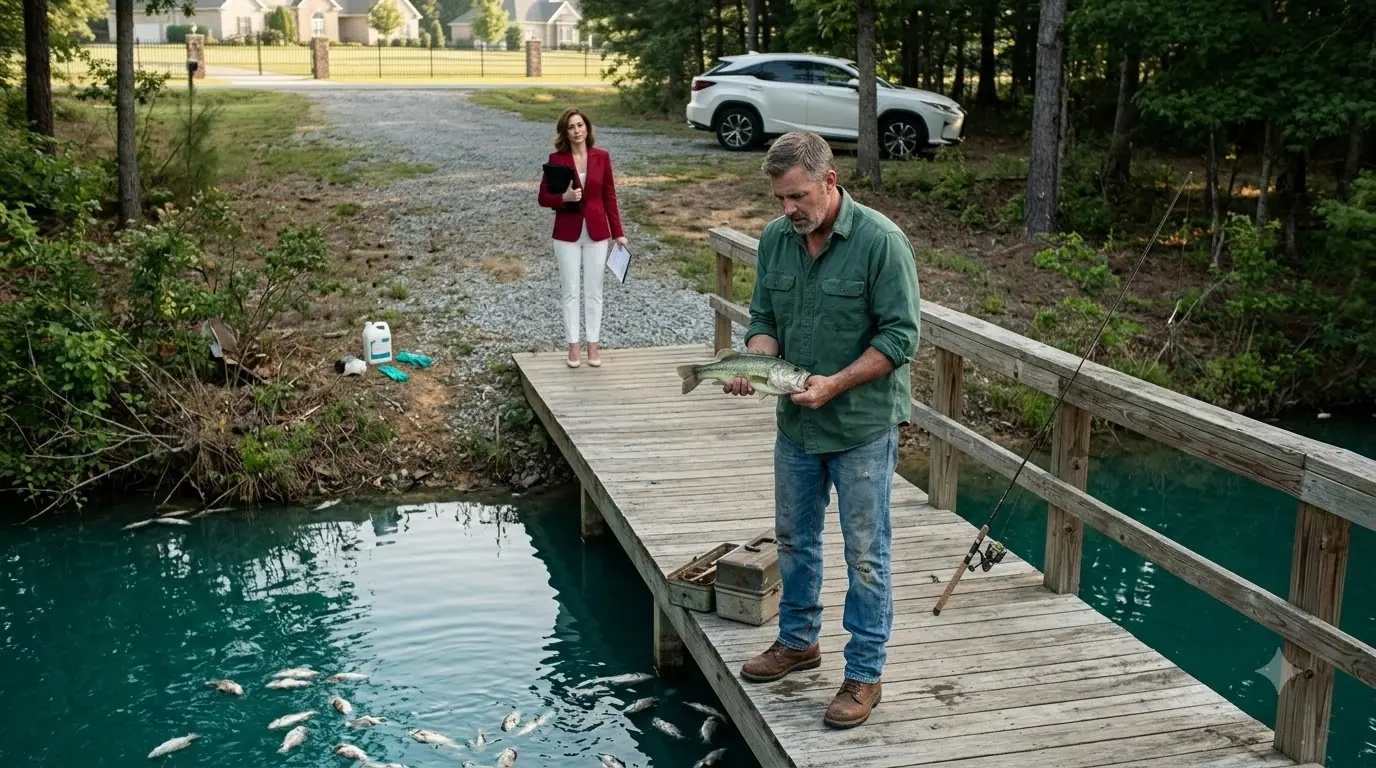
That morning, the air burned my nose with something metallic and artificial, a sharp chemical bite that did not belong anywhere near cypress knees, blue herons, or bass feeding under a pale North Carolina sky.
I stopped halfway down the gravel path my grandfather had laid by hand in the 1950s. The stones were dark with dew, my boots crunching over the same uneven places I had known since childhood, but the water ahead looked wrong. Instead of reflecting the pink edge of dawn, the surface had turned an unnatural blue-green, the color of antifreeze under fluorescent shop lights.
Then I saw the fish.
At first there were only a few white bellies rocking near the reeds. Then my eyes adjusted, and I saw dozens more along the shoreline, bluegill, crappie, catfish, small bass, even the old carp that normally stayed deep near the spillway. By the time I reached the dock, I had counted more than a hundred bodies, and there were still more drifting in from the center of the lake.
Big Bertha floated twenty feet from the end of the dock.
She had been the largest largemouth bass I had ever seen in that water, close to eight pounds by my best estimate. I had first noticed her three summers earlier when she started waiting under the dock every morning, rising out of the shadows whenever I tossed in a worm or the leftover minnows from the previous day's bait bucket. I named her as a joke, then the name stuck, and soon my wife Sandra was rolling her eyes because I talked about a fish as if she were a neighbor who borrowed tools and never returned them.
I waded in up to my knees and brought Bertha in with both hands. Her body was slick and heavy, but there was no fight left in her, no sudden slap of the tail, no angry twist that would have sent water down the front of my shirt. I stood there holding her in the chemical-smelling shallows and felt something inside me go very still.
"I'm sorry, girl," I whispered.
The rage came second.
My name is Marcus Reed. I was fifty-two years old that summer, a retired union electrician who had spent the previous nine years installing residential and commercial solar systems around Pine Ridge, North Carolina. I was the kind of man who trusted a voltage meter more than a meeting, preferred fixing a broken pump to discussing why it had broken, and believed that people could avoid half their problems by respecting property lines and telling the truth.
The twelve acres behind me had belonged to my family since 1952. My grandfather, Elijah Reed, bought the land after coming home from military service with more determination than money, when the whole area was tobacco fields, pine woods, and red clay roads that turned to soup after rain. He cleared the first driveway with two cousins, dug the first drainage ditch with a shovel, and built a small house overlooking the spring-fed basin that later became our lake.
The lake itself had existed in smaller form before he bought the property. A spring bubbled out of limestone under the western slope and fed a marshy basin crossed by two narrow tributaries. My grandfather worked with the county, built a legal earthen dam, and shaped the basin into something deep enough for irrigation and fish.
My father grew up swimming there. I learned to fish there. Sandra and I held our wedding reception under the white oaks above the eastern bank because we could not afford a hotel ballroom and did not want one anyway.
When my son was young, I taught him how to cast from the same dock where my grandfather had taught me. When my father died, we scattered part of his ashes under the cypress tree near the inlet because he had asked us to put him somewhere he could still hear frogs in spring.
The land was not just real estate to me. It was a family archive written in wood grain, water, fence posts, and memory.
For most of my life, the nearest neighbors were far enough away that you needed a truck to visit them. Then the developers arrived.
Fifteen years before the morning I found Big Bertha dead, a regional development company bought nearly six hundred acres surrounding our property. They built Willow Creek Estates, an expensive subdivision of stone-front houses, curved streets, ornamental ponds, walking trails, and the kind of mailboxes that all looked identical because somebody had once paid a consultant to decide which shade of bronze communicated stability.
The development eventually grew to 847 homes. Most were good people. Teachers, dentists, nurses, engineers, small-business owners, retired military families, people raising children and paying mortgages and trying to keep their lawns alive through July.
The original developer offered to buy my land three separate times. The first offer was generous. The second was outrageous. The third included a presentation showing how my lake could become the centerpiece of a private country club with a glass clubhouse overlooking what the sales brochure called "an exclusive water amenity."
I told them no every time.
The man handling acquisitions finally asked me why I would turn down enough money to retire twice. I looked out over the dock my grandfather had built and told him the truth.
"Because some things stop belonging to you alone once enough dead people trusted you to keep them."
He did not understand. I did not expect him to.
For years, my relationship with Willow Creek Estates was peaceful. Joggers waved when they passed the public road near my southern fence. Families sometimes asked whether their kids could fish if they stayed on my side and followed the rules. I usually said yes on Saturday mornings, especially if the parents brought their own life jackets and did not leave trash.
Then Vivian Blackwater moved in.
Vivian was forty-seven, a real estate attorney who carried herself as though every room was waiting for her to call it to order. She drove a white Lexus that never seemed to have dust on it, wore tailored clothes even to neighborhood cookouts, and spoke in the polished language of someone accustomed to turning preferences into policies.
She had a phrase for everything. A fence was a "visual boundary issue." A barking dog was a "quality-of-life disruption." A basketball hoop was "an inconsistent streetscape element." If a sentence could be made three words longer and twice as intimidating, Vivian considered that an improvement.
Within six months of moving into Willow Creek, she became president of the homeowners association. The previous president had been a retired accountant named George Ellis who believed the job mostly involved making sure the pool opened on time and the landscaping company did not overcharge for mulch. Vivian believed governance was destiny.
Her first major program was called the Community Enhancement Initiative. The official letter talked about protecting property values, harmonizing architectural appearance, and maintaining standards expected of a premier residential environment. What it meant in practice was that people began receiving violation notices for things nobody had cared about before.
A family on Hawthorne Lane got fined because their children's bicycles were visible from the street for two afternoons. An elderly widower named Mr. Bell received three letters about native flowers he had planted for pollinators because Vivian considered them weeds. A young couple was warned that their backyard vegetable trellis could be seen from a walking trail.
Then Vivian noticed me.
Her property sat on the ridge overlooking the north side of my lake. She had paid extra for what the listing called a protected water view, although the water was not part of Willow Creek and never had been.
The first time we spoke, I was cleaning a bass at the outdoor sink beside my shed. Vivian stood at my fence in white walking shoes and sunglasses large enough to qualify as protective equipment.
"Mr. Reed?"