They killed Big Bertha.
I know how strange that sounds if you have never loved a place long enough to recognize the animals living in it. Big Bertha was an eight-pound largemouth bass with a pale scar beneath her lower jaw and a stubborn habit of appearing beside my dock every morning.
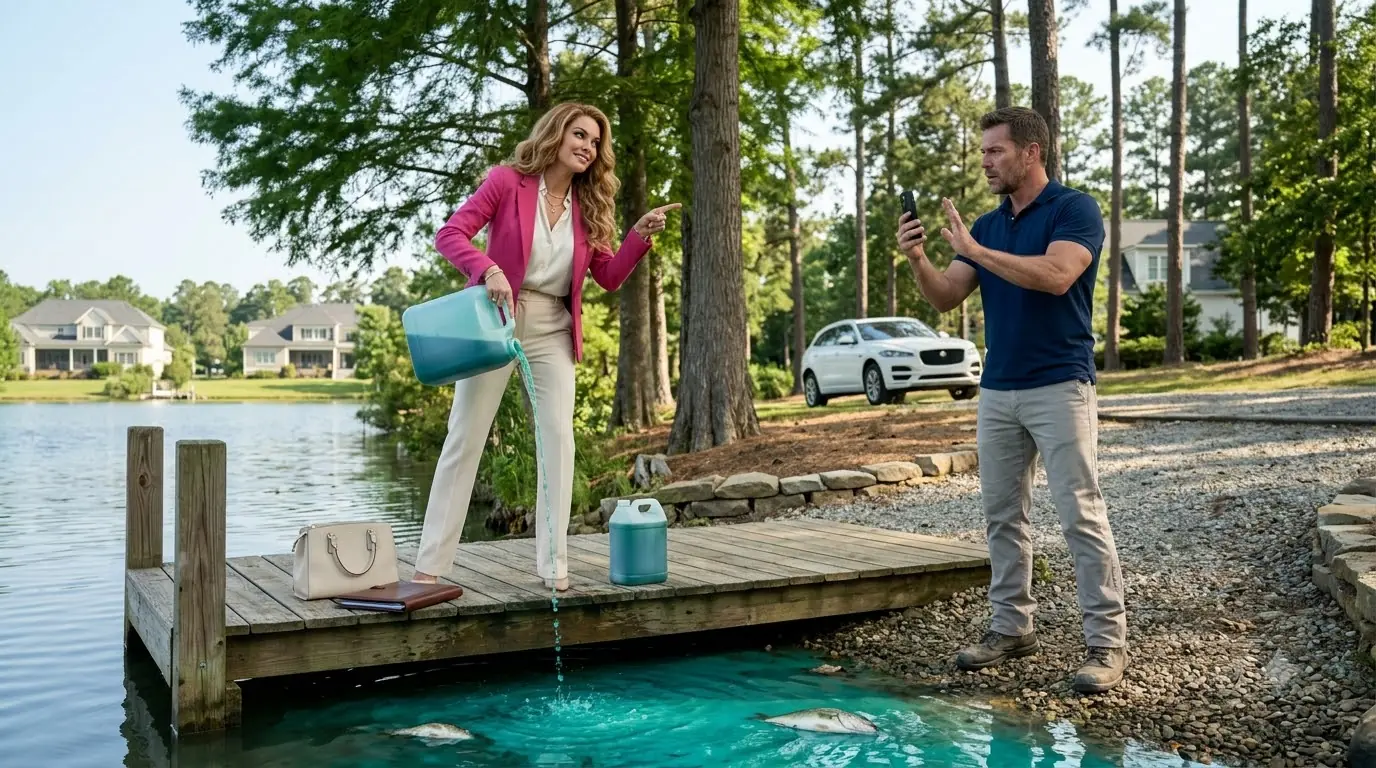
I had watched her grow for three years. I knew where she sheltered when the sun climbed above the cypress trees, where she hunted when the dragonflies came out, and how the water folded around her broad back when she rose toward the surface.
On the morning I found her floating belly up, there were more than two hundred other dead fish scattered along the shore. Bluegill drifted against the reeds. Catfish lay motionless in the shallows. A heron stood on the far bank, looking down at water that had turned a sickly blue-green overnight, and for once it did not even try to hunt. The air smelled metallic and wrong, a bitter chemical odor laid over the sour sweetness of dying fish.
I was fifty-two years old, a retired electrician who still installed solar panels when somebody needed a reliable hand, and I thought I had already learned what real anger felt like. I had felt it when my father died, when contractors cheated my mother, and when a man with a survey map tried to tell me my grandfather's land belonged to somebody else. But standing on that dock with Big Bertha caught in the long-handled net, I discovered a colder kind of anger. It was the kind that made every sound in the world seem distant while your mind began counting what had been taken.
The person responsible, as I would later learn beyond any reasonable doubt, was Vivian Blackwater, president of the Willow Creek Estates homeowners association. She had spent months trying to drive me away from the lake because she thought my dock and fishing boat spoiled the view from her expensive house. When legal threats failed, she arranged for a contractor to apply an industrial-strength algae treatment to water she did not own and had never tested. The charge was $3,500, paid through an account she controlled.
The nightmare might have remained a private disaster, another fight between one stubborn landowner and one powerful neighborhood association, if my grandfather had not left a particular paragraph in a deed written in 1952. It described rights connected to the spring and the underground water system beneath our valley. That paragraph did not make me king of all the groundwater in North Carolina, as I would sometimes angrily imagine. It did, however, point toward a neglected legal agreement and an old water system that linked my lake to the wells serving the 847 homes of Willow Creek Estates.