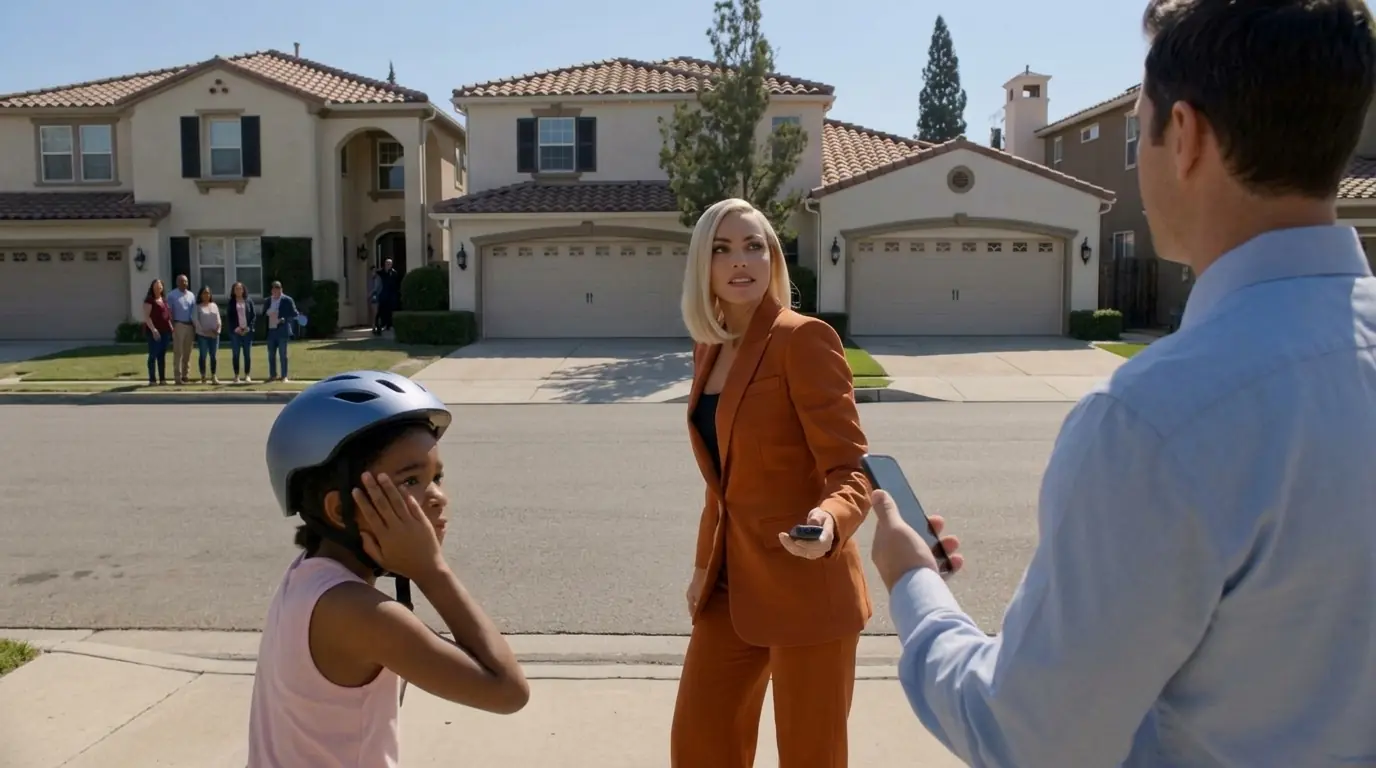
HOA President Grabbed a Girl’s Bike and Slapped Her — Then the Police Asked, “Who Gave You That Authority?”
The sound reached Marcus Hill before the scream did.
A flat, sharp crack.
Wrong sound.
Human sound.
He turned from the open garage and saw his twelve-year-old daughter standing in the street with one hand pressed against her cheek.
Her bicycle lay on its side.
The front wheel was still spinning.
Beside her stood Cynthia Parker.
President of the Briar Glen Homeowners Association.
Fifty-nine years old.
White visor.
Running shoes.
Yoga pants.
Phone clipped to one hand.
And an expression that said she still believed she was the person in charge.
Marcus did not remember dropping the wrench.
He only remembered running.
His younger daughter, Tessa, was screaming.
“Dad!”
Marcus reached them in seconds.
“What happened?”
His oldest, Ava, looked at him with tears in her eyes.
“She hit me.”
Marcus looked at Cynthia.
Cynthia crossed her arms.
“She was told not to ride here.”
For one second, Marcus could not process the sentence.
Not because he had not heard it.
Because it was too small for what had just happened.
He stepped between Cynthia and his daughters.
“You hit my child?”
Cynthia lifted her chin.
“She ignored a safety restriction.”
Marcus stared.
“What restriction?”
“The bike restriction.”
“There is no bike restriction.”
“There is now.”
That was when Marcus understood this was not an accident.
Not an emotional mistake.
Cynthia believed the HOA gave her personal authority over his daughter.
Marcus reached for his phone.
Not Cynthia.
His phone.
He dialed 911.
Cynthia’s expression changed.
“Don’t be dramatic.”
Marcus put the call on speaker.
“My twelve-year-old daughter was struck in the face by an adult neighbor.”
Cynthia stepped forward.
“I did not assault anyone.”
The dispatcher asked for the address.
Marcus gave it.
Ava was still crying.
Her cheek was turning red.
Tessa had picked up the bicycle and was holding it between herself and Cynthia like a shield.
Marcus said,
“Stay behind me.”
Cynthia pointed toward the girls.
“This is exactly the problem. No respect for authority.”
Marcus looked at her.
“You are not their authority.”
That was the beginning.
But not the real beginning.
The real beginning had started three weeks earlier with a scratch on Cynthia’s Lexus.
Nobody knew how it happened.
The SUV was parked partly over the curb near the community mailbox.
Cynthia discovered a four-inch mark along the rear passenger door and immediately decided a bicycle had caused it.
Not any bicycle.
A child’s bicycle.
She posted photographs in the neighborhood group.
WHOSE CHILDREN ARE RIDING TOO CLOSE TO CARS?
Then:
THIS WILL NOT BE TOLERATED.
Then:
HOA SAFETY REVIEW IN PROGRESS.
Marcus ignored it at first.
He lived at Briar Glen because it was boring.
That was the point.
He was forty-one.
Widowed.
Two daughters.
Ava, twelve.
Tessa, nine.
He worked as an electrical systems supervisor for the city transit authority.
Long days.
Emergency calls.
Enough workplace conflict.
Home was supposed to be simple.
His wife, Danielle, had died four years earlier after a sudden illness.
Since then, Marcus had built family routines with almost military consistency.
Breakfast.
School.
Work.
Homework.
Dinner.
Friday movie.
Saturday bikes.
The bikes mattered.
Danielle had taught both girls to ride.
Ava still had the purple helmet her mother bought before she got sick.
Marcus could not look at it without remembering the day Ava finally stopped wobbling.
Danielle running behind her.
Laughing.
Let go.
You’re doing it.
Ava riding ten more feet before realizing no one was holding the seat.
Then crashing into a hedge.
Family memory.
Ordinary.
Precious.
That was why Marcus noticed immediately when Cynthia’s complaints moved from vague posts to names.
At the next HOA meeting, she stood behind a folding table in the clubhouse and announced a “temporary bicycle safety restriction.”
No bicycles on interior neighborhood streets until the board reviewed the issue.
One board member frowned.
“When did we vote on that?”
Cynthia looked annoyed.
“It’s temporary.”
“That wasn’t my question.”
Another member, Denise Walker, opened the bylaws.
“I don’t see authority for unilateral road-use restrictions.”
Cynthia waved her off.
“This is about safety.”
Marcus sat in the second row.
He raised his hand.
“Are public streets maintained by the city?”
Silence.
Everyone knew the answer.
Yes.
Briar Glen’s streets were municipal.
The HOA controlled common landscaping, architectural standards, pool rules, private amenities.
Not city streets.
Cynthia said,
“The HOA has an obligation to protect residents.”
Marcus nodded.
“Then recommend helmets.”
A few people laughed.
Cynthia’s face tightened.
Marcus continued.
“You can’t ban bicycles from a public road.”
Cynthia pointed at him.
“Your children are part of the problem.”
The room changed.
Marcus lowered his hand.
“What problem?”
“They ride too close to parked vehicles.”
“Do you have video?”
“No.”
“Witnesses?”
“I’ve seen them.”
“Hit your car?”
“They were nearby.”
“That’s not the same thing.”
Cynthia’s voice sharpened.
“You don’t get to interrogate me.”
Marcus smiled slightly.
“I’m asking for evidence.”
The board voted that night.
Four to one against Cynthia’s proposed restriction.
No bike ban.
No special enforcement.
Cynthia lost.
That should have ended it.
Instead, she created her own version.
The next morning, residents received an email from the HOA account.
BICYCLE SAFETY NOTICE.
Children should refrain from riding on neighborhood streets pending safety review.
Not a rule.
But formatted like one.
Marcus forwarded it to Denise.
Did the board approve this?
Denise replied:
No.
Marcus saved the email.
That turned out to matter.
The following Saturday, Ava and Tessa asked to ride.
Marcus hesitated.
Not because Cynthia had authority.
Because he did not want drama.
Then he saw Cynthia’s grandchildren riding scooters in front of her house.
No helmets.
Fast.
No one stopping them.
That irritated him more than he wanted to admit.
He looked at his daughters.
“Helmets.”
Ava smiled.
“That means yes?”
“It means helmets.”
Tessa screamed.
Within minutes, they were outside.
Marcus stood in the driveway drinking coffee while the girls rode a loop from their house to the cul-de-sac and back.
No cars.
No danger.
Then Cynthia came outside.
She wore a visor and carried her phone.
Marcus saw her before the girls did.
She stepped toward the curb.
“Ava.”
Ava slowed.
Cynthia pointed.
“Off the bicycle.”
Ava looked toward Marcus.
He started walking.
Ava said,
“My dad said I can ride.”
Cynthia stepped into the street.
“I am the HOA president.”
Ava stopped the bike completely.
Marcus called,
“Cynthia, leave her alone.”
Cynthia ignored him.
She grabbed the handlebar.
Ava said,
“Let go.”
Cynthia pulled.
The front wheel turned sharply.
Ava lost balance and put one foot down.
Marcus started running.
Then Cynthia said,
“You children need to learn respect.”
Ava reached for the handlebar.
“Give it back.”
The slap happened.
Sharp.
Fast.
Ava’s head turned.
The bicycle fell.
Then the scream.
Now police were coming.
Cynthia was still talking.
“You should have taught them not to challenge adults.”
Marcus’s hands were shaking.
He forced them open.
Not fists.
Open.
He knew exactly how the scene could look if he touched her.
Large Black father.
White HOA president.
Crying children.
Phones coming out.
Narratives form quickly.
He said,
“Do not come closer.”
Cynthia laughed.
“You’re threatening me.”
“No.”
“I’m setting distance.”
A neighbor, Mrs. Patel, had come outside.
She held up her phone.
“I saw the whole thing.”
Cynthia turned.
“No, you didn’t.”
Mrs. Patel said,