The water came through the asphalt eleven days after the Hawthorne Ridge Homeowners Association opened its brand-new entrance road.
At first, nobody understood what they were looking at. A delivery driver noticed the first dark patch around five in the morning and assumed one of the new irrigation heads beside the landscaped median had been left running.
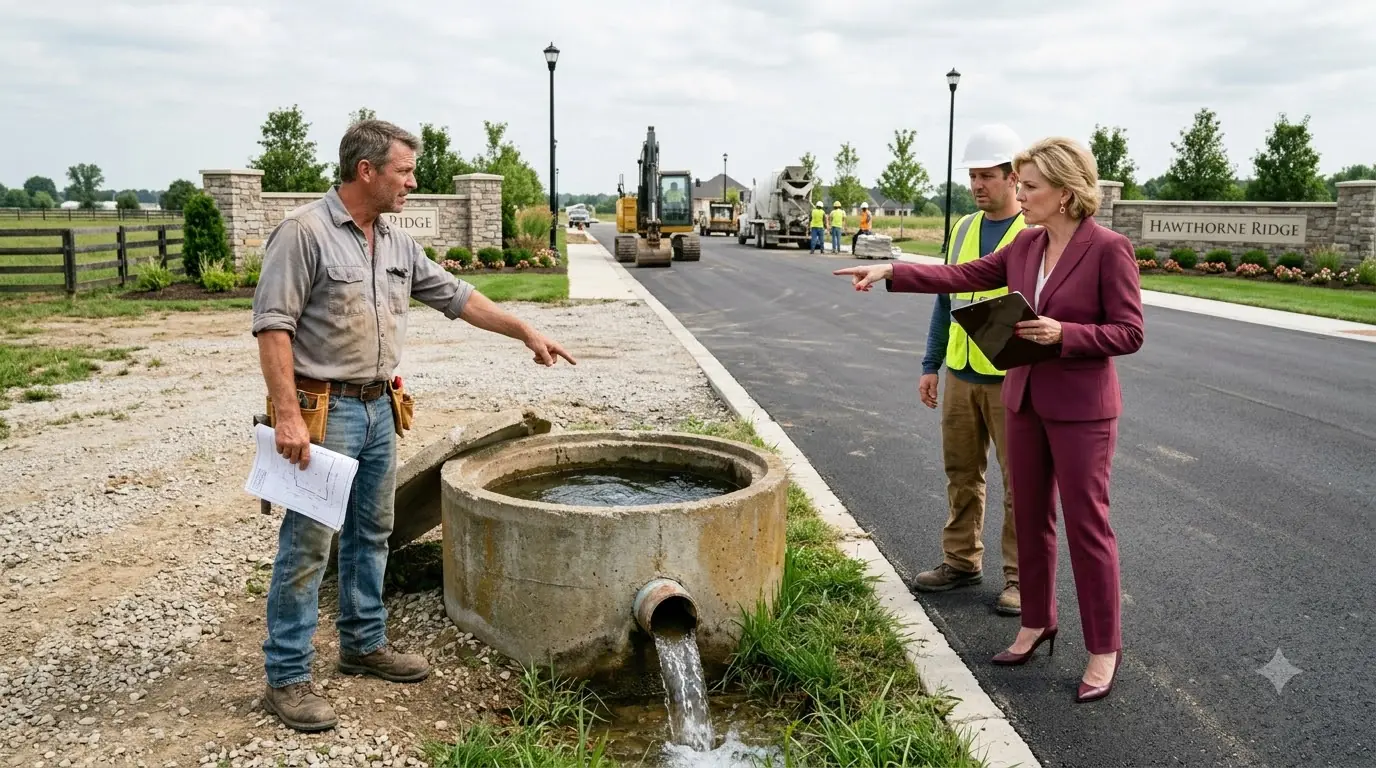
By sunrise, however, the pavement was still wet even though the irrigation system had been shut off, and tiny bubbles had begun appearing along the fresh asphalt seam beside the eastbound lane.
By eight, cold groundwater was pushing visibly through cracks in a road that had barely seen two weeks of traffic.
By noon, one section of pavement had lifted enough that a county road inspector could slide the edge of his clipboard beneath it.
That was when Cynthia Rowe stopped calling it my irrigation leak.
She stood beside the curb in a dark pink suit and expensive heels while muddy water curled around her shoes. A road crew behind her was cutting open the same pavement Hawthorne Ridge had spent months celebrating, and every few minutes another dump truck arrived to haul away material that had been installed less than a month earlier.
Cynthia turned toward me as though I had hidden a pipe under the road during the night.
“What did you do?”
“Nothing.”
“You expect me to believe that?”
“Yes.”
Her eyes narrowed.
“You’ve been complaining about this project for months.”
“I complained about you filling an active artesian well on my property.”
“It was abandoned.”
“It was flowing the day you covered it.”
She looked toward the excavation.
“That has nothing to do with this.”
I nodded toward the water coming through the fresh road base.
“Then you should have no problem proving it.”
Six days earlier, Cynthia had ordered a contractor to seal the old flowing well at the edge of my land because she considered it an abandoned safety hazard.
I warned her.
I showed her the water.
I showed her the overflow pipe.
I told her something I had learned repairing pumps, irrigation systems, and rural water equipment for more than thirty years.
Pressurized groundwater does not stop existing because somebody pours concrete over the place where it reaches daylight.
Cynthia smiled at me that afternoon and said:
“Modern drainage will handle it.”
Now modern drainage was being cut apart with diamond saws.
Three days later, a county water-resources inspector would uncover a well record dating back to 1957. A geotechnical engineer would find saturated aggregate beneath the new pavement. And the contractor who had altered the well would eventually produce an email containing the one question Cynthia should have answered before anyone touched the structure.
Do we have an approved well-abandonment plan for this structure?
They did not.
My name is Owen Parker.
I was fifty-four years old when this happened, and I made my living repairing irrigation pumps, agricultural wells, greenhouse control systems, and the sort of old rural water equipment most people ignore until it stops working.
I was not a hydrogeologist.
I was not a civil engineer.
I did not pretend to be either.
But I had spent enough years around wells and pumps to understand the difference between machinery creating pressure and geology creating pressure.
An ordinary pumped well stays quiet when you shut off the pump.
An artesian source can be different.
If the underground formation has enough natural hydraulic pressure, water rises whether anyone wants it to or not.
The old well on my property had been doing exactly that since before Hawthorne Ridge existed.
The land itself was older than the neighborhood by generations.
My grandfather, Wesley Parker, bought the farm in 1953.
At the time, the nearest paved road ended nearly two miles away. The property covered almost one hundred acres of pasture, vegetable ground, and timber, with a farmhouse, two barns, a livestock pond, and a spring-fed drainage swale crossing the western field.
The artesian well was drilled four years later.
I grew up hearing it called the flowing well.
Nobody called it artesian because nobody needed a technical word for something everyone understood.
Water came up by itself.
That was enough.
The original driller hit a confined water-bearing layer deeper than anyone expected. The pressure was strong enough to raise water above ground elevation without a pump, though it was never a geyser and never looked dramatic.
My grandfather built a concrete collection vault around the casing.
Water entered the vault.
A buried overflow pipe carried the excess downhill into a grass swale.
From there, it dispersed slowly through pasture before reaching a seasonal ditch.
Simple.
Quiet.
Reliable.
By the time I was a boy, my grandfather had connected the well to stock troughs and garden irrigation.
My father later installed a separate domestic well closer to the house because the old system was inconvenient during winter.
The flowing well remained.
When the farm was gradually sold off after my grandparents died, I kept a little over five acres surrounding the farmhouse, shop, and western pasture strip.
The old well sat near the eastern boundary.
For decades, it caused no problem.
The vault had a heavy locking lid.
The overflow line remained open.
I checked it every spring and fall.
Leaves collected near the outlet.
Roots occasionally grew into the swale.
Once every few years, sediment accumulated in the vault.
That was maintenance.