The first thing Nolan Vance noticed when he entered the Blackbird Diner was how quickly thirty-two grown men could become silent.
The second was the way the man at the head of the table looked at the photograph Nolan had brought.
His huge hands, hands that seemed capable of lifting an engine block without assistance, closed around the faded paper and began to tremble.
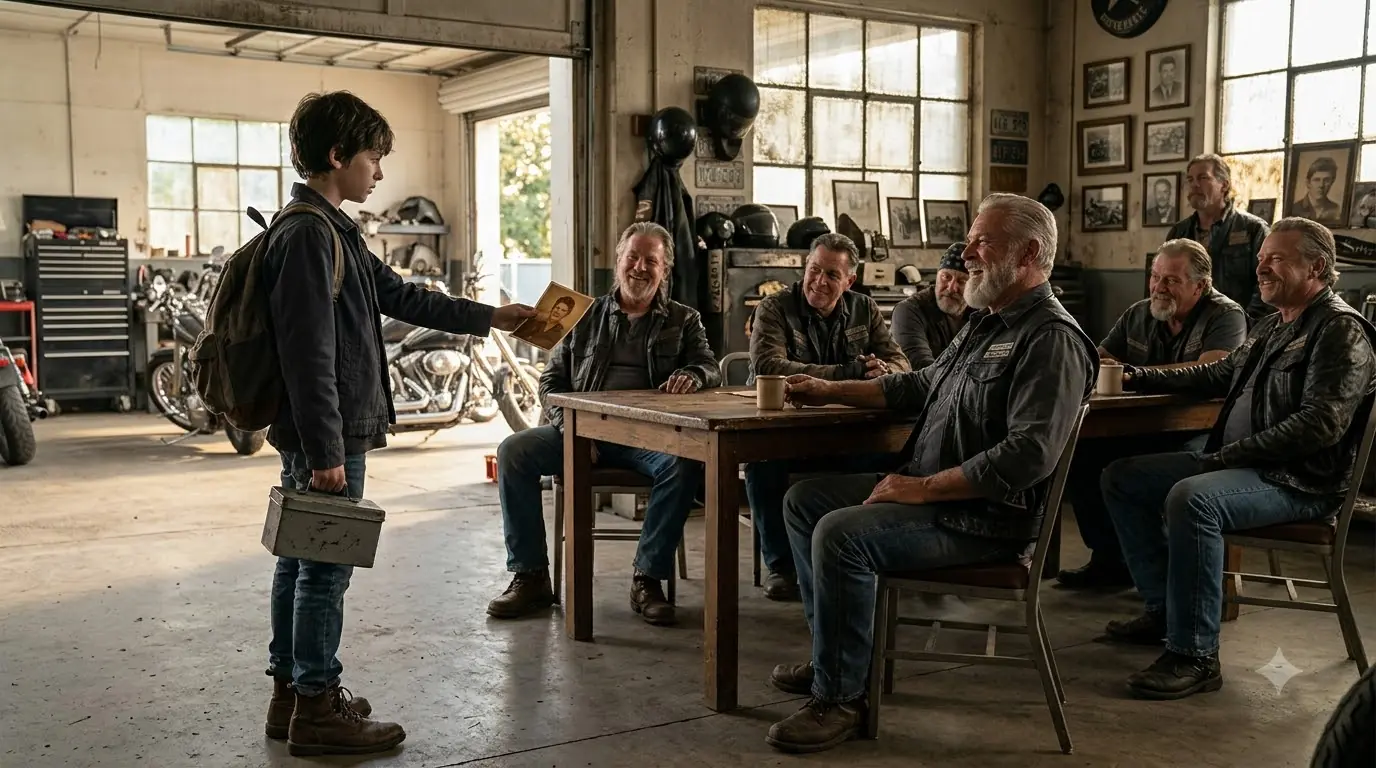
Nolan had come looking for an explanation about a father he believed had abandoned him.
He did not yet understand that he had carried twenty-two years of unfinished history into the room.
He was twenty-six, exhausted, and wearing the same dark work jacket he had worn to his mother's funeral eleven days earlier. His truck was nearly out of gas, his bank account was almost empty, and he had slept perhaps four hours the previous night. None of that mattered to the man studying the photograph. The biker's eyes had settled on the broad-shouldered figure standing beside a little boy, and for an instant he looked like someone hearing a voice from a grave. Nolan had rehearsed an opening question during the drive, but what emerged was simpler. "I found my dad's patch," he said.
To understand why those words mattered, Nolan would have had to begin four days earlier, in a storage unit on the industrial edge of the county. He would have had to explain the smell of old cardboard and machine oil, the fluorescent tube that flickered above him, and the small gray metal box that his mother had managed to keep hidden through years of unpaid bills and repeated moves. Most of all, he would have had to explain Carla Vance, a woman who had told her son almost everything about surviving and almost nothing about where he came from. The truth was that Nolan was still trying to understand her himself.
On Monday morning the manager of the storage facility had called to remind him that Carla's rental agreement would end on Sunday. He had spoken kindly enough, but kindness did not change the date. Carla's hospital bills had already consumed what remained of her savings, and Nolan had paid for the funeral by dividing the cost among two cards and money borrowed from a former coworker. The storage unit contained furniture no one wanted, appliances too old to sell, and boxes filled with an ordinary lifetime. Four days to empty it seemed possible until Nolan lifted the door and saw how much of his mother existed behind it.
He began with the kitchen things because they required the least thought. A stack of chipped plates went into a donation carton. A set of glass bowls went into the truck because he remembered Carla using them to serve soup whenever he came home sick from school. He threw away expired coupons, batteries that had leaked into their packaging, and a calendar from a year in which nothing memorable had happened. Then he opened a shoebox and found every birthday card he had ever given her, including one on which six-year-old Nolan had spelled his own name incorrectly. He sat on an overturned crate and held the card until the afternoon light under the metal door changed color.