I Saw My Neighbor’s Wife Having Dinner With Another Man—Then She Told Me Who He Really Was....
Last week, I saw my neighbor’s wife having dinner with another man.
They were sitting in the corner of a quiet Italian restaurant nearly twenty miles from our neighborhood.
Far enough away that they probably believed no one they knew would see them.
The man leaned across the table and held both of her hands.
She smiled at him.
Not politely.
Not like someone speaking to a coworker.
It was the kind of smile people saved for someone who knew them deeply.
Someone they trusted.
Someone they loved.
My neighbor, Ben Carter, had always been a decent guy.
He helped me repair my fence after a storm.
He brought groceries when my wife was recovering from surgery.
Every winter, he cleared the sidewalk in front of the elderly couple’s house before touching his own driveway.
He loved his wife, Rachel, openly.
Watching her hold another man’s hands made my blood boil.
I decided I would tell Ben everything.
Then, before I had the chance, I ran into Rachel at a coffee shop.
She walked directly toward me.
“I know you saw me last week,” she said quietly.
I stared at her.
Rachel glanced toward the crowded tables around us.
Then she lowered her voice.
“That wasn’t what you think.”
I almost laughed.
People always said that when something looked exactly like what it was.
She took a deep breath.
“It was my husband.”
My expression must have changed because she quickly added:
“Not Ben.”
The coffee shop suddenly felt smaller.
Rachel looked toward the door.
“The man you saw was my first husband.”
I knew Ben and Rachel had been married for eleven years.
I had never heard about another husband.
I looked at her wedding ring.
“Ben knows?”
Her eyes filled with fear.
“No.”
That answer made the situation worse.
I stepped away from her.
“You need to explain.”
Rachel nodded.
“I will.”
Then she said the sentence that turned a possible affair into something much more dangerous.
“My first husband died fifteen years ago.”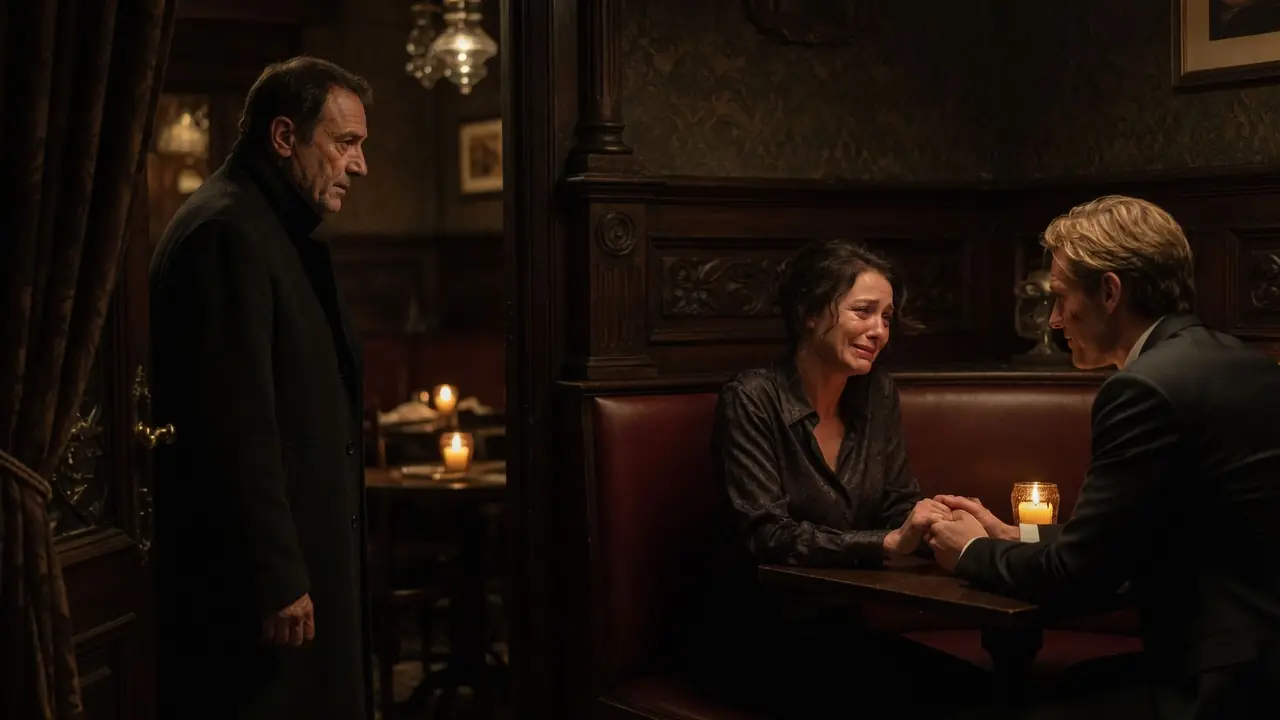
My wife, Melissa, and I had lived beside Ben and Rachel Carter for seven years.
They moved into the blue house next door during a rainy weekend in October.
Ben introduced himself before the moving truck had finished unloading.
He brought over a six-pack of beer and apologized in advance for any noise.
Rachel appeared later carrying a tray of brownies.
They seemed almost unnaturally well matched.
Ben was outgoing.
Rachel was quieter.
He told stories.
She remembered details.
He liked loud music and weekend projects.
She preferred gardening and old books.
They had one daughter, Lily, who was eight when they moved in.
Lily looked like Rachel around the eyes but had Ben’s broad smile.
At least, that was what everyone said.
The Carters became the kind of neighbors people hoped for.
We exchanged spare keys.
Watched one another’s houses.
Shared meals during power outages.
When Melissa needed emergency surgery, Rachel stayed at the hospital with me until nearly dawn.
Ben picked up our children from school.
I trusted them.
That was why seeing Rachel with another man felt personal.
It was not my marriage.
But betrayal had a way of spreading beyond the people directly involved.
It made every shared dinner and friendly conversation feel dishonest.
The restaurant encounter happened because of work.
I had driven across the city to meet a client.
The meeting ended early.
I stopped at a restaurant I used to visit with Melissa before we had children.
The dining room was dim and crowded.
I was being led to a table when I saw Rachel.
She wore a dark green dress I had never seen before.
The blond man opposite her was perhaps fifty.
Tall.
Well dressed.
There was a scar near his left temple.
He held Rachel’s hands.
She was crying.
Then she began laughing through the tears.
At one point, he reached across and touched her cheek.
I turned away before she saw me.
My appetite disappeared.
I left without ordering.
That evening, Ben was outside washing his truck.
He raised a hand when I pulled into my driveway.
“Daniel.”
I almost told him immediately.
Then Lily came running from the house.
She was fifteen now.
She handed her father a towel and complained that he was spraying water onto her shoes.
Ben laughed.
Rachel appeared in the doorway.
For a second, our eyes met.
She looked normal.
Calm.
Nothing in her face suggested she had spent the previous evening holding hands with another man.
I said nothing.
I told myself I needed to be certain.
A restaurant dinner did not automatically prove an affair.
People met relatives.
Old friends.
Colleagues.
But the intimacy between them had not looked friendly.
I knew what I saw.
For three nights, I rehearsed how to tell Ben.
Every version sounded cruel.
Then I saw Rachel at the coffee shop.
The moment she admitted the man was her supposedly dead first husband, I forgot about Ben’s possible betrayal.
I began wondering whether I should call the police.
“You told everyone he died?”
“I believed he did.”
“That’s not the same thing.”
“No.”
“Who is he?”
Rachel looked toward the tables again.
“His name is Aaron Mercer.”
“And you married him?”
“When I was twenty-one.”
“Why does Ben not know?”
“Because I was told Aaron was dead before I ever met Ben.”
I folded my arms.
“You were holding his hands.”
“He was showing me something.”
“He touched your face.”
“He was checking a scar.”
“That sounds ridiculous.”
“I know.”
Rachel closed her eyes.
“Please give me ten minutes.”
I should have walked away.
Instead, I followed her to a table in the corner.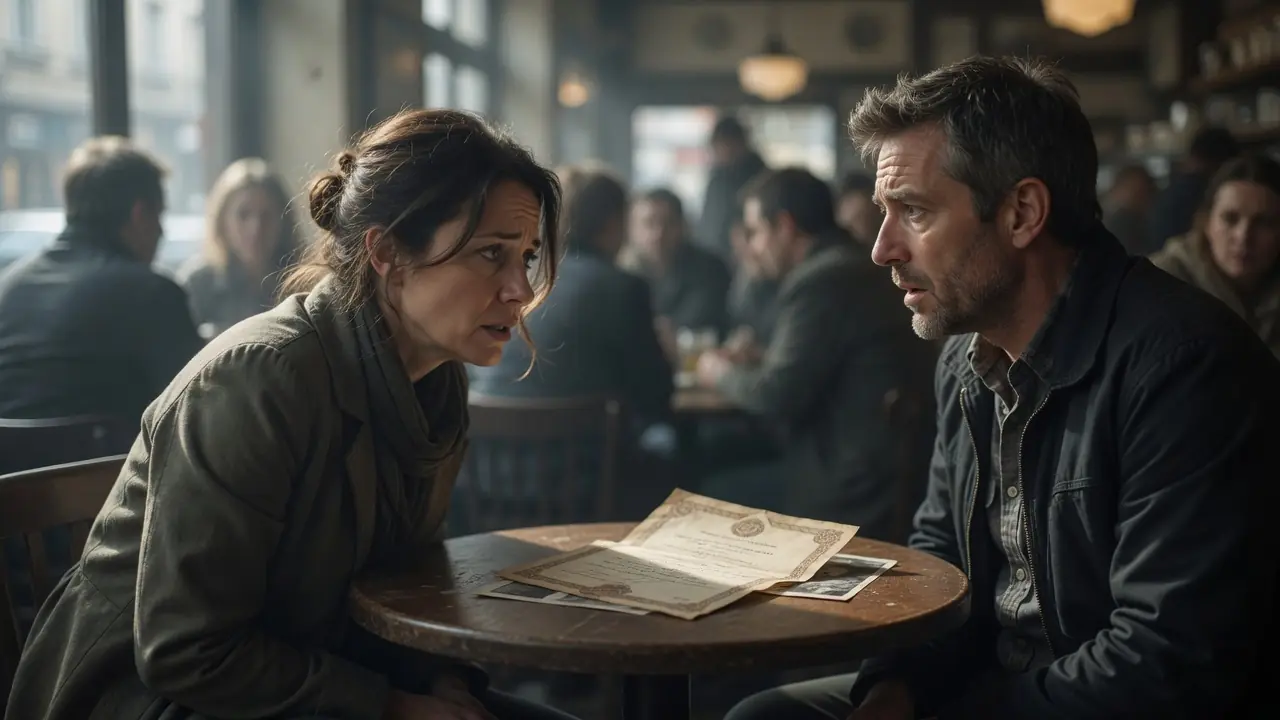
Rachel met Aaron when she was nineteen.
They both grew up in the same coastal town.
Aaron joined the Navy after high school.
Rachel attended nursing school.
They married during a courthouse ceremony before his second deployment.
Only four people attended.
They planned a larger wedding when he returned.
That wedding never happened.
Aaron’s ship was not attacked.
He did not disappear during a classified mission.
The truth was less dramatic and somehow more disturbing.
During an overseas assignment, Aaron suffered a severe head injury in a vehicle accident.
He was transported between military and civilian hospitals.
His identification was damaged.
Administrative records were confused with those of another sailor who died during the same incident.
Rachel received official notification that Aaron had been killed.
There was a funeral.
A folded flag.
A closed coffin.
She grieved him.
Years later, she moved away.
Eventually, she met Ben.
“People don’t accidentally declare living service members dead for fifteen years,” I said.
“They didn’t.”
Rachel’s voice dropped.
“Aaron’s father made sure the mistake stayed a mistake.”
I stared at her.
“Why?”
“Money.”
Aaron came from a wealthy family.
His father, Charles Mercer, owned a regional shipping company.
Aaron had one younger brother, Grant.
According to Rachel, Charles never approved of their marriage.
He considered her poor, impulsive, and unsuitable.
Before Aaron’s deployment, he had rewritten part of his estate plan.
If anything happened to him, Rachel would inherit certain family shares and a significant life insurance policy.
When the accident occurred, Aaron remained unconscious for months.
His father discovered the identification error before Rachel did.
Instead of correcting it, Charles told hospital administrators that Aaron had suffered extensive memory loss and required private long-term care.
He moved his son to a rehabilitation facility under his middle name.
Then he pressured Rachel into signing insurance and estate papers she barely understood.
She believed she was a widow.
Charles gained control of Aaron’s assets.
Grant became the sole future heir.
Aaron eventually woke.
But he could not remember his full identity.
He knew fragments.
A name.
A house near the ocean.
A woman with dark hair.
He remained in care for years.
His father told him Rachel had abandoned him after the accident.
Then Charles moved him again.
When Aaron’s memory slowly returned, he began searching.
His father died two years earlier.
Grant continued hiding the truth.
Only after finding old military records and sealed letters did Aaron discover Rachel’s current name.
He contacted her three weeks before I saw them at dinner.
I did not know what to believe.
Rachel spoke calmly, but the story sounded impossible.
“Why not tell Ben immediately?”
“I was trying to understand whether Aaron was really who he claimed.”
“And now?”
“He is.”
“You confirmed it?”
“Fingerprints. Military records. DNA through his aunt.”
“Then Ben needs to know.”
“I know.”
“When?”
Rachel looked down at her coffee.
“After I speak to a lawyer.”
“That sounds like delay.”
“It’s not only emotional.”
“What does that mean?”
She removed a folded document from her handbag.
It was a copy of an old marriage certificate.
Rachel Ellis and Aaron James Mercer.
The date was seventeen years earlier.
“If Aaron was alive,” she said, “I may never have been legally free to marry Ben.”
I looked at her.
The implications reached far beyond embarrassment.
Her marriage to Ben could be invalid.
Property.
Insurance.
Taxes.
Parentage.
Every part of their life might be affected.
Then I remembered Lily.
“How old is your daughter?”
“Fifteen.”
I already knew that.
I was asking something else.
Rachel understood.
“Aaron is her biological father.”
I stood so quickly that my chair struck the wall.
Several customers turned.
Rachel reached toward me.
“Please.”
“Ben thinks Lily is his daughter.”
“He is her father.”
“That wasn’t my question.”
Her face tightened.
“I was pregnant when Aaron was declared dead.”
“You knew?”
“I found out after the funeral.”
“And Ben?”
“I told him Lily’s biological father had died.”
That part was technically true.
At least, Rachel believed it at the time.
But Ben had raised Lily since she was two.
She called him Dad.
He had attended every school event.
Taught her to ride a bicycle.
Stayed awake beside her when she was sick.
Now a man thought dead had returned.
A man who was both Rachel’s legal husband and Lily’s biological father.
I felt anger rise again.
Not because Rachel had created the original lie.
Because she was still keeping Ben outside the truth.
“You need to tell him today.”
“I can’t.”
“You can.”
“Aaron asked me for two days.”
“Why?”
“He believes someone is following him.”
I almost laughed again.
Then Rachel showed me a photograph.
A black sedan parked outside the restaurant.
The same vehicle appeared in another image outside her workplace.
“Grant knows Aaron found me,” she said. “If Aaron proves he was alive, Grant could lose control of millions.”
“Have you gone to the police?”
“Aaron has.”
“And?”
“They say the car alone proves nothing.”
“What exactly does Aaron want from you?”
Rachel’s eyes moved toward the door.
“He wants me and Lily to disappear with him.”
That answer changed everything again.
I drove home unsettled.
Ben was in his garage repairing a lawn mower.
He waved.
I pretended not to see him.
For the first time in seven years, I went inside without stopping to speak.
Melissa noticed immediately.
“What happened?”
I told her everything.
She listened without interrupting.
When I finished, she said, “You have to tell Ben.”
“Rachel asked for time.”
“Rachel has had three weeks.”
“She may still be legally married to Aaron.”
“That gives Ben more reason to know.”
“What if Aaron is dangerous?”
“What if Rachel is lying?”
I had considered that too.
Melissa continued.
“You are carrying information that affects Ben’s home, marriage, and child. He deserves the chance to decide what to do with it.”
“She said there may be financial crimes.”
“Then she should involve law enforcement.”
“She claims she has.”
Melissa looked toward the window.
Ben’s garage light remained on.
“You were ready to tell him when you thought she was cheating.”
“Yes.”
“Why does a more complicated truth make silence acceptable?”
It didn’t.
I knew that.
The next morning, I planned to speak with Ben.
Before I could, police vehicles arrived at the Carters’ house.
Not with sirens.
Two unmarked cars.
An officer spoke to Rachel on the porch.
Ben stood beside her wearing an expression I had never seen before.
Not anger.
Confusion.
Lily watched through the window.
Rachel looked toward my house.
She knew I was watching.
Ten minutes later, Ben crossed the lawn.
He knocked once and entered when I opened the door.
“Did you know?”
There was no point pretending.
“I saw her with him.”
“When?”
“Last week.”
“You didn’t tell me?”
“I planned to.”
“When?”
I could not answer.
Ben laughed bitterly.
“My wife has a living husband, my daughter has a biological father I was told was dead, and the neighbor I trusted decided I needed more time.”
“I’m sorry.”
“No, you’re not.”
He was right.
At that moment, I was mostly relieved the truth had reached him without my involvement.
That was cowardice.
“What did the police say?”
Ben looked toward his house.
“Aaron Mercer was attacked last night.”
Someone followed Aaron from his hotel.
He was forced off the road.
The car struck a barrier.
Aaron survived with minor injuries.
Before the crash, he called Rachel.
That was why she finally told Ben everything.
Police believed the incident might connect to the Mercer family’s financial dispute.
Grant Mercer denied involvement.
He claimed Aaron was mentally unstable and had been trying to extort money from the family.
Aaron’s medical history made the accusation effective.
Years of rehabilitation.
Memory loss.
Psychiatric evaluations.
Guardianship orders signed by his father.
On paper, Aaron appeared confused and dependent.
In person, he was coherent.
But proving what happened over fifteen years required documents held by the same family that benefited from his disappearance.
Ben asked me to come over.
Not because he forgave me.
Because Rachel wanted a witness she considered neutral.
We sat in their living room.
Lily was upstairs with Melissa.
Rachel placed documents across the coffee table.
Marriage certificate.
Death notification.
Hospital files.
Photographs.
Letters Aaron had written during rehabilitation but never mailed.
Ben looked through everything without speaking.
When he reached Lily’s birth certificate, he stopped.
His name appeared under father.
He had legally adopted her when she was four.
That part remained valid.
But emotionally, the truth was destroying him.
“You met him three times?” Ben asked.
“Yes.”
“And held his hands?”
“He has nerve damage. His fingers shake when he’s overwhelmed.”
“You let him touch your face.”
“He was looking at the scar near my eyebrow.”
“What scar?”
Rachel pointed to a faint line I had never noticed.
“Aaron was with me when I got it. He was confirming a memory.”
Ben stood.
“You could have called me.”
“I was afraid.”
“Of me?”
“Of losing everything.”
“You lost it when you decided I couldn’t handle the truth.”
Rachel began crying.
Ben walked out.
For the next several days, the neighborhood became filled with unfamiliar cars.
Reporters discovered Aaron’s story.
A missing heir.
A false death.
A hidden marriage.
A possible financial conspiracy.
The Mercer family issued a statement claiming Aaron had suffered a tragic injury and that his father had acted according to medical advice.
They denied hiding him.
They also denied any connection to the crash.
Grant appeared on television looking concerned.
He described his brother as vulnerable.
He asked the public not to encourage “confused allegations.”
Aaron responded through an attorney.
The attorney produced evidence that Charles Mercer had known Aaron’s identity within weeks of the accident.
Private hospital payments came from a Mercer company.
Letters from Rachel were intercepted.
Several estate transfers occurred while Aaron lacked independent counsel.
The situation became a federal investigation involving fraud, insurance, guardianship abuse, and falsified records.
Ben moved into a hotel.
Rachel remained in the house with Lily.
Aaron did not stay with them.
He entered protective housing while investigators reviewed the attack.
That mattered.
Part of me had assumed Rachel wanted Aaron back.
She didn’t know what she wanted.
The man she had loved at twenty-one was alive.
But he had returned as a stranger carrying fragments of their old life.
Ben was the man who raised her child and shared eleven years with her.
Neither relationship could simply resume.
Lily learned the truth from Rachel and Ben together.
I was not present.
Later, Melissa told me Lily came to our house crying.
She asked whether Ben was still her father.
Melissa said yes.
She asked whether Aaron was also her father.
Melissa said biologically, yes.
Lily asked which one she was supposed to love.
That question broke everyone.
Children suffer when adults treat love like a legal category.
Ben avoided me for weeks.
I did not blame him.
I had betrayed his trust through delay.
One evening, I found him sitting on the curb outside his house.
The sun had set.
Rachel and Lily were inside.
I sat several feet away.
“You should have told me,” he said.
“Yes.”
“I keep thinking about that dinner.”
“I’m sorry.”
“You thought she was cheating.”
“Yes.”
“And then she gave you a complicated story, so you let her decide what I could handle.”
“Yes.”
He looked at me.
“That’s exactly what she did.”
I had no defense.
After a while, he asked, “Did they look in love?”
The question was painful.
“They looked emotional.”
“That isn’t what I asked.”
“I don’t know.”
He nodded.
That was the most honest answer I could give.
The investigation lasted nearly a year.
Grant Mercer was eventually charged with financial fraud, obstruction, and conspiracy related to the concealment of Aaron’s legal status.
Evidence showed he knew his brother was alive for years.
He used guardianship arrangements and false medical claims to maintain control over company shares.
The road incident was connected to a private security contractor hired through one of Grant’s businesses.
The intent appeared to be intimidation, not murder.
But the result could have been fatal.
Several former administrators cooperated.
The official death record was corrected.
Aaron regained control of part of his estate.
He also received substantial compensation from institutions that had allowed his identity to be hidden.
No amount of money returned fifteen years.
Rachel’s legal situation was complicated but not criminal.
She had married Ben in good faith, believing Aaron was dead.
The state recognized protections for putative spouses.
Ben’s adoption of Lily remained intact.
Their property could be divided legally if they separated.
The hardest questions were not legal.
They were personal.
Rachel’s first marriage had never truly ended.
But the husband who returned was not the man she remembered.
Ben’s marriage had been real in every emotional sense.
But it began inside a false legal reality.
Everyone wanted a clean answer.
There wasn’t one.
Rachel and Ben entered counseling.
Aaron began therapy focused on trauma, identity, and long-term coercive control.
Lily met Aaron slowly.
The first meeting happened in a therapist’s office.
Aaron brought no gifts.
He did not ask her to call him Dad.
He showed her a photograph of Rachel when she was twenty.
Lily laughed at her mother’s haircut.
That broke some of the tension.
Aaron told her:
“Ben is your father. I am someone who lost the chance to know you. I hope I can earn a place that doesn’t take anything away from him.”
When Ben heard that, something in him softened.
Not enough to remove the pain.
Enough to make cooperation possible.
Rachel never resumed a romantic relationship with Aaron.
That surprised many people.
They expected the story to become a reunion.
A lost husband returning.
A love restored.
Real life was not that simple.
Aaron and Rachel grieved the marriage they had lost.
They spoke about the past.
Visited the town where they grew up.
Returned to the courthouse where they married.
Then they filed legal documents ending the marriage formally.
Aaron said:
“I spent fifteen years trying to get back to the life they took from me. I didn’t understand that the life had kept moving.”
Rachel cried.
So did he.
Then they signed.
Ben and Rachel separated for eight months.
He needed distance.
She needed to accept that fear did not justify excluding him.
Eventually, they began again.
Not by pretending nothing happened.
By rebuilding from the truth.
Ben moved home.
They renewed their vows privately two years later.
Only Lily, Aaron, Melissa, and I attended.
I was surprised to receive an invitation.
Before the ceremony, Ben pulled me aside.
“I’m still angry you waited.”
“I know.”
“But you stayed when everything became ugly.”
“I owed you that.”
He nodded.
“Next time, tell me sooner.”
“There will not be a next time.”
For the first time in years, he smiled at me normally.
Aaron became part of Lily’s life.
Not as a replacement.
As Aaron.
She called him by his name.
They shared interests Ben did not.
Photography.
Sailing.
Old music.
Ben taught her to drive.
Aaron taught her to navigate by stars.
Rachel stopped asking which relationship mattered more.
Different love did not need identical titles.
One afternoon, several years later, I saw Rachel and Aaron having lunch.
They sat outside a café.
No secrecy.
No hidden corner.
Ben joined them ten minutes later.
Lily arrived last.
Four people connected by loss, betrayal, biology, and choice.
From a distance, they almost looked ordinary.
But ordinary families often contain impossible histories.
The difference was that this one no longer survived through secrets.
I still think about the coffee shop.
Rachel walking toward me.
“I know you saw me.”
Her fear.
My certainty.
I believed I understood what was happening because I recognized the shape of betrayal.
A married woman.
Another man.
Hands touching.
A hidden dinner.
But context can transform the same image completely.
The man was not a lover she had chosen behind Ben’s back.
He was the husband she had buried fifteen years earlier.
The biological father of her daughter.
The victim of a family that profited from keeping him legally dead.
That did not make Rachel’s secrecy right.
It only made the truth more complicated than the judgment I had already formed.
When she paused and said, “It was my...”
I expected brother.
Cousin.
Coworker.
Maybe therapist.
I never expected:
“My husband.”
I certainly never expected her to add:
“The one I was told died.”
That secret nearly destroyed two families.
Not because Aaron returned.
Because too many people believed they had the right to control who received the truth.
Charles controlled Aaron.
Grant controlled the records.
Rachel tried to control Ben’s reaction.
I helped her do it by delaying.
Every person claimed they were protecting someone.
In reality, we were protecting ourselves from difficult consequences.
The lesson was not that neighbors should interfere in every marriage.
It was not that every suspicious dinner hides an extraordinary explanation.
Most of the time, what looks like betrayal may simply be betrayal.
But when someone’s life is directly affected by the truth, silence becomes a decision too.
I learned that the hard way.
Ben eventually forgave me.
He never said the delay didn’t matter.
Forgiveness did not rewrite it.
It only allowed our friendship to continue with a scar.
Sometimes that is the most honesty a relationship can hold.
Last week, I saw my neighbor’s wife holding hands with another man.
I thought I was witnessing an affair.
I was actually seeing two people confirm that a life buried fifteen years earlier had been real.
Rachel was not laughing because she had found someone new.
She was laughing because a man she mourned had remembered the joke that caused the scar near her eyebrow.
He was not touching her face like a lover claiming her.
He was checking whether one of his few returning memories belonged to the woman sitting in front of him.
And I was not the righteous neighbor about to expose a cheater.
I was a witness standing at the edge of a truth large enough to change every person involved.
Rachel told me the man was her first husband.
Then she told me he was supposed to be dead.
That was when I realized the secret was not an affair.
It was a stolen life.